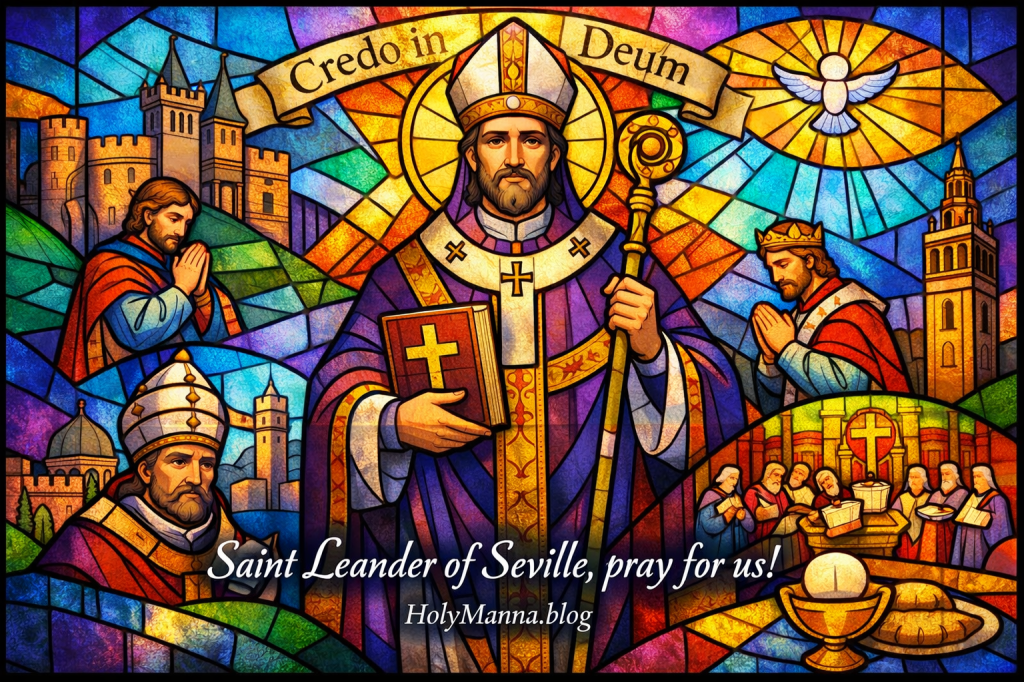
A Shepherd for a Divided Spain
Saint Leander of Seville stands at one of those turning points in Church history where doctrine is not an abstract debate. It is life and death, unity and fracture, truth and confusion. In sixth century Spain, the Visigothic ruling class largely followed Arianism, a heresy that denied the full divinity of Jesus Christ. The Church has always guarded the truth that the Son is true God, not a “lesser” being, because the Gospel itself collapses if Jesus is not who He says He is. That is why the Church’s confession of the Trinity and the Incarnation is so central in The Catechism CCC 242-246 and CCC 465.
Leander is revered because he did not merely argue for orthodoxy. He labored to rebuild a Catholic culture from the inside out, through teaching, prayer, sacramental life, and patient leadership. He is remembered as a bishop who helped move an entire people from confusion back to the clear light of the Creed, and he did it with the steady courage of a pastor who loved souls more than comfort.
From a Holy Household to a Heavy Mitre
Leander was born around the year 534, and Catholic tradition remembers his family as one of those rare households that seems to breathe sanctity. His siblings include Saint Isidore of Seville, Saint Fulgentius, and Saint Florentina. That alone tells a story. God sometimes raises up not only one saint, but a whole family that becomes a kind of spiritual engine for a region.
His early path was monastic. Before he became a bishop, he lived the disciplined rhythm of prayer and study. That detail matters because it explains the kind of leader he became. He was not formed first by politics. He was formed by the altar, the psalms, and the demanding honesty of religious life.
When Leander became Bishop of Seville in 579, he stepped into a city and a kingdom that needed more than administrative skill. It needed clarity about Christ. It needed courage to resist error. It needed patience to shepherd converts who had lived for generations in a distorted version of Christian belief.
Converting a Kingdom Without a Sword
Leander is most known for his role in the conversion of Visigothic Spain from Arianism to Catholic Christianity. He worked close to the nerve center of the kingdom, not to gain influence for its own sake, but to win souls and to protect the faith handed down from the apostles.
One of the most dramatic threads in his story involves the royal family. Catholic sources connect Leander to the conversion of Prince Hermenegild, a conversion that inflamed conflict with the Arian king. The details of sixth century politics can get complicated, but the spiritual meaning is simple. Leander helped lead people to the truth of Christ even when the cost was severe. That is what bishops are for.
Later, under King Reccared, the story turns from tragedy toward triumph. Reccared’s conversion and the rejection of Arianism became publicly anchored in the Church’s councils, especially the Third Council of Toledo in 589. This was not a private preference. It was a public return to Catholic confession. It was the kind of moment that changes the future of nations.
The Creed as a Sword of Light
A striking tradition tied to Leander is his promotion of the Nicene Creed in the Mass in Spain as a direct antidote to Arian confusion. That decision was pastoral genius. When a culture is confused about who Jesus is, the Church does not merely publish statements. The Church teaches her children to pray the truth.
The Creed is not a checklist. It is the Church’s living memory and public confession. The Catechism explains that the Creed gathers up the essential faith of the Church and becomes a rule of belief for the baptized, especially in the context of worship and catechesis, as seen in CCC 185-186. In other words, Leander helped put orthodoxy on the lips of ordinary Catholics, week after week, so that faith would become something confessed, loved, and lived.
Holiness That Looks Like Steady Fire
Many saints are remembered for healings or visible wonders. Leander is remembered more for a different kind of miracle, the miracle of conversion at scale, and the miracle of fidelity under pressure.
Major Catholic reference traditions do not preserve a stable set of miracle stories performed by Leander during his lifetime. That absence is not a weakness. It is simply the shape of his vocation. His sanctity shows up in the kind of work that rarely feels dramatic while it is happening. He educated clergy and laity. He built a center of learning in Seville. He counseled leaders. He held the line on doctrine. He worked for unity with Rome, even receiving the pallium as a sign of communion and authority.
This is the kind of holiness that is easy to underestimate until it is gone. It is the holiness of a shepherd who keeps showing up, keeps teaching, keeps praying, and keeps loving the Church when the Church is under strain.
The Cost of Truth
Leander’s suffering did not end in a martyr’s execution, but it still had teeth. He faced political hostility and was exiled under the Arian king. He spent years away from his see, far from home, paying the price for resisting error and defending converts.
Yet even exile became fertile ground. In Constantinople, Leander formed a friendship with the man who would become Pope Saint Gregory the Great. Gregory’s own words preserve the warmth and respect between them. “Long ago in Constantinople I got to know you, blessed brother.”
That kind of line matters because it shows that Leander’s influence extended beyond Spain. Saints build one another up across borders and decades. Leander’s suffering also shows something essential about Catholic life. When the Church calls error what it is, the world often responds with penalties, not applause. The cost is real. The grace is real too.
A City That Still Remembers
After Leander’s death around 600 or 601, his impact did not fade. His most visible “afterlife” is not a stack of miracle dossiers. It is the living Catholic memory of Seville itself. Seville Cathedral preserves devotion to him, including a chapel dedicated to him and the veneration of his relics. His feast is celebrated with particular strength locally in Seville, and he remains closely associated with the city’s Catholic identity.
It is also worth noting a quieter kind of cultural impact. His name traveled with Spanish Catholic heritage far beyond Spain. Places named “San Leandro” stand as a reminder that Catholics once named towns not after vague ideals, but after real saints whose lives taught real faith.
As for miracle stories after death, widely recognized Catholic reference traditions do not preserve specific, consistent narratives of healings attributed to Saint Leander in the way they do for some other saints. Catholics through the centuries have certainly sought his intercession and credited him with favors, but particular stories are not securely preserved in the common historical record available from major Catholic sources. When stories are not preserved, it is more honest and more Catholic to say so plainly than to dress uncertainty up as certainty.
A Word From the Saint and His Circle
Leander is not famous for short catchy slogans. His best verified “voice” comes through his surviving writings and the testimony of saints who knew him. Saint Isidore, his brother, praised him with words that still read like a model of what a bishop should be. “This man of suave eloquence and eminent talent shone as brightly by his virtues as by his doctrine.”
Leander’s own surviving preaching reflects the amazement of watching whole peoples come into Catholic unity. In a homily celebrating the Church’s victory as the Visigoths embraced the faith, he rejoiced in Latin with a line often summarized like this. “Suddenly the Church is seen to give birth to new peoples, and those whose harshness once grieved us now delight us by their faith.”
That is not propaganda. It is the Church witnessing what grace can do in history.
Bringing the Creed Back into Daily Life
Saint Leander’s life lands close to home because modern Catholics also live in a time of confusion, even if the labels are different. Many people still treat Jesus as a wise teacher rather than the Lord. Many still reduce Christianity to values rather than worship. Many still want a Church that is “nice” rather than true.
Leander shows a better path. He reminds Catholics that clarity about Christ is not optional. If Jesus is truly God, then everything changes. Worship changes. Morality changes. Suffering changes. Hope changes. That is why the Creed matters, and why the Church insists on guarding the truth about the Trinity and the Incarnation as seen in CCC 242-246 and CCC 465.
The practical application is not complicated, but it is demanding. A Catholic can pray the Creed slowly, not like a speed bump at Mass, but like a declaration of allegiance. A Catholic can take one line, such as “consubstantial with the Father,” and let it reorient the heart toward awe. A Catholic can also follow Leander’s example by investing in learning the faith, because confusion thrives where Catholics are lazy about catechesis. That includes reading The Catechism, studying Scripture, and refusing to treat doctrine like a hobby.
Where has faith become vague instead of clear, and what would change if Jesus were approached again as Lord and God?
What would happen if the Creed were prayed like it mattered, because it does?
Engage with Us!
Share your thoughts and reflections in the comments below. Saint Leander’s story is not only about sixth century Spain. It is about what happens when the Church refuses to compromise on who Jesus is, and then teaches that truth patiently until hearts change.
- Where does modern life tempt people to treat Jesus as a “good teacher” instead of true God and true man as the Church confesses in CCC 465?
- When the Creed is prayed at Mass, does it feel like a routine, or does it feel like a real confession of faith? What would help it become more personal?
- What is one practical step that can be taken this week to grow in Catholic clarity, such as reading a section of The Catechism CCC 242-246 or studying one Gospel passage more carefully?
- Who in daily life needs patient Catholic witness the way Leander patiently guided a confused culture toward truth?
May Saint Leander pray for every Catholic trying to stay steady in a confused world. May courage be matched with charity, conviction with humility, and truth with mercy. Go live the faith with the love and mercy Jesus taught, and do not be afraid to confess Him clearly, worship Him faithfully, and serve Him wholeheartedly.
Saint Leander of Seville, pray for us!
Follow us on YouTube, Instagram and Facebook for more insights and reflections on living a faith-filled life.

 Holy Manna!
Leave a comment