Friday of the Third Week of Lent – Lectionary: 241
When the Heart Comes Home
Some days in Lent feel like standing on the front steps after being gone too long. The door is familiar, the silence is honest, and the only question left is whether the heart will finally stop bargaining and start returning. That is the thread stitching today’s readings together: sincere conversion that becomes undivided love. In Hosea 14:2-10, God teaches Israel how to come back with real repentance, not theatrics, with the humble “words” of confession and trust. In Psalm 81:6-11, 14, 17, the Lord sounds like a Father who remembers the chains He already broke and asks for one thing in return, not performance, but listening. In Mark 12:28-34, Jesus takes the whole Law and sets it on one foundation, love of God with everything and love of neighbor with integrity, the kind of love that is worth more than sacrifices offered without the heart.
The background matters because these readings come from a people who knew what it meant to drift. Hosea preached to the northern kingdom in a time when Israel tried to secure its future through alliances, military strength, and the seductive certainty of idols. That is why the repentance in today’s first reading is so concrete: “Assyria will not save us, nor will we mount horses; We will never again say, ‘Our god,’ to the work of our hands.” The psalm picks up the same story from the other side, recalling the Exodus and the covenant, as if God is saying that freedom was already given, so the only tragedy left is refusing to listen. Then the Gospel places the finishing touch on the whole day by returning to the Shema, the daily prayer of Israel, the heartbeat confession that God is one and deserves the whole person. Jesus does not discard worship, but He exposes what worship is supposed to be: the soul’s total surrender to God expressed in concrete charity. When the scribe answers with understanding, Jesus says something both hopeful and challenging, because it sounds like someone close enough to see the Kingdom but not yet fully inside it: “You are not far from the kingdom of God.”
Lent is the Church’s season for choosing what will be loved most and what will be left behind. The idol language in Hosea 14:2-10 and Psalm 81:6-11, 14, 17 is not antique history; it is a mirror. The Gospel makes the mirror even clearer by showing that the opposite of idolatry is not merely avoiding bad behavior, but loving God without conditions and loving neighbor without excuses. How would life change if conversion stopped being a vague intention and became a concrete return to God with undivided love today?
First Reading – Hosea 14:2-10
Real Repentance, Real Healing
Hosea speaks into a wounded chapter of Israel’s story. The northern kingdom, often called Ephraim, had learned to lean on anything that felt strong in the moment. Foreign alliances looked safer than prayer. Military power felt more dependable than obedience. Handcrafted idols felt more manageable than the living God. In that setting, the Lord does not merely scold His people. He teaches them how to return. This reading fits today’s theme by showing what sincere conversion actually sounds like, and what God’s mercy actually does. True repentance is not vague regret. It is a clear turning away from false saviors and a wholehearted return to the One who loves freely, heals deeply, and restores what sin has fractured.
Hosea 14:2-10 – New American Bible (Revised Edition)
Sincere Conversion and New Life
2 Return, Israel, to the Lord, your God;
you have stumbled because of your iniquity.
3 Take with you words,
and return to the Lord;
Say to him, “Forgive all iniquity,
and take what is good.
Let us offer the fruit of our lips.
4 Assyria will not save us,
nor will we mount horses;
We will never again say, ‘Our god,’
to the work of our hands;
for in you the orphan finds compassion.”
5 I will heal their apostasy,
I will love them freely;
for my anger is turned away from them.
6 I will be like the dew for Israel:
he will blossom like the lily;
He will strike root like the Lebanon cedar,
7 and his shoots will go forth.
His splendor will be like the olive tree
and his fragrance like Lebanon cedar.
8 Again they will live in his shade;
they will raise grain,
They will blossom like the vine,
and his renown will be like the wine of Lebanon.9 Ephraim! What more have I to do with idols?
I have humbled him, but I will take note of him.
I am like a verdant cypress tree.
From me fruit will be found for you!Epilogue
10 Who is wise enough to understand these things?
Who is intelligent enough to know them?
Straight are the paths of the Lord,
the just walk in them,
but sinners stumble in them.
Detailed Exegesis
Verse 2 – “Return, Israel, to the Lord, your God; you have stumbled because of your iniquity.”
This is the first mercy of God: He names the problem without destroying the sinner. Israel has “stumbled,” not because God is harsh, but because sin is always a tripwire. The command to “return” is covenant language. It is the Lord calling His people back into relationship, not merely back into moral performance.
Verse 3 – “Take with you words, and return to the Lord; Say to him, ‘Forgive all iniquity, and take what is good. Let us offer the fruit of our lips.’”
God tells Israel to bring “words,” because conversion is personal and honest. Repentance is not a transaction; it is a confession. The “fruit of our lips” is the sacrifice of truthful prayer, praise, and contrition. It is the kind of worship that rises from a heart that stops pretending. This line also resonates with the Church’s penitential life in Lent, especially the Sacrament of Reconciliation, where sin is named and mercy is received.
Verse 4 – “Assyria will not save us, nor will we mount horses; We will never again say, ‘Our god,’ to the work of our hands; for in you the orphan finds compassion.”
Israel renounces three false supports. “Assyria” stands for political salvation, the temptation to believe that security comes from the right alliance. “Horses” represent military strength, the temptation to trust force and strategy more than God. The “work of our hands” is the idol, the temptation to worship what can be controlled. Then comes the tender center: God is the Father of the fatherless. The orphan has no leverage, no résumé, no backup plan. That is the point. Mercy is received, not earned.
Verse 5 – “I will heal their apostasy, I will love them freely; for my anger is turned away from them.”
God does not only forgive; He heals. Apostasy is a falling away from God, but the Lord’s answer is not revenge. The phrase “love them freely” reveals grace. God’s love is not a wage paid to the deserving. It is a gift poured out because God is good.
Verse 6 – “I will be like the dew for Israel: he will blossom like the lily; He will strike root like the Lebanon cedar,”
Dew is quiet, steady, and life-giving, especially in a dry land. God promises a renewal that is not loud or performative, but real. The lily suggests beauty and new life. The cedar of Lebanon suggests stability and endurance. The Lord intends to make Israel fruitful and rooted, not fragile and drifting.
Verse 7 – “and his shoots will go forth. His splendor will be like the olive tree and his fragrance like Lebanon cedar.”
The restored life spreads outward. Shoots go forth because grace does not stay locked inside one heart. The olive tree evokes richness, anointing, and lasting strength. Fragrance suggests a life that becomes attractive again, not because it is flawless, but because it has been healed.
Verse 8 – “Again they will live in his shade; they will raise grain, They will blossom like the vine, and his renown will be like the wine of Lebanon.”
Shade is protection. Grain is daily provision. Vine and wine speak of joy and celebration. The Lord is not offering Israel a bare survival. He is offering flourishing. This is the pattern of conversion: God restores what sin drains, including joy, steadiness, and fruitfulness.
Verse 9 – “Ephraim! What more have I to do with idols? I have humbled him, but I will take note of him. I am like a verdant cypress tree. From me fruit will be found for you!”
God confronts the idol problem with fatherly clarity. Idols are a dead end. Even when humility has to be learned the hard way, God still “takes note” of His people. Then the Lord says something decisive: all real fruit comes from Him. This is not religious poetry meant to impress. It is spiritual reality. Anything that replaces God eventually starves the soul.
Verse 10 – “Who is wise enough to understand these things? Who is intelligent enough to know them? Straight are the paths of the Lord, the just walk in them, but sinners stumble in them.”
The reading ends like a wisdom lesson. God’s ways are “straight,” meaning they are reliable and true. The difference is not that the path changes for different people. The difference is the heart. The just walk in God’s ways because they trust Him. Sinners stumble because they keep trying to walk while looking backward at their idols.
Teachings
The Catechism describes conversion as a real interior turning, not a cosmetic religious upgrade. CCC 1431 teaches: “Interior repentance is a radical reorientation of our whole life, a return, a conversion to God with all our heart, an end of sin, a turning away from evil, with repugnance toward the evil actions we have committed.” That is Hosea’s message in plain terms. God is not asking for better excuses. God is asking for the heart.
This reading also exposes idolatry, which is not only kneeling before statues. Idolatry is whenever something created takes God’s place as the source of identity, security, or meaning. CCC 2113 says: “Idolatry not only refers to false pagan worship. It remains a constant temptation to faith. Idolatry consists in divinizing what is not God.” That is why Israel must renounce Assyria, horses, and handmade gods. The Lord is teaching His people how to stop outsourcing salvation.
The promise, “I will heal their apostasy”, fits the Church’s confidence in God’s mercy, especially in Lent. CCC 1432 describes the many expressions of conversion and includes this line: “The conversion of the heart is expressed in a truly Christian life by many ways: ‘fasting, prayer, and almsgiving,’ which express conversion in relation to oneself, to God, and to others.” Hosea’s “words” are prayerful repentance. Israel’s renunciation is fasting from idols. God’s compassion for the orphan pushes outward into love of neighbor, which today’s Gospel will make unmistakable.
Saint Augustine’s spiritual wisdom also fits Hosea’s call to return with honest speech. In his preaching on repentance, he emphasized that God does not despise the contrite heart, because God Himself is the One drawing the sinner back. Hosea shows that mercy is not a prize at the end of a perfect performance. Mercy is the Father’s embrace that makes a new life possible.
Reflection
Hosea sounds ancient until it starts sounding familiar. Assyria, horses, and idols show up in modern clothes. Assyria can look like the belief that the right connection, the right institution, or the right plan will finally make life safe. Horses can look like raw self-reliance, the habit of forcing outcomes through pressure, control, and anxious overworking. Idols can look like anything that quietly becomes non-negotiable, whether it is money, attention, comfort, lust, bitterness, politics, success, or the approval of strangers.
Lent is the season to return with words. That means taking ten honest minutes and speaking to God without theatrics. It means naming the false savior that has been trusted. It means asking for mercy and then accepting the mercy through confession and amendment of life. A practical step is to write a simple prayer that echoes Hosea 14:3-4 and then bring it to an examination of conscience. Another step is to choose one concrete renunciation that makes room for God, because idols weaken when they are denied their daily fuel. Another step is to practice one hidden act of mercy, because the God who has compassion on the orphan is forming His children to live the same way.
What has been acting like “Assyria” lately, the thing that feels like it will save everything if it just works out?
What has been acting like “horses,” the strength that gets trusted more than grace, especially when life feels uncertain?
What “work of the hands” has been treated like a god, not with incense, but with attention, time, and emotional dependence?
Hosea’s promise is steady and personal: God heals apostasy and loves freely. The only honest response is to stop stalling at the doorstep and return.
Responsorial Psalm – Psalm 81:6-11, 14, 17
The God Who Freed Israel Still Speaks: Listen, Turn, and Be Filled
This psalm sounds like a sacred memory being read aloud in the middle of worship. Israel is gathered, and the Lord reminds them who He is by reminding them what He has done. He is the God who broke chains in Egypt, carried His people through the desert, and stayed faithful even when they did not. The reference to Joseph and the Exodus places the prayer inside the foundational story of Israel’s identity, because God’s covenant love is not an abstract idea. It is a historical rescue. The mention of Meribah recalls a painful moment when the people doubted God’s care and tested Him in the wilderness. In Lent, this psalm fits today’s theme by pressing one urgent question into the heart: will God’s people listen and return, or will they keep chasing foreign gods that cannot feed them? The Lord’s invitation is both simple and startlingly intimate, because it promises not only guidance, but satisfaction: “Open wide your mouth that I may fill it.”
Psalm 81:6-11, 14, 17 – New American Bible (Revised Edition)
6 He made it a decree for Joseph
when he came out of the land of Egypt.7 I heard a tongue I did not know:
“I removed his shoulder from the burden;
his hands moved away from the basket.
8 In distress you called and I rescued you;
I answered you in secret with thunder;
At the waters of Meribah I tested you: 9 ‘Listen, my people, I will testify against you
Selah
If only you will listen to me, Israel!
10 There shall be no foreign god among you;
you shall not bow down to an alien god.
11 ‘I am the Lord your God,
who brought you up from the land of Egypt.
Open wide your mouth that I may fill it.’14 O that my people would listen to me,
that Israel would walk in my ways,17 But Israel I will feed with the finest wheat,
I will satisfy them with honey from the rock.”
Detailed Exegesis
Verse 6 – “He made it a decree for Joseph when he came out of the land of Egypt.”
The psalm begins by anchoring everything in God’s saving action. “Joseph” represents the people as a whole, linking Israel’s origins to God’s providence long before Moses ever raised his staff. Worship is built on memory, because forgetting God’s rescue is usually the first step toward new idols.
Verse 7 – “I heard a tongue I did not know: ‘I removed his shoulder from the burden; his hands moved away from the basket.”
The “tongue” signals something foreign, the harsh language of slavery and oppression. God answers that dehumanizing world with liberation. The image is physical and concrete: shoulders unburdened, hands freed. The Lord is not only concerned with souls in the abstract. He sees the weight people carry, and He acts.
Verse 8 – “In distress you called and I rescued you; I answered you in secret with thunder; At the waters of Meribah I tested you:”
God recalls the pattern of grace. Israel cried out, and God responded. The “secret with thunder” evokes Sinai, where God’s voice shakes the mountain, and it also hints that God’s presence is both near and overwhelming. Then Meribah surfaces like an old scar. In the desert, Israel doubted God’s goodness and demanded proof. The test reveals what is in the heart, because pressure exposes whether trust is real.
Verse 9 – “Listen, my people, I will testify against you, Selah, If only you will listen to me, Israel!”
This verse carries the ache of a Father whose children keep tuning Him out. God’s “testimony” is not petty accusation. It is covenant truth spoken for the sake of healing. The repeated plea, “If only you will listen,” shows that disobedience often begins as deafness, not ignorance. God’s word is near, but it can be resisted.
Verse 10 – “There shall be no foreign god among you; you shall not bow down to an alien god.”
Here the psalm tightens the focus. The problem is not that Israel believes in God a little. The problem is that Israel mixes God with rivals. “Foreign god” is not only about statues. It is anything treated as ultimate. This verse is the heartbeat of today’s theme, because love cannot be divided without becoming something less than love.
Verse 11 – “I am the Lord your God, who brought you up from the land of Egypt. Open wide your mouth that I may fill it.”
God introduces Himself the way He does in the Ten Commandments: by recalling liberation first. He does not begin with demands. He begins with grace. Then comes the tender command that feels almost too personal: “Open wide your mouth.” The Lord is describing a posture of trust, like a child receiving food. The God who freed Israel does not merely want compliance. He wants communion.
Verse 14 – “O that my people would listen to me, that Israel would walk in my ways,”
Listening becomes walking. God’s ways are not abstract philosophies. They are a path, a lived obedience that shapes character, relationships, and worship. Lent is exactly this: learning again how to walk.
Verse 17 – “But Israel I will feed with the finest wheat, I will satisfy them with honey from the rock.”
God ends with a promise of abundance. Finest wheat means more than survival. Honey from the rock means sweetness where no sweetness should exist. The Lord can bring nourishment out of what seems impossible, and He can satisfy a heart that has been scraping life from idols that never deliver.
Teachings
This psalm stands inside the First Commandment, because it is a dramatic reminder that God alone saves and God alone deserves worship. The Catechism ties God’s identity to His liberating action in words that echo the psalm’s logic. CCC 2084 says: “God makes himself known by recalling his all-powerful loving, and liberating action in the history of the one he addresses: ‘I brought you out of the land of Egypt, out of the house of bondage.’ The first word contains the first commandment of the Law: ‘You shall fear the LORD your God; you shall serve him…. You shall not go after other gods.’ God’s first call and just demand is that man accept him and worship him.” This is why the psalm keeps repeating “listen.” Listening is the beginning of worship, because it is how the heart stops treating God like background noise.
The psalm’s warning against foreign gods also lands squarely in the Church’s teaching on idolatry. CCC 2113 says: “Idolatry not only refers to false pagan worship. It remains a constant temptation to faith. Idolatry consists in divinizing what is not God. Man commits idolatry whenever he honors and reveres a creature in place of God, whether this be gods or demons (for example, satanism), power, pleasure, race, ancestors, the state, money, etc. Jesus says, ‘You cannot serve God and mammon.’ Many martyrs died for not adoring ‘the Beast’ refusing even to simulate such worship. Idolatry rejects the unique Lordship of God; it is therefore incompatible with communion with God.” That list feels uncomfortably modern, because it is. The psalm insists that the soul cannot bow down twice and still remain free.
The psalm is also a lesson in prophetic prayer, because it reveals God speaking inside worship, testing hearts, and calling His people back. CCC 2584 teaches: “In their ‘one to one’ encounters with God, the prophets draw light and strength for their mission. Their prayer is not flight from this unfaithful world, but rather attentiveness to the Word of God. At times their prayer is an argument or a complaint, but it is always an intercession that awaits and prepares for the intervention of the Savior God, the Lord of history.” The wilderness stories behind this psalm are filled with complaint, fear, and arguments. God does not abandon His people for that. He calls them deeper, toward attentive listening and renewed trust.
The Church’s tradition also hears something Eucharistic and spiritual in the psalm’s promise to “fill” His people. Saint Augustine, preaching on Psalm 81, pressed the verse into the interior life with a line that sticks: Saint Augustine, Exposition on Psalm 81 says, “Open wide your mouth… in confessing, in loving: and I will fill it.” The mouth opens not only to ask for blessings, but to confess sin, to praise God, and to receive what God gives.
Reflection
This psalm challenges the modern habit of treating God like one voice among many. It describes a Father who says, with real emotion, that the tragedy is not weakness but refusal to listen. Listening sounds simple until life gets loud. The phone buzzes, the news churns, stress rises, and suddenly the “foreign god” is not a statue but a constant stream of noise that trains the soul to panic and react.
A practical Lenten move is to reclaim listening as an act of worship. That can begin with a quiet, daily moment where distractions are put down and the psalm is prayed slowly, especially the line “Open wide your mouth that I may fill it.” Another step is to name the “alien god” that has been demanding attention lately. Sometimes it is money, sometimes it is control, sometimes it is pleasure, sometimes it is resentment that feels justified, and sometimes it is the need to be right. Idols always promise to feed, and they always leave people hungry.
The psalm also invites trust in a God who can bring “honey from the rock,” sweetness from the hard place. That matters when life feels dry, because the enemy loves to whisper that prayer is pointless and change is impossible. Lent answers that lie with a memory: God has already rescued His people before, and He still rescues.
What is the loudest voice competing with God’s voice right now, and what would change if that voice lost its power for one day?
Where has the heart been testing God like Meribah, demanding proof instead of choosing trust?
What would it look like to “open wide” the mouth in confession and love, so that God can fill what has been empty for too long?
Holy Gospel – Mark 12:28-34
Love That Ends the Argument: The Heart of the Law and the Doorway to the Kingdom
The scene unfolds in Jerusalem in the days leading up to the Passion, when the air is tense and every question sounds like a test. Religious leaders have been disputing with Jesus in the Temple precincts, the very place where sacrifice, prayer, and teaching were meant to lead God’s people into communion with the Lord. Into that atmosphere steps a scribe, a man trained in the Law, who is not throwing a trap but listening closely. He has heard the debates, and he has seen that Jesus answers with clarity. His question goes straight to the center: which commandment is first? In a world where people could argue endlessly about priorities and details, Jesus gives an answer that is both ancient and fresh, rooted in the daily prayer of Israel and fulfilled in the life of grace. Today’s theme comes into full focus here. Conversion is not only turning away from idols, as Hosea 14:2-10 insists, or learning to listen again, as Psalm 81:6-11, 14, 17 pleads. Conversion becomes undivided love: love of God with everything and love of neighbor with integrity. This is the worship God desires, a heart that belongs to Him and a life that proves it.
Mark 12:28-34 – New American Bible (Revised Edition)
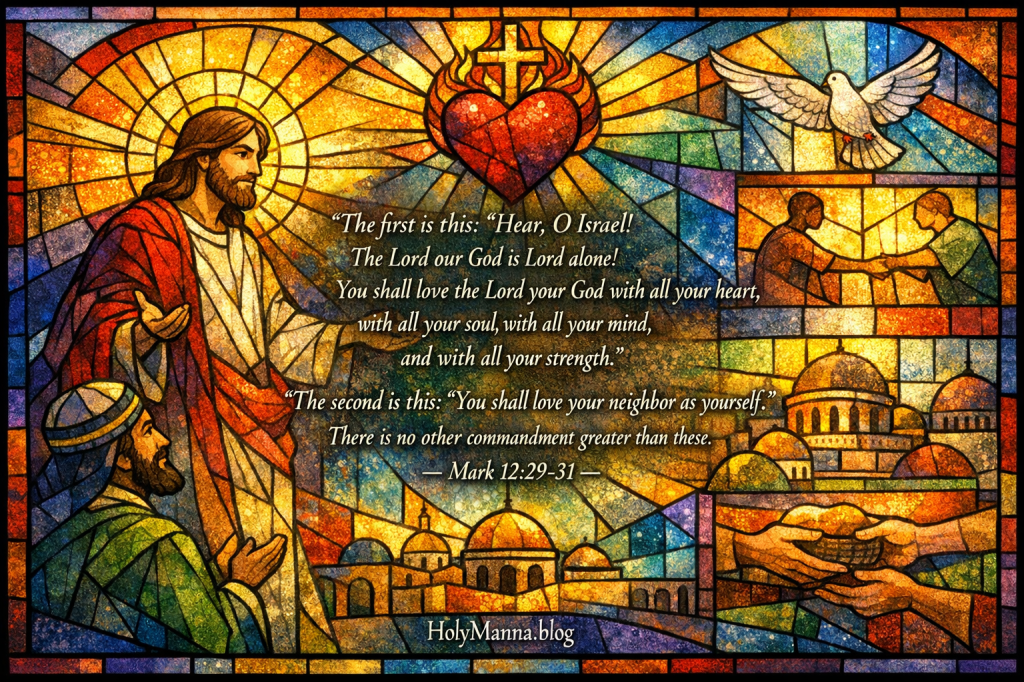
28 One of the scribes, when he came forward and heard them disputing and saw how well he had answered them, asked him, “Which is the first of all the commandments?” 29 Jesus replied, “The first is this: ‘Hear, O Israel! The Lord our God is Lord alone! 30 You shall love the Lord your God with all your heart, with all your soul, with all your mind, and with all your strength.’ 31 The second is this: ‘You shall love your neighbor as yourself.’ There is no other commandment greater than these.” 32 The scribe said to him, “Well said, teacher. You are right in saying, ‘He is One and there is no other than he.’ 33 And ‘to love him with all your heart, with all your understanding, with all your strength, and to love your neighbor as yourself’ is worth more than all burnt offerings and sacrifices.” 34 And when Jesus saw that [he] answered with understanding, he said to him, “You are not far from the kingdom of God.” And no one dared to ask him any more questions.
Detailed Exegesis
Verse 28 – “One of the scribes, when he came forward and heard them disputing and saw how well he had answered them, asked him, ‘Which is the first of all the commandments?’”
The scribe is a scholar of the Law, and his approach matters. He comes after watching Jesus respond “well,” which suggests respect and openness. His question is not trivial, because Israel’s life was shaped by the commandments. To ask for the “first” commandment is to ask what everything else depends on. It is also a very Lenten question, because Lent is about reordering life around what is truly first.
Verse 29 – “Jesus replied, ‘The first is this: Hear, O Israel! The Lord our God is Lord alone!’”
Jesus begins with Israel’s foundational confession, the Shema, which faithful Jews prayed daily. Before any command is given, identity is declared: God is one, and God alone is Lord. This directly confronts idolatry, because idols multiply loyalties and fracture the heart. The Gospel is insisting that authentic religion begins with hearing and acknowledging the true God.
Verse 30 – “You shall love the Lord your God with all your heart, with all your soul, with all your mind, and with all your strength.’”
Love is not reduced to emotion here. It is total self-gift. Heart, soul, mind, and strength describe the whole person. This love claims thoughts, desires, decisions, and energy. It does not leave a private corner reserved for a hidden idol. In Lent, this verse calls out half-surrenders, because God does not ask for a slice of life. God asks for the center.
Verse 31 – “The second is this: You shall love your neighbor as yourself.’ There is no other commandment greater than these.”
Jesus immediately binds love of neighbor to love of God. The second commandment is not a bonus feature. It is the proof that the first commandment is real. Neighbor love is measured “as yourself,” meaning it is not sentimental, but just and consistent. Jesus then seals the teaching by placing both loves at the top, because the whole moral life hangs on them.
Verse 32 – “The scribe said to him, ‘Well said, teacher. You are right in saying, He is One and there is no other than he.’”
The scribe repeats the truth of God’s oneness. This is not flattery; it is agreement with understanding. He is recognizing that Jesus has not invented something new, but has revealed the true center of what Israel already possessed. His response shows that clarity about God leads to clarity about worship.
Verse 33 – “And to love him with all your heart, with all your understanding, with all your strength, and to love your neighbor as yourself is worth more than all burnt offerings and sacrifices.”
This line lands with force in the Temple setting. Burnt offerings and sacrifices were commanded by God and deeply woven into Israel’s worship, but they were never meant to replace the heart. The scribe recognizes what the prophets preached repeatedly: God does not want ritual without love. Love is “worth more” because it is the interior reality that sacrifice was supposed to express. This connects cleanly to Hosea 14:3, where repentance is offered as the “fruit of our lips,” and to Psalm 81:11, where God promises to fill the open mouth, not the closed heart.
Verse 34 – “And when Jesus saw that he answered with understanding, he said to him, You are not far from the kingdom of God.’ And no one dared to ask him any more questions.”
Jesus affirms the scribe’s understanding, but the phrasing is sober: “not far” is not the same as “inside.” The scribe is close because he sees the truth about love and worship, but the Kingdom is not only a concept to admire. The Kingdom is entered through faith, conversion, and communion with the King. The final line shows the effect of Jesus’ authority. The arguments quiet down, because the center has been named.
Teachings
The Catechism treats this Gospel as a direct summary of the moral life. CCC 2055 says: “When someone asks him, ‘Teacher, what must I do to inherit eternal life?’ Jesus replies: ‘If you would enter life, keep the commandments.’ To the question ‘Which?’ Jesus says: ‘You shall not kill, You shall not commit adultery, You shall not steal, You shall not bear false witness, Honor your father and your mother, and, You shall love your neighbor as yourself.’ Finally Jesus sums up these commandments positively: ‘Whatsoever you wish that men would do to you, do so to them.’” This teaching shows that love is not vague spirituality. It becomes concrete obedience, expressed in how people treat God and neighbor.
The Gospel also reveals that charity is not one virtue among many, but the soul of Christian life. CCC 1822 says: “Charity is the theological virtue by which we love God above all things for his own sake, and our neighbor as ourselves for the love of God.” That sentence is practically Mark 12:30-31 in the Church’s own language. Charity is the shape of holiness, because it unites the two directions of love into one coherent life.
The Church also teaches that charity gives form to every virtue, meaning it is the interior principle that makes other good actions truly Christian. CCC 1827 says: “The practice of all the virtues is animated and inspired by charity, which ‘binds everything together in perfect harmony’ (Col 3:14); it is the form of the virtues; it articulates and orders them among themselves; it is the source and the goal of their Christian practice. Charity upholds and purifies our human ability to love, and raises it to the supernatural perfection of divine love.” In other words, almsgiving without charity becomes self-display. Fasting without charity becomes pride. Prayer without charity becomes performance. Jesus is calling for the kind of love that makes every Lenten practice honest.
Saint Augustine presses this point with the sharpness of a spiritual surgeon. In On Christian Doctrine, he says, “Whoever, therefore, thinks that he understands the divine Scriptures or any part of them, so that it does not build up the double love of God and of our neighbour, does not understand it at all.” This is why Jesus ends the argument. The center is not an academic puzzle. The center is love that builds up.
Reflection
This Gospel challenges a common temptation: treating faith like a debate to win instead of a life to live. The scribe’s question is good, but Jesus’ answer demands more than correct theology. It demands a reordered heart. Loving God with all heart, soul, mind, and strength means the inner life must stop splitting loyalties. It means prayer cannot be treated as a hobby and Sunday cannot be treated as optional. It means the mind must be trained by truth, the strength must be offered in service, and the heart must be guarded from the quiet rival gods that promise comfort while stealing freedom.
The second commandment makes the first commandment visible. Love of neighbor is not limited to people who are easy to love. It includes the spouse who is weary, the coworker who is irritating, the family member who pushes buttons, and the stranger who cannot repay kindness. This is where Lent becomes real. A person can give up desserts and still keep the heart hard. A person can pray more and still refuse to forgive. Jesus is not impressed by sacrifice that does not become love.
A practical way to live this Gospel is to choose one concrete act that unites both commandments. Prayer becomes love of God. A specific act of mercy becomes love of neighbor. Put together, they become one offering. Another practical step is to examine what receives the “all.” If the strongest emotional energy is reserved for anxiety, politics, money, pleasure, or reputation, then the heart is being catechized by a foreign god. Lent is the season for returning the “all” back to God.
What receives the best attention, the strongest energy, and the deepest loyalty right now, and does that reality match the command to love God with everything?
Which neighbor is easiest to ignore, and what would change if that person were loved with the same seriousness given to personal needs?
If Jesus looked at today’s choices, would He say, “You are not far from the kingdom of God”, or would He see someone already walking inside by trusting Him and living love without excuses?
From “Not Far” to “All In”
Today’s readings move like a single conversation from God’s heart to a restless human heart that has been trying to live on substitutes. Hosea 14:2-10 gives the words of return and the courage to renounce false saviors. It shows that conversion is not vague guilt or spiritual mood. Conversion is a real turning back to the Lord, with a clear refusal to keep calling created things “god,” and a humble trust that the Father of the orphan will receive anyone who comes home. Then Psalm 81:6-11, 14, 17 places the whole story inside memory and worship. The Lord reminds His people that He already broke the chains, already carried the burdens, and still speaks with a steady invitation: “Open wide your mouth that I may fill it.” Finally, Mark 12:28-34 brings everything into focus by naming the center of the Law and the center of life: love God with everything, and love neighbor with integrity. Jesus does not flatter the scribe, but He gives a hopeful warning that can wake anyone up: “You are not far from the kingdom of God.” Close is good, but close is not the goal. The goal is communion. The goal is surrender. The goal is a life where love becomes the true sacrifice.
Lent is not a spiritual self-improvement program. Lent is homecoming. It is the season for returning to the Lord with honest words, listening again to what has been ignored, and putting love back in first place. A simple call to action can be taken straight from the readings. Return with words by making a sincere examination of conscience and bringing it to Confession. Return with listening by praying Psalm 81:11 slowly and letting that promise challenge the heart. Return with love by choosing one concrete act of charity that costs something, whether it is time, patience, forgiveness, or attention to someone usually overlooked.
What would change if the heart stopped living “not far” from the Kingdom and started living as if God really is Lord alone? Let today be more than a good reflection. Let it be a decisive step. Let the idols be named and renounced. Let the ears be opened to the Father’s voice. Let love become the clearest proof of faith, so that the path of the Lord is not only admired, but actually walked.
Engage with Us!
Readers are invited to share reflections in the comments below, because God often teaches through the way His Word lands in real lives, real struggles, and real victories.
- First Reading, Hosea 14:2-10: What has been acting like “Assyria” lately, the thing that feels like it will save everything if it just works out? What “horses” has the heart been trusting, meaning habits of control or self-reliance that push God to the margins? What “work of the hands” has been treated like a god, not with incense, but with attention, time, and emotional dependence, and what would it look like to return with honest words and let the Lord heal it?
- Responsorial Psalm, Psalm 81:6-11, 14, 17: What is the loudest voice competing with God’s voice right now, and what would change if that voice lost its power for one day? Where has the heart been testing God like Meribah, demanding proof instead of choosing trust? What would it look like to pray “Open wide your mouth that I may fill it” as a real act of surrender, especially in the areas where the soul feels most hungry or restless?
- Holy Gospel, Mark 12:28-34: What receives the best attention, the strongest energy, and the deepest loyalty right now, and does that reality match Jesus’ command to love God with everything? Which neighbor is easiest to ignore, and what would change if that person were loved with the same seriousness given to personal needs? If Jesus looked at today’s choices, would He say “You are not far from the kingdom of God”, or would He see a heart already stepping fully inside by choosing faith expressed through concrete love?
Keep walking in faith with steady courage. Let repentance be honest, let prayer be listening, and let every sacrifice become love, so that everything done today is marked by the mercy and charity Jesus taught and lived.
Sacred Heart of Jesus, we trust in You!
Immaculate Heart of Mary, pray for us!
Saint Michael the Archangel, defend us in battle!
Follow us on YouTube, Instagram and Facebook for more insights and reflections on living a faith-filled life.

 Holy Manna!
Leave a comment