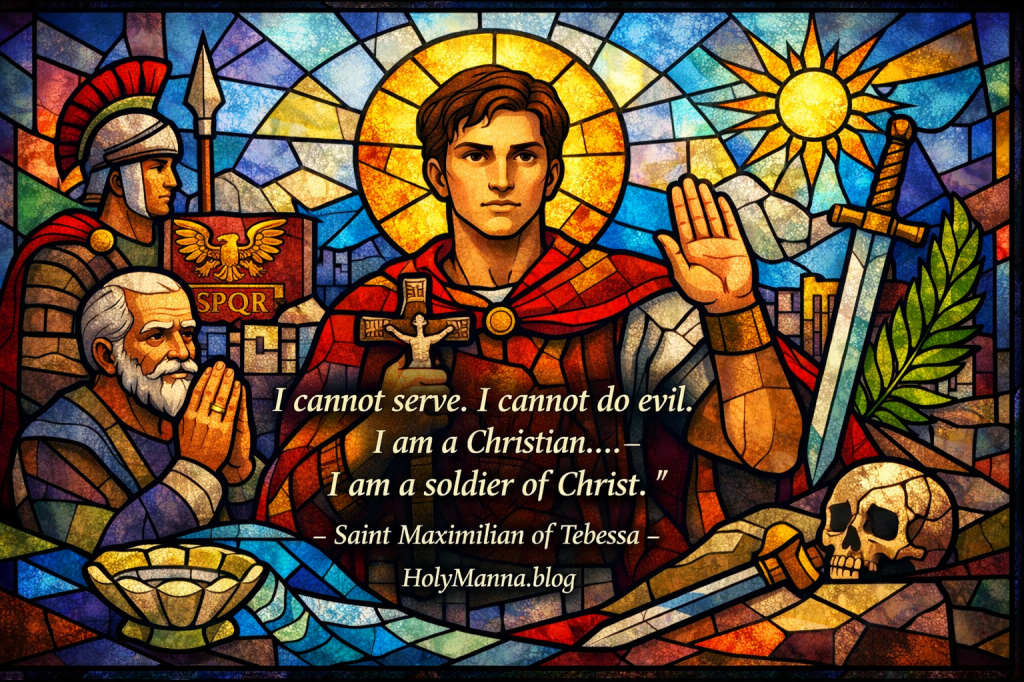
A Young Man Who Refused to Belong to Caesar
There are saints who evangelized crowds, founded monasteries, or wrote pages that shaped the Church for centuries. Saint Maximilian of Tebessa is remembered for something quieter and, in its own way, more shocking. He simply stood in a public place, answered a government official honestly, and refused to let anyone place a new “brand” on his soul.
The Church remembers him as a martyr from North Africa, killed in the year 295 at Theveste, also known as Tebessa. His story has endured because it is not built on dramatic legends or grand adventures. It is built on conscience. It is built on baptism. It is built on a young man who understood that a Christian belongs to Christ first, even when that loyalty costs everything.
Roots in Roman North Africa and a Call He Did Not Choose
Not much is known about Maximilian’s childhood, and that honesty matters. The tradition does not pretend to know what it cannot prove. What is remembered is enough to make the point.
He lived in Roman North Africa, and he was the son of a man named Victor, described in the Church’s official remembrance as a veteran. That one detail quietly explains the pressure that fell on Maximilian. In a world where Rome shaped daily life, military service was not only common, it was tied to identity, status, and expectation. Maximilian reached the age when young men were called up. He did not volunteer for the moment that made him famous. The moment came looking for him.
If there was a “conversion” in his life, it was not from paganism to Christianity in the dramatic way some saints experienced. It was the deeper conversion that every baptized person eventually faces, when faith stops being something inherited and becomes something chosen. It is the moment when a Christian has to decide whether baptism is a nice memory or a permanent seal. The Church teaches that Baptism marks the soul with an indelible spiritual sign, a seal that cannot be erased, and that seal consecrates a person for Christian worship and belonging. This is why the language of the “seal” is so powerful in his story. It echoes what the Church teaches about Baptism in CCC 1272 and CCC 1274.
The Day the Empire Measured Him
The heart of Maximilian’s story is a courtroom scene, preserved in the memory of the Church because it shows a real clash between two loyalties. He was brought before the proconsul Dion for enrollment as a soldier. The process was ordinary, even clinical. He was treated like a recruit to be processed.
Then the ordinary machine of Rome hit something it could not digest. Maximilian refused.
He did not refuse with slogans. He refused with a confession of identity. He spoke the words that have traveled through centuries because they are simple and absolute. “I cannot serve. I cannot do evil. I am a Christian.” He made it even clearer when he insisted, “I am a soldier of Christ.”
This is where many modern readers misunderstand him, because they try to squeeze him into today’s political categories. Maximilian was not giving a policy speech. He was protecting worship. He was protecting his baptismal identity. In the Roman world, military service was wrapped in oaths and symbols bound to the empire’s religious atmosphere. Maximilian would not take the military oath, and he would not accept what he called the seal of this world because he already belonged to Christ. In the tradition, his words come through with steel in them. “I already have the seal of Christ.”
He also showed an important kind of Catholic restraint. When the official argued that other Christians served in the army, Maximilian did not turn into a judge. He did not condemn them. He essentially said that they would answer for themselves, and he must answer for his own conscience. That detail matters because it sounds like the real moral struggle of a Christian trying to be faithful, not the posturing of someone trying to win an argument.
A Martyr’s Knife Edge Between Fear and Fidelity
The pressure against Maximilian was not only legal. It was personal. A son of a veteran refusing service was not a small embarrassment. It was a rejection of the path expected of him. In front of power, he was offered the chance to comply, to speak the words, to accept the mark, to walk out alive. He refused again.
Then he was condemned to death and executed by the sword. The Church remembers his martyrdom on March 12. This matters, because martyrs are not remembered as merely tragic victims. Martyrs are remembered as witnesses. The Church teaches that martyrdom is the supreme witness to the truth of the faith, a participation in Christ’s own sacrifice, and a sign that love is stronger than death. This is the heart of Christian witness in CCC 2473 and CCC 2474.
One of the most striking pieces of the tradition is the reaction of his father. Instead of treating Maximilian’s death as meaningless loss, the story presents his father leaving with gratitude, praising God for what was offered. It is a hard detail to hear in a modern world, but it is also a deeply Christian one. It shows how early Christians understood martyrdom not as a defeat, but as fidelity sealed with blood.
Why the Church Still Says His Name
After his execution, Maximilian did not disappear into history. He was buried in Carthage through the care of a noblewoman remembered as Pompejana. His burial in that great Christian city placed his memory among the early North African witnesses who shaped the Church’s courage during persecution.
When people ask about miracles connected to Saint Maximilian of Tebessa, the responsible answer is simple. No widely established miracle tradition is attached to him in the way it is for many other saints, and the Church’s remembrance focuses on his testimony and martyrdom rather than spectacular wonders. If stories of miracles ever grew up around his relics locally, they have not come down through the Church’s mainstream memory in a firm, testable way. His legacy is not a trail of healings that can be cataloged. His legacy is a conscience that would not be bought.
And that legacy has had real impact. In modern times, Catholics reflecting on war, peace, and moral responsibility have looked back to Maximilian as a patron and example for conscientious objection. His witness speaks especially to Catholics who feel trapped between social expectation and the quiet voice of conscience. The Church teaches that conscience must be formed and followed, and that a person must not be forced to act against conscience, while also bearing the responsibility to form conscience in the light of truth. This is the kind of moral seriousness found in the Church’s teaching on conscience in CCC 1776 through CCC 1802. His story also belongs in the wider Catholic conversation about peace, legitimate defense, and moral limits in war, themes treated carefully in CCC 2308 through CCC 2311.
So Maximilian stands in a very Catholic tension. His life does not erase the Church’s teaching that public authorities have responsibilities, or that legitimate defense can be morally licit under strict conditions. Instead, his life proclaims that no authority can own the soul, and no earthly mark outranks the baptismal seal.
The Quiet Courage of a Well-Formed Conscience
Saint Maximilian of Tebessa feels surprisingly modern because many people today live with pressure that is not always violent, but still real. The pressure to go along. The pressure to sign what everyone signs. The pressure to let work, culture, or approval define what is true.
His witness invites a sober Catholic question. What does Baptism actually mean in daily life. If the Church is right that Baptism seals the soul and consecrates a person to Christ, then a Christian does not merely “have beliefs.” A Christian belongs to Someone.
Maximilian’s holiness is not complicated. He listened to conscience, and he refused to betray Christ for security. That kind of courage is not only for martyrs in ancient courts. It shows up in ordinary decisions when no one is cheering. It shows up when a Catholic refuses dishonest money, refuses impurity, refuses to mock the faith to fit in, refuses to treat the Eucharist casually, refuses to make peace with sin.
A practical way to imitate him is to build a life where conscience can speak clearly. That means regular confession, daily prayer, serious reading of Scripture, and staying close to the sacramental life of the Church. It also means learning how the Church thinks, so that “following conscience” does not become code for “doing whatever feels right.” Conscience is meant to be formed by truth, purified by grace, and strengthened by virtue.
How often does daily life try to place a different seal on the heart, a mark of fear, approval, pleasure, or comfort that competes with Christ? Maximilian’s life answers with calm clarity. The seal of Christ is enough.
Engage with Us!
Readers are invited to share thoughts and reflections in the comments below, especially any moment when faith demanded a hard choice and grace made fidelity possible.
- Where does modern life pressure the soul to accept “the seal of this world,” even if it is subtle and socially respectable?
- What practices most effectively form conscience in the light of Christ and His Church, especially when emotions are loud and truth feels costly?
- When has fear of consequences tempted compromise, and what would it look like to respond with Maximilian’s calm courage?
- How does remembering the baptismal seal, as taught in CCC 1272 and CCC 1274, change the way ordinary decisions are made?
- What is one concrete act of fidelity that can be chosen this week, even if no one notices?
May Saint Maximilian teach hearts to live as people truly sealed for Christ. May every choice, public or hidden, be done with the love and mercy Jesus taught, so that faith becomes not a label but a lived belonging.
Saint Maximilian of Tebessa, pray for us!
Follow us on YouTube, Instagram and Facebook for more insights and reflections on living a faith-filled life.

 Holy Manna!
Leave a comment