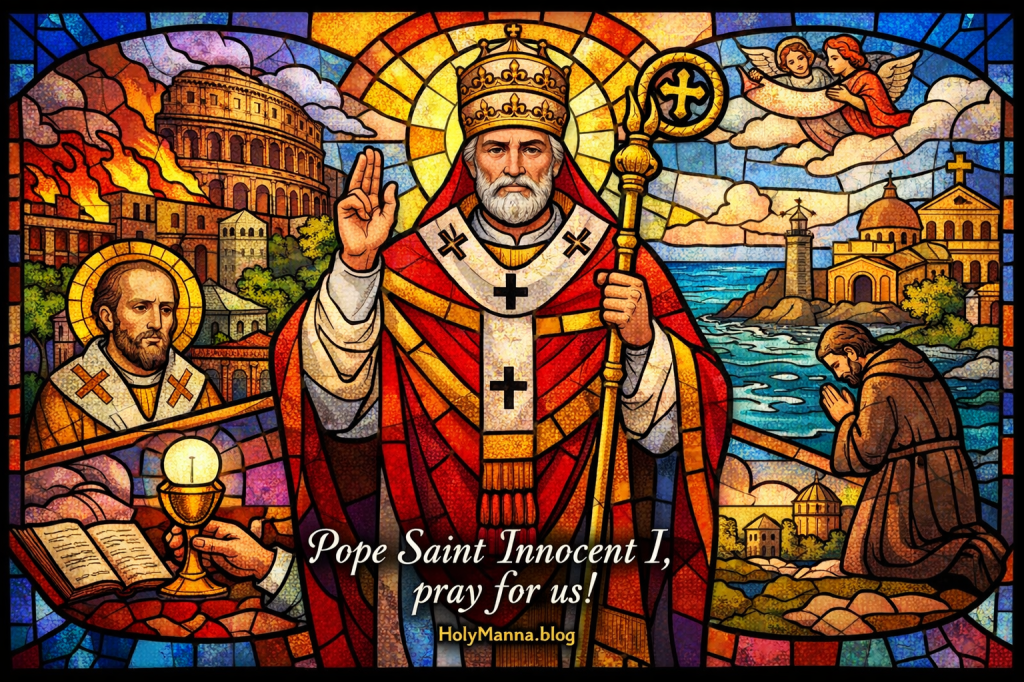
The Pope Who Held the Line While Rome Burned
Imagine trying to lead the Church while the world around it feels like it is collapsing in real time. That was Pope Saint Innocent I. He served as Bishop of Rome from A.D. 401 to 417, right as the Western Roman Empire groaned under the weight of invasion, political weakness, and spiritual confusion. When heresies threatened the faith and powerful men tried to silence faithful bishops, Innocent did not blink. He wrote. He judged. He defended. He protected communion with the Church of Rome as something real, not symbolic, because unity in Christ is never an accessory.
He is revered as a saint because his holiness showed up where many people do not notice holiness at first: in steady leadership, doctrinal clarity, mercy for sinners who return, and courage when the world’s fear tries to bully the Church into compromise. The Church remembers him as a pope and confessor, not a martyr, and that matters, because his witness is the quiet heroism of fidelity, which is often the kind of holiness most people are actually called to live.
A Roman Heart Formed for the Chair of Peter
The early details of Innocent’s life are not richly documented, and that humility of the record is almost fitting. Catholic tradition associates him with Albano, near Rome, and he was formed in the life of the Roman Church before his election. Some later traditions even suggest a family connection to Pope Saint Anastasius I, whom he succeeded, but the safest way to say it is simple: he belonged to Rome, and Rome belonged to the faith.
What is clearer than his childhood story is his spiritual formation. Innocent came to the papacy when the Church needed a father who could govern with firmness and tenderness at the same time. That is the conversion worth noticing here. It is the conversion of a man who understands that authority in the Church is not about ego, but about guarding what has been handed down. In the language of The Catechism, this is the Petrine service of unity, the particular task entrusted to Peter and his successors for the sake of the whole Church, as taught in CCC 881 to 882.
He became pope around the end of A.D. 401, and from the beginning he acted like a man who knew he was holding something sacred in his hands. He did not treat doctrine as a debate club, and he did not treat Church discipline as optional. He treated both as medicine for souls.
Letters Like Lightning, Mercy Like Bread
Pope Saint Innocent I is remembered for a life of governance that reached farther than most people expect. He was not only dealing with Rome. Bishops across the West and even in the East treated the Roman See as a court of appeal when disputes became too heavy for local solutions. Innocent answered questions from Gaul, Spain, Britain, Italy, and beyond, building a paper trail of pastoral judgment that still matters for Catholic history today.
One of his most influential letters was written to Bishop Decentius of Gubbio, who wanted to know what was truly the Roman practice in worship and discipline. Innocent’s answers became a major witness to early Roman sacramental life. When he speaks about Confirmation, he ties the sacrament to the bishop’s role in a way that Catholics still recognize instantly. He insists that the completion of initiation through the sacred signing belongs properly to the bishop, saying “the signing… may not be done by any other than a bishop.” That fits cleanly with CCC 1312, which calls the bishop the ordinary minister of Confirmation and ties the sacrament to apostolic communion.
He also connects the Anointing of the Sick directly to James 5:14 to 15, showing that this sacrament is not a medieval invention or a pious extra. It is biblical, apostolic, and pastoral. The Church still teaches this clearly in CCC 1516.
Innocent is also remembered for strengthening how the Church treated those near death. In a letter to Saint Exuperius of Toulouse, he speaks with a tenderness that sounds like a father who refuses to let fear or rigor steal hope from the dying. He defends giving Communion as viaticum, the food for the final journey, and he refuses to imitate the harshness of schismatic rigorism, saying “communion be given to the departing… as a viaticum… that we may not seem to follow the harshness and the rigor of the Novatian.”
That is not sentimental mercy. That is Catholic mercy, which always keeps one eye on truth and one eye on salvation.
As for miracles during his lifetime, there are no widely preserved, reliable miracle accounts attached to Pope Saint Innocent I in the classic Catholic sources the way there are for many wonder-working monks or martyrs. His sanctity is not remembered through dramatic healings or visions. It is remembered through courageous leadership, sacramental clarity, and defense of unity when that unity was bleeding.
Rome Besieged, the Pope Unshaken
Innocent’s papacy unfolded in the shadow of a terrifying event: Rome was threatened and then sacked by the Goths under Alaric in A.D. 410. During the crisis, Innocent was involved in efforts tied to negotiations and appeals to imperial authority, and ancient Catholic accounts preserve the painful detail that he was absent from the city when it fell, unable to return as the situation tightened. That kind of moment could break a leader. It could make a man retreat into self-protection, into silence, into bitterness.
Instead, the tradition remembers him returning to strengthen the people, urging them to suffer as Christians, and even witnessing how pagan onlookers were struck by the patience of believers who did not curse God when their world collapsed. The lesson is blunt and timeless. When the Church suffers publicly, the world watches. When Christians suffer with faith, the world sometimes converts.
He also endured the pressure of doctrinal warfare. Pelagianism was spreading, teaching in various forms that human beings can reach salvation by their own effort, as though grace were a nice decoration rather than the beating heart of redemption. Innocent supported the African bishops, including Saint Augustine’s camp, confirming condemnations of Pelagian teaching and reinforcing that salvation is grace from start to finish, exactly as the Church later synthesizes in CCC 1996 to 2001.
In the East, he defended Saint John Chrysostom, one of the greatest bishops and preachers in Christian history, who had been unjustly deposed and exiled through ecclesiastical politics and imperial pressure. Innocent refused to recognize the injustice as legitimate. That matters because it reveals something about Catholic leadership. A pope is not meant to be a politician who keeps the peace by calling every conflict a misunderstanding. A pope is meant to serve communion in truth, even when truth is inconvenient.
Innocent did not die a martyr’s death, and he is not honored as a martyr in the strongest Catholic historical judgment. His hardships were the long, grinding trials of leadership: war, heresy, schism, injustice, and the constant responsibility of guarding souls.
Relics Protected, Churches Built
Because Innocent’s sanctity is remembered primarily through his governance and doctrinal witness, there is not a strong catalogue of miracle stories after his death in the way many saints have. Some saints are remembered because stories of healings cluster around their tomb like candles around an altar. Innocent is remembered because his letters and decisions still echo whenever Catholics talk about unity, sacraments, Scripture, and the nature of grace.
Even so, his posthumous impact is very real. He was buried along the Via Portuensis, in a cemetery tradition later associated with the catacombs area connected to Pontian. In later centuries, as Rome faced instability and threats to sacred sites, the relics of certain popes were translated for protection, and tradition holds that Innocent’s relics were among those preserved in Rome’s churches, including San Martino ai Monti, which is known for holding relics of multiple early popes. This is not a miracle story in the strict sense, but it is a sign of the Church’s instinct to honor and safeguard the memory of her shepherds.
His cultural footprint is also carved into the city itself. Through the generosity of a Roman noblewoman named Vestina, a church was built and endowed in Rome, connected to the dedication of Saints Gervasius and Protasius, and Innocent’s name remains tied to that living Roman memory. The point is simple. Saints do not vanish after death. They become part of the Church’s bloodstream.
One of Innocent’s enduring contributions is his witness to the canon of Scripture. In his letter to Exuperius, he provided a list of the sacred books received in the canon, and he warned against spurious writings falsely attributed to apostles. This matters because Catholics do not treat the Bible as a book that fell from the sky. Catholics receive the Bible within the Church, as taught in CCC 120, and Innocent’s letter stands as an early Roman witness to that living reception.
He is commemorated in the Church’s memory with feast day traditions that have varied over time, including a long-standing remembrance on July 28 in older Western calendars and his death date of March 12 as a natural point of remembrance. The deeper celebration is not the calendar date. The deeper celebration is what his life proclaims: Christ guards His Church, even when the empire falls apart.
In terms of verified quotations, several lines from his letters have endured precisely because they capture the Catholic instinct with clarity. When he speaks of the Apostolic See’s role in confirming the faith of the churches, he uses imagery that still lands with force, describing a kind of fountain-source logic. In one well-known passage he speaks in the tone of Roman responsibility, saying “reference must be made to our judgment… realizing what is due the Apostolic See.”
And in a later tradition of papal citation, his voice is remembered with a tender image of the Church as refuge, described as “a port that resists the waves.” Those are not slogans. They are a Catholic worldview in a sentence. The Church is not a hobby. The Church is a ship, and the sea is real.
When the World Shakes, Hold Fast to Grace
Pope Saint Innocent I is a saint for anyone who feels worn down by chaos, confused by loud opinions, or tempted to treat doctrine like optional background noise. His life is a reminder that unity matters, sacraments matter, and grace matters. Pelagianism is not only a fourth-century problem. It shows up every time someone says, “Just try harder,” without mentioning prayer, repentance, sacraments, and the mercy of God. It shows up every time someone turns Christianity into self-improvement instead of salvation. The Church’s teaching on grace in CCC 1996 to 2001 is not abstract theology. It is oxygen.
Innocent also teaches that mercy is not weakness. Mercy is courage. Giving the dying the Eucharist as viaticum is a proclamation that Christ has the final word, not fear, not shame, not the devil, not death. The next time someone is tempted to be harsh, to write someone off, or to treat the sinner as hopeless, Innocent’s spirit pushes back. The Church is not Novatian. The Church is Catholic.
There is also something deeply practical here. Innocent’s insistence on the bishop’s role in Confirmation and the Church’s fidelity to apostolic practice is a reminder that Catholic worship is not made up on the spot. It is received. It is guarded. It is handed on. That is why Catholics can walk into a church anywhere in the world and find the same sacraments, the same creed, and the same Eucharistic Lord.
The best way to honor Pope Saint Innocent I is to imitate his stability. Stay close to the sacraments. Stay close to the Church. Do not let the noise of the age bully the soul into confusion. When the world shakes, hold fast to Christ, because Christ is not shaking.
Engage with Us!
Readers are invited to share thoughts and reflections in the comments below, especially any ways this saint’s story connects with the struggles and pressures of daily life.
- Where does the heart feel tempted to rely on self effort instead of God’s grace, and what would change if grace were treated as absolutely necessary?
- When has suffering or disappointment tempted the soul to bitterness, and how could faith turn that same moment into a witness that draws others toward Christ?
- How seriously is the Eucharist treated as strength for the journey, both in ordinary life and at the hour of death, and what practical steps could deepen that reverence?
- What does staying in communion with the Church look like in everyday choices, especially when opinions and controversies feel loud and exhausting?
May Pope Saint Innocent I teach courage that does not panic, clarity that does not compromise, and mercy that does not grow cold. Live a life of faith, stay close to Jesus in the sacraments, and do everything with the love and mercy Christ taught, because that love is stronger than the waves.
Pope Saint Innocent I, pray for us!
Follow us on YouTube, Instagram and Facebook for more insights and reflections on living a faith-filled life.

 Holy Manna!
Leave a comment