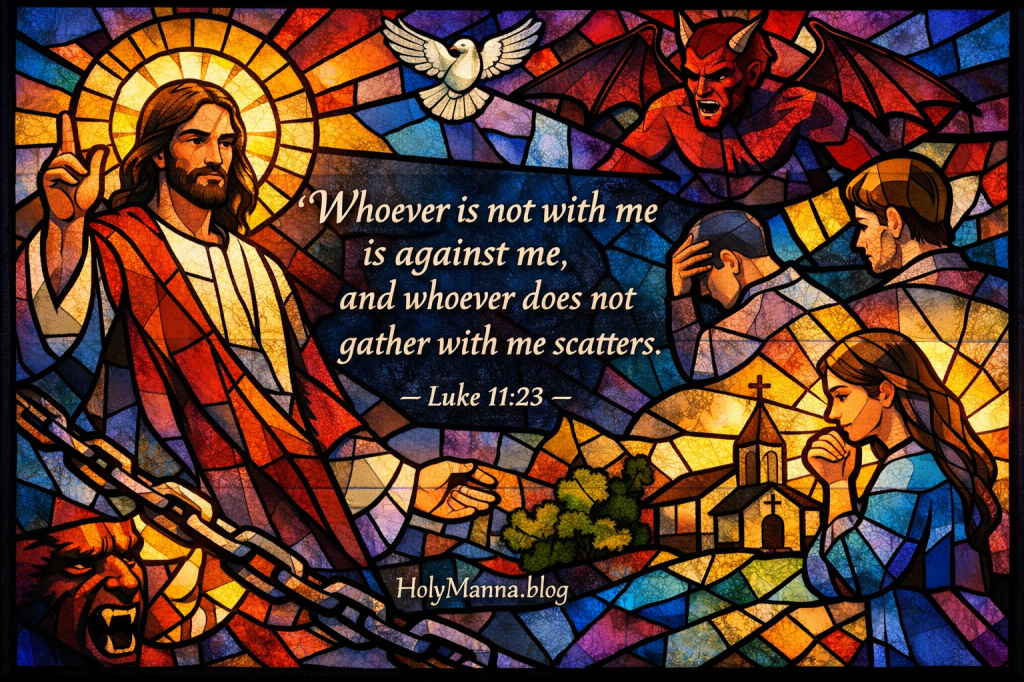
Thursday of the Third Week of Lent – Lectionary: 240
The Day the Voice of God Breaks Through the Noise
There is a moment every Lent when the heart has to stop pretending and pick a side. Not a dramatic, movie scene moment, but a quiet, honest one, where God speaks plainly and the soul either listens or stiffens up.
That is the central thread running through today’s readings: hearing the voice of God and responding with real obedience, not just religious noise. In Jeremiah 7:23-28, the Lord is not asking for spiritual theatrics, but covenant loyalty: “Listen to my voice; then I will be your God and you shall be my people” (Jer 7:23). The tragedy is not ignorance, but refusal. Israel has the Temple, the rituals, and the history, yet the Lord says they have “turned their backs, not their faces” to Him (Jer 7:24). That warning lands hard in Lent because it exposes a temptation that never goes away: to keep the outside of religion while the inside stays unconverted.
Psalm 95 answers like a Church bell ringing at dawn, calling God’s people back to worship and back to trust: “Oh, that today you would hear his voice: Do not harden your hearts” (Ps 95:7-8). The Psalm points to Meribah and Massah, those wilderness days when God’s works were visible, but the people still demanded proof, as if the Lord had to audition for their faith (Ps 95:8-9). The Church puts that word “today” on the lips during Lent because grace is not meant to be delayed. A heart can harden slowly, one excuse at a time, until correction feels like an insult.
Then The Gospel of Luke 11:14-23 shows what a hardened heart looks like up close. Jesus frees a man from a demon, the man speaks, and instead of repentance, some respond with accusation, claiming Christ acts by the prince of demons (Lk 11:15). It is the same old story from Jeremiah: God acts, prophets speak, signs appear, and the stubborn heart looks for a way to dismiss it. Jesus does not leave room for a neutral middle ground. He names the spiritual stakes plainly: “Whoever is not with me is against me” (Lk 11:23). Lent is the season when that sentence stops sounding harsh and starts sounding merciful, because it tells the truth while there is still time to choose life.
What would change if the Lord’s word “today” became the turning point, instead of “later”?
First Reading – Jeremiah 7:23-28
A Covenant That Refuses to Be Reduced to Religious Routine
This passage comes from a hard moment in Judah’s history, when people still had the Temple, still knew the stories of Moses, and still spoke the language of faith, but their hearts were drifting into something colder. The prophet Jeremiah is preaching in an age when worship could easily become a mask, because sacrifices continued even while injustice and stubbornness spread through everyday life. God’s complaint is not that His people lack religion. God’s complaint is that they refuse relationship.
That is why today’s theme lands so sharply here. Lent is not mainly about adding spiritual activities. Lent is about whether God’s voice is actually being heard and obeyed. In this reading, the Lord lays out the covenant in plain terms, then exposes the tragedy of a nation that keeps hearing words without giving Him its attention. It is the same choice echoed in Psalm 95 and made unavoidable in Luke 11:14-23: the heart either listens and turns its face toward God, or it hardens and learns how to justify itself.
Jeremiah 7:23-28 – New American Bible (Revised Edition)
23 This rather is what I commanded them: Listen to my voice; then I will be your God and you shall be my people. Walk exactly in the way I command you, so that you may prosper.
24 But they did not listen to me, nor did they pay attention. They walked in the stubbornness of their evil hearts and turned their backs, not their faces, to me. 25 From the day that your ancestors left the land of Egypt even to this day, I kept on sending all my servants the prophets to you. 26 Yet they have not listened to me nor have they paid attention; they have stiffened their necks and done worse than their ancestors. 27 When you speak all these words to them, they will not listen to you either. When you call to them, they will not answer you. 28 Say to them: This is the nation which does not listen to the voice of the Lord, its God, or take correction. Faithfulness has disappeared; the word itself is banished from their speech.
Detailed Exegesis
Verse 23 – “This rather is what I commanded them: Listen to my voice; then I will be your God and you shall be my people. Walk exactly in the way I command you, so that you may prosper.”
This is covenant language, the kind of promise Israel heard at Sinai. God is not bargaining for occasional attention. God is claiming His people, and He is offering them the life that comes from walking with Him. The order matters. Listening comes first, then belonging, then walking, then the fruit of a life aligned with God. Prosperity here is not a shallow guarantee of comfort. It is the biblical idea of well being that comes from living in the truth, because sin always has a cost even when it looks fashionable.
Verse 24 – “But they did not listen to me, nor did they pay attention. They walked in the stubbornness of their evil hearts and turned their backs, not their faces, to me.”
This verse names the real enemy: stubbornness. It is not merely a mistake, but a posture that resists correction. The image is personal and painful. Turning the back to God is the opposite of worship, because worship is the face turned toward the Lord. Lent keeps calling the faithful back to this, because sin is often less like a single fall and more like a slow turning away, one rationalization at a time.
Verse 25 – “From the day that your ancestors left the land of Egypt even to this day, I kept on sending all my servants the prophets to you.”
God reveals His patience here. The prophets are not random voices. They are mercy sent in human form, a steady stream of warnings and invitations. The Lord is reminding His people that He has not been silent. He has been faithful for generations. When Scripture shows God sending prophets “again and again,” it is showing a Father who keeps calling His children home.
Verse 26 – “Yet they have not listened to me nor have they paid attention; they have stiffened their necks and done worse than their ancestors.”
“Stiffened their necks” is an old biblical image for refusing the yoke of God’s guidance. It is the stubborn ox that will not be led. The line about doing worse than their ancestors is especially sobering, because it reveals how sin can deepen over time when it is protected instead of confessed. A culture, a family, or a soul can inherit wounds, but it can also choose to repeat them, intensify them, and hand them down.
Verse 27 – “When you speak all these words to them, they will not listen to you either. When you call to them, they will not answer you.”
Jeremiah is being prepared for rejection. This is part of the prophetic vocation: to speak truth without being controlled by the crowd’s reaction. There is a quiet lesson here for every Christian who tries to live the faith clearly. Fidelity cannot depend on applause. A disciple is called to witness, even when people would rather not be interrupted.
Verse 28 – “Say to them: This is the nation which does not listen to the voice of the Lord, its God, or take correction. Faithfulness has disappeared; the word itself is banished from their speech.”
This is the diagnosis. A nation can lose the habit of listening, and then it loses the ability to be corrected, and then even language gets corrupted. When “faithfulness has disappeared,” speech itself becomes unreliable because truth no longer has a home. It is an unsettling line, but it is also a mercy, because God speaks the truth about the sickness so that healing can begin.
Teachings
This reading is a wake up call against a counterfeit version of religion, one that keeps external signs while resisting interior conversion. God’s covenant has always demanded more than ritual. It demands a listening heart that becomes an obedient life. That is why the Church speaks of faith as obedience, not because God wants robots, but because love must be lived, not merely admired.
The Catechism puts it with bracing clarity: “To obey (from the Latin ob-audire, to ‘hear or listen’) in faith is to submit freely to the word that has been heard.” CCC 144 This is Jeremiah’s message in Catholic language. The problem is not that God has not spoken. The problem is that the people refuse to hear Him in a way that changes how they walk.
The Catechism also describes what that submission really is: “By faith, man completely submits his intellect and will to God.” CCC 143 That is not a sterile idea. It is the opposite of the stiff neck. It is the face turned toward God, trusting that His commands are not cages but guardrails leading to life.
The saints echo the same wisdom in a more personal tone. The opening line of the Rule of Saint Benedict sounds like it was written for Jeremiah 7: “Listen carefully, my son, to the master’s instructions, and attend to them with the ear of your heart.” That “ear of the heart” is what Judah had lost. It is what Lent aims to restore.
Reflection
This reading presses on one uncomfortable truth: it is possible to be surrounded by holy things and still be stubborn inside. A person can attend Mass, know Catholic vocabulary, and keep a few respectable habits, while quietly turning the back to God in the daily choices that matter most. Jeremiah exposes that gap because God wants a whole heart, not a managed image.
One practical step is to treat God’s correction as grace instead of insult. When conscience stings, when Scripture challenges, or when a faithful friend calls something out, the easy move is to stiffen the neck and defend the ego. The holy move is to soften, confess, and turn the face back toward the Lord. That is how freedom begins.
Another step is to make listening concrete. Listening is not vague. It looks like a real examination of conscience, a sincere confession, and a willingness to repair what sin damaged. It looks like choosing obedience in the small things, especially when nobody is watching, because that is where stubbornness usually hides.
Where has God been asking for obedience that keeps getting postponed? What habit, relationship, or private compromise has trained the heart to turn its back instead of its face toward the Lord? If the Lord’s voice is speaking through Scripture, the Church, and conscience, what would change this week if that voice were taken seriously “today” instead of “later”?
Responsorial Psalm – Psalm 95:1-2, 6-9
When Worship Becomes a Choice to Trust
This Psalm is one of the Church’s most familiar calls to prayer, and it has the feel of a door opening at the start of a new day. It begins with joy, moves into adoration, and then turns serious with a warning that sounds almost fatherly. That shift is not an accident. Psalm 95 was used in Israel’s worship as a summons to gather before the Lord, but it also served as a public reminder of a painful national memory. The people once saw God’s saving works with their own eyes, yet they still resisted Him in the desert. That old story is brought into the present with one urgent word: “today.”
That is exactly why it fits today’s theme so perfectly. Jeremiah 7:23-28 exposes a people who refuse to listen, and Luke 11:14-23 shows hearts that watch God act and still find a way to accuse Him. The Psalm stands in the middle like a steady voice in the Church, calling the faithful to worship God as God, and to listen while grace is still being offered. The real danger is not that the Lord stops speaking. The real danger is that the heart hardens and stops hearing.
Psalm 95:1-2, 6-9 – New American Bible (Revised Edition)
A Call to Praise and Obedience
1 Come, let us sing joyfully to the Lord;
cry out to the rock of our salvation.
2 Let us come before him with a song of praise,
joyfully sing out our psalms.6 Enter, let us bow down in worship;
let us kneel before the Lord who made us.
7 For he is our God,
we are the people he shepherds,
the sheep in his hands.Oh, that today you would hear his voice:
8 Do not harden your hearts as at Meribah,
as on the day of Massah in the desert.
9 There your ancestors tested me;
they tried me though they had seen my works.
Detailed Exegesis
Verse 1 – “Come, let us sing joyfully to the LORD; cry out to the rock of our salvation.”
The Psalm opens as an invitation, not a lecture. Worship is meant to be communal and joyful, because God is not an idea but a Savior who acts. Calling the Lord “rock” speaks to stability and protection. In a world that shifts constantly, the Lord is not a mood. The Lord is firm ground. This kind of praise trains the heart to stop clinging to control and to start leaning on God.
Verse 2 – “Let us come before him with a song of praise, joyfully sing out our psalms.”
This verse describes a posture of approach. It is not casual wandering into God’s presence. It is coming before Him with intention. Israel knew liturgical worship as a real meeting with God, and the Church receives that same instinct. Praise is not entertainment. Praise is truth spoken aloud until the heart catches up. When praise is sincere, it softens pride and makes room for obedience.
Verse 6 – “Enter, let us bow down in worship; let us kneel before the LORD who made us.”
Now the Psalm moves from singing to kneeling. The body joins the soul. Bowing and kneeling are not empty gestures, because the human person is not a floating spirit. The body expresses what the heart is choosing. Kneeling says, without argument, that God is God and man is not. In Lent, this matters because a hardened heart often shows up as a stiff posture toward God, an interior refusal to bend. The Psalm calls for humility that can be seen.
Verse 7 – “For he is our God, we are the people he shepherds, the sheep in his hands. Oh, that today you would hear his voice.”
This is the heart of the Psalm. God is not only Creator. God is Shepherd. That is covenant language, the kind of belonging Jeremiah is pleading for when the Lord says, “I will be your God and you shall be my people” (Jer 7:23). The image of sheep in His hands is meant to produce trust. Then comes the word that gives Lent its urgency: “today.” This is not a sentimental line. It is a rescue line. It means God is speaking now, and the soul is responsible now.
Verse 8 – “Do not harden your hearts as at Meribah, as on the day of Massah in the desert.”
Meribah and Massah recall the desert testing, when Israel demanded water and questioned whether the Lord was truly with them. The tragedy was not thirst. The tragedy was distrust. A hardened heart is not merely a heart that feels dry. It is a heart that turns dryness into accusation, and difficulty into rebellion. The Psalm warns that it is possible to be physically near holy things and still spiritually resistant, which is exactly what Jeremiah laments about Judah.
Verse 9 – “There your ancestors tested me; they tried me though they had seen my works.”
This verse makes the warning sharper. The ancestors had seen God’s works, and still tested Him. That pattern is not ancient history. It repeats whenever people treat God like a suspect who has to prove Himself again, instead of a Father who has already shown His love. This connects tightly to the Gospel, where some people see liberation in front of them and still accuse Jesus of acting by evil power (Lk 11:15). The hardened heart does not lack evidence. It lacks surrender.
Teachings
The Church does not treat the Psalms as religious poetry from a distant era. The Church prays them as living speech, the Word of God placed on the lips of God’s people. The Catechism teaches this plainly: “The Book of Psalms is the book in which the Word of God becomes man’s prayer.” CCC 2587 That line explains why Psalm 95 can speak about Meribah and still be aimed at a modern Catholic heart. God’s Word becomes prayer so that prayer can become obedience.
The Psalm’s call to worship with the body also fits Catholic instinct. Kneeling is not a preference. It is a confession. The Catechism explains why bodily posture matters in prayer: “Bodily posture, such as kneeling, is a sign of humility and respect.” CCC 2713 That matters because pride often hides behind excuses that sound spiritual. Kneeling tells the truth without needing to win an argument.
Saints and Doctors of the Church repeatedly saw this Psalm as a daily alarm against spiritual laziness. Saint Augustine preached that the word “today” is God’s mercy, because as long as it is “today,” repentance is still possible. The warning is not meant to crush the soul. The warning is meant to keep the soul from drifting into a stubbornness that no longer wants to hear correction.
Historically, the desert testing referenced here shaped Israel’s identity. It was the school of trust where God provided manna, water, and guidance, and it was also the place where complaints and fear exposed the heart. The Church reads that history as a mirror for every believer. Lent is the desert season of the year, not because God is absent, but because the heart is being trained to trust Him more deeply.
Reflection
This Psalm offers a simple but demanding invitation: worship the Lord with joy, and obey Him with trust, today. It is easy to imagine hardened hearts as something that happens to other people, but the Psalm makes it personal. Hardened hearts form slowly through patterns of delay, resentment, and spiritual bargaining.
One practical step is to take the Psalm’s movement seriously. Start with praise, then move into kneeling, then move into listening. Many people want to jump straight to asking God for things, but the Psalm teaches a healthier order. Praise restores perspective, kneeling restores humility, and listening restores obedience.
Another step is to recognize modern Meribahs. The desert testing shows up today when God’s past faithfulness is forgotten the moment life gets uncomfortable. It shows up when prayer becomes a complaint hotline instead of a relationship, or when the soul demands a sign as a condition for trust. The Psalm does not condemn honest struggle. It warns against turning struggle into stubbornness.
Where has the heart grown cynical or resistant, even while keeping religious routines? What would change if God’s voice were treated as the highest authority “today,” not after everything feels easier? When difficulty hits, does prayer become worship and trust, or does it slide into testing God like Israel in the desert?
Holy Gospel – Luke 11:14-23
The Moment the Heart Starts Choosing a King
In the world of The Gospel of Luke, people knew the language of the spiritual realm. They believed in angels and demons, and they also lived in a culture where accusations of sorcery could be used as a weapon against anyone who threatened the status quo. So when Jesus drives out a demon and restores a man’s speech, the crowd’s amazement is real, but the resistance is real too. Some hearts are ready to worship, and other hearts immediately start spinning narratives to avoid surrender.
That tension fits today’s theme perfectly. In Jeremiah 7:23-28, God laments a people who refuse to listen, even after generations of mercy. In Psalm 95, the Church pleads, “Oh, that today you would hear his voice: Do not harden your hearts” (Ps 95:7-8). Here in the Gospel, the voice of God is not only heard, it is seen, because liberation is happening in public. The real test is not whether Jesus has power. The real test is whether the heart will admit where that power comes from, and what it demands.
Luke 11:14-23 – New American Bible (Revised Edition)
14 He was driving out a demon [that was] mute, and when the demon had gone out, the mute person spoke and the crowds were amazed. 15 Some of them said, “By the power of Beelzebul, the prince of demons, he drives out demons.” 16 Others, to test him, asked him for a sign from heaven. 17 But he knew their thoughts and said to them, “Every kingdom divided against itself will be laid waste and house will fall against house. 18 And if Satan is divided against himself, how will his kingdom stand? For you say that it is by Beelzebul that I drive out demons. 19 If I, then, drive out demons by Beelzebul, by whom do your own people drive them out? Therefore they will be your judges. 20 But if it is by the finger of God that [I] drive out demons, then the kingdom of God has come upon you. 21 When a strong man fully armed guards his palace, his possessions are safe. 22 But when one stronger than he attacks and overcomes him, he takes away the armor on which he relied and distributes the spoils. 23 Whoever is not with me is against me, and whoever does not gather with me scatters.
Detailed Exegesis
Verse 14 – “He was driving out a demon that was mute, and when the demon had gone out, the mute person spoke and the crowds were amazed.”
This is not a party trick. The miracle is both physical and spiritual. A demon’s oppression has silenced a man, and Jesus restores his voice by expelling the enemy. In Scripture, speech is often connected to dignity and communion. When the man speaks again, it is a sign that the Kingdom of God is restoring what evil tried to steal.
Verse 15 – “Some of them said, ‘By the power of Beelzebul, the prince of demons, he drives out demons.’”
This is the dark turn. Instead of reading the miracle as mercy, some accuse Jesus of being empowered by evil. Beelzebul is invoked as a title for the leader of demons, which makes the accusation as insulting as it is serious. The hardened heart does not deny the event. It re-labels it so that obedience can be avoided.
Verse 16 – “Others, to test him, asked him for a sign from heaven.”
This is a different kind of resistance, more polite, but still resistant. They want to set the terms. They are not receiving; they are testing. It echoes the desert temptation named in Psalm 95, where God’s works were seen, yet the people still demanded proof on their schedule. The heart that demands constant signs is often a heart that is trying to stay in control.
Verse 17 – “But he knew their thoughts and said to them, ‘Every kingdom divided against itself will be laid waste and house will fall against house.’”
Jesus answers with calm clarity. He exposes how irrational their accusation is. If Satan’s kingdom is fighting itself, it collapses. He is also warning them spiritually: division destroys households, communities, and even souls. When truth is rejected, stability breaks down, because a life built on denial cannot stand for long.
Verse 18 – “And if Satan is divided against himself, how will his kingdom stand? For you say that it is by Beelzebul that I drive out demons.”
Jesus presses the logic. Their claim undermines itself. Satan does not sabotage his own dominion by liberating captives. Jesus is forcing the crowd to face a choice they want to avoid: either God is acting here, or their entire moral compass is broken.
Verse 19 – “If I, then, drive out demons by Beelzebul, by whom do your own people drive them out? Therefore they will be your judges.”
Jesus points to their inconsistency. If they accept that some among them perform exorcisms or deliverance prayers, then why deny Jesus unless the real issue is pride and jealousy? Their own standards will expose them. The Gospel shows how self-deception works: the heart invents a rule, then breaks it whenever obedience becomes inconvenient.
Verse 20 – “But if it is by the finger of God that I drive out demons, then the kingdom of God has come upon you.”
This is the heart of the passage. “Finger of God” recalls the Exodus story, when Egypt’s magicians recognized that God’s power was at work beyond them. Jesus is saying the same reality is happening now, but in a greater way. The Kingdom is not merely promised. The Kingdom is arriving in person. If the Kingdom has come, then neutrality is gone, because the King is present.
Verse 21 – “When a strong man fully armed guards his palace, his possessions are safe.”
Jesus paints a picture of Satan’s grip. The “palace” is the territory the enemy claims, and the “possessions” are the captives he wants to keep. Evil often looks stable while it is in control, because a captive system can feel “safe” when nobody challenges it. Sin can feel like order, until grace starts breaking chains.
Verse 22 – “But when one stronger than he attacks and overcomes him, he takes away the armor on which he relied and distributes the spoils.”
This is Christ’s victory in a sentence. Jesus is the “one stronger.” He does not negotiate with the enemy. He overcomes him. The armor is stripped, the false security is dismantled, and the spoils are distributed, meaning the captives are reclaimed and the enemy’s theft is reversed. This is why the Church never treats the devil as a cartoon. The devil is real, but he is not sovereign. Christ is.
Verse 23 – “Whoever is not with me is against me, and whoever does not gather with me scatters.”
Jesus ends by removing the comfortable middle. This is not political rhetoric. This is spiritual reality. A heart that refuses Christ still ends up serving the enemy’s agenda, even if it calls itself “neutral.” To “gather” with Jesus is to cooperate with His work, to build up the Kingdom through faith, repentance, and charity. To refuse that is to scatter, because sin always fragments what love is trying to unite.
Teachings
This Gospel sits right inside the Church’s sober teaching on spiritual warfare. The Church does not sensationalize the devil, but the Church does not pretend the devil is imaginary either. The heart of Catholic teaching is that Jesus truly confronts and defeats the powers of darkness, and His victory becomes present to believers through the life of grace, especially in the sacraments.
The Church speaks with clarity about exorcism, precisely because Jesus does what today’s Gospel describes. The Catechism teaches: “When the Church asks publicly and authoritatively in the name of Jesus Christ that a person or object be protected against the power of the Evil One and withdrawn from his dominion, it is called exorcism. Jesus performed exorcisms and from him the Church has received the power and office of exorcizing. In a simple form, exorcism is performed at the celebration of Baptism. The solemn exorcism, called ‘a major exorcism,’ can be performed only by a priest and with the permission of the bishop. In this matter, one must proceed with prudence, strictly observing the rules established by the Church. Exorcism is directed at the expulsion of demons or to the liberation from demonic possession through the spiritual authority which Jesus entrusted to his Church.” CCC 1673
That teaching helps frame what is happening in Luke 11. Jesus is not merely proving a point. He is liberating a person and revealing the Kingdom. It also explains why the crowd’s accusation is so spiritually dangerous. When God is clearly acting and a person insists on calling it evil, the heart is training itself to resist grace. That is how hardness forms: not by one dramatic rebellion, but by repeated refusal to admit the obvious truth in front of the soul.
The saints often warned that the devil’s most effective strategy is not loud horror-movie drama, but quiet distortion. If good can be labeled as evil, and evil can be justified as “not that bad,” then the conscience gets dulled. In today’s Gospel, Jesus refuses to let the conscience drift. He forces a decision, because the Kingdom’s arrival is a moment of mercy, and mercy always demands a response.
Reflection
This Gospel is a mirror, because it shows how people can witness God’s goodness and still find a way to dodge conversion. Some accuse Jesus outright. Others keep demanding new signs. Both reactions share one core problem: the heart does not want to yield. Lent exists to break that pattern before it becomes permanent.
A practical first step is to stop bargaining with grace. If the Lord has already made something clear through Scripture, the Church’s teaching, or a well-formed conscience, it is time to obey rather than negotiate. Delayed obedience often disguises itself as “discernment,” but it usually produces the same fruit: a hardened heart and a life stuck in circles.
A second step is to live like someone who believes Jesus is the “one stronger.” That means taking ordinary spiritual protection seriously without becoming weird about it. Confession matters because it tears down the devil’s footholds. Daily prayer matters because it trains the mind to recognize God’s voice. Fasting matters because it weakens the illusion that cravings are kings. Works of mercy matter because gathering with Christ always includes gathering souls, not scattering them with bitterness, gossip, and division.
A third step is to watch for the subtle accusation that creeps into modern life. Sometimes it shows up as cynicism that assumes holiness must be fake. Sometimes it shows up as resentment toward someone else’s conversion. Sometimes it shows up as the habit of calling the Church’s moral clarity “harmful” simply because it demands change. Those patterns do not come from the “finger of God.” They come from a heart that is trying to stay in charge.
Where has the heart been trying to stay neutral with Jesus, as if neutrality were safe? What area of life needs to be “gathered” back into Christ’s hands instead of scattered by compromise? When God’s work is visible, does the heart respond with gratitude and repentance, or with suspicion and excuses?
When “Today” Becomes the Turning Point
Today’s readings all circle the same fork in the road: God speaks, God acts, and the heart has to decide whether it will listen or harden. In Jeremiah 7:23-28, the Lord exposes the sadness of a people who keep religious appearances while refusing covenant obedience. The problem is not that God has been unclear. The problem is that the heart has learned how to turn away without leaving the building. In Psalm 95, the Church answers with a cry that feels urgent and tender at the same time: “Oh, that today you would hear his voice: Do not harden your hearts” (Ps 95:7-8). That word “today” is mercy, because it means conversion is still possible.
Then the Gospel in Luke 11:14-23 puts the choice into sharp focus. Jesus frees a man from demonic oppression, and instead of simple gratitude, some hearts try to re-label the miracle so they do not have to submit. Jesus refuses to let anyone hide in a comfortable middle. His words still cut through the fog: “Whoever is not with me is against me, and whoever does not gather with me scatters” (Lk 11:23). That is not meant to scare the soul. It is meant to wake it up while grace is still knocking.
Lent is the season to stop managing faith like an image and start living it like a covenant. Worship is meant to turn the face toward God, not just fill time. Obedience is meant to be love in motion, not a bitter duty. And repentance is meant to be real, not theoretical, because the “one stronger” is not trying to humiliate anyone. Christ is trying to free captives and rebuild what sin has scattered.
Let today be the day the heart chooses to listen without bargaining. Let prayer become honest, not performative. Let confession become normal, not rare. Let fasting and self-denial become a way of saying no to false kings. Let charity become practical, because gathering with Jesus always includes caring for real people in real need. The Lord is still speaking, and the Church is still repeating the same invitation with calm urgency. Oh, that today you would hear his voice.
Engage with Us!
Readers are invited to share reflections in the comments below, because the Word of God comes alive when it is prayed, discussed, and lived with sincerity in the middle of real life.
- First Reading, Jeremiah 7:23-28: Where has God been calling for obedience that is simple and concrete, but the heart has been resisting or postponing it? What would change this week if the face turned toward God in that exact area instead of turning away with excuses?
- Responsorial Psalm, Psalm 95:1-2, 6-9: What does a “hardened heart” look like in daily life right now, and what would it mean to take the word “today” seriously in prayer, repentance, and trust?
- Holy Gospel, Luke 11:14-23: Where has the heart tried to stay neutral with Jesus, and what would it look like to “gather with him” through clearer repentance, deeper prayer, and more intentional charity?
Keep leaning into the Lord with trust, even when conversion feels uncomfortable, because God does not speak to crush the soul. God speaks to heal it. Live with a faith that listens, a courage that obeys, and a mercy that shows up in real action, doing everything with the love and compassion Jesus taught.
Sacred Heart of Jesus, we trust in You!
Immaculate Heart of Mary, pray for us!
Saint Michael the Archangel, defend us in battle!
Follow us on YouTube, Instagram and Facebook for more insights and reflections on living a faith-filled life.

 Holy Manna!
Leave a comment