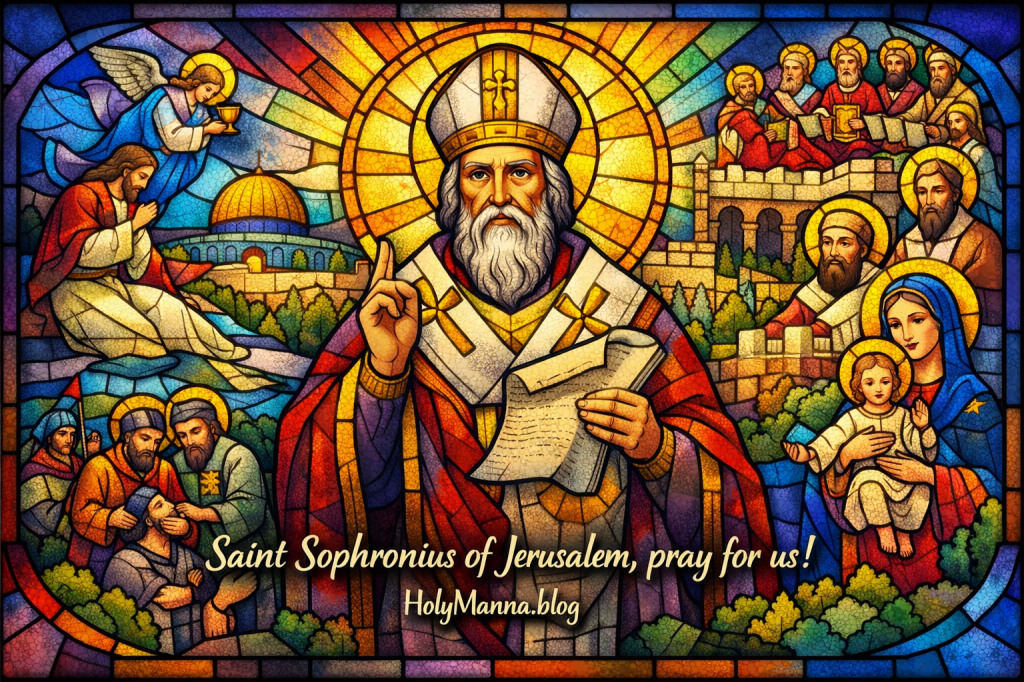
The Watchman at the Holy City’s Gate
Saint Sophronius of Jerusalem lived at the kind of crossroads most people only read about in history books. He stood where theology, empire, and everyday Christian survival all collided. He is revered as a Patriarch of Jerusalem and as a fierce defender of what the Church teaches about Jesus Christ. When confusion spread that tried to soften Christ’s full humanity for the sake of political peace, Sophronius held the line. He insisted that the Savior is not a half-human redeemer with a blurred interior life. Jesus Christ is true God and true man, and that means He possesses a true human will that freely obeys the Father. This is the faith the Church later re-affirmed with clarity, and it is echoed in The Catechism at CCC 475.
His story is not just about winning an argument. It is about guarding the truth that saves. If Christ truly took on what is human, then what is human can truly be healed, lifted up, and redeemed. Sophronius is remembered because he protected that truth when it would have been easier to stay quiet.
From Damascus to the Desert School of the Saints
Sophronius was born around the year 560 in Damascus. He was known as “the Sophist,” which points to a man trained in rhetoric and learning, someone comfortable in the world of ideas. That background mattered, because God would later use his mind to defend the faith when the Church needed careful language and courage at the same time.
His deepening into the Christian life unfolded over years, not in one dramatic moment. Catholic tradition remembers him spending a long stretch of his life near Jerusalem under the spiritual guidance of a holy monk named John Moschus. This was not the path of a celebrity preacher or a public reformer. It was the slow path of discipleship, where a soul is shaped by prayer, obedience, and the daily choice to prefer God over comfort.
That friendship with Moschus became one of the great spiritual friendships of the early medieval Church. Together they traveled, visited monasteries, and drank deeply from the wisdom of the desert. Their journeys took them especially into Egypt, a land famous for monks who fought spiritual battles in silence and won them on their knees.
Along the way, Sophronius also came into the orbit of Saint John the Almsgiver, Patriarch of Alexandria, a saint known for mercy and reform. Sophronius’ life shows how God often forms saints through other saints. Holiness spreads the way fire spreads, not by force, but by contact.
Sophronius is most known for what came next. He became a defender of orthodox Christology during the Monothelite crisis, when some voices claimed Christ had only one will. Sophronius recognized what was at stake. If Christ does not have a true human will, then the obedience of Gethsemane becomes theater, not redemption. The Church’s faith is that Christ truly prays, truly chooses, truly offers His human will to the Father. That is why the teaching later emphasized in CCC 475 matters for ordinary Christians trying to surrender their lives to God.
A Miracle of Healing and a Life Spent Pointing to God’s Works
Sophronius is not remembered primarily as a wonderworker who drew crowds. He is remembered as a pastor and teacher. Still, there is a miracle closely tied to his life that Catholic tradition preserves with gratitude.
During his years of travel and devotion, Sophronius suffered from a serious eye illness, an ophthalmia that threatened his sight. He went to the shrine associated with the holy Unmercenary Saints Cyrus and John, and he was cured. That healing was not treated as a random stroke of luck. It was received as mercy, as a sign that God sees the suffering of His children and answers through the intercession of His saints.
That miracle also shaped Sophronius’ later work. In thanksgiving, he became closely associated with recording and promoting devotion connected to Saints Cyrus and John, including accounts of healings attributed to their intercession. The pattern is beautiful and very Catholic. A grace received becomes a mission. A mercy experienced becomes a testimony offered to strengthen others.
Sophronius also became known for preaching and writing with a mind sharpened by study and a heart softened by prayer. Later traditions, especially in the Eastern Catholic world, connect him to powerful spiritual texts used in the Church’s life of prayer, including the Life of Saint Mary of Egypt. Some Catholic scholarship debates authorship, but the spiritual influence of the text in the Church’s Lenten tradition remains real, and its message fits perfectly with the kind of repentance and hope Sophronius spent his life defending.
One line associated with that tradition captures the spirit of a saint who wants God’s mercy to be proclaimed rather than hidden: “It is good to hide the secret of a king, but it is glorious to reveal and preach the works of God.”
The Storm of Heresy and the Sorrow of Jerusalem
Sophronius did not step into leadership during calm waters. He became Patriarch of Jerusalem around 634, and almost immediately his life became a double burden. He was fighting a theological crisis inside the Church while facing political catastrophe outside it.
On the doctrinal front, he opposed the language and strategies that tried to blur the truth about Christ. He assembled bishops, taught clearly, and sent urgent appeals for the Church to act with clarity. Catholic tradition even preserves an intense moment where he urged action toward Rome, pressing that the Apostolic See be engaged until the novelty was condemned. The tone was not casual. This was a shepherd guarding the flock from a teaching that could hollow out the Incarnation.
Then came the external crisis. Jerusalem faced the advancing Saracen forces and the reality that the Holy City could be lost. Sophronius is remembered as a leader trying to protect Christian life and worship in the places made sacred by Christ’s saving work. The image that remains is not a politician chasing power, but a pastor trying to spare suffering, preserve what could be preserved, and endure grief without surrendering faith.
His hardships were not only physical. They were spiritual and emotional. Imagine being the Patriarch of Jerusalem, watching the world change in a way that none of your people can stop, while still being responsible to preach hope and keep the faith pure. That is a slow martyrdom of the heart, even if the sword never falls.
Sophronius died around March 11, 638, near the time of Jerusalem’s fall. Even without a dramatic execution scene, his life carried the shape of martyrdom in the older sense of the word. It was a witness. He witnessed to Christ’s truth when compromise looked safer. He witnessed to Christ’s love when fear would have been easier.
The Triumph After the Funeral: His Name Vindicated and His Voice Preserved
Sometimes a saint’s greatest victory happens after death, when the Church finally speaks with the clarity the saint begged for in life. That is exactly what happened with Sophronius.
Decades after his death, the Church gathered at the Sixth Ecumenical Council, Constantinople III (680 to 681), and affirmed with authority what Sophronius had fought to protect: Christ has two wills, divine and human, united without confusion or division. In the same spirit, the council received Sophronius’ teaching as orthodox and honored his memory in the Church’s liturgical life. This matters because it means his struggle was not a lonely opinion. It was a faithful witness that the Church later recognized and confirmed.
His impact also continued through the prayer of the Church. In Eastern Catholic and Byzantine tradition, Sophronius is remembered not only as a doctrinal defender, but as a voice woven into liturgical life, especially through texts associated with Lenten repentance and the Church’s call to conversion. His feast is kept on March 11, and his legacy continues wherever Christians need courage to confess Christ clearly.
Catholic tradition also preserves famous praise of the Blessed Virgin Mary attributed to Sophronius, a reminder that the saints who defend Christ also love His Mother with reverence. One powerful line captures his Marian devotion with awe: “You surpass all the gifts that God’s magnificence ever bestowed on any human person… More than anyone you are made rich by God dwelling in you.”
As for posthumous miracles specifically worked through Sophronius’ intercession, Catholic sources tend to emphasize him more as a teacher and shepherd than as a saint surrounded by miracle stories at his tomb. Still, the miracle connected to his healing during life, and the many miracle accounts he helped preserve about Saints Cyrus and John, remain part of his wider spiritual legacy. The Church does not only remember saints for what they did with their hands. The Church also remembers saints for what they protected with their voice.
A Lesson for Ordinary Catholics Who Want to Be Faithful
Saint Sophronius can feel distant at first because his story includes councils and controversies. But his message lands right in the middle of everyday life.
When Sophronius defended the truth that Christ has a human will, he was defending hope for anyone trying to surrender their own will to God. If Jesus truly has a human will, then Jesus truly knows what it is to struggle, to choose, to obey, and to offer that obedience in love. That is why CCC 475 is not trivia. It is medicine for the soul.
Sophronius also teaches that clarity is charity. A vague faith cannot hold up under pressure. When culture shifts, when politics get scary, when people want religion to be a soft fog instead of solid truth, Sophronius reminds Catholics that love does not lie. Love tells the truth that saves.
He also shows the power of spiritual friendships and steady formation. He was shaped through years of prayer, guidance, and travel among holy people. That should encourage anyone who feels like sanctity is too far away. God is patient. God forms saints over time.
Now take one practical step. Pray slowly through Christ’s obedience in Gethsemane and unite it to your own surrender. Bring one stubborn area of life to Him. Ask for the grace to mean it when you say, “Thy will be done.” Then ask Saint Sophronius to help you love truth and live it gently.
What part of your life most needs the courage to be honest with God today?
Where has comfort tempted you to soften the truth, even in small ways?
How might Christ’s true human will, offered perfectly to the Father, give you hope to offer yours?
Engage with Us!
Share your thoughts and reflections in the comments below.
- Where do you feel pressured to compromise your faith for the sake of keeping things “easy” or “peaceful”?
- How does the Church’s teaching on Christ’s human will in CCC 475 change the way you understand obedience, temptation, and prayer?
- What is one concrete way you can practice clarity with charity this week, at home, at work, or online?
- If God has been slowly forming you over time, what has He been teaching you lately through prayer, friendships, or trials?
Keep going. Stay close to Jesus. Hold tight to the truth. Live a life of faith that refuses bitterness and refuses compromise, and do everything with the love and mercy Jesus taught us.
Saint Sophronius of Jerusalem, pray for us!
Follow us on YouTube, Instagram and Facebook for more insights and reflections on living a faith-filled life.

 Holy Manna!
Leave a comment