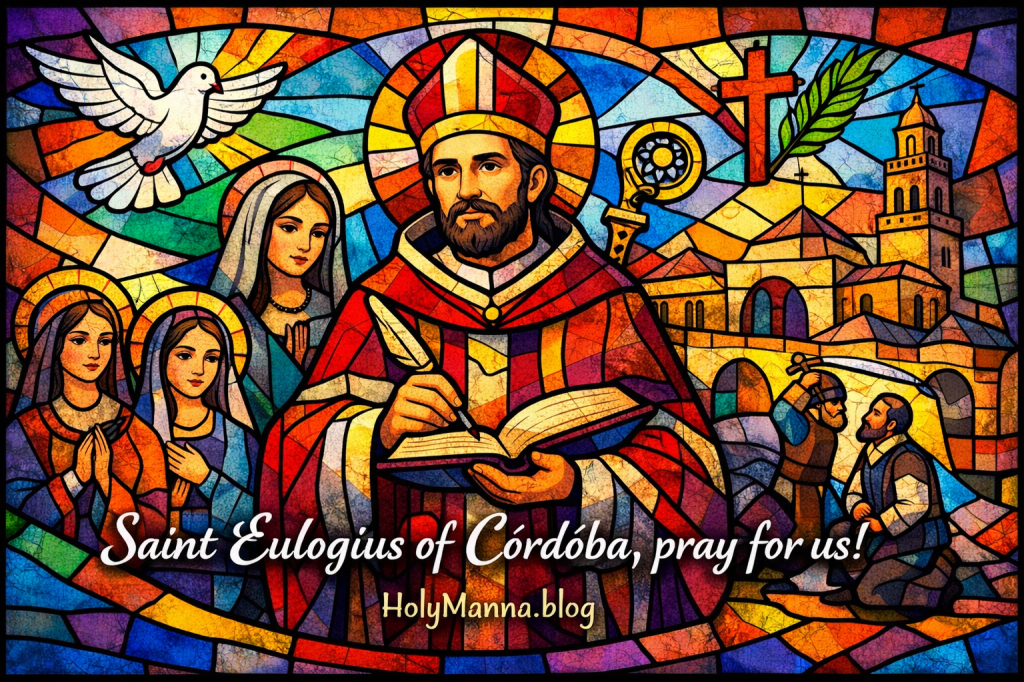
When a Quiet Priest Becomes a Lighthouse
Saint Eulogius of Córdoba was a Catholic priest in ninth-century Spain, living in Córdoba under Islamic rule. He was not remembered because he built a cathedral or led an army. He was remembered because he refused to let the faith die in his city, and because he stood close to the martyrs when it suddenly became costly to say the name of Jesus out loud.
He became the great storyteller and defender of the “Martyrs of Córdoba,” preserving their witness and strengthening frightened Christians when the pressure kept rising. In the end, he joined the martyrs himself, not chasing death, but refusing to betray Christ or abandon someone who needed protection. That is why the Church honors him as both scholar and saint, both pastor and martyr.
Noble Roots and a Heart Trained for Heaven
Eulogius was born in Córdoba, in a respected family with deep local roots. His exact birth year is not known, but he was born before 819. His mother, Isabel, raised him with care, and his family life carried surprising contrasts. One of his brothers held a high office in the emir’s palace, and one of his sisters, Anulona, lived as a consecrated religious. That mix says a lot about Christian life in Córdoba at the time. Catholics could live, work, and worship, but always as a minority navigating a complicated world.
As a young man, Eulogius studied at the monastery of Saint Zoilus, under the guidance of learned teachers, including Abbot Speraindeo. He became a serious student of Scripture and Christian doctrine, and he formed a deep friendship with Álvaro of Córdoba, who would later write about his life. Eulogius was ordained a priest by Bishop Recared of Córdoba.
There is an important detail that shows his temperament. At one point, he desired to make a pilgrimage to Rome to venerate the tomb of Saint Peter, and he even intended to go on foot. But when wise counsel urged prudence, he let the plan go. That kind of humility shows a man who was zealous, but not reckless.
A Scholar Who Refused to Let Christians Forget
Eulogius loved learning, not as a hobby, but as a way to keep the soul of a Christian people alive. He traveled and gathered books and writings to bring back to Córdoba, strengthening the Christian community’s intellectual and spiritual inheritance. In a world where cultures were colliding and Christians were tempted to shrink into silence, he believed memory mattered. He wrote, taught, and formed hearts so that Catholics would not drift into confusion or fear.
This is one of his biggest legacies. Some saints are remembered for what they built with stone. Eulogius is remembered for what he built with words. His writings preserved the stories of the martyrs, defended the faith, and left the Church a record of courage that still stirs the blood today.
The Miracle of Courage
When people hear “saint,” they often expect dramatic miracles during life. With Eulogius, Catholic tradition remembers him more for fidelity, teaching, and spiritual fatherhood than for public wonders. There are no widely attested reports of healings worked by him during his lifetime in the way some other saints are known for.
But do not miss the deeper miracle. In a time when many people went quiet to survive, he kept speaking truth with clarity. In a time when fear could have scattered the faithful, he helped hold them together. That is not flashy, but it is supernatural. It is the kind of grace that keeps families Catholic for generations.
During the persecutions that began to intensify around 850, Eulogius was imprisoned with other clergy. Even from prison, he acted like a pastor. He encouraged Christians facing death, including two women, Saints Flora and Mary. His words were not sentimental. They were steady, strong, and intensely Catholic, the kind of counsel that fixes your spine when everything shakes. He wrote to them that their persecutors “cannot injure the purity of your souls” and he reminded them that “victory is won by death alone.” Those lines do not glorify suffering for its own sake. They declare that Christ is worth everything, and that the soul belongs to God even when the body is threatened.
The Price of Protecting a Convert
Eulogius lived through an era where Christian life in Córdoba could be tolerated in one season and threatened in the next. He endured imprisonment, interrogations, and the constant danger that came with being an outspoken priest. He could have chosen a safer path. He could have become quieter, more “reasonable,” more careful with words. But the Gospel is not a private hobby. It is a public truth.
His final trial came through an act of protection. A young woman named Leocritia had left Islam and embraced Christ. That alone placed her in grave danger. Eulogius helped shelter her through Christian networks, and when authorities discovered this, he was arrested again.
He was offered the chance to soften his stance, to avoid the blade, to save himself. He refused. He confessed Christ and defended the faith. He was condemned and executed by beheading on March 11, 859. Leocritia was executed shortly afterward. There is another striking historical detail. Eulogius had been elected Archbishop of Toledo shortly before his death, but he was never consecrated because martyrdom came first.
The Church calls martyrdom the highest form of witness. The Catechism teaches that martyrdom is “the supreme witness given to the truth of the faith” in CCC 2473. That is exactly what happened in Córdoba. Eulogius did not seek death as a performance. He accepted death as a confession.
The Long Echo of a Martyr’s Voice
After his execution, Catholic tradition preserves stories of signs and later miracles connected to his relics.
One ancient account reports that after his body was cast out, a dove of dazzling whiteness came and settled upon the martyr’s body, and those who tried to drive it away could not. This story is a pious tradition, and it cannot be verified with modern historical certainty, but it has long been received as a symbolic sign of innocence, peace, and heavenly favor.
His relics were later translated and venerated at Oviedo, and his memory became woven into the Catholic heritage of Spain. Another tradition, preserved in connection with the veneration of these martyrs’ relics, tells of an archdeacon of Oviedo who was suddenly rendered mute and later healed through the intercession of the holy martyrs. This story is part of the later miracle tradition surrounding their relics, and it cannot be verified with modern historical certainty, but it is included in Catholic memory as testimony to God’s ongoing mercy through the communion of saints.
His cultural impact is not limited to texts in a library. In Córdoba, sacred art has honored him, and local Catholic devotion has kept his name present. Some places commemorate him on March 11, tied to the date of his martyrdom, while local calendars and communities have also honored him on other dates as part of their regional liturgical life. The important point is that the Church did not let his witness disappear. His courage kept speaking long after his voice was silenced.
What This Saint Teaches a Modern Catholic
Saint Eulogius does not feel like a distant medieval character when his story is heard the right way. He feels like the friend who reminds a drifting Catholic that faith is not supposed to be comfortable all the time.
He teaches that learning is not pride when it is ordered to truth and love. He teaches that loyalty to the Church matters, especially when the culture tries to isolate believers into private spirituality with no public backbone. He teaches that courage is not loudness. Courage is fidelity when silence would be easier.
Most of all, he teaches that protecting the vulnerable is part of Catholic holiness. He died because he protected a convert and refused to betray Christ. That kind of love has a name in the Gospel. It is sacrifice. It is the Cross, lived out in ordinary time until it becomes extraordinary.
How often does fear try to shrink faith into something private and hidden?
What would change if the daily choices of speech, media, friendships, and priorities were shaped by the conviction that Christ is worth everything?
Where is God asking for steady courage rather than dramatic gestures?
Engage With Us!
Share your thoughts and reflections in the comments below, because the saints are not meant to be admired from a distance. They are meant to be imitated with real life choices.
- Where does faith feel most pressured right now, and what would it look like to respond with calm courage instead of quiet compromise?
- What is one concrete way to strengthen the mind and heart this week through prayer, Scripture, or solid Catholic reading, the way Eulogius strengthened his community?
- Is there anyone in your life who needs protection, encouragement, or patient guidance back toward Christ, even if it costs comfort or reputation?
- How does the Church’s teaching on martyrdom in CCC 2473 challenge the way modern life defines “success” and “safety”?
May Saint Eulogius of Córdoba teach every Catholic heart to live with clarity, courage, and charity. May today be lived with real faith, and may every decision, even the smallest one, be done with the love and mercy Jesus taught us.
Saint Eulogius of Córdoba, pray for us!
Follow us on YouTube, Instagram and Facebook for more insights and reflections on living a faith-filled life.

 Holy Manna!
Leave a comment