Wednesday of the Third Week of Lent – Lectionary: 239
The Law That Proves God Is Near
Some days in Lent feel like walking through a quiet house at night, with only one light on in the distance, and the heart has to decide whether it is going to move toward that light or turn back into the shadows. Today’s readings speak to that exact moment. They pull back the curtain on something many people misunderstand about God’s commandments. They are not cold rules meant to control. They are signs of a Father who is close, a gift meant to protect life, and a path meant to lead the soul into communion.
That is why Deuteronomy sounds the way it does. Moses is not giving a classroom lecture, and he is not trying to win an argument. He is standing on the edge of a threshold, with Israel poised to enter the land promised to their ancestors. Behind them is slavery, wilderness, and the long schooling of the desert. Ahead of them is prosperity, temptation, and the constant pull to forget the God who saved them. So Moses speaks like a spiritual father who knows how easily the human heart drifts. He warns them not to forget what their eyes have seen, and he tells them to hand the faith down to their children and their children’s children. The law is presented as wisdom that will shine before the nations, but even more than that, it is presented as proof of relationship, because Israel’s greatness is not military power or cultural prestige. Israel’s greatness is that the Lord is near when they call.
The Psalm takes that same truth and turns it into praise. Psalm 147 celebrates a God who strengthens, protects, and blesses, but it also celebrates something even more intimate. The Lord speaks. He does not leave His people to guess what goodness is. He gives His word, His statutes, His ordinances, not to crush them, but to build them into a people who live in peace and truth. In the world of the ancient Near East, nations were constantly surrounded by idols, rituals, and political gods who demanded fear but offered no real closeness. Israel was different because the Lord did not just demand, He revealed. He did not just rule, He drew near.
Then the Gospel brings the whole story to its climax. In The Gospel of Matthew, Jesus stands on the mountain and speaks with the authority of the Lawgiver Himself. He says, “Do not think that I have come to abolish the law or the prophets. I have come not to abolish but to fulfill.” This is not Jesus softening God’s expectations. This is Jesus completing what was always unfinished without grace. The law was never meant to be a mere external code. It was meant to shape a holy people and prepare them for the Messiah who would write God’s will into the heart. The Church teaches that the Old Law was holy and good, but it could not by itself give the strength to live what it commanded, and that is why the New Law is the law of grace given by Christ through the Holy Spirit, leading believers to live charity from within, as described in The Catechism in the teaching on the Old Law and the New Law, especially CCC 1961 to 1974.
So the central theme today is simple and demanding in the best way. God’s commandments are not a rejection of freedom. They are the language of love from a God who stays close, and in Jesus Christ they reach their full meaning. Lent is not a season for pretending to be perfect. Lent is a season for returning to the God who speaks, remembering what He has done, and letting His word become wisdom, worship, and real obedience that leads to life.
First Reading – Deuteronomy 4:1, 5-9
The Gift of Commandments That Keeps a People Alive
Israel is standing at the edge of the Promised Land, and Moses is speaking like a father who knows how quickly a heart can drift once life gets comfortable. The wilderness is almost behind them, but a new danger is coming, not the danger of hunger and thirst, but the danger of forgetting. In the ancient world, every nation had its “laws,” but Israel’s law was different because it was not merely a social contract or a king’s policy. It was covenant. It was revelation. It was the living God drawing near and teaching His people how to live as His own.
That is why this passage fits today’s theme so perfectly. God’s commandments are not presented as a cold list meant to control behavior. They are presented as wisdom, as protection, and as proof that the Lord is close enough to be called upon. Moses insists that fidelity is not just about private morality. It becomes public witness. A people that remembers God and keeps His ways shines in a world full of idols, confusion, and spiritual amnesia. Lent presses the same question into the modern heart. Will the soul treat God’s law as a burden, or will it receive it as a gift that leads to life and keeps love from going off the rails?
Deuteronomy 4:1, 5-9 – New American Bible (Revised Edition)
Advantages of Fidelity. 1 Now therefore, Israel, hear the statutes and ordinances I am teaching you to observe, that you may live, and may enter in and take possession of the land which the Lord, the God of your ancestors, is giving you.
5 See, I am teaching you the statutes and ordinances as the Lord, my God, has commanded me, that you may observe them in the land you are entering to possess. 6 Observe them carefully, for this is your wisdom and discernment in the sight of the peoples, who will hear of all these statutes and say, “This great nation is truly a wise and discerning people.” 7 For what great nation is there that has gods so close to it as the Lord, our God, is to us whenever we call upon him? 8 Or what great nation has statutes and ordinances that are as just as this whole law which I am setting before you today?
Revelation at Horeb. 9 However, be on your guard and be very careful not to forget the things your own eyes have seen, nor let them slip from your heart as long as you live, but make them known to your children and to your children’s children,
Detailed Exegesis
Verse 1 “Now therefore, Israel, hear the statutes and ordinances I am teaching you to observe, that you may live, and may enter in and take possession of the land which the LORD, the God of your ancestors, is giving you.”
Moses begins with a word that cuts through excuses: “hear.” In Scripture, hearing is never passive. It means listening with the intention to obey. Moses links obedience to life, not because life is earned like a paycheck, but because God’s ways align with reality. Sin always bends reality and eventually breaks the person. Fidelity is not spiritual decoration. It is survival. Israel is about to inherit a land, but Moses wants them to understand that possessing land without possessing the covenant leads to ruin. The land is a gift, but the gift must be lived rightly.
Verse 5 “See, I am teaching you the statutes and ordinances as the LORD, my God, has commanded me, that you may observe them in the land you are entering to possess.”
Moses is not inventing rules to manage a crowd. He is handing on what he received. That is religious authority in its proper form: stewardship, not self-expression. The law is meant to be observed in the land, which matters because it shows that worship and morality are not confined to sacred places or holy days. Covenant fidelity is meant to shape ordinary life, work, family, economics, and justice.
Verse 6 “Observe them carefully, for this is your wisdom and discernment in the sight of the peoples, who will hear of all these statutes and say, ‘This great nation is truly a wise and discerning people.’”
Here Moses reveals a missionary logic that feels surprisingly modern. Holiness becomes a witness that other people can recognize as wisdom. Israel’s obedience is not meant to make them smug. It is meant to make God visible. A community that lives God’s commandments with integrity becomes a kind of signpost for the nations, showing that truth exists, goodness is possible, and human life has a real shape.
Verse 7 “For what great nation is there that has gods so close to it as the LORD, our God, is to us whenever we call upon him?”
This is the emotional center of the passage. The commandments are framed by closeness. In the pagan world, “gods” were often distant, unpredictable, and manipulated through ritual. Moses says Israel’s God is different. The Lord is near. The Lord listens. The Lord can be called upon. That is why His law is not just a legal code. It is the way a near God forms a near people. The commandments protect relationship, because love without truth becomes sentiment, and truth without love becomes harshness. God’s law holds both together.
Verse 8 “Or what great nation has statutes and ordinances that are as just as this whole law which I am setting before you today?”
Moses appeals to justice, not simply devotion. God’s law is ordered toward right relationship, first with God and then with neighbor. That is why later Catholic teaching can say that the moral law is not arbitrary. It corresponds to human dignity and the good of the person and the community. When God commands, He is not competing with human flourishing. He is protecting it.
Verse 9 “However, be on your guard and be very careful not to forget the things your own eyes have seen, nor let them slip from your heart as long as you live, but make them known to your children and to your children’s children.”
Moses identifies the real enemy: forgetting. Notice that he does not describe forgetting as a minor memory problem. He treats it like a spiritual catastrophe. What God has done must be guarded in the heart, because the heart is where gratitude turns into loyalty. Then Moses commands something that sounds almost like a family mission statement. Hand it on. Tell the children. Tell the grandchildren. The faith is not meant to die with one generation’s emotions. It is meant to be transmitted as living memory, like a fire that must be fed so it does not go out.
Teachings
This reading stands right on top of what the Church calls the Old Law, the revealed law given to Israel to prepare the world for Christ. The Catechism describes this preparation with striking clarity. It teaches that God “chose Israel” and “revealed his Law to them,” “thus preparing for the coming of Christ,” and it adds that the Old Law’s “moral prescriptions are summed up in the Ten Commandments” (CCC 1961-1962). That matters for today, because Moses is not merely giving advice. He is speaking within a divine plan that is moving toward Jesus, who will fulfill the law by giving the grace to live it from the heart.
The Catechism also explains why the law is both holy and still insufficient without grace. It says the law “shows what must be done,” but “does not of itself give the strength” to fulfill it (CCC 1963). That is exactly why Moses sounds urgent. He is teaching Israel the way of life, but the story of salvation will reveal how badly the human heart needs more than instruction. The heart needs redemption. It needs the Holy Spirit.
Even the image of the commandments as a gift of fatherly closeness is explicitly Catholic teaching. The Catechism calls the law “a fatherly instruction by God” that “prescribes for man the ways that lead to the promised beatitude” (CCC 1975). That is Deuteronomy in one sentence. God is not merely issuing orders. He is fathering a people.
The command to teach the children also fits the Church’s constant insistence that parents are the first educators in the faith and that the home is meant to become a place where the love of God is learned and lived. Moses is not describing an optional devotional hobby. He is describing how covenant life survives. A generation that refuses to hand on the faith does not stay neutral. It creates a vacuum, and something else always rushes in to fill it.
Reflection
This reading lands hard because it refuses to let faith stay theoretical. Moses ties obedience to life, and he ties memory to survival. In a culture that constantly distracts and constantly forgets, this passage calls the modern disciple to choose intentional remembrance. Lent is a perfect season for that, because repentance is not just feeling sorry. Repentance is returning to reality, and reality includes God’s commandments.
A practical starting point is to treat God’s law like a gift that deserves time, not like background noise. It can look like taking one commandment or one moral teaching of the Church and asking how it protects love rather than restricts it. It can look like building small habits of fidelity that train the heart, especially when nobody is watching. It can look like guarding the memory of what God has done through daily prayer, frequent confession, and a serious commitment to Sunday Mass, because forgetfulness rarely begins with rebellion. It usually begins with neglect.
This reading also puts the responsibility of handing on the faith right in the center of the story. Even when children are not present in the home, the Christian life is still meant to be contagious in the best way, because faith is meant to be shared, spoken, and witnessed. A quiet, steady fidelity often evangelizes more effectively than loud arguments.
Where has forgetfulness started to steal the edge off faith, not through hatred of God, but through distraction and neglect?
What part of God’s teaching has been treated as optional, even though it was meant to guard love and protect life?
If a child or a friend learned the faith by watching daily choices, what picture of God would they receive: a distant rule-maker, or a Father who stays near when called upon?
Responsorial Psalm – Psalm 147:12-13, 15-16, 19-20
When God Speaks, a City Stands and a Heart Wakes Up
Psalm 147 belongs to that final stretch of the Psalms where praise starts to sound like a victory bell. Israel has learned, often the hard way, that life collapses when God is forgotten and life is rebuilt when God is honored. The Psalm sings to Jerusalem and Zion as a real people in a real place, surrounded by enemies, weather, uncertainty, and the constant temptation to trust in human strength. Yet the focus is not on Israel’s talent for survival. The focus is on the Lord who protects the city, blesses the children, governs creation, and most importantly, gives His word.
That is why this Psalm fits today’s theme so cleanly. Deuteronomy insists that God’s statutes are wisdom and a sign of His closeness. The Gospel has Jesus declare that He fulfills the Law, not cancels it. This Psalm steps in between like a choir in the middle of the story, praising the God who speaks and acts. His command runs swiftly, His creation obeys, and His people are not left guessing what truth is. The Psalm is not praising an idea. It is praising a God who draws near through His word.
Psalm 147:12-13, 15-16, 19-20 – New American Bible (Revised Edition)
12 Glorify the Lord, Jerusalem;
Zion, offer praise to your God,
13 For he has strengthened the bars of your gates,
blessed your children within you.15 He sends his command to earth;
his word runs swiftly!
16 Thus he makes the snow like wool,
and spreads the frost like ash;19 He proclaims his word to Jacob,
his statutes and laws to Israel.
20 He has not done this for any other nation;
of such laws they know nothing.
Hallelujah!
Detailed Exegesis
Verse 12 “Glorify the LORD, Jerusalem; Zion, offer praise to your God,”
This is a call to worship that is both personal and public. Jerusalem and Zion are not just symbols. They are the heart of Israel’s covenant life, the place of Temple worship, sacrifice, and communal identity. Praise here is not a private mood. It is a chosen act of faith. When the Psalm calls Jerusalem to glorify the Lord, it is calling the whole people to remember who their protector is and to return worship to its proper center.
Verse 13 “For he has strengthened the bars of your gates, blessed your children within you.”
The Psalm immediately gives reasons for praise. Gates and bars are not poetic decorations. In the ancient world they meant security, stability, and the ability to sleep at night. The Lord is praised as the one who fortifies what is vulnerable. Then the Psalm moves to children, which is even more intimate. A city can have walls and still be dying if its families are fractured. The Lord’s blessing is shown in life, continuity, and the flourishing of the next generation. This verse quietly reveals something Catholic hearts recognize. God cares about the concrete realities of protection, family, and peace, not just abstract spirituality.
Verse 15 “He sends his command to earth; his word runs swiftly!”
God’s word is not slow, uncertain, or powerless. When God speaks, reality responds. This is the same biblical logic seen throughout salvation history. The Lord creates by His word, calls by His word, judges by His word, and heals by His word. The Psalm teaches that God is not distant. He is active. His command moves with purpose, and nothing can block it. In the context of today’s readings, that matters because God’s Law is not presented as dead ink. It is a living communication from a living God.
Verse 16 “Thus he makes the snow like wool, and spreads the frost like ash;”
The Psalm turns to creation as a kind of visible catechesis. Snow like wool suggests both abundance and gentleness, as if the earth is covered with a warm blanket from the Creator’s hand. Frost like ash suggests a fine, spreading layer, delicate but undeniable. Nature becomes a witness that the Lord governs what humans cannot control. This is not nature worship. It is Creator worship. The point is not that weather is pretty. The point is that creation obeys the One who commands, and that steadiness is meant to awaken trust in the human heart.
Verse 19 “He proclaims his word to Jacob, his statutes and laws to Israel.”
Now the Psalm reaches the center of the day’s theme. God’s word is not only displayed in snow and frost. It is proclaimed in revelation. Israel did not discover the covenant by human genius. Israel received it. Statutes and laws are gifts, not inventions. This verse echoes Moses almost word for word in spirit. God has made Himself close enough to teach, and holy enough to command, and merciful enough to guide.
Verse 20 “He has not done this for any other nation; of such laws they know nothing. Hallelujah!”
This is not arrogance. It is gratitude. Israel is not told to boast in superiority, but to marvel at mercy. Revelation is a gift that creates responsibility. If God has spoken, then His people must listen. If God has given His statutes, then His people must live them and hand them on. The final “Hallelujah” is the only sane response to a God who draws near rather than leaving the world in darkness.
Teachings
The Church has always understood the Psalms as more than ancient poetry. They are the prayerbook of God’s people, taken up and perfected in the prayer of Christ and His Church. The Catechism says, “The Psalms are the masterwork of prayer in the Old Testament.” CCC 2585 This matters because the Responsorial Psalm at Mass is not a musical pause. It is the Word of God being returned to God as prayer. The Church listens, then answers, letting Scripture form the heart’s voice.
The Psalm’s focus on God’s “word” and “command” also fits the Church’s constant teaching that God reveals Himself for communion, not merely for information. When the Psalm praises the Lord for proclaiming His statutes to Israel, it is praising a God who wants relationship strong enough to shape life. That is why the moral life in Catholic teaching is never reduced to rule-keeping. It is covenant living, a response to a God who speaks first, loves first, and stays close when called upon.
The Psalm also quietly teaches a Catholic instinct about family and formation. God blesses “children within you,” and Moses commands the faith to be taught to the children and grandchildren. The Church echoes this generational seriousness because the faith is not meant to be reinvented each decade. It is meant to be received, guarded, and handed on as a living inheritance. Lent intensifies this call because repentance is not only personal cleanup. Repentance is returning to the truth so that the home, the parish, and the next generation are not built on spiritual forgetfulness.
Reflection
This Psalm invites a particular kind of honesty. It asks whether praise has become rare because trust has become thin. It also asks whether God’s word is treated like background noise instead of the voice that holds life together. The Psalm does not deny hardships. It simply refuses to grant them the last word. It points to a God who strengthens gates, blesses children, commands creation, and reveals His statutes. That is a God worth listening to, especially when the heart feels scattered.
A good Lenten practice is to pray this Psalm slowly and let it reorder the week. Praise can be offered before feelings catch up, because praise is an act of faith. The mind can be trained to notice God’s protection, not as superstition, but as gratitude for real providence, real help, and real guidance. The Psalm also pushes the soul to treat God’s commandments as a gift of closeness, not as a threat. If God has spoken, it means He is not far away. It means the relationship is real.
Where has God’s word stopped running swiftly in daily life, not because God is silent, but because attention has become divided?
What “gates” in the spiritual life need strengthening right now, meaning boundaries that protect peace, purity, and integrity?
If God has given such a gift in His word, what would change if it was received each day with gratitude instead of resistance?
Holy Gospel – Matthew 5:17-19
Jesus Does Not Cancel God’s Commands, He Fulfills Them
This Gospel lands in the middle of the Sermon on the Mount, where Jesus is teaching as the true Rabbi and more than a rabbi. He speaks with an authority that goes deeper than any classroom lesson, because He is not merely interpreting God’s word. He is revealing its full meaning. In first-century Jewish life, the Law was not a side topic. It shaped worship, family life, justice, and identity. Israel knew the Lord had drawn near through covenant, and the commandments were a sign of that closeness. Yet by the time of Jesus, many people were caught in a tug of war. Some reduced the Law to external rule keeping that could be measured, displayed, and weaponized. Others were tempted to treat the Law as a burden and look for loopholes.
Jesus steps into that tension and refuses both extremes. He does not flatten God’s commandments into cold legalism, and He does not dissolve them into vague good intentions. He declares that He fulfills the Law and the Prophets, meaning He brings God’s revelation to its intended completion. This fits today’s theme with perfect clarity. Deuteronomy proclaims that God’s statutes are wisdom and proof that the Lord is near. Psalm 147 praises God for proclaiming His word and statutes to His people. Now Jesus reveals that the same God who spoke at Sinai is standing on the mountain speaking again, not to abolish, but to fulfill.
Matthew 5:17-19 – New American Bible (Revised Edition)
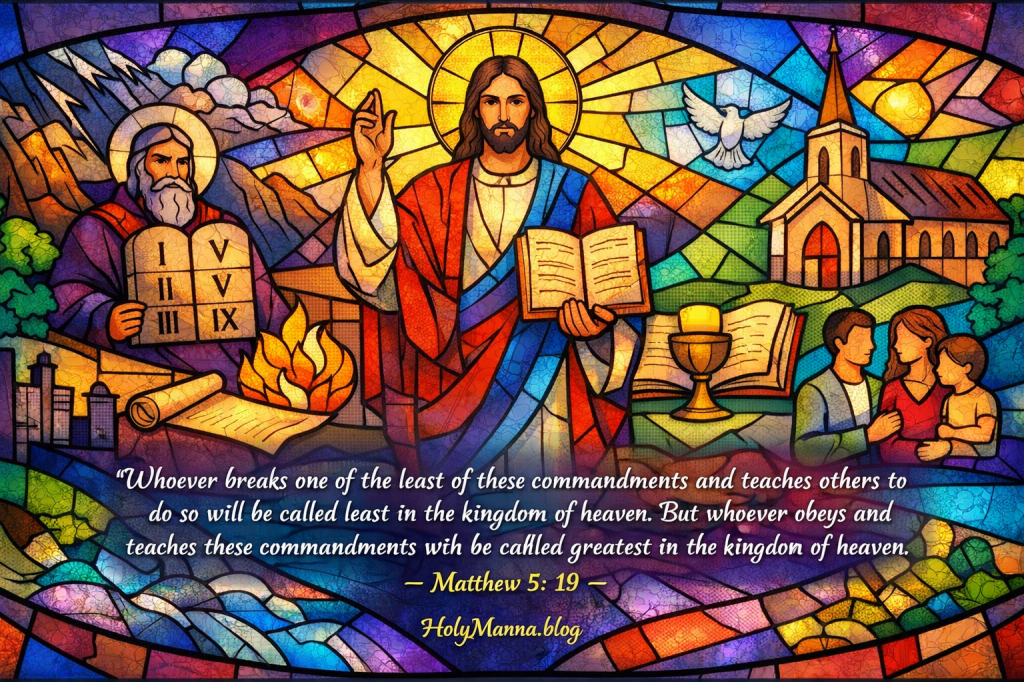
Teaching About the Law. 17 “Do not think that I have come to abolish the law or the prophets. I have come not to abolish but to fulfill. 18 Amen, I say to you, until heaven and earth pass away, not the smallest letter or the smallest part of a letter will pass from the law, until all things have taken place. 19 Therefore, whoever breaks one of the least of these commandments and teaches others to do so will be called least in the kingdom of heaven. But whoever obeys and teaches these commandments will be called greatest in the kingdom of heaven.
Detailed Exegesis
Verse 17 “Do not think that I have come to abolish the law or the prophets. I have come not to abolish but to fulfill.”
Jesus begins by correcting a suspicion before it spreads. Some might assume the Messiah would sweep away Israel’s sacred inheritance. Jesus says the opposite. He does not abolish the Law and the Prophets, which is a way of speaking about the whole of God’s revealed word in the Old Covenant. He fulfills them. Fulfillment does not mean watering down. Fulfillment means bringing something to its full purpose. The Law revealed God’s holiness and taught His people how to live as covenant sons and daughters. The Prophets called Israel back when hearts grew hard and worship became empty. Jesus fulfills both by embodying everything they pointed toward. He perfectly obeys the Father, reveals the true meaning of righteousness, and prepares to pour grace into the heart so that obedience becomes possible from the inside out.
Verse 18 “Amen, I say to you, until heaven and earth pass away, not the smallest letter or the smallest part of a letter will pass from the law, until all things have taken place.”
Jesus swears this with the solemn authority of “Amen, I say to you,” which is not casual speech. He is declaring permanence and seriousness. The image of the smallest letter and the smallest stroke points to the tiniest details of written Scripture. The point is not that every ceremonial practice will remain unchanged in the same way after Christ’s saving work. The point is that God’s word is not disposable and God’s moral will is not negotiable. Nothing God has revealed is meaningless. Everything is heading toward its completion in Christ, and nothing can be treated as irrelevant simply because it is inconvenient. This verse also exposes a common modern temptation. People often want the comfort of Jesus without the authority of Jesus. Christ will not be divided like that. The same Lord who saves is the Lord who teaches.
Verse 19 “Therefore, whoever breaks one of the least of these commandments and teaches others to do so will be called least in the kingdom of heaven. But whoever obeys and teaches these commandments will be called greatest in the kingdom of heaven.”
Jesus moves from principle to responsibility. He warns against breaking even “least” commandments and, even more, against teaching others to break them. That is a direct shot at casual scandal and casual theology, the kind that shrugs at sin and spreads excuses like they are compassion. Jesus is not saying that greatness in the kingdom is earned like a trophy. He is saying that love is proven by fidelity, and fidelity includes what is practiced and what is taught. The Christian life is never only private. Someone is always watching, learning, copying, and absorbing. A parent, a friend, a younger sibling in the faith, or even a coworker who has never said a word about religion can still be taking notes. Jesus praises the one who obeys and teaches, because that person shows that God’s word is not just admired. It is lived, guarded, and handed on.
Teachings
The Church reads this Gospel as a cornerstone text for understanding how Christians relate to God’s commandments. Jesus fulfills the Law by revealing its deepest aim and by giving the grace to live it. This is why Catholic teaching refuses two traps at once. The first trap is legalism, which tries to replace relationship with God by mere external compliance. The second trap is moral laxity, which tries to replace holiness with personal preference.
The Catechism speaks about the New Law, not as a cancellation of God’s moral truth, but as its interior power. It states, “Its principal precept is the new commandment to love one another as Christ has loved us.” CCC 1972 That matters because it shows what “fulfill” looks like. Christ does not reduce the commandments. He completes them by ordering everything toward charity, a charity that is not sentimental, but cruciform, truthful, and obedient.
The saints also speak with blunt clarity about the relationship between law and grace. St. Augustine expressed the logic of salvation in a line that has steadied Christian hearts for centuries: “For the Law was given that grace might be sought; and grace was given that the Law might be fulfilled.” This Gospel fits that perfectly. The Law teaches what is good. Christ gives grace so that goodness can actually be lived.
This is also why the Church has consistently taught that authentic Christian freedom is not the freedom to redefine good and evil. It is the freedom to do the good with joy and integrity because the heart is being healed. Lent becomes the season where that healing is welcomed again through prayer, fasting, almsgiving, and a serious return to confession, not as self-improvement projects, but as surrender to the One who fulfills the Law by remaking the heart.
Reflection
This Gospel forces a decision that cannot be delayed forever. Will Jesus be treated as a comforting spiritual symbol, or will He be received as Lord, meaning Teacher, Savior, and King? Many people struggle here because they have seen commandments used as weapons, so the instinct is to run. Others struggle because they have used commandments as shields, so the instinct is pride. Jesus exposes both and offers something better. He offers a life where obedience is not humiliation but love, and where love is not vague but real.
A practical way to live this today is to stop arguing with God’s word and start letting it examine the conscience. One small commandment that has been treated as “least” can reveal a whole pattern of compromise. A second practical step is to take seriously the part about teaching. The teaching might be done with words, but it is often done through tone, habits, and what is laughed off as normal. A third step is to ask for the grace to love in truth, because Christ does not merely demand holiness. He supplies what He commands through the life of grace, especially in the sacraments.
Which commandment has been quietly downgraded in daily life, not with open rebellion, but with excuses that have started to feel normal?
Who is being taught by example, whether intentionally or not, and what version of Christianity is being handed to them?
What would change if obedience was approached as a response to closeness, meaning the Lord is near enough to call upon and loving enough to guide?
When God Commands, He Invites You Closer
Today’s readings tell one clear story from three angles, and it is the kind of story Lent was made for. God does not speak to show off authority. God speaks because He is near, because He loves, and because He intends to lead His people into life. In Deuteronomy, Moses stands at the edge of the Promised Land and warns against the quiet disaster of forgetting. He presents God’s statutes as wisdom, justice, and the unmistakable sign of a Lord who is close enough to answer when called upon. In Psalm 147, the Church answers with praise, celebrating the God who strengthens what is vulnerable, blesses families, governs creation, and proclaims His word so His people are not left wandering in confusion. Then in The Gospel of Matthew, Jesus brings the whole theme into focus by declaring that He did not come to abolish the Law and the Prophets, but to fulfill them, which means God’s commandments are not discarded. They are completed in Christ and written into the heart through grace so that obedience becomes love lived from within.
The day’s key message is simple and demanding in the best way. God’s commandments are not a cage. They are a gift of closeness. They reveal what love looks like when it is grounded in truth. They protect the soul from the slow drift into spiritual amnesia. They form a life that becomes a witness even without loud words, because real fidelity has a quiet weight that other people can feel.
Lent is the perfect season to take this seriously and take one concrete step forward. A good place to start is to stop treating God’s word like background noise and begin treating it like a living voice that deserves attention. It can mean praying with the commandments instead of arguing with them. It can mean confessing the compromises that have been renamed as “normal.” It can mean choosing one act of obedience that costs something small, not to earn love, but to respond to it. It can also mean handing on the faith more intentionally, because Moses is right. What is not remembered will not be passed on, and what is not passed on eventually disappears.
God is not distant in these readings. God is near. God is speaking. God is inviting the heart to come back to Him, not just with feelings, but with a life that actually follows. The Lord who commands is the Lord who stays close, and the Lord who stays close is the Lord who leads His people into freedom that is real.
Engage with Us!
Readers are invited to share their reflections in the comments below, because faith grows stronger when it is spoken, tested, and encouraged in community, especially during Lent when God is calling hearts back to what is true and life giving.
- First Reading Deuteronomy 4:1, 5-9: Where has spiritual forgetfulness started to creep in, not through open rejection of God, but through distraction and neglect, and what is one concrete way to “be on your guard” this week?
- Responsorial Psalm Psalm 147:12-13, 15-16, 19-20: What would change in daily life if praise became a deliberate habit, and how might trusting God’s word strengthen the “gates” of the heart, meaning the boundaries that protect peace and purity?
- Holy Gospel The Gospel of Matthew 5:17-19: Which of God’s commandments has been treated as “least” in practice, and what would it look like to let Jesus fulfill that area through grace, so obedience becomes a real act of love instead of mere rule keeping?
Keep walking forward with confidence, because the Lord who teaches is the Lord who saves, and every step of fidelity is a step toward freedom. Let everything today be done with the love, truth, and mercy Jesus taught, so that even ordinary moments become acts of worship and quiet witness.
Sacred Heart of Jesus, we trust in You!
Immaculate Heart of Mary, pray for us!
Saint Michael the Archangel, defend us in battle!
Follow us on YouTube, Instagram and Facebook for more insights and reflections on living a faith-filled life.

 Holy Manna!
Leave a comment