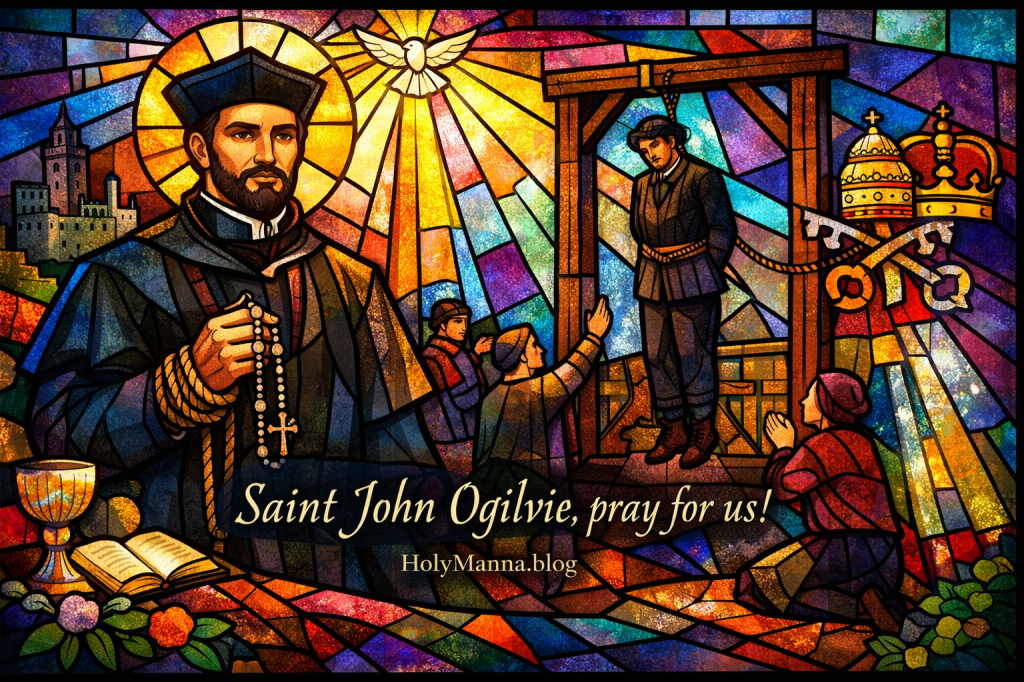
The Rosary at the Gallows
Saint John Ogilvie was a Scottish Jesuit priest who lived at a time when being a Catholic priest in Scotland meant living like a fugitive. He is remembered because he did not treat the Faith like a private hobby or a political badge. He treated it like reality, like the Church truly is the Body of Christ, like the sacraments truly are encounters with Jesus, and like no king, no court, and no threat could take away what belongs to God.
His story is not mainly about rebellion. It is about spiritual loyalty. He was willing to obey civil authority in what properly belongs to civil authority, but he refused to hand over the Church’s spiritual authority to the state. That is the line he would not cross, even when the cost was torture and death.
The Church calls martyrdom “the supreme witness given to the truth of the faith” in CCC 2473. John Ogilvie lived that definition in public, in the cold air of Glasgow, with a rope waiting.
A Hidden Catholic Thread in a Scottish Home
John Ogilvie was born in Scotland near Keith in Banffshire, around 1579. His upbringing was shaped by a tense religious landscape. Public life was officially Protestant, and families often felt pressure to conform. A striking detail in his story is that Catholic faith was not simply an abstract idea he stumbled upon later. There was a Catholic thread in his family line, even if it could not always be spoken aloud.
He was educated abroad as a teenager, which was common for families seeking strong schooling and opportunity. That decision changed everything, because Europe exposed him to Christianity’s great dividing line of the era: the question of whether the Catholic Church was truly the Church founded by Jesus Christ, or whether it had lost the Gospel and needed replacement.
When a Searching Mind Meets the Church
Ogilvie’s conversion was not a sudden emotional moment. It was a long wrestling match with truth. He studied in Protestant and Catholic settings, and he encountered the Catholic intellectual tradition at full strength. Eventually, he was received into the Catholic Church in Leuven under Jesuit guidance.
Then he did something that still surprises modern readers. He did not keep the Faith as a personal preference. He chose the priesthood, and not the comfortable kind. He entered the Society of Jesus, the Jesuits, a community known for discipline, learning, and mission.
This matters because his martyrdom can look like a quick tragedy, but it was built on years of preparation. He spent roughly two decades outside Scotland in formation and ministry, and then returned home for a mission that lasted less than a year before arrest. The public witness was brief, but the interior foundation was not.
A Priest in Disguise, A Church in Hiding
When Ogilvie returned to Scotland, he did not walk in like a celebrity preacher. He came in disguise, using an alias and presenting himself as a horse dealer. He moved carefully, because Catholic worship and priestly ministry were treated as crimes.
He served Catholics who had been starved of the sacraments. He heard confessions, reconciled people back to the Church, offered the Holy Sacrifice of the Mass in secret, and strengthened families who had been living under fear for generations.
This is one of the most practical lessons from his life. He understood that what Catholics need most is not merely religious talk. Catholics need Jesus Christ in the sacraments. That conviction is why he took the risk.
The Line He Would Not Cross
In October of 1614, Ogilvie was betrayed and arrested in Glasgow. What followed was meant to break him. He was interrogated and tortured. One of the most infamous methods used against him was prolonged sleep deprivation, often called “The Watching,” where a prisoner is kept awake night after night until the mind frays. Accounts also describe physical crushing of his legs and continual pricking to prevent sleep.
The goal was not only to get a confession. The goal was to get names, to make him betray the Catholics who had sheltered him. Ogilvie refused.
At trial, the decisive issue was spiritual authority. The state demanded that he acknowledge the king’s spiritual jurisdiction over the Church. Ogilvie would not. He was willing to be loyal in civil matters, but he would not pretend that the Church belongs to the Crown.
A line commonly preserved from his trial captures his position clearly: “In all that concerns the king, I will be slavishly obedient… But in the things of spiritual jurisdiction… I cannot and must not obey.”
That stance fits the Church’s teaching on conscience and civil authority. The Church teaches that citizens owe legitimate obedience to rightful authorities, yet “the citizen is obliged in conscience not to follow the directives of civil authorities when they are contrary to… the teachings of the Gospel” in CCC 2242. Ogilvie’s “no” was not political swagger. It was Catholic conscience.
The Rope at Glasgow Cross
On March 10, 1615, John Ogilvie was executed at Glasgow Cross. Accounts preserve words attributed to him from the scaffold, sharp and uncompromising, reflecting the religious conflict of his time: “If there be here any hidden Catholics, let them pray for me but the prayers of heretics I will not have.”
Those words can sound jarring today, but they reveal the intensity of a man facing death with a conscience that would not bend. In that moment, he was not trying to be liked. He was trying to die faithful.
Ogilvie’s death also carried another detail that stayed lodged in Catholic memory. He had a rosary with him, and tradition holds that he cast it into the crowd. That small act became a symbol of his legacy: a martyr does not only die. A martyr plants something.
The Miracles and Echo After Death
After his death, Ogilvie’s body was buried quickly, and the exact location did not become a stable site of relic veneration. In other words, he did not leave behind famous relics that could be carried from shrine to shrine. What he left behind was something else: testimony, conversion stories, and a name that would not disappear.
One of the strongest “after” stories connected to him is the conversion associated with that rosary. A hostile onlooker, remembered in Catholic accounts as John Eckersdorff, later described the moment as a spiritual wound that did not heal until it turned into faith. This story is deeply rooted in Catholic retellings of Ogilvie’s martyrdom, but the exact historical details are not always verifiable in the way modern readers might want, so it should be received as a strong tradition rather than a laboratory-proven fact. It cannot be fully verified.
The major miracle tied to Ogilvie is far more concrete in Catholic memory because it was investigated for canonization. In the twentieth century, a Glasgow man named John Fagan suffered from advanced cancer. After prayers for Ogilvie’s intercession and devotion connected to him, Fagan’s cancer reportedly disappeared in a way later judged medically inexplicable after years of investigation. This healing was accepted by the Church as the miracle associated with Ogilvie’s canonization.
Ogilvie was beatified in 1929 and canonized in 1976. His veneration remains especially alive in Glasgow, where a national shrine honors him and keeps his witness in the heart of Scottish Catholic life. He is also remembered with feast day observances connected to March 10, the day of his martyrdom, and in some calendars October 14, the day of his arrest.
His cultural impact is quiet but real. He is often described as the only canonized Scottish martyr of the Reformation era. That makes him a singular figure, not because Scotland lacked holy Catholics, but because his cause became a public signpost for the Church’s endurance through persecution.
A Martyr’s Message for Modern Catholics
Saint John Ogilvie does not belong only to history books. He belongs to every Catholic who feels pressured to shrink the Faith down to something private, silent, and safe.
His life asks a hard question in a gentle way. Where has comfort trained the heart to compromise? Ogilvie shows that the Faith is not maintained by intensity alone, but by clarity. He knew what belonged to Caesar and what belonged to God. He would not let the state rewrite the Church.
There is a very practical way to imitate him without needing a prison cell. Build a life that makes sense if the Faith is true. Go to confession regularly. Stay close to the Eucharist. Pray the rosary when life gets loud and messy. Speak about the Faith with charity, but do not apologize for the Church’s claims. When pressure rises at work, in friendships, or online, remember the simple apostolic logic: “We must obey God rather than men.” Acts 5:29.
Ogilvie’s courage was not a personality trait. It was grace strengthened by practice. Catholics do not drift into fidelity. Fidelity is chosen, again and again, in small moments that prepare the soul for the big ones.
The Courage to Belong Fully to Christ
Saint John Ogilvie’s story is not only about dying well. It is about living well before the crisis arrives. He learned to belong to Jesus Christ completely, and he learned to belong to the Church without bargaining.
This is where his witness becomes a roadmap for daily life. When culture tries to redefine faith as private opinion, Catholics can respond with calm confidence. When anxiety rises, Catholics can respond with prayer. When sin tempts, Catholics can respond with confession and conversion. When fear whispers that silence is safer, Catholics can respond with charity and truth.
What would change if the Faith was treated like it is real, not merely meaningful? That question is not meant to crush anyone. It is meant to free the heart. A real Jesus changes real choices.
Engage with Us!
Share your thoughts and reflections in the comments below.
- Where does daily life pressure the soul to “keep faith private,” and what would it look like to respond with peaceful courage?
- What is one practical way to strengthen conscience this week through prayer, confession, or a more serious commitment to Sunday Mass?
- When has God used suffering, discomfort, or opposition to purify faith and make it clearer?
- What does obedience to God look like in a specific situation right now at home, at work, or online?
Keep walking forward in faith. Choose truth with humility, choose courage with charity, and do everything with the love and mercy Jesus taught, because that is how saints are made, one faithful decision at a time.
Saint John Ogilvie, pray for us!
Follow us on YouTube, Instagram and Facebook for more insights and reflections on living a faith-filled life.

 Holy Manna!
Leave a comment