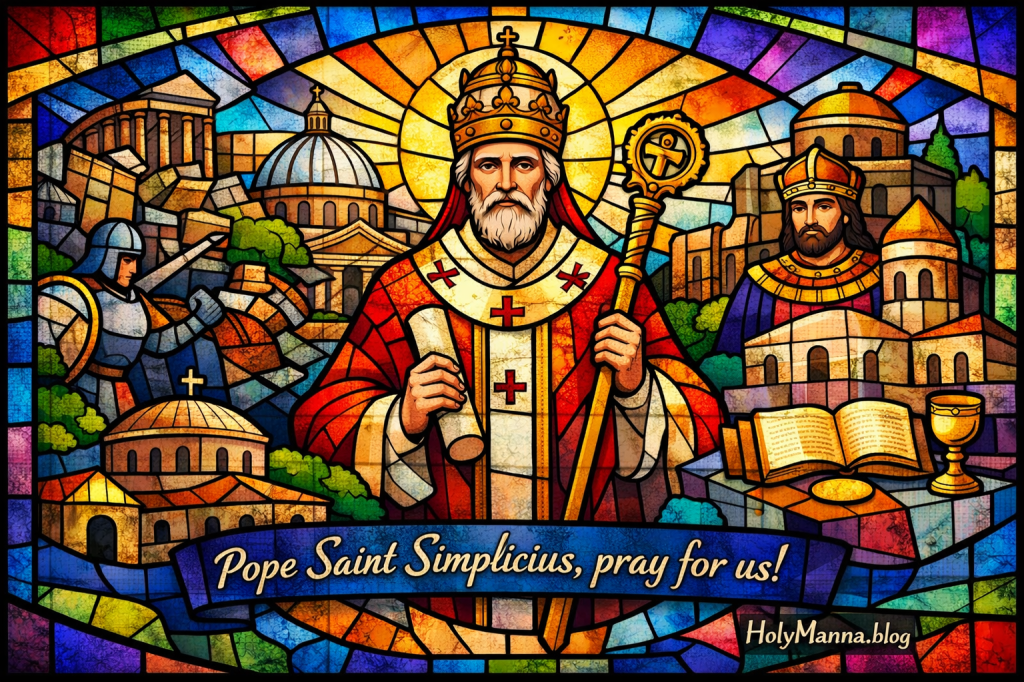
When the Empire Fell and the Church Stood
If a person ever wonders what the Church looks like when everything around her is falling apart, Pope Saint Simplicius is a perfect answer. He was the Bishop of Rome at a moment when the Western Roman Empire cracked and finally collapsed, when political leaders rose and fell like waves, and when the faithful needed the steady voice of Peter more than ever. He is remembered not for spectacle, but for courage that refuses to panic, and for a faith that refuses to negotiate what God has revealed.
Simplicius is revered because he guarded the truth about Jesus Christ, strengthened the Church’s unity, and kept the sacramental life of Rome alive while the world was changing right under everyone’s feet. His holiness shines with the kind of light that is easy to miss if people only look for drama, but impossible to forget once they see it.
From Tivoli to the Chair of Peter
Simplicius came from Tivoli, not far from Rome, and the ancient record preserves the name of his father as Castinus. Details about his childhood are scarce, which is common for early popes, but Catholic tradition remembers him as a respected Roman cleric before his election. He lived and served in a Church still glowing with the memory of Pope Saint Leo the Great, and he inherited a world that would not stay stable for long.
His “conversion” story is not told in the way some saints have a single dramatic turning point. Instead, his life shows the quieter kind of conversion that never ends, the steady deepening of a man who keeps saying yes to God until he is ready for responsibilities he never could have planned. When he was elected pope in A.D. 468, he stepped into a role that would demand spiritual clarity and a backbone made of prayer.
The Church He Protected
To understand what Simplicius is most known for, it helps to remember what the Church was fighting to protect in his day. The biggest theological battle was not an abstract argument. It was about Jesus Himself. Was Jesus truly God and truly man, or could His humanity be minimized, blurred, or swallowed up by confusion?
The Church’s teaching, proclaimed at the Council of Chalcedon (A.D. 451), defended what Christians had always believed: Jesus Christ is one divine Person with two natures, fully God and fully man. This is not a technical detail. This is the reason salvation is real. If Christ is not truly man, then humanity is not truly healed. If Christ is not truly God, then the Cross is not truly victorious. The Church continues to teach this clearly in CCC 464-469.
Simplicius spent much of his pontificate defending that Chalcedonian faith against political pressure and theological compromise. He lived in an age when emperors sometimes tried to “manage” doctrine for the sake of peace. Simplicius understood something every Catholic needs to understand today. Unity is a gift, but it cannot be bought with ambiguity. Peace is precious, but it cannot be purchased by softening the truth.
He also defended the authority and responsibility of the Apostolic See. The Pope is not a religious celebrity or a political figure. The Pope is a father charged with strengthening the brethren, a visible sign of unity for the whole Church, as the Church teaches in CCC 880-882. Simplicius did not treat that mission like a title. He treated it like a duty before God.
A Life of Faithfulness
Simplicius reigned from A.D. 468 to A.D. 483, and his life as pope reads like a long lesson in spiritual endurance. During his pontificate, the Western Roman Empire fell in A.D. 476. Rome changed rulers, and an Arian king, Odoacer, became the dominant political power in Italy. In the middle of that upheaval, the Church did not collapse, because the grace of Christ does not depend on an empire.
Simplicius worked to keep the Church’s life organized and accessible. He arranged for clergy to serve the great Roman basilicas outside the city walls so that worship, baptism, and penitential discipline would not be neglected. He strengthened Church governance beyond Rome by appointing a papal representative in Spain, a practical act that helped keep communion with Rome strong across distance and instability. He also defended proper ecclesial order when local disputes threatened to turn into power grabs.
Catholic sources do not preserve a set of verified miracle stories performed by Simplicius during his lifetime in the way some saints are remembered. That does not weaken his sanctity. It highlights a different kind of wonder. His life shows the miracle of steadiness. It shows what happens when a man is faithful, day after day, when the world is loud and the Church needs clarity.
Even his building efforts preached without words. He is associated with the establishment or dedication of churches in Rome, including the famous round church known as Santo Stefano Rotondo. He also supported sacred worship with liturgical gifts, an expression of the Church’s conviction that the liturgy is not an accessory, but the heartbeat of Catholic life.
Courage Without Compromise
Simplicius was not martyred, but he did not have an easy life. He faced pressure from political authorities and theological factions at the highest level. In the East, emperors rose and fell, and religious policy shifted with them. When Basiliscus seized power, he pushed an anti-Chalcedonian agenda, pressuring bishops to reject what the Church had defined. Simplicius resisted, calling for fidelity to the faith the Church had received.
When Emperor Zeno returned, the situation did not simply become peaceful. Egypt and Alexandria were torn by rival claimants and doctrinal conflict. Simplicius fought to prevent non-Chalcedonian leaders from being recognized as legitimate shepherds. Late in his pontificate, a political document known as the Henotikon attempted to unify factions through carefully chosen ambiguity. This is one of the most surprising realities of Church history for modern readers. Sometimes the greatest threat is not open persecution. Sometimes it is a “peace deal” that asks the Church to speak less clearly about Jesus.
Simplicius refused that bargain. A short line from his correspondence captures his conviction about the Petrine responsibility. “The Lord entrusted the care of the entire flock”. His leadership was not driven by ego or rivalry. It was driven by the belief that Christ Himself protects the Church, and that the Pope must never treat revealed truth like a political tool.
Another line attributed to his communication with Emperor Zeno shows the kind of world he was navigating, where the freedom of faith was tangled up with the stability of civil power. “Your empire has been restored alongside the freedom of the Catholic faith.” Simplicius was not flattering an emperor for fun. He was pushing for a world where the Church could breathe, teach, and sanctify without being bullied into doctrinal compromise.
He also insisted that the Church does not pretend her own councils were mere suggestions. “What was settled by their definition cannot be reconsidered.” That sentence belongs in the modern Catholic vocabulary too, because it is the opposite of the spirit of the age. The world loves to renegotiate everything. The Church guards what she has received.
Rome Remembers, the Church Endures
Simplicius died in A.D. 483 and was buried at St. Peter’s. Even after his death, his story stayed tangled with the question every age faces in one form or another. Who gets to control the Church? After his passing, an attempt was made by civil authority to influence papal elections, as if the Bishop of Rome could be selected only with political permission. The Church resisted that idea, because the Church belongs to Christ.
Miracle stories attached to Simplicius after death are not prominent in the standard tradition in the way that some saints have a long trail of healings and dramatic interventions. When a story is not preserved, it should not be invented. What is clearly preserved is veneration, liturgical remembrance, and the enduring imprint of his pontificate on the life of Rome. People can still walk into places tied to the Roman Church’s ancient memory and sense that these saints were not imaginary. They were real fathers in real crises.
His feast is commonly commemorated on March 10 in modern listings, and older tradition also connects him to March 2. That detail is not just trivia. It shows how deeply rooted his memory is in the Church’s calendar, even across centuries of liturgical development.
Simplicius’ cultural impact is not about festivals or folklore. It is about Catholic continuity. He represents the Church’s calm refusal to be reshaped by collapsing societies and shifting powers. He is a saint for anyone who feels like the ground is moving under their feet, and wonders whether the faith can still stand.
A Reflection for Catholics Living in Loud Times
Pope Saint Simplicius is a reminder that holiness is not only for the heroic moment. Holiness is for the long season. It is for the steady protection of truth, the patient defense of unity, and the refusal to let the world redefine Jesus.
His life teaches that the Church does not survive by clever marketing or political alliances. The Church survives because Christ is alive, because the sacraments are real, and because the Holy Spirit keeps the faith intact through shepherds willing to suffer pressure rather than betray clarity.
In daily life, this can be lived in simple and concrete ways. A person can guard the truth about Christ by learning the faith and refusing to treat doctrine like opinion. A person can protect unity by resisting gossip and division, especially within the Church. A person can keep the sacramental life central by choosing Mass, confession, and prayer even when life feels unstable. A person can practice courage by speaking clearly about Jesus without being harsh, and by remaining charitable without becoming vague.
The world loves comfort, but Simplicius loved Christ. The world loves compromise, but Simplicius loved clarity. That is why the Church calls him saint.
Engage With Us!
Share thoughts and reflections in the comments below. The Church needs living witnesses who can talk about the saints like real fathers, because that is exactly what they are.
- Where is life feeling unstable right now, and what would it look like to respond with the calm faith of Pope Saint Simplicius?
- How can the truth about Jesus Christ, fully God and fully man, shape the way suffering and temptation are faced this week, in light of CCC 464-469?
- Is there any place where “keeping the peace” has tempted compromise, and how can clarity be practiced with charity instead?
- What is one concrete step that can be taken to protect the sacramental life of the home, such as confession, Sunday Mass, or a consistent prayer rule?
May Pope Saint Simplicius teach every reader to live a life of faith in changing times, and may every act, public or hidden, be done with the love and mercy Jesus taught us.
Pope Saint Simplicius, pray for us!
Follow us on YouTube, Instagram and Facebook for more insights and reflections on living a faith-filled life.

 Holy Manna!
Leave a comment