Tuesday of the Third Week of Lent – Lectionary: 238
When Mercy Becomes the Only Currency Left
Some days in Lent feel like walking through heat that cannot be escaped, the kind that reveals what is real because everything fake burns off. That is the atmosphere of today’s liturgy. The central theme tying these readings together is simple and demanding: God receives the sinner who returns with a contrite heart, and that mercy must immediately become the mercy shown to others.
The prayer from The Book of Daniel rises from a brutal moment in Israel’s story, when God’s people are exiles living under a pagan empire, surrounded by idols, and stripped of the familiar supports of worship. Azariah stands in the fire and prays not like a man bargaining with God, but like a man who knows he has nothing left to bring except honesty. His cry is not a performance, because the flames make performance impossible. It is the prayer of a people who have learned what sin does, how it scatters a nation, silences prophets, and leaves the heart hungry for God again. In that furnace, the offering is no longer bulls or incense, but repentance and trust, because God never despises a heart that truly turns back.
Psalm 25 answers that fire-prayer with the voice of a believer who is done pretending. It asks for guidance, for cleansing, for a new beginning, and it leans hard on something older than personal failure: the Lord’s compassion, the mercy that is “ages old.” The psalm teaches that God does not merely tolerate the humble sinner. God actively teaches the humble sinner, because humility is the door that opens when pride finally collapses.
Then The Gospel of Matthew brings the theme to its sharpest edge. Mercy is not only something to beg for in prayer. Mercy becomes a debt of love that must be paid forward. Peter’s question about limits gets answered with a number that breaks the calculator, and Jesus seals it with a story where one man is forgiven an impossible debt and then refuses to forgive a small one. The warning is not meant to crush a wounded heart. It is meant to wake up a hardened heart. Lent is not only about admitting sin. Lent is about letting God’s forgiveness rewire the soul so completely that resentment no longer gets to rule the house.
Where is the furnace in life right now, the place where excuses are finally running out and only honesty is left? Who is the person carrying a smaller debt, while God has already erased a mountain? Today’s readings prepare the heart for a very Catholic kind of freedom: the freedom of repentance that trusts God’s covenant love, and the freedom of forgiveness that proves mercy was truly received.
First Reading – Daniel 3:25, 34-43
When All the Usual Offerings Are Gone, God Still Wants the Heart
This prayer comes from one of the most intense scenes in The Book of Daniel: the three faithful young men of Israel standing in a pagan empire that demanded worship of its idols. They refuse. They are thrown into a furnace. And right there, in the place where fear should have the final word, Azariah opens his mouth and prays.
There is an important layer of history behind the words. Israel knew what it meant to be scattered, humbled, and stripped of the public worship that shaped their identity. Exile meant more than losing a homeland. It meant the collapse of the ordinary religious life that kept the covenant alive in daily habits. That is why this reading sounds like a holy ache. It is the prayer of a people who cannot fix what they broke, who cannot offer what they used to offer, and who can only cling to the mercy of God for the sake of His promises.
That is exactly why this reading fits today’s theme so perfectly. Lent is the season when the Church teaches the soul to stop pretending it can purchase God’s favor. Azariah does not bring a bargain. He brings repentance. He brings humility. He brings trust. And this is the foundation for everything else today, because the mercy God pours out on the contrite heart is meant to become mercy poured out through that heart.
Daniel 3:25, 34-43 – New American Bible (Revised Edition)
25 Azariah stood up in the midst of the fire and prayed aloud:
34 For your name’s sake, do not deliver us up forever,
or make void your covenant.
35 Do not take away your mercy from us,
for the sake of Abraham, your beloved,
Isaac your servant, and Israel your holy one,
36 To whom you promised to multiply their offspring
like the stars of heaven,
or the sand on the shore of the sea.
37 For we are reduced, O Lord, beyond any other nation,
brought low everywhere in the world this day
because of our sins.
38 We have in our day no prince, prophet, or leader,
no burnt offering, sacrifice, oblation, or incense,
no place to offer first fruits, to find favor with you.
39 But with contrite heart and humble spirit
let us be received;
As though it were burnt offerings of rams and bulls,
or tens of thousands of fat lambs,
40 So let our sacrifice be in your presence today
and find favor before you;
for those who trust in you cannot be put to shame.
41 And now we follow you with our whole heart,
we fear you and we seek your face.
Do not put us to shame,
42 but deal with us in your kindness and great mercy.
43 Deliver us in accord with your wonders,
and bring glory to your name, O Lord
Detailed Exegesis
Verse 25 – “Azariah stood up in the midst of the fire and prayed aloud:”
Azariah does not wait for the fire to cool down. He prays inside the trial. This is already a kind of conversion. A person can suffer and still stay turned inward, bitter, and self-protective. Azariah suffers and turns outward toward God. This is what real faith looks like when it is tested. It is not a calm life. It is a heart that still reaches for the Lord when everything is burning.
Verse 34 – “For your name’s sake, do not deliver us up forever, or make void your covenant.”
Azariah appeals to God’s Name and God’s covenant, not Israel’s performance. In the Bible, God’s “name” is not a label. It represents His revealed identity and His fidelity. The covenant is not a fragile contract that collapses when Israel fails. It is God’s enduring promise, which Israel can only return to through repentance. This verse teaches a deeply Catholic instinct: when sin has made a mess, the safest place to stand is not on personal merit but on God’s faithfulness.
Verse 35 – “Do not take away your mercy from us, for the sake of Abraham, your beloved, Isaac your servant, and Israel your holy one,”
Azariah prays like a son of the covenant family. He calls on the patriarchs because God’s saving plan is historical and relational. The prayer leans on the story God already wrote. It is the voice of someone saying, “Lord, remember what You began.” Catholics hear in this the shape of salvation history that culminates in Christ. God’s mercy is not an abstract idea. It is a living commitment that runs through generations.
Verse 36 – “To whom you promised to multiply their offspring like the stars of heaven, or the sand on the shore of the sea.”
This verse remembers God’s promise in Genesis, where the covenant is anchored in God’s initiative. Azariah is doing what the faithful always do in Scripture: bringing God’s own words back to Him in prayer, not to manipulate Him, but to cling to hope when circumstances scream despair.
Verse 37 – “For we are reduced, O Lord, beyond any other nation, brought low everywhere in the world this day because of our sins.”
This is the moment where excuses die. Azariah does not blame Babylon first. He confesses Israel’s sin. The furnace becomes a mirror. This is not self-hatred. It is truth. And truth is the doorway to mercy. The Church calls this interior repentance, the kind that names sin without theatricality, and that finally stops defending what cannot be defended.
Verse 38 – “We have in our day no prince, prophet, or leader, no burnt offering, sacrifice, oblation, or incense, no place to offer first fruits, to find favor with you.”
The prayer describes spiritual poverty. No leadership. No public worship. No temple life. No visible “tools” that usually carry religious identity. This is why the reading hits so hard in Lent. Many people recognize this feeling even without exile. There are seasons where prayer feels dry, where life feels disordered, where the soul feels like it has nothing to bring. This verse teaches that the absence of external offerings does not cancel the possibility of returning to God. It strips the heart down to what really matters.
Verse 39 – “But with contrite heart and humble spirit let us be received; As though it were burnt offerings of rams and bulls, or tens of thousands of fat lambs,”
Here is the turning point. Israel cannot offer what it used to offer, but it can offer what God has always wanted: contrition and humility. This does not reject true worship. It purifies worship. God never wanted ritual without repentance. This verse echoes the biblical truth that God desires the heart, not religious theater. The language is sacrificial because the heart is being placed on the altar.
Verse 40 – “So let our sacrifice be in your presence today and find favor before you; for those who trust in you cannot be put to shame.”
Azariah asks that this interior sacrifice be accepted “today,” meaning now, in this moment, not after life gets tidy. This is the urgency of conversion. Trust is not presented as a mood. It is presented as a decision to place the soul under God’s mercy even when the situation remains unresolved.
Verse 41 – “And now we follow you with our whole heart, we fear you and we seek your face.”
This verse describes what repentance looks like from the inside. It is not merely regret. It is a return. To “seek God’s face” is to desire His presence and approval more than the approval of idols, crowds, or kings. Holy fear here is not panic. It is reverence. It is the awakening of the heart to the reality that God is God, and life is meant to be lived before Him.
Verse 42 – “Do not put us to shame, but deal with us in your kindness and great mercy.”
Azariah asks for mercy, not humiliation. He knows shame can either crush a person into despair or drive a person into God’s arms. This verse chooses the second path. It is also a confession that God’s kindness is not sentimental. It is powerful. It rescues. It restores.
Verse 43 – “Deliver us in accord with your wonders, and bring glory to your name, O Lord.”
The final request lifts the prayer above survival. Azariah wants God’s glory. This is the mature end of repentance: not simply “get me out,” but “Lord, show who You are.” In a furnace, that is an act of faith that refuses to believe suffering has the last word.
Teachings
This reading is one of the clearest biblical portraits of interior conversion. It teaches that when sin has emptied the hands, God still welcomes the soul that returns with humility. The Catechism describes this kind of repentance in words that match Azariah’s posture in the fire: CCC 1431 says, “Interior repentance is a radical reorientation of our whole life, a return, a conversion to God with all our heart, an end of sin, a turning away from evil, with repugnance toward the evil actions we have committed. At the same time it entails the desire and resolution to change one’s life, with hope in God’s mercy and trust in the help of his grace.” This is exactly what Azariah models. There is confession of sin, there is a turning of the heart, and there is hope anchored in mercy.
Azariah also teaches what sacrifice becomes when outward religion is stripped away. Scripture has always insisted that the heart is the true altar. The line that harmonizes with this reading is from Psalm 51, a truth every Catholic should have memorized because it protects the soul from fake religion: “A clean heart create for me, O God.” and “A broken spirit; a broken, contrite heart, O God, you will not despise.” When Azariah says, “With contrite heart and humble spirit let us be received,” he is living that psalm inside the furnace.
Saints and Doctors of the Church repeatedly return to this biblical logic: God does not reject sacrifice, but God rejects sacrifice that is disconnected from conversion. That is why Lent is never just about giving something up. Lent is about giving the heart back. When the heart comes home, then worship becomes truthful again, charity becomes possible again, and forgiveness becomes realistic again. The Gospel later today will demand mercy from the forgiven, but this reading shows where mercy begins: with the sinner who stops defending himself and starts trusting God.
Reflection
Azariah’s prayer is for anyone who feels spiritually underpowered right now. It is for the person who has regrets and cannot undo them. It is for the person who realizes how much damage sin can do, not only to personal peace but to the ability to pray with confidence. It is also for the person who wants to return to God but feels embarrassed because life is not in order yet.
The first step is simple but not easy. The heart has to stop bargaining. God is not impressed by polished speeches. God receives humility. A practical way to live this reading is to bring one honest sentence into prayer today, spoken plainly, without drama, and without excuses. The second step is to connect repentance to trust. Azariah does not confess sin to spiral into shame. He confesses sin to lean harder on mercy. The third step is to let this prayer reshape how daily life is handled. When the mind replays failures, it can either become a courtroom or become a confessional. Lent trains the soul to choose the confessional, where truth is spoken and mercy does not flinch.
Where has sin reduced life lately, not only in obvious actions, but in the quieter ways like impatience, resentment, or spiritual laziness? What would change if the heart stopped waiting for the perfect moment and prayed instead, right in the middle of the heat? If God is asking for a “contrite heart and humble spirit” today, what specific pride needs to be surrendered so mercy can actually enter?
Responsorial Psalm – Psalm 25:4-9
The Road Back to God Begins with Being Teachable
In Israel’s prayerbook, the Psalms are not polite poems. They are real human words offered to a real God, often spoken by people who know they have wandered and need to come home. Psalm 25 is a classic prayer of conversion because it does not start with self-confidence. It starts with a request to be taught. In a culture where covenant fidelity shaped everything, asking God to “teach” His ways was not an academic hobby. It was a plea for survival, because God’s “ways” are the path of life, and sin is always a detour that costs more than expected.
That is why this psalm sits so naturally beside Azariah’s prayer in The Book of Daniel. Both are spoken from spiritual poverty. Both admit the need for mercy. Both place hope not in personal perfection but in the Lord’s ancient compassion. And that prepares the heart for the hard mercy of The Gospel of Matthew, because the person who begs God, “Remember me according to your mercy,” cannot honestly refuse mercy to someone else.
Psalm 25:4-9 – New American Bible (Revised Edition)
4 Make known to me your ways, Lord;
teach me your paths.
5 Guide me by your fidelity and teach me,
for you are God my savior,
for you I wait all the day long.
6 Remember your compassion and your mercy, O Lord,
for they are ages old.
7 Remember no more the sins of my youth;
remember me according to your mercy,
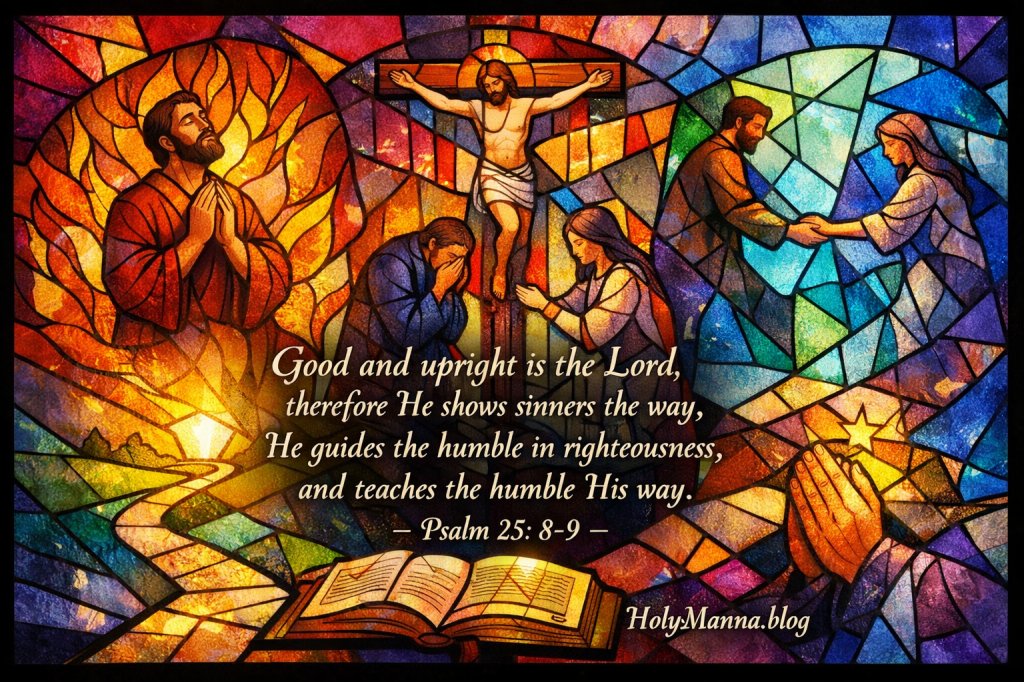
because of your goodness, Lord.8 Good and upright is the Lord,
therefore he shows sinners the way,
9 He guides the humble in righteousness,
and teaches the humble his way.
Detailed Exegesis
Verse 4 – “Make known to me your ways, Lord; teach me your paths.”
This is the beginning of repentance that actually changes a life. The psalmist does not say, “Approve my plan.” He says, “Show the plan.” God’s “ways” are not simply rules. They are the pattern of life that flows from God’s own goodness. This verse is the soul admitting it can be sincerely religious and still lost. Lent is meant to make people teachable again, because pride always acts like it already knows the route.
Verse 5 – “Guide me by your fidelity and teach me, for you are God my savior, for you I wait all the day long.”
The word “fidelity” matters. The psalmist does not ask to be guided by moods, public opinion, or personal impulses. He asks to be guided by God’s faithfulness, meaning God’s steady covenant love that does not wobble. Waiting “all the day long” describes perseverance, the kind of prayer that keeps showing up even when nothing feels dramatic. This is how conversion becomes stable. It becomes a daily dependence on God as Savior, not as a spiritual accessory.
Verse 6 – “Remember your compassion and your mercy, O Lord, for they are ages old.”
This verse reaches back into salvation history. God’s mercy is not a new idea that shows up when humans behave. It is “ages old,” meaning it is woven into who God is and how He has acted from the beginning. The psalmist is appealing to the deepest thing about God, and that is a very Catholic instinct. God’s mercy is not sentimental permission to stay in sin. It is the power that rescues sinners who come home.
Verse 7 – “Remember no more the sins of my youth; remember me according to your mercy, because of your goodness, Lord.”
Here the prayer gets personal. “Sins of my youth” are not always childish mistakes. They can be patterns that shaped the heart: old lusts, old arrogance, old resentments, old selfish habits that still try to steer the wheel. The psalmist does not deny them. He asks God not to “remember” them, which in biblical language means he is begging God not to treat him according to them. Then comes the key line: “remember me according to your mercy.” This is not the sinner demanding a clean record as a right. This is the sinner asking to be defined by God’s goodness rather than by his worst chapters.
Verse 8 – “Good and upright is the Lord, therefore he shows sinners the way,”
This is one of the most hopeful lines in the whole psalm. The Lord is good and upright, and precisely because of that, He does not abandon sinners in confusion. He shows them the way. God’s goodness is not only moral purity. It is the active goodness that seeks the lost and points them home. That is why the Church never preaches repentance as despair. Repentance is hopeful because God instructs sinners instead of discarding them.
Verse 9 – “He guides the humble in righteousness, and teaches the humble his way.”
This verse teaches a spiritual law that shows up everywhere in Scripture. God guides the humble. Pride blocks guidance because pride refuses to be corrected. Humility receives guidance because humility can admit, “This is not working. Something has to change.” The psalm does not say God teaches the impressive, the loud, or the self-justifying. It says God teaches the humble. That is why humility is not weakness. It is the posture that makes growth possible.
Teachings
This psalm is practically a map of Catholic prayer in Lent: ask, wait, repent, and trust mercy. The Catechism describes prayer in a way that fits Psalm 25 line for line. CCC 2559 says, “Prayer is the raising of one’s mind and heart to God or the requesting of good things from God.” The psalm does both. It raises the heart to God, and it requests a great good: guidance, mercy, and a reformed life.
The psalm also reveals why humility is so central to conversion. Humility is not pretending to be worse than reality. Humility is agreeing with reality so God can heal it. When the psalm repeats “teach me,” it is showing the inner attitude that makes repentance more than a temporary emotional moment. It becomes a willingness to be led.
In the tradition of the Church, these lines have always been heard as the voice of a penitent preparing for worship and for mercy. That is why the theme “teach me your paths” belongs to the Church’s Lenten rhythm. Lent is not only about feeling sorry. Lent is about being re-formed, re-taught, and re-directed so the Christian can live like someone who has truly been forgiven. That connection matters today because the Gospel will demand a merciful heart. Psalm 25 shows where that merciful heart begins: a person who knows he needs mercy and asks God to reshape him.
Reflection
This psalm speaks to the person who wants to be holy but keeps getting stuck in the same ruts. It also speaks to the person who is tired of old memories and old shame, especially the “sins of youth” that still whisper accusations. The psalm does not teach denial. It teaches direction. It teaches the soul to ask God for a path, and then to walk it patiently, even when feelings lag behind obedience.
A practical way to live this psalm today is to turn one line into a real daily prayer before the day gets noisy. A person can say, “Make known to me your ways, Lord; teach me your paths,” and then pause long enough to mean it. Another concrete step is to bring the past into God’s mercy without rehearsing it like a self-punishment. The psalm does not say, “Forget me because I am terrible.” It says, “Remember me according to your mercy, because of your goodness.” That is a spiritual habit worth practicing, especially when tempted to spiral.
This psalm also quietly prepares the heart for forgiveness. People who constantly remember the sins of others usually struggle to believe God has truly “remembered no more” their own sins. Letting God define the soul by mercy is what makes it possible to extend mercy without feeling like it is surrendering to injustice.
Where does the heart need to become teachable again, especially in a habit, a relationship, or a recurring temptation? What would change if the day began by asking God for His path instead of demanding that God bless a preferred path? Is the past being carried like a chain, when God is inviting the soul to be remembered according to mercy instead of shame?
Holy Gospel – Matthew 18:21-35
Mercy That Stops at the Throat Was Never Mercy That Reached the Heart
This Gospel lands like a Lenten wake up call because it takes forgiveness out of the category of “nice spiritual advice” and places it right where Jesus always places discipleship, in the heart, in the will, and in eternity. Peter asks a fair question in a culture where many teachers spoke of forgiveness with limits, and he even tries to sound generous. Jesus answers with a number that is meant to break the calculator, because the kingdom is not built on keeping score.
There is also a deeper biblical echo running under Jesus’ words. The Old Testament remembers a man named Lamech who bragged about limitless vengeance, and Jesus deliberately flips that logic. In the kingdom of heaven, the “limitless” is not retaliation. The “limitless” is mercy. That is why this Gospel fits today’s theme so tightly. Daniel shows a contrite heart begging for mercy in the fire. Psalm 25 shows a humble sinner begging to be taught and remembered according to mercy. Now Jesus insists that anyone who has been forgiven by God must become a person who forgives others from the heart. This is not a side quest. This is the straight road of Lent.
Matthew 18:21-35 – New American Bible (Revised Edition)
21 Then Peter approaching asked him, “Lord, if my brother sins against me, how often must I forgive him? As many as seven times?” 22 Jesus answered, “I say to you, not seven times but seventy-seven times. 23 That is why the kingdom of heaven may be likened to a king who decided to settle accounts with his servants. 24 When he began the accounting, a debtor was brought before him who owed him a huge amount. 25 Since he had no way of paying it back, his master ordered him to be sold, along with his wife, his children, and all his property, in payment of the debt. 26 At that, the servant fell down, did him homage, and said, ‘Be patient with me, and I will pay you back in full.’ 27 Moved with compassion the master of that servant let him go and forgave him the loan. 28 When that servant had left, he found one of his fellow servants who owed him a much smaller amount. He seized him and started to choke him, demanding, ‘Pay back what you owe.’ 29 Falling to his knees, his fellow servant begged him, ‘Be patient with me, and I will pay you back.’ 30 But he refused. Instead, he had him put in prison until he paid back the debt. 31 Now when his fellow servants saw what had happened, they were deeply disturbed, and went to their master and reported the whole affair. 32 His master summoned him and said to him, ‘You wicked servant! I forgave you your entire debt because you begged me to. 33 Should you not have had pity on your fellow servant, as I had pity on you?’ 34 Then in anger his master handed him over to the torturers until he should pay back the whole debt. 35 So will my heavenly Father do to you, unless each of you forgives his brother from his heart.”
Detailed Exegesis
Verse 21 – “Then Peter approaching asked him, ‘Lord, if my brother sins against me, how often must I forgive him? As many as seven times?’”
Peter calls Jesus “Lord,” which is already the right posture, but the question reveals a temptation that still lives in every age. The temptation is to treat forgiveness like a quota. Peter’s “seven times” sounds heroic, but it still assumes forgiveness ends at a certain number, as if mercy can be exhausted.
Verse 22 – “Jesus answered, ‘I say to you, not seven times but seventy-seven times.’”
Jesus is not giving a new quota. Jesus is removing the whole logic of quotas. The point is a heart that chooses mercy again and again, because it lives from the mercy of God.
Verse 23 – “That is why the kingdom of heaven may be likened to a king who decided to settle accounts with his servants.”
Jesus frames the parable as a window into the kingdom. “Settling accounts” is judgment language. It is not meant to make the faithful paranoid. It is meant to make disciples honest.
Verse 24 – “When he began the accounting, a debtor was brought before him who owed him a huge amount.”
The servant is not casually behind on a payment. He is drowning. Jesus sets the stage for a debt that cannot be solved by human effort, which quietly mirrors the spiritual truth that sin creates a debt a person cannot repay alone.
Verse 25 – “Since he had no way of paying it back, his master ordered him to be sold, along with his wife, his children, and all his property, in payment of the debt.”
This reflects the harsh realities of the ancient world, where debt could lead to a form of servitude. Jesus is not praising the system. Jesus is showing the hopelessness of the servant’s situation. The debt is so crushing that it threatens everything.
Verse 26 – “At that, the servant fell down, did him homage, and said, ‘Be patient with me, and I will pay you back in full.’”
The servant’s promise is unrealistic, but the posture is revealing. He falls down and begs. This is the beginning of repentance, even if the words still assume self-salvation. A sinner often begins by begging for time, and mercy meets him there.
Verse 27 – “Moved with compassion the master of that servant let him go and forgave him the loan.”
This is the turning point. The king forgives because he is moved with compassion. Mercy begins in the heart of the king, not in the skill of the servant. This is how God forgives, not because the sinner becomes impressive, but because God is merciful.
Verse 28 – “When that servant had left, he found one of his fellow servants who owed him a much smaller amount. He seized him and started to choke him, demanding, ‘Pay back what you owe.’”
The contrast is the whole lesson. The forgiven man becomes violent over a small debt. The choking is not just physical. It symbolizes what resentment does spiritually. It grabs people by the throat, and it blocks mercy from flowing through the heart.
Verse 29 – “Falling to his knees, his fellow servant begged him, ‘Be patient with me, and I will pay you back.’”
The second servant repeats the same plea that the first servant used. This repetition is intentional. Jesus is holding up a mirror. The forgiven man is now staring at his own past posture, and he cannot recognize himself.
Verse 30 – “But he refused. Instead, he had him put in prison until he paid back the debt.”
This is the anatomy of an unforgiving heart. It refuses mercy and chooses punishment. It prefers control over compassion. It would rather lock someone up than be vulnerable to mercy.
Verse 31 – “Now when his fellow servants saw what had happened, they were deeply disturbed, and went to their master and reported the whole affair.”
Even other servants recognize the ugliness of it. An unforgiving spirit scandalizes the community because it contradicts the mercy that should define the king’s household.
Verse 32 – “His master summoned him and said to him, ‘You wicked servant! I forgave you your entire debt because you begged me to.’”
The king names the problem clearly. The servant is “wicked” not because he needed mercy, but because he received mercy and then acted as if mercy meant nothing.
Verse 33 – “Should you not have had pity on your fellow servant, as I had pity on you?’”
This is the moral logic of the kingdom. Mercy received becomes mercy owed. It is not optional. It is the expected fruit of having encountered the king’s compassion.
Verse 34 – “Then in anger his master handed him over to the torturers until he should pay back the whole debt.”
The parable uses severe imagery because Jesus is dealing with a severe spiritual danger. An unforgiving heart locks itself into a prison of its own making. The “whole debt” returns because the servant has rejected the only path that could keep him free, which is living inside the mercy he received.
Verse 35 – “So will my heavenly Father do to you, unless each of you forgives his brother from his heart.”
Jesus removes any remaining distance between story and soul. This is not about polite words or forced smiles. This is about the heart. Forgiveness “from the heart” means the will chooses mercy, refuses revenge, and entrusts justice to God, even when feelings lag behind.
Teachings
This Gospel sits right on top of the Lord’s Prayer and makes it unavoidable. The Church teaches that asking God for forgiveness while refusing to forgive is spiritually incoherent. The Catechism states this plainly in CCC 2838: “Now and this is daunting this outpouring of mercy cannot penetrate our heart as long as we have not forgiven those who have trespassed against us.” The point is not that God is stingy. The point is that an unforgiving heart becomes sealed shut, and grace does not force open what pride insists on locking.
The Church goes even further and insists that forgiveness is not merely a moral suggestion but a participation in the very mercy of God. The Catechism says in CCC 2840: “Now and this is daunting this outpouring of mercy cannot penetrate our heart as long as we have not forgiven those who have trespassed against us. Love like the Body of Christ is indivisible we cannot love the God we cannot see if we do not love the brother or sister we do see.” This is the nerve of Jesus’ warning. The refusal to forgive is not a small flaw. It is a rupture in charity that contradicts the life of Christ.
This is why the saints preach so fiercely about mercy. Saint John Chrysostom presses the point with a short line that cuts through self-justification: “Not to others are we cruel, but to ourselves.” He is describing what resentment does. It feels like strength, but it becomes a self-inflicted prison.
Saint Augustine ties this Gospel to the daily prayer Christians dare to speak. CCC 2842 quotes him, and the line is worth carrying into Lent because it forces honesty: “This petition is so important that it is the only one expanded and developed in the Lord’s Prayer.” Forgiveness is expanded because it is where many disciples collapse. It is also where God wants to set people free.
Historically and spiritually, the Church has always heard this Gospel as a call to live sacramentally and morally in the same direction. Confession is not a loophole that allows hatred to remain. Confession is a school of mercy that trains the heart to forgive because it has been forgiven.
Reflection
This Gospel does not ask for naivety, and it does not ask anyone to pretend wounds are not real. It does insist that disciples cannot nurse vengeance and still call themselves followers of a merciful King. Lent is the season when God exposes the ways the heart still grabs people by the throat, sometimes with words, sometimes with cold silence, sometimes with endless replaying of the offense like a private movie that keeps anger alive.
A practical first step is to name the “small debt” being clutched right now. It could be disrespect, betrayal, neglect, criticism, or an old humiliation that still stings. Naming it honestly before God matters because vague resentment is hard to heal, but a named wound can be offered to mercy. A second step is to choose one concrete act of forgiveness that does not depend on feelings. That could mean praying for the person’s good, refusing to speak about them with contempt, or surrendering the desire to see them suffer. A third step is to reconnect forgiveness to the mercy already received. Many people struggle to forgive because they secretly believe they are still paying for their own sins. When a person lives as if the “huge debt” was not truly forgiven, the heart tightens, and mercy becomes scarce.
Who is being held by the throat in the heart right now, even if the face stays polite? What would change if the soul believed that God truly forgave the “huge amount” and expects that same mercy to flow outward? Is the refusal to forgive protecting anything good, or is it quietly building a prison that keeps peace out and keeps bitterness in?
From the Furnace to the Father’s Heart
Today’s readings move like one clear story with three scenes, and each scene asks for the same conversion. In The Book of Daniel, Azariah prays from the fire with nothing left to offer except repentance and trust, and he dares to believe that God receives a broken heart as a true sacrifice. In Psalm 25, the voice of a sinner becomes teachable again and asks the Lord for a path, because mercy is not only a pardon, it is guidance that leads a person out of old patterns and back into the light. Then in The Gospel of Matthew, Jesus takes the mercy God gives and makes it the mercy a disciple must live. The king forgives a crushing debt, and the servant’s failure is not weakness but refusal, the refusal to let received mercy become given mercy.
Put together, the message is steady and personal. God does not wait for life to become impressive before offering compassion. God receives the contrite heart today. God teaches the humble today. God forgives the sinner today. And because God’s mercy is real, it cannot stay trapped inside a heart that still wants to choke a brother with resentment. The mercy that saves also reshapes. That is the point of Lent. God is not only trying to cancel a debt. God is trying to change the kind of person who walks away from the throne.
This is a good day to choose one concrete step that makes the readings real. It could be a humble confession of sin spoken plainly in prayer, without excuses and without despair. It could be a deliberate return to God’s path by asking, “Teach me your ways, Lord,” and then obeying one small prompt of conscience. It could be the hardest step of all, releasing someone from the grip of the heart, not because the wound was small, but because the King’s mercy was bigger. The call to action is simple and brave: bring a contrite heart to God, let Him teach the way forward, and then prove that mercy was received by practicing mercy from the heart.
What would change this week if repentance became less about shame and more about trust in God’s kindness? What relationship would begin to heal if forgiveness stopped being a scorecard and became an act of discipleship? This Lent, God is offering more than a religious reset. God is offering a new heart, the kind of heart that survives the furnace and still looks like the Father.
Engage with Us!
Readers are invited to share reflections in the comments below, especially any moment from today’s readings that brought conviction, comfort, or a new desire to begin again.
- First Reading, Daniel 3:25, 34-43: Where is life feeling like a furnace right now, and what would it look like to offer God a truly contrite heart and humble spirit in that exact place? Is there a specific sin, habit, or attitude that needs to be named honestly so mercy can meet it?
- Responsorial Psalm, Psalm 25:4-9: What “path” is the Lord inviting the heart to walk in today, especially in an area where pride has resisted being taught? How can the prayer “Remember me according to your mercy” reshape the way the past is carried and the way the future is faced?
- Holy Gospel, Matthew 18:21-35: Who is the person the heart is still gripping, even quietly, with resentment, coldness, or a desire for payback? What is one concrete act of forgiveness “from the heart” that can be chosen today, even if feelings have not caught up yet?
Keep walking forward in faith, even when the road feels hot and heavy. God receives the humble, guides the teachable, and strengthens the merciful. Let every word, decision, and relationship be shaped by the love and mercy Jesus taught, so the world can see what the kingdom of heaven looks like in ordinary life.
Sacred Heart of Jesus, we trust in You!
Immaculate Heart of Mary, pray for us!
Saint Michael the Archangel, defend us in battle!
Follow us on YouTube, Instagram and Facebook for more insights and reflections on living a faith-filled life.

 Holy Manna!
Leave a comment