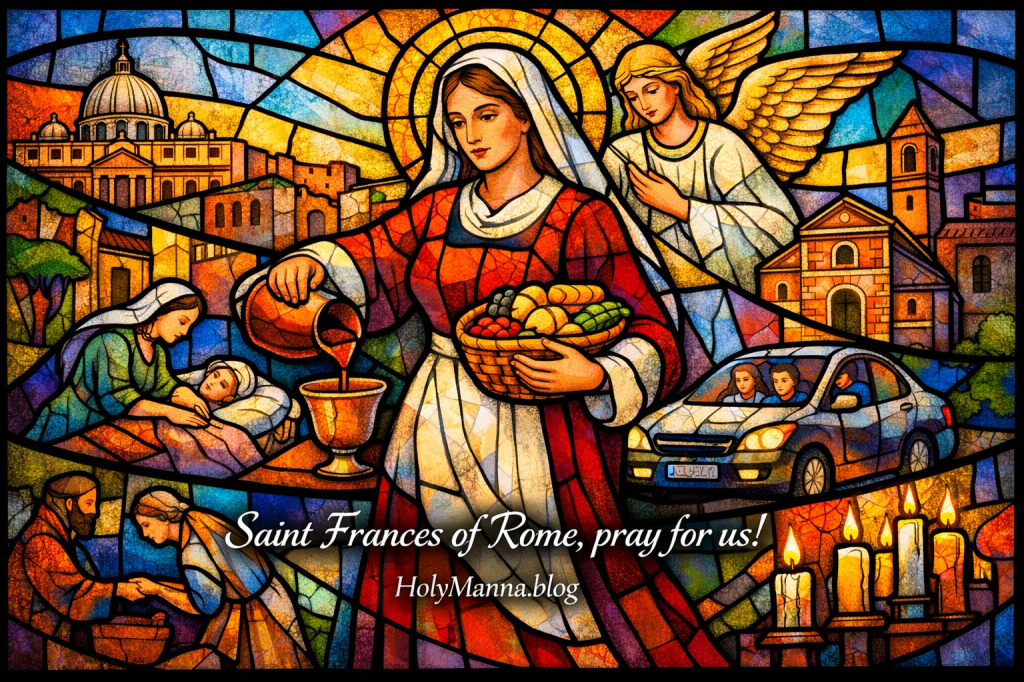
The Saint Who Found God in the Kitchen and on the Streets of Rome
Rome can feel like the kind of city that never sleeps. In Saint Frances of Rome’s day, it also felt like a city that never stopped bleeding. Politics churned, sickness spread, families lost everything overnight, and even the Church’s unity was tested in painful ways. In the middle of that noise and instability, God raised up a saint who did not run away from ordinary life. She sanctified it.
Saint Frances of Rome is revered because she proves something many people quietly doubt. Holiness is not reserved for monks and missionaries. Holiness can be lived by a wife, a mother, a widow, and a woman who spends her day juggling chores, grief, service, and prayer. The Church remembers her as a mystic, a servant of the poor, the foundress of a community of oblates, and a woman known for deep devotion to her guardian angel. Her life is a living reminder that the Christian path is not about escaping your responsibilities. It is about letting Christ enter them and transform them from the inside out.
A Girl Who Wanted the Cloister, and the Lord Gave Her a Home
Frances was born in Rome in 1384, into a noble family. Even as a child, she was drawn to prayer and a life totally given to God. She desired religious life, which makes her story immediately relatable to anyone who has ever had a holy desire and then watched God lead them into something they did not plan.
Her father arranged her marriage when she was still very young, around the age most modern people can barely imagine as a bride. She married Lorenzo Ponziani, a Roman nobleman, and began a life that looked, on the outside, like a typical upper class household. But God was building a saint in the place many people least expect to find one: inside marriage and family life.
That is already a Catholic lesson worth pausing on. The Church teaches that marriage is a real vocation and a real path to holiness, not a lesser plan for people who could not “make it” into religious life. God calls spouses to help each other become saints through faithful love, sacrifice, and openness to life, all lived in Christ (CCC 1603-1658). Frances did not become holy by ignoring her duties. She became holy by offering them to God.
The Domestic Church Turned Into a House of Mercy
Frances became a wife and mother in a Rome that kept getting hit by tragedy. Illness swept through the city, and war and political violence shook families. She experienced the kind of suffering that purifies faith, including the death of children, the threat of famine, and the collapse of security that wealth usually promises.
What made her stand out was not that she had an easy life. What made her stand out was what she did with a hard life. She chose works of mercy with a steady, almost stubborn love. She cared for the sick, served the poor, and gave generously, even when it cost her comfort and reputation. In Catholic life, works of mercy are not extra credit for the extremely devout. They are part of the normal shape of Christian love (CCC 2447).
Her charity was not soft sentiment. It was action. When the poor needed food, she gave food. When the sick needed care, she showed up. When Rome felt unsafe, she did not hide behind locked doors. She walked into the suffering because she believed Christ was there. The Gospel makes that logic unmistakable when Jesus identifies Himself with the needy, saying “I was hungry and you gave me food, I was thirsty and you gave me drink, a stranger and you welcomed me” (Mt 25:35). Frances lived as if that was literally true, because it is.
Wonders in the Middle of Ordinary Life
Saint Frances of Rome is remembered not only for charity but also for miracles and mystical gifts. Catholic tradition speaks of ecstasies and visions, and especially of her devotion to her guardian angel. Her story became closely tied to angelic protection because many accounts say she experienced her guardian angel’s presence in an unusually vivid way, even guiding and protecting her through the dangers of the city. The Church teaches that God’s providence often includes the help of angels, and that each faithful person is aided by a guardian angel (CCC 336).
Several miracle stories have been passed down about her life, and they reveal something important about how God works through saints. The miracles are not presented like party tricks. They are signs of God’s mercy, often connected to the needs of the poor.
One well known story describes a moment of famine. Frances gave away food and supplies until the household stores were basically gone. Her generosity looked reckless to anyone who thinks charity must always keep a safety margin. She prayed, and the story says the corn bin and the wine barrel were found replenished. This miracle story cannot be independently verified in every detail, but it has been preserved for centuries in Catholic retellings, and it fits the kind of sign God often grants through saints: the miracle serves mercy, and mercy points back to God.
Another striking story comes from older hagiographies. Frances tried to pray while being constantly pulled away by household duties. When she returned, the story says she found the verse she had been praying completed in a beautiful way, described as “letters of gold.” This story cannot be verified with modern documentation, but it has long been told to highlight a spiritual point that is deeply Catholic: God is not offended by duties of love. God is present in them.
There is also a severe, surprising detail found in older biographies that describe her penance and “memento mori” spirituality. One account says she used a human skull as a cup as a reminder of death and the need for conversion. That specific claim cannot be verified, and it should not be treated as required belief. Still, it shows how seriously medieval saints took the Gospel call to live with eternity in view, remembering that life is short and judgment is real (Heb 9:27).
The Quiet Heroism of Endurance
Frances did not suffer persecution in the classic martyr sense, but she endured a different kind of hardship that is still very real. Rome’s conflicts led to upheaval, and her family experienced violence and loss. Accounts describe times when property was confiscated, the household was threatened, and loved ones were harmed. Her husband Lorenzo suffered severe injury during these turbulent years, and she carried the burden of caring for him through long illness.
Here is what makes her endurance so powerful. She did not become bitter. She did not turn inward. She kept serving. That is a saintly kind of resilience, and it is deeply Catholic because it mirrors Christ. The Cross is not only something to admire from a distance. The Cross becomes a pattern for daily life, especially when suffering comes through responsibilities that cannot be abandoned.
Later, with Lorenzo’s consent, Frances embraced a form of continence within marriage, living in a deeper dedication to prayer while still remaining faithful to her state in life. That kind of sacrifice is not a rejection of marriage. It is a choice some couples have embraced in the tradition, by mutual agreement, for spiritual reasons, and it shows the seriousness with which she pursued holiness while honoring her vocation.
The Oblates of Tor de’ Specchi
Frances’ holiness was not only personal. It became communal. Over time, other women were drawn to her way of life, a blend of prayer, penance, and organized charity. This spiritual family became what is known as the Oblates of Tor de’ Specchi, associated with Benedictine spirituality. Their life was distinctive. They were not strict cloistered nuns, yet they lived a stable commitment to God, prayer, and service.
This matters because it shows the Church’s genius for creating forms of life that fit real human needs. God called Frances to build something that allowed women to dedicate themselves to prayer and mercy in a way that was deeply Catholic and deeply Roman. The city shaped the charism, and the charism served the city.
Frances died on March 9, 1440. Tradition holds that she died while praying the Office of the Blessed Virgin Mary, which is a fitting end for a woman who lived in steady devotion. After her death, devotion spread rapidly. Stories of favors and healings at her body were reported, and her veneration grew over time. Many of these posthumous miracle stories cannot be verified today, and honesty demands saying that clearly. Still, they are part of her received Catholic legacy, and they point to what the Church teaches about the communion of saints: the saints intercede, and God continues to pour grace through their witness (CCC 956).
Her memory is woven into Rome itself. She is honored as a patroness of the city, even called an advocate for Rome, and her name is linked to one of Rome’s beloved churches near the Roman Forum. Her monastery at Tor de’ Specchi is also part of her enduring story, a place associated with her community and the continuation of her charism.
Protector on the Road
One of the most charming and unexpected parts of Saint Frances of Rome’s legacy is her connection to drivers and motorists. Catholic tradition connects that patronage to her devotion to her guardian angel and to stories of angelic guidance. In modern times, devotion expressed itself publicly in a way that feels very Roman and very human: a tradition of blessing vehicles around her feast day. That practice is not superstition. It is a sacramental instinct. Catholics bless objects and places because everything belongs to God, and because daily life, including travel and work, should be placed under the Lord’s protection.
Her cultural impact is not limited to cars and roads, though that is the detail many people remember. Her real impact is that she became a model for Catholics who want to be faithful without pretending life is simple. She is the saint for people who love God but also have laundry, deadlines, family responsibilities, and grief. She is the saint for people trying to pray without becoming unrealistic.
A famous line traditionally attributed to her captures that perfectly: “A married woman must leave God at the altar to find Him in her domestic cares.” This saying is widely repeated in Catholic devotional tradition, and while the exact historical origin of the wording is difficult to verify, the spiritual truth of it matches the Church’s understanding of vocation and the sanctification of daily life.
How to Find God in Our Daily Lives
Saint Frances of Rome teaches that holiness is not fragile. It does not break the moment life gets busy. Holiness deepens when faith is lived in the real world, where love is proven by sacrifice. Her story invites a hard but freeing question. Is prayer treated like an escape from duties, or is prayer treated like fuel for love?
This saint also challenges the modern temptation to romanticize spirituality. A person does not need a perfect routine, perfect silence, or perfect conditions to become holy. Frances became holy in a noisy city, during chaos, while managing a home, while burying loved ones, and while serving people who could not repay her.
Her life encourages practical spiritual habits that still work today. A person can receive the sacraments regularly, especially Confession and the Eucharist. A person can choose one concrete work of mercy each week, even if it is small, because love grows by being practiced. A person can ask for the help of a guardian angel before driving, before a difficult conversation, or before walking into a hard day, trusting God’s providence (CCC 336). A person can also stop postponing charity until life feels stable, because saints like Frances show that mercy is often most needed when life is unstable.
Most of all, she teaches that God is not only found in church, though He is truly present there. God is also found in the faithful duties of your vocation, when those duties are carried with love, patience, and the steady intention to serve Christ in others.
Engage with Us!
Share your thoughts and reflections in the comments below. What part of Saint Frances of Rome’s story stayed with you, and what part felt uncomfortably close to home?
- Where does daily life most often pull you away from prayer, and how might God be inviting you to find Him in that duty instead of resenting it?
- What is one concrete work of mercy you can practice this week that actually costs something, even if it only costs time or comfort?
- Do you ask for the help of your guardian angel, especially before travel or stressful moments, and what would change if you began doing that consistently?
- When suffering enters your life through family, work, or responsibilities, what would it look like to carry it with the calm strength Saint Frances of Rome showed?
Keep moving forward in faith. Keep choosing prayer that leads to mercy, and mercy that leads back to prayer. Live like the Gospel is true, and do everything with the love and mercy Jesus taught, because that is how saints are made in the real world.
Saint Frances of Rome, pray for us!
Follow us on YouTube, Instagram and Facebook for more insights and reflections on living a faith-filled life.

 Holy Manna!
Leave a comment