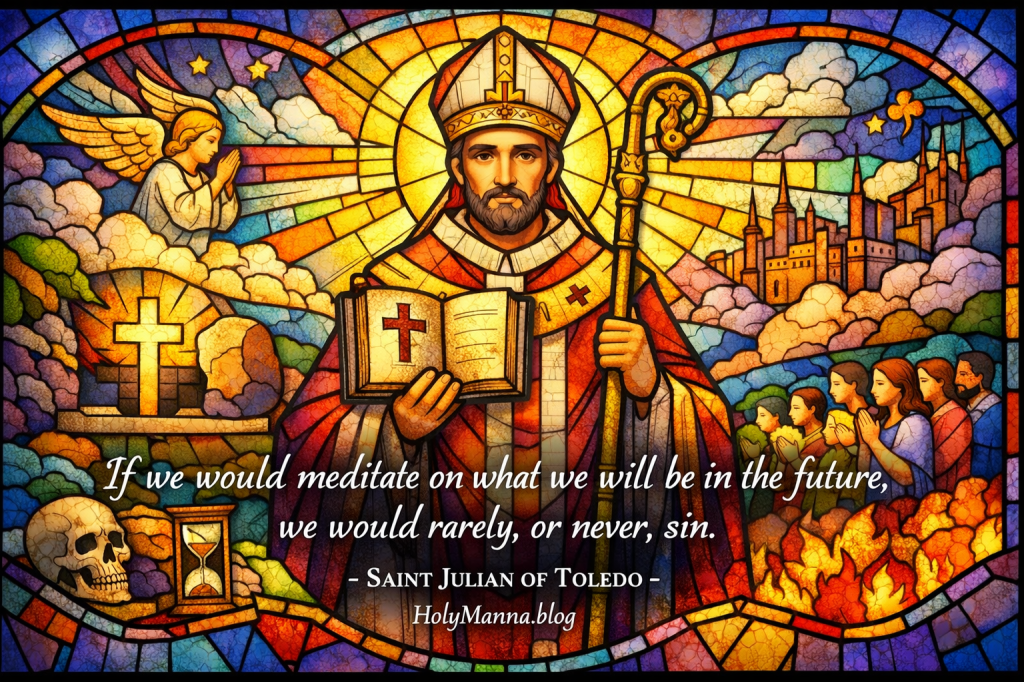
The Bishop Who Taught Spain to Remember Eternity
Saint Julian of Toledo lived in seventh century Spain, in a world where kings rose and fell quickly, councils debated hard questions, and ordinary people still had to find bread for the table and hope for the soul. Julian became Archbishop of Toledo and was honored by the Church as a confessor, which means he did not die a martyr’s death, but he lived a life of heroic fidelity to Christ.
He is remembered for three things that still matter today. He was a pastor who loved his people in real crises, including seasons of hunger and instability. He was a builder of the Church’s unity through councils and disciplined leadership. He was also a teacher who helped generations of Catholics think clearly about death, judgment, the purification of souls, and the resurrection of the body, themes that the Church holds close when she teaches about the last things in CCC 1030-1032.
Julian’s life is a reminder that holiness is not only found in dramatic martyrdom. Holiness is also found in patient governance, deep prayer, careful teaching, and charity that costs something.
From School to the Weight of the Mitre
Julian was formed in Toledo itself. He was baptized and educated at the cathedral, which means his faith was not a weekend hobby. It was the air he learned to breathe. He studied under the leaders of the Toledo church and grew into a cleric known for discipline and wisdom.
There is a beautiful human detail preserved about him. Julian shared a close friendship with another cleric named Gudila, a friendship described in the spirit of the early Church, the kind of bond that looks less like networking and more like sanctity. It was the kind of friendship that makes a man steadier when the world gets loud.
Like many saints, Julian seems to have had a desire for a quieter path, something like the peace of monastic life. Providence had other plans. He was drawn into public service in the Church, and eventually he was chosen as Archbishop of Toledo in 680. The story that follows is not the story of a man chasing power. It is the story of a man carrying a burden because the Church needed him to carry it.
Julian is most known for his leadership of the Church in Visigothic Spain, his guidance through major councils of Toledo, his contribution to the liturgical tradition associated with Toledo, and his writings, especially a major work on the world to come.
Charity in a Hard Land and Wisdom for a Confused Age
Julian’s years as archbishop were not a peaceful retirement gig. Spain faced political tension, ecclesial controversies, and seasons of suffering among the people. Accounts of his episcopate emphasize his pastoral care, especially his charity when hardship struck. In an age that could be brutal, he is remembered as a bishop who did not keep the poor at arm’s length.
He also worked to strengthen the Church’s order and unity through councils. Councils in that era were not academic conferences. They shaped discipline, worship, and public Christian life. Julian helped hold the line for orthodox teaching and Church stability when instability would have been the easier option.
His greatest intellectual legacy is his treatise on the last things, Prognosticum futuri saeculi, written in three parts, treating death, the state of souls before the resurrection, and the final resurrection. If the modern world tries to ignore death, Julian insists on facing it with Christian realism and hope. The Church does the same, teaching that death is real, judgment is real, and mercy is real, and that for those who die in God’s friendship there can be a final purification before entering the joy of Heaven, as taught in CCC 1030-1032.
Julian even offers a line that hits with the blunt kindness of a spiritual father. “If we would meditate on what we will be in the future, we would rarely, or never, sin.” That is not morbid. That is sobriety. It is the kind of sobriety that frees a man from silly temptations and reminds him that every choice has weight.
In his prayerful writing, he also speaks with the longing of a pilgrim who knows this world is not the final home. “You are the only Way… my heart sighing for the return to its homeland.” That kind of longing is not escapism. It is the heartbeat of Catholic hope.
As for miracles during his lifetime, the early Catholic sources that preserve his life focus far more on his virtues, reforms, charity, and teaching than on stories of spectacular signs or healings. Because no specific miracle accounts are reliably preserved in those sources, no miracle narratives can be responsibly told here without inventing details.
When the Shepherd Walks into the Storm
Julian’s story includes a surprising moment where theology and royal politics collided. A king named Wamba fell gravely ill, and Julian administered penance and the monastic habit. After Wamba recovered, he did not resume his kingship in the same way, and the kingdom moved on under a new ruler. Later tradition treats this episode as complicated, and it is precisely the kind of moment that reminds modern readers that saints sometimes have to act in situations where not every human motive around them is pure.
Julian also faced theological tensions involving Rome. The important Catholic point is this. He defended what he believed to be true, he engaged the concerns raised, and he remained within the Church’s orthodox faith and communion. That matters for Catholics today who are tempted to treat disagreement as an excuse for division. Julian’s model is firmness without schism.
Julian was not a martyr, so his sanctity is not sealed in blood. It is sealed in perseverance. It is the quiet heroism of staying faithful when leadership is exhausting and when the Church needs a steady hand more than she needs a dramatic headline.
The Church He Strengthened
Julian died on March 6, 690, after about a decade as archbishop, and he was buried in Toledo at the basilica associated with Saint Leocadia. His memory endured especially in Spain, and his influence traveled through his writings and liturgical work. While many saints are remembered through healings at a tomb, Julian is remembered through something just as powerful, the spiritual architecture he helped build in the Church’s mind and prayer.
His work on the last things shaped medieval theology and devotional life, especially Catholic reflection on prayer for the dead. The Church teaches that the faithful can help the souls undergoing purification through prayer and especially through the Holy Sacrifice of the Mass, a truth bound up with the communion of saints in CCC 946-962 and the Church’s teaching on purgatory in CCC 1030-1032. Julian’s voice belongs to that living tradition of prayerful realism.
There is also a line associated with him that later theologians, including Saint Thomas Aquinas, used when discussing purgatory’s purification. “If the incorporeal spirit is held by the body, why shall it not be held after death by a corporeal fire?” Catholics should read that kind of statement in the Church’s balanced teaching, which insists that purification is real, mercy is real, and that all of it is ordered toward union with God, not toward fear for fear’s sake.
As for miracle stories after his death, no specific posthumous miracle narratives are consistently preserved in the standard early Catholic accounts of Julian’s life that are commonly cited. Because of that, there are no concrete miracle stories that can be repeated here without speculation. The safest and most faithful Catholic approach is to honor what the sources actually give: a saint whose intercession is trusted by the Church, and whose enduring impact came through teaching, worship, and pastoral courage.
His feast is commonly associated with early March, with some calendars placing him on March 6 in connection with his death, and other older devotional traditions sometimes placing him on March 8. In Toledo, local remembrance has also been connected with the date of his episcopal consecration. The details vary by calendar tradition, but the point stays the same: the Church remembers him because his life bore lasting fruit.
The Julian Way
Saint Julian offers a strong remedy for modern spiritual drift. He teaches Catholics to remember eternity without becoming weird about it. He teaches Catholics to take sin seriously without despairing. He teaches Catholics to pray for the dead because love does not stop at the grave, and the Church remains one family in Christ, as taught in CCC 946-962.
A practical way to imitate Julian is to recover the habit of examining life in the light of death and resurrection. That does not mean obsessing over darkness. It means refusing to live shallow. It means asking what kind of man or woman will stand before Christ with peace.
Julian also models fidelity to the Church when Church life is complicated. He lived through political pressure and theological disputes and still chose unity, discipline, and service. That is a very needed witness in a time when many people treat the Church like a commentary section rather than the Body of Christ.
And there is one more quiet lesson. Julian wanted a simpler life, but he accepted the life God actually gave him. That is where many people today get stuck. Holiness is not found in the fantasy vocation. Holiness is found in obedience, charity, and truth inside the life already in front of you.
What would change this week if eternity felt more real than anxiety, more real than temptation, and more real than the need to impress anyone?
Engage With Us!
Share your thoughts and reflections in the comments below. The community learns when Catholics speak honestly about what God is doing in their lives.
- Where does life feel most rushed or shallow right now, and how could remembering death and resurrection bring clarity instead of fear?
- Who is one person, living or deceased, that needs prayer today, and how can that prayer become a real act of love rather than a quick habit?
- What is one temptation that would lose its grip if eternity felt more concrete, and what practical boundary could be put in place this week?
- How can truth and unity be held together in daily life, especially when conversations about the Church get heated?
May Saint Julian pray for the Church, for families, and for all who feel overwhelmed by the noise of the age. May his witness help hearts live with sobriety and hope. Keep walking forward in faith, and do everything with the love and mercy Jesus taught us.
Saint Julian of Toledo, pray for us!
Follow us on YouTube, Instagram and Facebook for more insights and reflections on living a faith-filled life.

 Holy Manna!
Leave a comment