The Broken Road That Became a Hospital for Christ
Saint John of God is one of those saints who makes people stop and stare, because his life looks messy at first and then suddenly it becomes unmistakably holy. He is remembered as a founder of Catholic “hospitality,” which is not just being polite or generous, but welcoming the suffering as if Christ Himself walked through the door. He is beloved because he refused to treat the sick poor like problems to manage. He treated them like persons to love.
The Church honors him as a patron of the sick, hospitals, and caregivers, and his spiritual family still serves around the world through the Hospitaller Order of Saint John of God. His story also has a surprising edge. He was once mistaken for insane, locked up, and mistreated. God used that humiliation to form a man who would insist on dignity for those nobody wanted to touch.
A Life Spent Searching
He was born in 1495 in Montemor o Novo, Portugal. Catholic tradition preserves the names of his parents as André Cidade and Teresa Duarte, simple merchants who raised him with Christian roots. Then something happened that shaped his whole life. As a child, he left home and ended up in Spain, and the details of how it happened are not clear. What is clear is the wound it left behind. Later traditions say that his disappearance brought deep sorrow to his family, and that his mother died prematurely after the heartbreak.
John grew up in Oropesa, Spain, working as a shepherd. It is easy to imagine those long silent days under the sky. That kind of life can harden a man or humble him. In John’s case, it prepared him for endurance, patience, and the ability to stay near the suffering without flinching.
His youth also included something many people never expect from a hospital saint. He became a soldier and served in campaigns under Emperor Charles V, including major conflicts that Catholic biographies remember clearly. He also traveled widely, worked various jobs, and spent time in places like Ceuta in North Africa, where he labored on fortifications and helped families struggling to survive. Before he ever opened a hospital, he even worked as a seller of religious books and images, trying to put faith into ordinary hands by making holy things accessible.
All of this looks like wandering. In reality, it was a long preparation for mercy.
The Day Repentance Looked Like Madness
The turning point came in Granada. He heard the preaching of Saint John of Ávila, and something in John broke open. His repentance became intense and public. He wept, cried out, and acted with such force that people assumed he had lost his mind. He was taken to the Royal Hospital.
That moment matters, because Catholic accounts preserve a hard truth about the era. Treatment for mental distress could be harsh, even brutal, and John tasted that humiliation and suffering firsthand. He learned what it felt like to be restrained, misunderstood, and handled without tenderness. God did not waste that pain. It became part of his vocation.
Afterward, Saint John of Ávila guided him toward a more grounded path. John made a pilgrimage, commonly linked with Our Lady of Guadalupe, and returned to Granada with a clear mission. This was not just about penance anymore. This was about love. This was about the sick poor.
The Cry That Shook a City Awake
In 1539, John opened a small hospital in Granada on Via Lucena. It became known as the House of God. At first, it was just him, a few beds, and a fierce trust in providence. He begged at night for food, linens, and medicine, and then served the sick by day. He did not beg like someone embarrassed. He begged like a man trying to wake souls up.
Catholic tradition preserves the phrase he cried out in the streets. “Fate bene, fratelli!” It means, “Do good, brothers!” That cry became so connected to his mission that it shaped the nickname many people later used for his followers.
There is a reason the Church treasures his story. It is not simply because he did charitable work. It is because he did it in a deeply Catholic way. He treated the sick as Christ, and he built a home where the poor could be cared for with reverence.
That spirit sits right inside the Church’s own teaching. The corporal works of mercy are not optional decorations for Catholic life. They are the shape of love. The Church explicitly names “visiting the sick” as a corporal work of mercy in CCC 2447. If Saint John of God could leave a single message behind, it would sound like this: mercy has hands and feet, and it shows up.
Charity With Structure
John’s work grew quickly. Benefactors, priests, physicians, and volunteers began to help. He eventually moved the hospital to a larger location, and he even traveled to seek support from powerful leaders, including Prince Philip, the future Philip II. This is a detail that often gets ignored. John was not only tender. He was practical. He wanted his works of mercy to endure, and he knew that love needs organization if it is going to serve more than a handful of people.
Catholic biographies also preserve something beautiful about the people who gathered around him. Some of his early companions were men with rough pasts who were converted through his influence. John was not building a club for the already respectable. He was building a home for sinners who wanted to love.
Mercy in Plain Language
One of the strongest pieces of evidence about John’s spirituality is that several of his letters survive. In them, he speaks with the voice of a man who has seen suffering up close and learned to trust God anyway. Catholic tradition preserves these lines from his letters, and they sound like a father talking to a spiritual son.
“If we kept before us the mercy of God, we would never be deficient in doing good.”
That sentence alone explains his life. He was not powered by optimism. He was powered by mercy received, then given away.
He also wrote about charity as something that cleanses the soul:
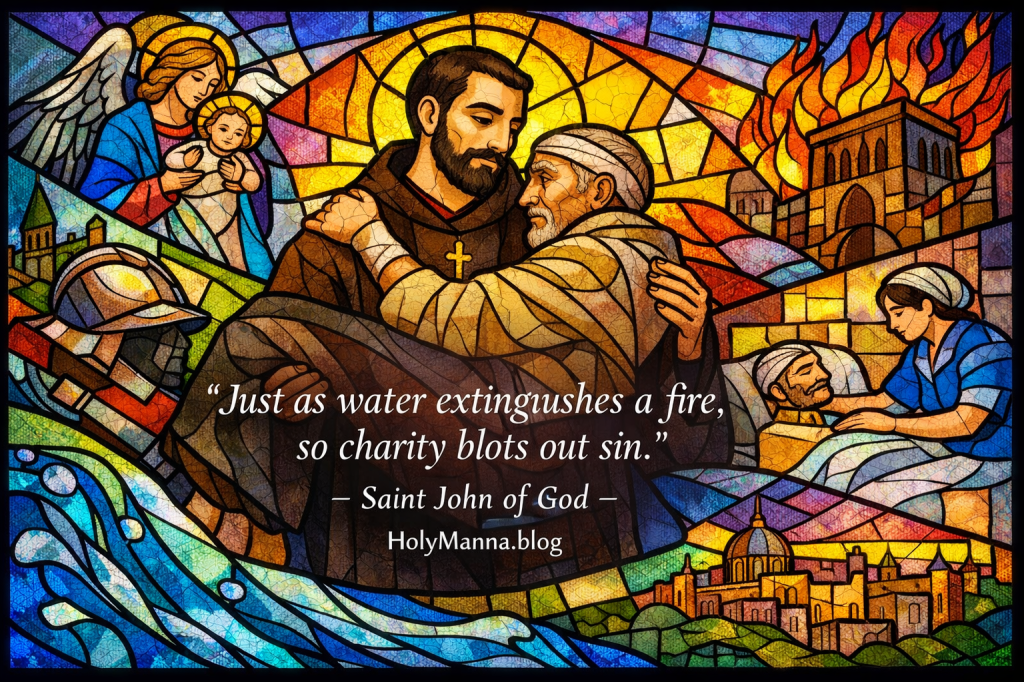
“Just as water extinguishes a fire, so charity blots out sin.”
This is not sentimental. It is Catholic to the bone. Charity is not merely kindness. It is a participation in the love of God, poured into the heart, and expressed in action. That is why the Church can speak of Christ as the physician of the whole human person, body and soul, in CCC 1503.
The Miracle That Made Him Famous
John’s life includes miracle stories that Catholic sources have repeated for centuries. The most famous is tied to a fire in a major hospital in Granada. Tradition holds that when flames threatened the patients, John rushed in, carried people out, and moved through the danger in a way that astonished witnesses. Catholic accounts describe him as escaping without the kind of injury that should have been inevitable. This story became one of the best known wonders associated with his life.
There are other extraordinary traditions as well. Catholic biographies also report a story that Saint Raphael the Archangel appeared to assist him, helping lighten his burdens. This cannot be verified in a modern historical sense, but it is part of the devotional tradition passed down in Catholic sources, and it fits the Church’s long memory that God sometimes sends help in surprising ways. This story cannot be verified.
Another tradition speaks of a vision of the Infant Jesus connected to the name by which he became known, “John of God.” This also belongs to the realm of tradition rather than strict documentation. This story cannot be verified.
What can be said with confidence is this. Whether through ordinary strength or extraordinary help, John lived as if every moment were a chance to protect Christ in the suffering.
Humiliation, Exhaustion, and a Holy Death
John of God was not a martyr in the classic sense. No executioner took his life. His hardship was the daily grind of mercy. He lived under the weight of constant need. He was frequently in debt because sick bodies do not wait for budgets. He carried the burden of caring for people with diseases that frightened society. He dealt with misunderstandings, suspicion, and the strain of relentless labor.
His death matches his mission. Catholic accounts connect his final illness to an act of rescue during flooding, when he tried to save a drowning young man. His strength failed, his health collapsed, and he died in Granada on March 8, 1550. Tradition also remembers that he died in the care of the Pisa family, benefactors who sheltered him at the end.
It is hard not to see the pattern. He spent his life pulling people out of suffering, and his body gave out while trying to do it one more time.
A Legacy That Never Stopped Walking
After his death, devotion grew. The work continued through companions and eventually became the Hospitaller Order associated with his name, approved in the life of the Church and spreading the charism of hospitality far beyond Granada. His legacy includes not only hospitals but an entire Catholic way of caring for the vulnerable, shaped by reverence for the human person.
Catholic tradition also holds that many favors and healings have been attributed to his intercession after death, especially among the sick, the dying, nurses, and caregivers who call on him in desperate moments. Specific cases are not consistently documented in widely available public sources across regions and centuries, so they cannot be responsibly narrated here without risking invention. What can be said faithfully is that his veneration has been sustained by generations of Catholics who experienced him as a powerful intercessor.
His relics became objects of veneration, and Catholic tradition preserves the memory of a formal translation of his remains in Granada, a moment that strengthened devotion and public celebration. The Basilica in Granada remains closely tied to his memory and is widely regarded as a major spiritual home connected to his life and relics.
His cultural impact is also real. In parts of the Catholic world, devotion to him shaped language, shaped healthcare institutions, shaped the identity of caregivers, and even influenced public celebrations on his feast. He is also remembered as a patron for those who face fire and danger in the service of others, a devotion linked to the famous fire story from his life.
There is also a uniquely Catholic detail that shows how deeply his legacy penetrated daily Church life. He is honored as the patron saint of the Vatican Pharmacy, which is a quiet reminder that faith and medicine are not enemies in Catholic thought when both are ordered toward the good of the human person.
A Mercy That Has a Pulse
Saint John of God is not meant to stay in a stained glass window. He is meant to show Catholics what mercy looks like in ordinary life. He did not wait until he felt ready. He did not wait until he had money. He did not wait until people understood him.
He teaches something simple and demanding. The suffering person in front of you is never an interruption. That person is a visitation.
This is where his story meets daily life. Most people will not open a hospital, but everyone will face someone who needs patient love. A tired spouse. A lonely parent. A coworker battling anxiety. A neighbor drowning in grief. The Church’s path is not to romanticize suffering, but to meet it with charity shaped by truth.
Saint John of God also teaches Catholic men something important. Strength is not proven by domination. Strength is proven by service. A man becomes more manly when he becomes more merciful.
And if the heart asks, What if mercy costs too much? his life answers with the only Christian logic that matters. Mercy is never wasted, because it is love poured into Christ.
When the Sick Become a Sacrament of Encounter
Saint John of God invites believers to look again at the people society avoids. He also invites believers to look again at their own wounds. His early life was marked by loss and displacement, and yet God used it to form compassion. That is a comfort for anyone who carries a past that feels scattered.
His conversion also teaches something practical. Repentance is real, but it must become love. A faith that only stays inside private devotion is not the full Catholic life. The works of mercy are a test of whether the Gospel has really taken root, and the Church names them plainly in CCC 2447.
There are simple ways to imitate him without pretending to be him. Serve someone who cannot repay you. Visit someone sick or isolated. Offer tangible help instead of vague words. Support Catholic healthcare and caregivers. Pray for nurses, doctors, and first responders by name when you hear about them. Confess sins quickly and take mercy seriously, because John’s whole life began when he finally stopped negotiating with grace and surrendered.
And his best advice is already in his own words. “If we kept before us the mercy of God, we would never be deficient in doing good.” That line can guide every decision, from how to talk to family, to how to treat strangers, to how to spend money.
Engage with Us!
Share your thoughts and reflections in the comments below. Saint John of God has a way of stirring the conscience, because his mercy is concrete and inconvenient in the best way.
- Where has God asked for mercy that feels too costly or too disruptive right now?
- Who is the “unnoticed sick” in daily life, the person who needs presence more than advice?
- What would change if every act of care were offered to Christ, as if it were done for Him directly?
- Is there a wound from the past that God might want to transform into compassion for others?
- What is one practical work of mercy that can be chosen this week, and what would stop it from happening?
Keep moving forward in faith. Keep choosing mercy. Keep doing the next right thing with love, because that is how saints are made, and that is how a life becomes a living echo of the love and mercy Jesus taught us.
Saint John of God, pray for us!
Follow us on YouTube, Instagram and Facebook for more insights and reflections on living a faith-filled life.

 Holy Manna!
Leave a comment