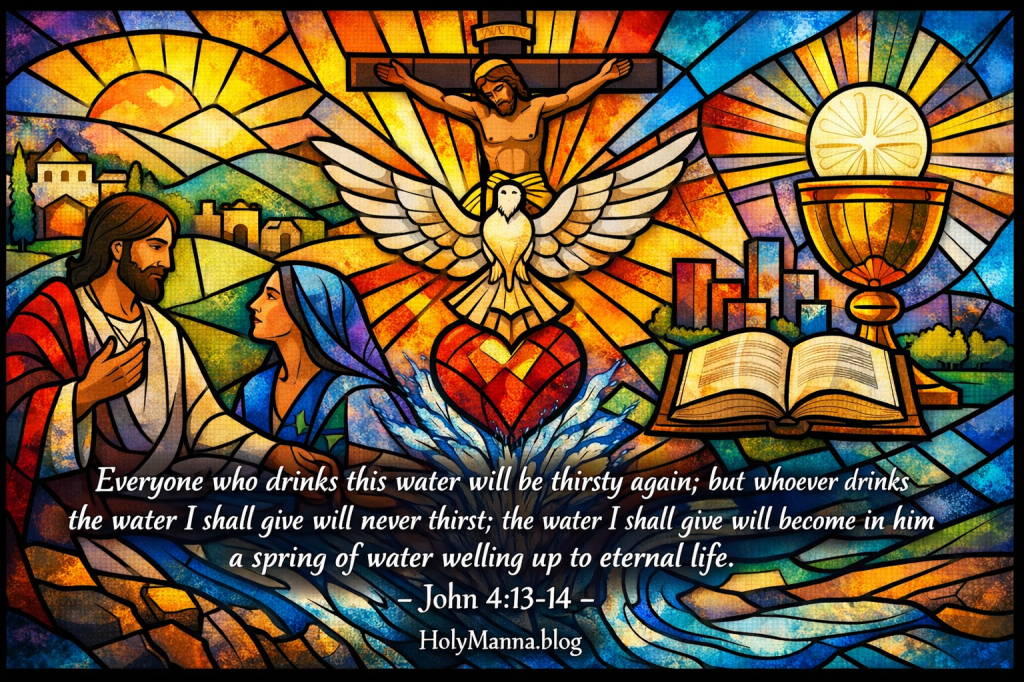
Third Sunday of Lent – Lectionary: 28
Thirst That Tells the Truth
Some days the soul feels like a dry throat in the middle of a long walk. Life keeps moving, responsibilities keep stacking up, and the heart quietly starts asking the same question Israel shouted in the desert: “Is the LORD in our midst or not?” Today’s readings answer that question with one steady message. God does not stand far away, waiting for perfect people to find Him. God draws near, meets real human thirst, and turns it into a doorway to grace.
The Church places these readings on the Third Sunday of Lent because Lent is not just about giving things up. Lent is about learning what the heart is truly thirsty for, and then letting God satisfy that thirst in a way that heals instead of merely numbing. In The Book of Exodus, a liberated people discovers that freedom does not instantly erase fear, and the desert exposes what is hidden inside them. They grumble, they quarrel, and they test the Lord, but God answers with mercy. He commands Moses to strike the rock, and water flows where it should not. The message is not subtle. The Lord is present, even when the people are unstable, and He can bring life out of what looks lifeless.
That same desert warning becomes a living plea in Psalm 95. The psalm invites worship, but it also gives a serious caution: “Oh, that today you would hear his voice: Do not harden your hearts.” The word “today” matters because the human heart loves to postpone conversion. Tomorrow always feels safer than now. Today’s liturgy insists that God is speaking in the present moment, and the only real question is whether the heart will listen or resist.
Then Saint Paul opens the deepest meaning of this thirst in The Letter to the Romans. God does not wait for humanity to get its act together. God proves His love by moving first. “While we were still sinners Christ died for us.” Peace with God is not earned like a paycheck. It is given as grace, and that grace becomes hope that can actually hold up under pressure because, as Scripture says, “the love of God has been poured out into our hearts through the holy Spirit.”
All of that comes to a head in the Gospel scene at Jacob’s well in The Gospel of John. The setting is loaded with meaning. A well was a place of daily need, but in the Scriptures it was also a place of encounter, memory, and covenant. Noon heat presses down, the woman arrives carrying her jar, and Jesus begins with a simple request: “Give me a drink.” The conversation moves from ordinary water to a far deeper thirst, and Jesus reveals that He is not only the One who knows the truth about a person’s life. He is the One who can satisfy the heart with “living water” that becomes “a spring of water welling up to eternal life.”
The central theme tying everything together is this: God meets human thirst with His own presence, and He turns testing into trust. The desert, the psalm, the Cross, and the well all tell one story. God is in our midst, and He is not afraid of the places in the heart that feel dry, complicated, or exposed. How would life change if the deepest thirst were brought to Jesus instead of brought to distractions?
First Reading – Exodus 17:3-7
When Thirst Turns into a Trial, God Still Shows Up
The scene opens in the wilderness, not long after the Lord has shattered Pharaoh’s grip and led Israel out of Egypt. Freedom has begun, but formation is far from finished. The desert is where God trains a people to live by trust, not by panic, and to learn dependence without falling into despair. In that harsh place, thirst becomes more than a physical problem. It becomes a spiritual pressure test. When water runs out, fear rises fast, and the heart blurts out what it really believes about God’s goodness.
This is why today’s theme fits so tightly. The desert question, “Is the LORD in our midst or not?”, is the same question that hides inside so many modern hearts when life feels dry. The miracle that follows is not only about hydration. It is about presence. The Lord does not merely send help from a distance. The Lord declares that He is there, standing before Moses at the rock, and He provides water in a way that can only be called mercy. That mercy prepares the soul to recognize Jesus at another “water” moment in the Gospel, where thirst becomes the doorway to living water and true worship.
Exodus 17:3-7 – New American Bible (Revised Edition)
3 Here, then, in their thirst for water, the people grumbled against Moses, saying, “Why then did you bring us up out of Egypt? To have us die of thirst with our children and our livestock?” 4 So Moses cried out to the Lord, “What shall I do with this people? A little more and they will stone me!” 5 The Lord answered Moses: Go on ahead of the people, and take along with you some of the elders of Israel, holding in your hand, as you go, the staff with which you struck the Nile. 6 I will be standing there in front of you on the rock in Horeb. Strike the rock, and the water will flow from it for the people to drink. Moses did this, in the sight of the elders of Israel. 7 The place was named Massah and Meribah, because the Israelites quarreled there and tested the Lord, saying, “Is the Lord in our midst or not?”
Detailed Exegesis
Verse 3: “Here, then, in their thirst for water, the people grumbled against Moses, saying, ‘Why then did you bring us up out of Egypt? To have us die of thirst with our children and our livestock?’”
Thirst is real, and the concern is understandable, but the grumbling reveals a deeper story. The people speak as if Egypt, the place of slavery, was safer than the wilderness of freedom. That is what fear does. Fear rewrites history and paints bondage as comfort. Notice how quickly the complaint becomes an accusation. Moses becomes the target, but the real suspicion is aimed at God. The heart implies that the Lord rescued them only to abandon them. In Lent, this verse exposes a familiar spiritual pattern: when the soul feels deprived, it can start interpreting God’s commands as cruelty instead of love.
Verse 4: “So Moses cried out to the LORD, ‘What shall I do with this people? A little more and they will stone me!’”
Moses does not answer anger with anger. He brings the crisis to the Lord. This is leadership in the biblical sense: not controlling outcomes, but turning toward God when chaos threatens. The threat of stoning shows how resentment escalates when people feel entitled to immediate relief. It also hints at a hard truth. When the heart hardens, it does not only reject God’s gifts. It can also lash out at God’s servants.
Verse 5: “The LORD answered Moses: Go on ahead of the people, and take along with you some of the elders of Israel, holding in your hand, as you go, the staff with which you struck the Nile.”
God answers with instruction, not condemnation. He tells Moses to go ahead, which is a quiet act of courage and obedience. The elders are brought as witnesses so the people can see that this is truly the Lord’s work, not a trick or rumor. The staff matters too. It is the same instrument associated with the judgment on Egypt and the liberation of Israel. That detail ties deliverance and provision together. The Lord who saves is the Lord who sustains. The same God who broke chains can also break open rock.
Verse 6: “I will be standing there in front of you on the rock in Horeb. Strike the rock, and the water will flow from it for the people to drink. Moses did this, in the sight of the elders of Israel.”
This is the heart of the passage. The Lord does not merely point Moses toward a resource. The Lord declares His presence: “I will be standing there in front of you.” Horeb is holy ground, associated with Sinai, the mountain of covenant. In other words, the place of dryness becomes a place of encounter. The command to strike the rock is not magic; it is obedience. Water from rock is not a natural solution, which means the miracle is meant to teach trust. God provides in a way that leaves no room for boasting and no excuse for forgetting. The elders witness it, because God’s works are meant to be remembered, told, and handed on.
Verse 7: “The place was named Massah and Meribah, because the Israelites quarreled there and tested the LORD, saying, ‘Is the LORD in our midst or not?’”
The names preserve the lesson. Massah means “testing,” and Meribah means “quarreling.” Scripture does not hide the failure, because grace grows best in truth. The people “tested” the Lord, which is more than asking for help. It is demanding proof on personal terms, as if God must earn trust every time discomfort appears. The question is painful because it is so honest. It is the question that resurfaces whenever prayer feels dry, whenever providence seems slow, and whenever suffering makes God feel distant.
Teachings
The Church speaks directly about what Israel does here, because this temptation does not stay in the desert. It follows humanity into every generation. The Catechism defines this kind of testing with striking clarity in CCC 2119: “Tempting God consists in putting his goodness and almighty power to the test by word or deed. Thus Satan tried to induce Jesus to throw himself down from the Temple and, by this gesture, force God to act. Jesus opposed Satan with the word of God: ‘You shall not put the LORD your God to the test.’ The challenge contained in such tempting of God wounds the respect and trust we owe our Creator and Lord. It always harbors doubt about his love, his providence, and his power.” This is exactly what happens at Massah and Meribah. The surface problem is water. The deeper wound is distrust.
The Church also reads this passage with a sacramental imagination. Water in Scripture is never only water. It becomes a sign of life, cleansing, and divine gift. That is why The Catechism connects water to the Holy Spirit and to Baptism in CCC 694: “The symbolism of water signifies the Holy Spirit’s action in Baptism, since after the invocation of the Holy Spirit it becomes the efficacious sacramental sign of new birth: just as the gestation of our first birth took place in water, so the water of Baptism truly signifies that our birth into the divine life is given to us in the Holy Spirit. As ‘by one Spirit we were all baptized,’ so we are also ‘made to drink of one Spirit.’ Thus the Spirit is also personally the living water welling up from Christ crucified as its source and welling up in us to eternal life.” The rock in Horeb points forward to the deeper gift God intends, not only water for a day, but life for eternity.
Saint Paul makes the Church’s typology explicit when he looks back on Israel’s wilderness experience and sees Christ already at work. The First Letter to the Corinthians says: “and all drank the same spiritual drink, for they drank from a spiritual rock that followed them, and the rock was the Christ.” (1 Corinthians 10:4). The point is not that Israel understood everything in the moment. The point is that God’s providence was always Christ-centered, moving history toward the fullness of salvation.
This is also why the Gospel for today pairs so naturally with this reading. The Lord who provides water from rock is the same Lord who sits weary at a well and offers living water. The Catechism captures the spiritual core of that offer in CCC 2560: “The wonder of prayer is revealed beside the well where we come seeking water: there, Christ comes to meet every human being. It is he who first seeks us and asks us for a drink. Jesus thirsts; his asking arises from the depths of God’s desire for us. Whether we realize it or not, prayer is the encounter of God’s thirst with ours. God thirsts that we may thirst for him.” The desert and the well tell the same story. God is present, God is seeking, and God is teaching the heart to desire the right things.
Reflection
This reading lands close to home because it describes what happens when life stops feeling convenient. A tough week can turn the soul into a courtroom, with God on trial and every inconvenience treated like evidence. The desert exposes this reflex so it can be healed. The Lord does not deny the reality of thirst, but He refuses to let fear become the loudest voice. The deeper invitation is to bring need to God as a child, not to throw accusations like a prosecutor.
A practical way to live this is to pay attention to the moment grumbling begins. That moment usually carries a hidden demand: “God must fix this immediately or God has failed.” Lent invites a different response. Instead of rehearsing worst-case scenarios, the heart can learn to pray with honesty and humility, asking for daily bread, daily water, and daily strength. The Lord who stood before Moses at the rock has not stopped being present, even when feelings lag behind truth.
It also helps to remember that God involved the elders as witnesses. God’s mercies are meant to be remembered. When anxiety claims that God has never come through, memory can speak back with facts. The Lord has provided before, and the Lord remains faithful. This is not denial of difficulty. It is refusal to let despair rewrite reality.
Where does the heart quietly say, “God brought me this far to drop me,” even if the mouth does not say it out loud?
What would change if the day’s biggest stress was brought to prayer before it was brought to complaining?
Is the Lord being tested with demands, or trusted with petitions, especially in the places where life feels most dry?
Responsorial Psalm – Psalm 95:1-2, 6-9
A Song that Turns Thirst into Worship, and Complaints into Listening
This psalm sounds like the doorway into the whole day’s liturgy. After hearing Israel’s grumbling in the desert, the Church answers with a different voice, a voice that calls the heart to praise before it calls the heart to explanations. Psalm 95 is an ancient liturgical invitation, the kind of hymn a covenant people would recognize as a summons to gather, to bow low, and to remember who God is before speaking about what God has not yet done. It carries the rhythm of temple worship and communal prayer, but it also carries a warning carved into Israel’s memory: Meribah and Massah, the place where fear hardened into testing.
That is why this psalm fits today’s theme so perfectly. The first reading shows a people asking whether God is present. The Gospel shows Jesus revealing Himself as the One who satisfies the deepest thirst with living water. This psalm stands in the middle like a shepherd’s staff, guiding the soul away from suspicion and toward worship. It insists that praise is not a mood. Praise is an act of faith. It is a decision to kneel before the Lord who made us, even when the throat is dry and the path feels long.
Psalm 95:1-2, 6-9 – New American Bible (Revised Edition)
A Call to Praise and Obedience
1 Come, let us sing joyfully to the Lord;
cry out to the rock of our salvation.
2 Let us come before him with a song of praise,
joyfully sing out our psalms.6 Enter, let us bow down in worship;
let us kneel before the Lord who made us.
7 For he is our God,
we are the people he shepherds,
the sheep in his hands.Oh, that today you would hear his voice:
8 Do not harden your hearts as at Meribah,
as on the day of Massah in the desert.
9 There your ancestors tested me;
they tried me though they had seen my works.
Detailed Exegesis
Verse 1: “Come, let us sing joyfully to the LORD; cry out to the rock of our salvation.”
The psalm begins with “come,” because worship is never meant to be a private hobby that stays locked inside personal preference. It is a summons into communion, a people gathering before God. The title “rock of our salvation” carries the weight of Israel’s story. A rock is stable, immovable, and dependable. In today’s liturgy, that word “rock” echoes the rock in the desert that poured out water, and it also points beyond the symbol to the Lord’s steady presence. The psalm invites the heart to cry out, not to panic, but to praise, because salvation is not an abstract idea. Salvation is the Lord Himself acting in history.
Verse 2: “Let us come before him with a song of praise, joyfully sing out our psalms.”
This is not the language of reluctant duty. It is the language of approach, “come before him,” like subjects entering the presence of a king, or children running toward a Father. The psalm assumes that gratitude has a voice. It also assumes that the faithful rehearse God’s goodness through prayer. Singing the psalms is how Israel remembered, and it is how the Church still remembers, because memory is often the first battleground when life feels dry.
Verse 6: “Enter, let us bow down in worship; let us kneel before the LORD who made us.”
The psalm moves from sound to posture. It does not separate the body from the soul. Bowing and kneeling are not empty gestures; they are the body telling the truth the heart is learning to accept. God is Creator, and the creature is not self-made. In a culture that celebrates self-definition as the highest virtue, kneeling is an act of spiritual realism. The psalm teaches that worship is not only words about God. Worship is surrender before God.
Verse 7: “For he is our God, we are the people he shepherds, the sheep in his hands. Oh, that today you would hear his voice:”
Here the psalm reveals covenant intimacy. God is not only powerful. God is personal. The shepherd image is tender, but it is also corrective. Sheep do not survive by pretending they are wolves. They survive by staying close to the shepherd. The line “in his hands” is meant to calm the anxious heart, because hands that create are also hands that guide. Then the psalm presses the urgency of grace into one word: “today.” God speaks in the present. Conversion is not meant to be postponed until life becomes convenient.
Verse 8: “Do not harden your hearts as at Meribah, as on the day of Massah in the desert.”
The psalm does not allow worship to become sentimental. It names a real danger: hardness of heart. Hardness happens when repeated disappointment, unchecked sin, or stubborn pride makes a person stop listening. Meribah and Massah are not just geography. They are a spiritual warning label. The desert can either teach trust or produce bitterness. The psalm begs the listener not to repeat the old story.
Verse 9: “There your ancestors tested me; they tried me though they had seen my works.”
This verse exposes the tragedy of spiritual forgetfulness. The people had seen God act, but fear made them interpret the present as if the past never happened. Testing God is what happens when the heart demands proof while refusing remembrance. The psalm calls the faithful to a mature obedience that does not require constant signs to keep believing.
Teachings
The Church hears Psalm 95 as both invitation and examination. It is praise that lifts the soul, and it is warning that protects the soul. Its call to kneel is deeply Catholic because the faith is not only interior feelings. The faith is embodied adoration. The Catechism describes adoration in a way that sounds like this psalm put into doctrine. In CCC 2096, the Church teaches: “Adoration is the first attitude of man acknowledging that he is a creature before his Creator. It exalts the greatness of the Lord who made us and the almighty power of the Savior who sets us free from evil. Adoration is homage of the spirit to the ‘King of Glory,’ respectful silence in the presence of the ‘ever greater’ God. Adoration of the thrice-holy and sovereign God of love blends with humility and gives assurance to our supplications.” That is the heart of “let us kneel before the LORD who made us.”
The warning against hardened hearts also belongs at the center of Lent. The Catechism explains the sin underneath Meribah and Massah, because this is not merely complaining. This is the heart putting God on trial. In CCC 2119, the Church teaches: “Tempting God consists in putting his goodness and almighty power to the test by word or deed. Thus Satan tried to induce Jesus to throw himself down from the Temple and, by this gesture, force God to act. Jesus opposed Satan with the word of God: ‘You shall not put the LORD your God to the test.’ The challenge contained in such tempting of God wounds the respect and trust we owe our Creator and Lord. It always harbors doubt about his love, his providence, and his power.” The psalm is basically saying, “Do not live like that.”
The Church’s spiritual tradition also treats this psalm as a daily threshold of obedience. The phrase “Oh, that today you would hear his voice” has long been treasured in monastic life as a call to immediate conversion, because delayed obedience usually turns into disobedience. That tradition fits the Lenten season, when the faithful are called to listen, repent, and return, not eventually, but now.
Reflection
This psalm is a mercy for modern people because it gives the heart a script when emotions feel unreliable. When life feels dry, the instinct is often to narrate everything through frustration. Psalm 95 offers a better beginning. It teaches that the day should start with praise and end with obedience, because worship reorders desire. Praise tells the truth about God’s greatness. Kneeling tells the truth about human dependence. Listening tells the truth about what love requires.
A practical way to live this reading is to treat “today” like a sacred word. When prayer feels distracted, “today” can become a gentle reset, bringing attention back to the Lord’s presence instead of the mind’s spirals. When temptation whispers that God is distant, “today” can become a refusal to harden the heart. The psalm also invites a serious inventory of spiritual memory. If the Lord has provided before, then gratitude becomes an anchor against panic. A heart that remembers becomes a heart that trusts.
Where does the heart resist kneeling, not only with the body but with the will, because pride wants control?
What would change if the first response to stress today was praise instead of complaint?
Is the Lord being listened to “today,” or is conversion being postponed until life feels easier?
Second Reading – Romans 5:1-2, 5-8
Peace with God Is Not Earned, It Is Given
Saint Paul writes The Letter to the Romans to a Church made up of both Jewish and Gentile believers, people coming from different spiritual instincts and different wounds. Some were tempted to treat God like a strict scoreboard. Others were tempted to treat grace like a free pass. Paul cuts through both errors with a truth that anchors the entire Lenten journey. Salvation is God’s gift before it is ever man’s achievement. The Christian life begins, not with self-improvement, but with reconciliation, because sin breaks communion and Christ restores it.
That is why this reading fits today’s theme of thirst and trust. In the desert, Israel questioned whether the Lord was truly present. At the well, Jesus reveals Himself as the One who satisfies the deepest thirst with living water. Here, Paul explains what makes that living water possible: the Cross. God does not prove love by making life easy. God proves love by entering suffering and conquering sin from the inside. The result is not merely comfort. The result is peace with God, access to grace, and hope that does not collapse when life feels dry.
Romans 5:1-2, 5-8 – New American Bible (Revised Edition)
Faith, Hope, and Love. 1 Therefore, since we have been justified by faith, we have peace with God through our Lord Jesus Christ, 2 through whom we have gained access [by faith] to this grace in which we stand, and we boast in hope of the glory of God.
5 and hope does not disappoint, because the love of God has been poured out into our hearts through the holy Spirit that has been given to us. 6 For Christ, while we were still helpless, yet died at the appointed time for the ungodly. 7 Indeed, only with difficulty does one die for a just person, though perhaps for a good person one might even find courage to die. 8 But God proves his love for us in that while we were still sinners Christ died for us.
Detailed Exegesis
Verse 1: “Therefore, since we have been justified by faith, we have peace with God through our Lord Jesus Christ,”
Justification is not God pretending sin did not happen. Justification is God making the sinner righteous by grace, restoring communion that sin damaged. Faith is not a self-generated optimism. Faith is trusting reception of God’s gift in Christ. “Peace with God” means reconciliation, not simply inner calm. It is the end of hostility between the sinner and the Holy One, accomplished through Jesus, not through human effort.
Verse 2: “through whom we have gained access [by faith] to this grace in which we stand, and we boast in hope of the glory of God.”
Jesus is not only the messenger of salvation. Jesus is the doorway into grace. The phrase “in which we stand” suggests stability and belonging, like being placed on solid ground after years of slipping in mud. “Hope of the glory of God” is not shallow positivity. It is confidence that God will finish what He began, drawing the faithful into communion with Him, even through suffering and purification.
Verse 5: “and hope does not disappoint, because the love of God has been poured out into our hearts through the holy Spirit that has been given to us.”
Hope does not disappoint because it is not rooted in the believer’s consistency. It is rooted in God’s fidelity. The love of God is not described as a trickle or a ration. It is poured out. The Holy Spirit is not merely an influence. The Holy Spirit is a Gift given to dwell within the baptized and to make divine love present and active in the heart, especially when feelings are weak and circumstances are harsh.
Verse 6: “For Christ, while we were still helpless, yet died at the appointed time for the ungodly.”
“Helpless” names a hard truth. Humanity could not climb out of sin by willpower, discipline, or cleverness. The Cross is not a reward for the righteous. It is rescue for the ungodly. “At the appointed time” points to God’s plan, the fullness of time, where salvation is not accidental but promised and fulfilled. Christ dies, not for the lovable, but for the lost.
Verse 7: “Indeed, only with difficulty does one die for a just person, though perhaps for a good person one might even find courage to die.”
Paul appeals to common human experience. Sacrificial love is rare, and even then, it usually aims at someone perceived as worthy. This verse sets up a comparison that will make God’s love shine brighter. Human love often waits for merit. Divine love moves first.
Verse 8: “But God proves his love for us in that while we were still sinners Christ died for us.”
This is the center of the passage. God’s love is not theoretical. It is demonstrated. The proof is not found in comfort, convenience, or success. The proof is found in the Cross offered to sinners. The timing matters. Christ dies “while” humanity is still sinful, which means grace is not a response to human improvement. Grace is what makes improvement possible.
Teachings
This reading sits right on the Church’s core teaching about grace and justification. Catholic faith does not teach that a person saves himself by good behavior. Catholic faith teaches that salvation begins with God’s initiative, God’s gift, and God’s mercy, and that the human response is real cooperation made possible by grace. The Catechism expresses this with clarity in CCC 1996: “Our justification comes from the grace of God. Grace is favor, the free and undeserved help that God gives us to respond to his call to become children of God, adoptive sons, partakers of the divine nature and of eternal life.” Paul’s claim that believers “stand” in grace is exactly this stability of belonging, not earned, but received.
Paul’s line about the Holy Spirit pouring love into hearts also echoes the Church’s definition of sanctifying grace, which is not a mere external label but an interior gift that changes the soul. The Catechism says in CCC 1997: “Grace is a participation in the life of God. It introduces us into the intimacy of Trinitarian life: by Baptism the Christian participates in the grace of Christ, the Head of his Body. As an ‘adopted son’ he can now call God ‘Father,’ in union with the only Son. He receives the life of the Spirit who breathes charity into him and who forms the Church.” This is why hope does not disappoint. The Christian is not left alone with a motivational speech. The Christian is given divine life.
Paul’s teaching on hope also matches the Church’s definition of hope as a theological virtue rooted in God, not in circumstances. The Catechism teaches in CCC 1817: “Hope is the theological virtue by which we desire the kingdom of heaven and eternal life as our happiness, placing our trust in Christ’s promises and relying not on our own strength, but on the help of the grace of the Holy Spirit.” That line explains why Lent is not supposed to be a season of grim self-reliance. It is a season of trusting Christ’s promises and leaning harder into grace.
The Cross, then, becomes the definitive proof of God’s love. It answers the desert question with finality. When the heart asks whether God is present, the Church points to Christ crucified and risen, because that is where love becomes visible and measurable. The Cross does not remove every hardship, but it removes the lie that hardship means abandonment.
Reflection
This reading invites a different way of carrying daily life. When stress hits, the temptation is to believe that God’s attitude depends on performance. A bad day feels like condemnation, and a good day feels like approval. Paul corrects that unstable thinking with a rock-solid foundation. Peace with God is grounded in Jesus Christ. Grace is something the Christian stands in, not something the Christian earns and loses every time emotions swing.
A practical response begins with one interior decision: refusing to interpret God’s love through mood. The Cross is the measure, not the moment. When shame starts talking, this passage gives a better voice to listen to. “While we were still sinners Christ died for us.” That truth trains the heart to repent without despair, to strive without pride, and to trust without demanding constant proof.
The passage also challenges the way suffering is interpreted. Lent often feels like a desert, and deserts can expose helplessness. Paul does not hide that word. He uses it. Then he shows why helplessness can become holy. Helplessness becomes the place where grace is finally welcomed, because grace is easiest to receive when pride stops pretending it can handle everything alone.
Is God being treated like a scoreboard, where love rises and falls with performance, or like a Father who has already proven love on the Cross?
Where does the heart need to stop “testing” God and start standing in grace, especially when prayer feels dry or life feels heavy?
What would change this week if hope was anchored, not in circumstances, but in the Holy Spirit who pours God’s love into the heart?
Holy Gospel – John 4:5-42
The Well Where God’s Thirst Meets Ours
This Gospel unfolds like a quiet scene that turns into an earthquake. Jesus sits at Jacob’s well near Sychar in Samaria, a place loaded with tension. Jews and Samaritans shared a tangled history, old wounds, and rival claims about where true worship should happen. Samaritans traced their heritage to the patriarchs and revered the Law, but they worshiped on Mount Gerizim, while the Jews worshiped in Jerusalem. By the time of Jesus, suspicion ran deep on both sides, and respectable people did not cross those lines lightly.
Then Jesus does something that feels almost too ordinary to be holy. He asks for a drink. That simple request opens a door into the day’s theme: thirst. Israel thirsted in the desert and tested God’s presence. This woman thirsts in her daily life, and her heart carries its own deserts, regrets, and defenses. Jesus meets her at the most human level, but He is aiming at the deepest level. He offers living water, not as a poetic metaphor, but as the gift of divine life poured into a wounded human heart. This is why the Church loves this Gospel in Lent, especially when catechumens are preparing for Baptism. The Lord reveals that He does not merely teach from afar. He comes close, tells the truth, heals the soul, and sends the converted heart out as a witness.
John 4:5-42 – New American Bible (Revised Edition)
5 So he came to a town of Samaria called Sychar, near the plot of land that Jacob had given to his son Joseph. 6 Jacob’s well was there. Jesus, tired from his journey, sat down there at the well. It was about noon.
7 A woman of Samaria came to draw water. Jesus said to her, “Give me a drink.” 8 His disciples had gone into the town to buy food. 9 The Samaritan woman said to him, “How can you, a Jew, ask me, a Samaritan woman, for a drink?” (For Jews use nothing in common with Samaritans.) 10 Jesus answered and said to her, “If you knew the gift of God and who is saying to you, ‘Give me a drink,’ you would have asked him and he would have given you living water.” 11 [The woman] said to him, “Sir, you do not even have a bucket and the well is deep; where then can you get this living water? 12 Are you greater than our father Jacob, who gave us this well and drank from it himself with his children and his flocks?” 13 Jesus answered and said to her, “Everyone who drinks this water will be thirsty again; 14 but whoever drinks the water I shall give will never thirst; the water I shall give will become in him a spring of water welling up to eternal life.” 15 The woman said to him, “Sir, give me this water, so that I may not be thirsty or have to keep coming here to draw water.”
16 Jesus said to her, “Go call your husband and come back.” 17 The woman answered and said to him, “I do not have a husband.” Jesus answered her, “You are right in saying, ‘I do not have a husband.’ 18 For you have had five husbands, and the one you have now is not your husband. What you have said is true.” 19 The woman said to him, “Sir, I can see that you are a prophet. 20 Our ancestors worshiped on this mountain; but you people say that the place to worship is in Jerusalem.” 21 Jesus said to her, “Believe me, woman, the hour is coming when you will worship the Father neither on this mountain nor in Jerusalem. 22 You people worship what you do not understand; we worship what we understand, because salvation is from the Jews. 23 But the hour is coming, and is now here, when true worshipers will worship the Father in Spirit and truth; and indeed the Father seeks such people to worship him. 24 God is Spirit, and those who worship him must worship in Spirit and truth.” 25 The woman said to him, “I know that the Messiah is coming, the one called the Anointed; when he comes, he will tell us everything.” 26 Jesus said to her, “I am he, the one who is speaking with you.”
27 At that moment his disciples returned, and were amazed that he was talking with a woman, but still no one said, “What are you looking for?” or “Why are you talking with her?” 28 The woman left her water jar and went into the town and said to the people, 29 “Come see a man who told me everything I have done. Could he possibly be the Messiah?” 30 They went out of the town and came to him. 31 Meanwhile, the disciples urged him, “Rabbi, eat.” 32 But he said to them, “I have food to eat of which you do not know.” 33 So the disciples said to one another, “Could someone have brought him something to eat?” 34 Jesus said to them, “My food is to do the will of the one who sent me and to finish his work. 35 Do you not say, ‘In four months the harvest will be here’? I tell you, look up and see the fields ripe for the harvest. 36 The reaper is already receiving his payment and gathering crops for eternal life, so that the sower and reaper can rejoice together. 37 For here the saying is verified that ‘One sows and another reaps.’ 38 I sent you to reap what you have not worked for; others have done the work, and you are sharing the fruits of their work.”
39 Many of the Samaritans of that town began to believe in him because of the word of the woman who testified, “He told me everything I have done.” 40 When the Samaritans came to him, they invited him to stay with them; and he stayed there two days. 41 Many more began to believe in him because of his word, 42 and they said to the woman, “We no longer believe because of your word; for we have heard for ourselves, and we know that this is truly the savior of the world.”
Detailed Exegesis
Verse 5: “So he came to a town of Samaria called Sychar, near the plot of land that Jacob had given to his son Joseph.”
Jesus enters contested ground on purpose. This is not an accident on the map. He steps into a place where history and hostility still echo, showing that grace is not afraid of fractured relationships.
Verse 6: “Jacob’s well was there. Jesus, tired from his journey, sat down there at the well. It was about noon.”
Jesus is truly human, and His weariness is real. Noon suggests heat and exposure, and it also hints at a meeting that will bring hidden things into the light.
Verse 7: “A woman of Samaria came to draw water. Jesus said to her, ‘Give me a drink.’”
Jesus initiates the encounter. He does not start with a lecture. He starts with need, drawing her into a conversation that will become conversion.
Verse 8: “His disciples had gone into the town to buy food.”
The scene is intentionally private. The Lord often does His most personal work in the quiet space where a soul cannot hide behind a crowd.
Verse 9: “The Samaritan woman said to him, ‘How can you, a Jew, ask me, a Samaritan woman, for a drink?’ (For Jews use nothing in common with Samaritans.)”
She names the barrier out loud. Her surprise shows how unusual Jesus’ approach is. He crosses ethnic, religious, and social lines without compromising truth.
Verse 10: “Jesus answered and said to her, ‘If you knew the gift of God and who is saying to you, “Give me a drink,” you would have asked him and he would have given you living water.’”
Jesus shifts from physical water to the “gift of God.” The deeper point is that God is the Giver, and the soul is meant to ask, receive, and live.
Verse 11: “[The woman] said to him, ‘Sir, you do not even have a bucket and the well is deep; where then can you get this living water?’”
She thinks on the practical level, which is honest and human. Many conversions begin this way, with misunderstanding that slowly becomes revelation.
Verse 12: “Are you greater than our father Jacob, who gave us this well and drank from it himself with his children and his flocks?”
She appeals to tradition and ancestry. Jesus will show that He fulfills what the patriarchs pointed toward, not by rejecting them, but by completing their meaning.
Verse 13: “Jesus answered and said to her, ‘Everyone who drinks this water will be thirsty again;’”
Jesus names the limitation of earthly satisfactions. No created thing can carry the weight of the soul’s infinite hunger.
Verse 14: “‘but whoever drinks the water I shall give will never thirst; the water I shall give will become in him a spring of water welling up to eternal life.’”
This is promise and prophecy. The gift is not only relief but transformation. God does not merely fill the jar. God changes the heart into a spring.
Verse 15: “The woman said to him, ‘Sir, give me this water, so that I may not be thirsty or have to keep coming here to draw water.’”
Her request is still partly practical, but it is a real “ask,” and Jesus honors it. God can work with imperfect motives because He is after the person, not the performance.
Verse 16: “Jesus said to her, ‘Go call your husband and come back.’”
Jesus moves from desire to truth. He does not offer spiritual sweetness without moral clarity, because love heals by telling the truth.
Verse 17: “The woman answered and said to him, ‘I do not have a husband.’ Jesus answered her, ‘You are right in saying, “I do not have a husband.”’”
Jesus affirms the truth she speaks. The first step out of darkness is often a simple honest sentence.
Verse 18: “‘For you have had five husbands, and the one you have now is not your husband. What you have said is true.’”
Jesus reveals knowledge that pierces the heart, but He does not weaponize it. He exposes the wound so it can finally be healed.
Verse 19: “The woman said to him, ‘Sir, I can see that you are a prophet.’”
She recognizes spiritual authority. The soul begins to shift from defensiveness to reverence.
Verse 20: “‘Our ancestors worshiped on this mountain; but you people say that the place to worship is in Jerusalem.’”
She raises the great religious dispute. This is more than geography. It is the question of where God is truly found and how God is rightly adored.
Verse 21: “Jesus said to her, ‘Believe me, woman, the hour is coming when you will worship the Father neither on this mountain nor in Jerusalem.’”
Jesus announces a new era. True worship will not be limited to one sacred location, because God’s saving work will open access to the Father for all nations.
Verse 22: “‘You people worship what you do not understand; we worship what we understand, because salvation is from the Jews.’”
Jesus speaks plainly. God’s promises and covenants came through Israel, and the Messiah arises from that history. Universal salvation does not erase Israel’s role. It fulfills it.
Verse 23: “‘But the hour is coming, and is now here, when true worshipers will worship the Father in Spirit and truth; and indeed the Father seeks such people to worship him.’”
Worship becomes personal and interior, shaped by the Holy Spirit and anchored in truth. The Father “seeks” worshipers, which shows that grace is initiative, not human achievement.
Verse 24: “‘God is Spirit, and those who worship him must worship in Spirit and truth.’”
Jesus defines the heart of authentic religion. God is not an object to manage. God is Spirit, and worship must be real, obedient, and alive.
Verse 25: “[The woman] said to him, ‘I know that the Messiah is coming, the one called the Anointed; when he comes, he will tell us everything.’”
Even in Samaria there is expectation. She hopes for a Teacher who will finally make sense of life, worship, and truth.
Verse 26: “Jesus said to her, ‘I am he, the one who is speaking with you.’”
The revelation is direct. Jesus does not merely point to God. He declares Himself as the Messiah. The One she hopes for is already in front of her.
Verse 27: “At that moment his disciples returned, and were amazed that he was talking with a woman, but still no one said, ‘What are you looking for?’ or ‘Why are you talking with her?’”
The disciples feel the shock of the moment. Jesus is not breaking holiness by speaking with her. He is revealing holiness as mercy.
Verse 28: “The woman left her water jar and went into the town and said to the people,”
This is one of the quiet miracles of the Gospel. The jar represents routine and old priorities. She leaves it behind, because something greater has captured her.
Verse 29: “‘Come see a man who told me everything I have done. Could he possibly be the Messiah?’”
Her witness is honest and unpolished. She does not pretend to be perfect. She points to Jesus and invites others to encounter Him.
Verse 30: “They went out of the town and came to him.”
A community begins to move. Evangelization often starts with one person who simply tells the truth about meeting the Lord.
Verse 31: “Meanwhile, the disciples urged him, ‘Rabbi, eat.’”
The disciples stay on the surface. They are focused on food, while Jesus is focused on mission.
Verse 32: “But he said to them, ‘I have food to eat of which you do not know.’”
Jesus hints at a deeper nourishment. The Father’s will sustains Him more than bread.
Verse 33: “So the disciples said to one another, ‘Could someone have brought him something to eat?’”
They misunderstand, and the Gospel uses that misunderstanding to teach. Jesus draws minds upward from literal needs to spiritual realities.
Verse 34: “Jesus said to them, ‘My food is to do the will of the one who sent me and to finish his work.’”
Mission is not a side project for Jesus. It is His nourishment. Love becomes food when a person lives for the Father.
Verse 35: “‘Do you not say, “In four months the harvest will be here”? I tell you, look up and see the fields ripe for the harvest.’”
Jesus teaches urgency. Grace is present now. Souls are ready now. The disciples must learn to see what heaven sees.
Verse 36: “‘The reaper is already receiving his payment and gathering crops for eternal life, so that the sower and reaper can rejoice together.’”
Eternal life is the true harvest. The joy is shared because God’s plan is larger than any one worker.
Verse 37: “‘For here the saying is verified that “One sows and another reaps.”’”
Jesus describes the Church’s missionary reality. Some labor unseen. Others see results. Both serve the same Lord.
Verse 38: “‘I sent you to reap what you have not worked for; others have done the work, and you are sharing the fruits of their work.’”
Grace builds on what came before. The apostles will stand on the foundation of prophets, patriarchs, and countless hidden servants.
Verse 39: “Many of the Samaritans of that town began to believe in him because of the word of the woman who testified, ‘He told me everything I have done.’”
Personal testimony matters. God uses the voice of a converted sinner to open the door for others.
Verse 40: “When the Samaritans came to him, they invited him to stay with them; and he stayed there two days.”
Jesus accepts their hospitality. This is a sign that He is not only for one ethnic group. He is the Savior who enters the homes of outsiders.
Verse 41: “Many more began to believe in him because of his word,”
The woman’s testimony brings them to Jesus, but Jesus’ word seals faith. The Church still works this way: invitation leads to encounter, and encounter leads to belief.
Verse 42: “and they said to the woman, ‘We no longer believe because of your word; for we have heard for ourselves, and we know that this is truly the savior of the world.’”
This is the climax. Faith moves from borrowed belief to personal conviction. Jesus is confessed as Savior, not only of Israel, but of the world.
Teachings
This Gospel teaches that prayer begins with God’s initiative. Jesus asks for a drink, not because He lacks power, but because He wants the encounter. The Catechism captures the mystery of this moment in a line that belongs in every Lenten examination of conscience. In CCC 2560, it teaches: “Prayer is the encounter of God’s thirst with ours.” That single sentence explains why Jesus starts the conversation the way He does. God is not hard to find because He is hiding. God is already seeking.
The “living water” Jesus promises is not a vague spiritual feeling. It points to the Holy Spirit and to the sacramental life that flows from Christ’s saving work. The Catechism speaks of this symbol with clarity in CCC 694 when it says: “Thus the Spirit is also personally the living water welling up from Christ crucified as its source and welling up in us to eternal life.” The Church hears “living water” and thinks of Baptism, renewal, cleansing, and the Spirit poured into hearts, because God does not only forgive. God transforms.
Jesus also teaches what authentic worship is. Worship is not reduced to a location, a tribe, or a preference. Worship is communion with the Father, formed by the Spirit and grounded in truth. That is why the Church insists that the interior life and the moral life cannot be separated. The Lord’s conversation turns toward the woman’s real situation because worship in truth requires a heart willing to live in truth.
The Fathers of the Church loved this Gospel because it shows how Christ converts a soul with patience and precision. Saint Augustine emphasizes the simplicity of her witness and the power of her transformation. He notes that she became a messenger after meeting Christ, saying in essence that she ran to invite others. A short line from Augustine captures the turning point: “She left her waterpot, and ran to the city.” The point is not the pot. The point is the reordered heart.
Saint John Chrysostom also highlights the Lord’s method. Jesus does not crush her with the truth all at once. He leads her step by step, drawing her from the surface to the depths, from practical questions to worship, and from worship to confession of the Messiah. That is often how God works in real life, not with instant perfection, but with steady conversion.
This Gospel also carries missionary teaching that the Church never outgrows. The woman becomes a witness immediately, and a whole town comes to Jesus. The movement from testimony to personal encounter mirrors how the Church evangelizes: an invitation brings a soul near, but Christ’s word brings a soul into faith. The final confession, “the savior of the world,” shows the universal scope of Christ’s mission. No one is too far, too compromised, or too “other” to be sought by the Lord.
Reflection
This Gospel is a mirror that does not flatter, but it also does not condemn. It shows what happens when the heart keeps returning to ordinary wells that never satisfy. People drink and drink from approval, distraction, success, control, pleasure, and comfort, and then wonder why the soul stays thirsty. Jesus does not shame the thirst. He redirects it. He reveals that the deepest ache in the human person is a desire for God, even when it gets misdirected into lesser things.
A serious Lenten practice emerges from this scene. It is the practice of letting Jesus speak truth without running away. The woman does not bolt when her life is named. She stays in the conversation, and that is where healing begins. When sin is hidden, it keeps its power. When sin is brought into the light, grace begins to reorder the heart. That is why Confession fits this Gospel so perfectly. Confession is not humiliation. Confession is meeting Christ at the well, letting Him tell the truth, and receiving living water.
This passage also challenges the habit of postponing conversion. Jesus speaks about “the hour” and about a harvest already ripe. There is a gentle urgency in the Lord’s voice. The soul does not have to wait for perfect circumstances to start praying, to return to the sacraments, or to live in truth. The Father seeks true worshipers now, and the Spirit is ready to renew a heart now.
The final challenge is missionary. The woman leaves her jar and speaks. She does not need a platform, a degree, or a spotless past. She needs honesty and courage. A person who has met Christ and tasted mercy has something worth telling.
What “jar” keeps getting carried around, even though it has never truly satisfied the soul?
Where is Jesus inviting a deeper honesty, especially in the places the heart tries to keep hidden?
If the Lord asked for a drink today, would the heart stay in the conversation, or would it change the subject and walk away?
Who in daily life needs to hear a simple invitation that points toward Jesus, even if the words are imperfect?
Leave the Jar, Drink the Living Water
Today’s readings tell one steady story from beginning to end. Human hearts get thirsty, and when the thirst gets intense, the temptation is to panic, complain, and test God’s love. In Exodus 17:3-7, Israel stands in the desert with dry mouths and anxious minds, and the question spills out: “Is the LORD in our midst or not?” God answers, not with sarcasm, not with punishment, but with presence. The Lord stands before Moses at the rock, and water flows where it should not, proving that mercy is stronger than distrust.
Then Psalm 95 steps in like a wise voice that knows how quickly fear can harden the heart. It calls the faithful to sing, to kneel, and to listen, because worship is the antidote to cynicism. The psalm does not pretend the desert is easy, but it insists on one urgent word: today. “Oh, that today you would hear his voice: Do not harden your hearts.” The heart that listens becomes the heart that trusts.
In Romans 5:1-2, 5-8, Saint Paul reveals the deepest reason trust is possible. Peace with God is not earned through perfect performance. Peace with God is given through Jesus Christ. Hope does not disappoint because the Holy Spirit pours God’s love into the heart, and the Cross settles the question of divine love forever. “While we were still sinners Christ died for us.” If God moved toward humanity in sin, then God will not abandon the faithful in weakness.
Then the whole theme becomes personal at Jacob’s well in John 4:5-42. Jesus meets a woman carrying real history, real wounds, and a thirst she cannot solve with routine. He begins with a simple request, “Give me a drink,” and leads her into a gift she never expected. He offers living water, tells the truth without cruelty, and calls her into worship in Spirit and truth. The sign of conversion is quiet but unforgettable. She leaves the jar behind and becomes a witness, and an entire town discovers the joy of saying, “we have heard for ourselves.”
The call to action is simple and strong. Do not stay in the desert of suspicion. Do not keep returning to wells that cannot satisfy. Let the Lord meet the real thirst, the one that hides under stress and distraction, and let Him speak the truth that heals. Choose prayer that listens, not prayer that negotiates. Choose worship that kneels, not pride that tests. Choose the sacraments and the life of grace, because God does not only forgive the sinner. God makes the sinner new.
What would change this week if the heart stopped arguing with God and started asking Him for living water? Let today be the day to soften what is hard, surrender what is hidden, and walk back into the Lord’s presence with trust. The Father is still seeking true worshipers, and Jesus is still waiting at the well.
Engage with Us!
Share reflections in the comments below, because faith grows stronger when it is spoken out loud and lived in community, not kept locked inside private thoughts. Take a few minutes to sit with each reading and let the Lord show what He is inviting the heart to trust, repent of, and live out with courage.
- First Reading, Exodus 17:3-7: Where has the heart been tempted to complain or accuse God instead of asking Him for help with trust? What “desert” situation is revealing what the heart truly believes about God’s presence and providence?
- Responsorial Psalm, Psalm 95:1-2, 6-9: What does it look like to hear God’s voice “today” in one concrete act of obedience? Where might the heart be hardening, and what step could soften it through prayer, worship, and humility?
- Second Reading, Romans 5:1-2, 5-8: Is hope being built on feelings and circumstances, or on the certainty that “while we were still sinners Christ died for us”? How can the Holy Spirit’s poured-out love be welcomed more deeply through repentance and a return to grace?
- Holy Gospel, John 4:5-42: What “jar” keeps getting carried around, even though it never truly satisfies? Where is Jesus inviting deeper honesty so that the soul can worship the Father “in Spirit and truth” and finally drink the living water He offers?
Keep walking through Lent with steady confidence, because the Lord does not abandon the thirsty. Live a life of faith that listens, a life of repentance that tells the truth, and a life of charity that treats others with the same love and mercy Jesus taught and lived, especially when it costs something real.
Sacred Heart of Jesus, we trust in You!
Immaculate Heart of Mary, pray for us!
Saint Michael the Archangel, defend us in battle!
Follow us on YouTube, Instagram and Facebook for more insights and reflections on living a faith-filled life.

 Holy Manna!
Leave a comment