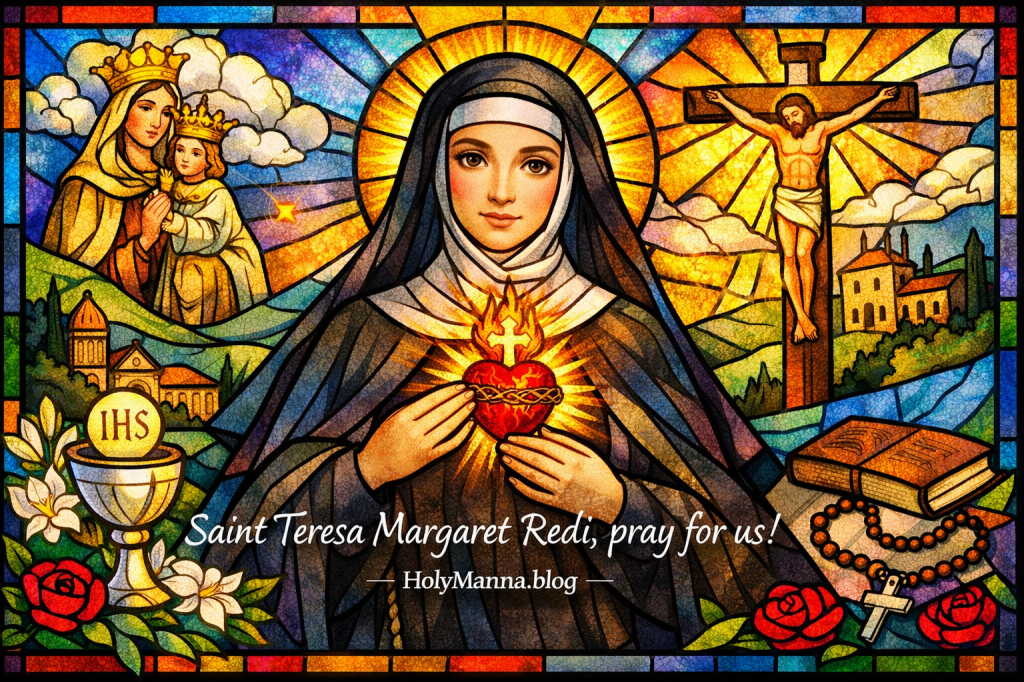
Burning Snow and the Sacred Heart
Saint Teresa Margaret Redi, a young Discalced Carmelite nun from Tuscany, lived a life that looked small from the outside and ended before she turned twenty-three. Yet the Church canonized her because her love was unmistakably real. She is remembered for a simple, blazing spirituality rooted in one line from The First Letter of John: “God is love.” 1 Jn 4:16. In Carmel, she tried to make that truth concrete in every ordinary duty, especially in the quiet heroism of caring for the sick.
Pope Pius XI famously described her with a paradox that still sticks in the mind: “burning snow.” It captures her purity, her gentleness, and also the fire of charity that made her impossible to ignore, even in a cloister.
A Tuscan Girl Marked by Carmel
She was born Anna Maria Redi on July 15, 1747, in Arezzo, Tuscany, into a noble Catholic family. She was baptized the next day, July 16, the feast traditionally associated with Our Lady of Mount Carmel. That date feels like a quiet prophecy when the rest of her story is heard.
As a girl she was educated in Florence, including time as a student with Benedictine sisters at Santa Apollonia. Her faith was not a vague family custom. It deepened into a real hunger for God and a desire to belong entirely to Jesus. She eventually felt drawn to the Discalced Carmelite life, the hidden school of prayer shaped by saints like Saint Teresa of Ávila.
When she entered Carmel in Florence on September 1, 1764, she began the path that would simplify her life down to one thing: love. She took the name Teresa Margaret of the Sacred Heart of Jesus. The name was not a poetic flourish. In the Church’s own records for her canonization, it is explained that “Margaret” was chosen because she looked to Saint Margaret Mary Alacoque as a guide, and “of the Sacred Heart” expressed her desire to offer herself as an oblation to the Heart of Jesus, returning love for love.
What was she most known for? Not public preaching, not politics, not a dramatic conversion story. She is known for something the modern world forgets how to value: a hidden life where charity becomes a constant decision.
The Infirmary as a School of Holiness
Inside the monastery, Teresa Margaret was not treated like a celebrity saint-in-training. She lived the same routine as the other sisters, and she learned to become small in the way that actually makes a soul strong.
Her signature was charity. She served as an infirmarian, caring for sick sisters with patience and tenderness. It is one thing to admire the idea of love. It is another thing to live it at close range, day after day, with real people who are tired, anxious, in pain, or difficult. She learned that love is not a mood. Love is a choice.
This is exactly where Catholic teaching becomes practical. The Church does not define holiness as being interesting. Holiness is charity perfected. The Catechism teaches that charity is the theological virtue by which Christians love God above all things and love neighbor for God’s sake, and that charity “binds everything together in perfect harmony.” CCC 1822–1829. Teresa Margaret lived that “harmony” not through comfort, but through sacrifice.
People sometimes ask whether she worked miracles during her lifetime. There is no widely attested record of public miracles performed by her while she lived. Her “miracle” in life was the steady transformation of ordinary duties into an offering of love, and the way her joy and patience seemed to lift the atmosphere of community life. Her spirituality revolved around Scripture, especially the line she repeated like a heartbeat: “God is love.” 1 Jn 4:16.
One of her most quoted lines, preserved in the Church’s biography of her, captures her warm simplicity about Jesus. She once exclaimed in Italian: “Che bella scala, che scala preziosa, indispensabile è il nostro buon Gesù!” The meaning in English is: “What a beautiful ladder, what a precious ladder, indispensable is our good Jesus!” It is the language of someone who does not treat the faith as a concept, but as a relationship.
The White Martyrdom of Daily Charity
Teresa Margaret was not a martyr in the sense of dying by persecution. Still, the Church has always recognized another kind of martyrdom, often called “white martyrdom,” where a person dies to self again and again through obedience, humility, and charity.
She endured the inner trials that come with religious life: misunderstandings, corrections, and humiliations offered as a test of virtue. She also endured physical suffering, including serious pain in her short life. Her final trial came suddenly. She became gravely ill and died on March 7, 1770, in Florence. Church sources describe her death as caused by peritonitis. She was not yet twenty three.
Her suffering matters spiritually because it shows the Christian pattern: love is proven in the moment it costs something. Christ does not save humanity by sentiment. He saves by the Cross. Teresa Margaret’s life was a small echo of that truth, lived behind monastery walls.
A Legacy of Sacred Heart Love
After her death, devotion to Teresa Margaret grew quickly, and stories spread about her holiness. Catholic tradition reports a fragrance associated with her death, sometimes called an odor of sanctity. Her body has been venerated in Florence and is often described in Catholic sources as incorrupt. The faithful have long visited and prayed there, asking her intercession, especially for growth in charity and purity of heart.
The Church’s process of canonization includes careful investigation of miracles attributed to a saint’s intercession. In Teresa Margaret’s case, multiple healings were formally recognized in the official documentation of her beatification and canonization recorded in Acta Apostolicae Sedis.
For her beatification, two healings were accepted as miracles attributed to her intercession. One involved Sister Maria Ducei, healed from a severe tubercular lung illness. Another involved a young girl named Henrica Giorgi, healed from Pott’s disease, a serious form of tuberculosis affecting the spine. These were not presented as vague rumors. They were investigated and approved in the Church’s official process.
For her canonization, two additional miracles were recognized. One involved a four year old boy, Laurentius Garbagni, who suffered from acute appendicitis with abscess and severe abdominal complications. According to the Church’s record, his mother placed a relic on him and prayed for Teresa Margaret’s intercession, and he recovered in a way judged medically extraordinary for the time. Another involved Fulvia Farsetti Razzi, an elderly woman with severe disability linked to a fractured femoral neck and complications. Her healing was associated with prayer during public veneration connected to Teresa Margaret’s body.
Alongside these officially recognized miracles, older Carmelite traditions also preserve stories of favors received through her intercession, including healings and help in desperate moments. Some accounts involve relics, such as a small object associated with her being used in prayer during illness. These stories belong to the stream of popular devotion and are not always verifiable today with the precision modern readers might want. When such accounts cannot be confirmed through formal documentation, they should be received as testimonies of faith and gratitude, while acknowledging that they cannot be verified.
Her cultural impact is strongest in Carmelite spirituality and in the Church’s devotion to the Sacred Heart. She is a living reminder that the Sacred Heart is not a decoration. It is a call to love with the seriousness of Jesus Himself. Her memory is celebrated on March 7, the day of her death, and she is also honored in Carmelite calendars with special observances connected to her Carmelite story.
Doing Small Things
Saint Teresa Margaret Redi is a saint for people who feel ordinary. She proves that holiness is not reserved for the dramatic and the famous. Holiness is for the faithful person who chooses love when it is inconvenient, and chooses it again when nobody is applauding.
Her whole life points back to one truth: “God is love.” 1 Jn 4:16. That line is not meant to be a cute caption. It is meant to become a way of living. The Christian life is not about winning arguments. It is about becoming a person who can love like Christ, because Christ lives in the soul by grace. The Catechism teaches that the charity of Christ is poured into hearts through the Holy Spirit, and that this charity shapes every virtue. CCC 1822–1829.
Her example is practical. Love God with real choices. Serve the people closest by, not the imaginary audience online. Be faithful in prayer. Receive the Eucharist with reverence. Keep devotion to the Sacred Heart from becoming sentimental by letting it demand something concrete, like patience with a spouse, kindness to a difficult coworker, or a quiet act of generosity no one sees.
The world is noisy and addicted to being noticed. Carmel teaches the opposite lesson: the soul becomes strong in silence, and love becomes pure when it is offered without applause.
Engage with Us!
Share your thoughts and reflections in the comments below. Saint Teresa Margaret Redi lived a hidden life, but her love still challenges modern hearts, especially when faith feels routine or unseen.
- Where is God inviting a more faithful, more patient love in daily life, especially in the small duties that feel unnoticed?
- When frustration rises, what would change if the heart repeated the truth, “God is love” 1 Jn 4:16, and chose charity anyway?
- What is one practical way to honor the Sacred Heart of Jesus this week through a real act of mercy or self-denial?
- Who is one person that needs gentleness right now, and how can that gentleness become an offering to Christ?
- If holiness is mostly hidden, what habits of prayer and discipline can help the soul stay faithful when nobody is watching?
Keep moving forward in faith. Live close to Jesus, stay close to His Heart, and do everything with the love and mercy He taught, because the smallest act done with true charity can become a fire that warms the world.
Saint Teresa Margaret Redi, pray for us!
Follow us on YouTube, Instagram and Facebook for more insights and reflections on living a faith-filled life.

 Holy Manna!
Leave a comment