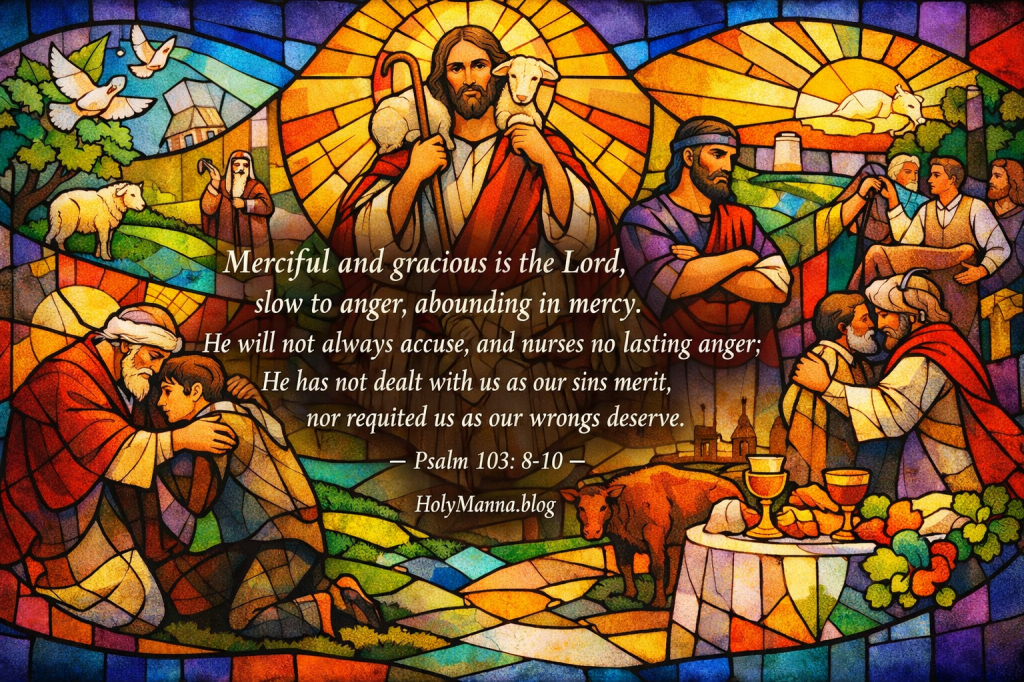
Saturday of the Second Week of Lent – Lectionary: 235
When Mercy Comes Looking for You
Some days in Lent feel like a long walk through the desert, but today’s Word of God feels like a road that leads back to the front door of the Father’s house. The central theme tying every line together is the Lord’s covenant mercy, a mercy that does not merely overlook sin, but actually removes guilt, restores communion, and turns return into celebration.
This is the kind of mercy Israel learned to recognize in its own history. In the days of the prophets, the people knew what it meant to be scattered, anxious, and unsure whether the future would hold judgment or restoration. Micah 7:14-15, 18-20 rises from that world, where God’s flock seems small and vulnerable, and yet the prophet dares to pray for a new Exodus, asking the Lord to shepherd His people again and to show mighty deeds like the wonders of Egypt. The miracle is not only that God can rescue, but that God wants to rescue, because His heart is not set on endless anger. The prophet says it with holy astonishment: “Who is a God like you, who removes guilt and pardons sin… who does not persist in anger forever, but instead delights in mercy.” In other words, the Lord’s power is revealed most clearly not when He crushes enemies, but when He crushes sin underfoot and throws it out of reach.
That same truth becomes a song in Psalm 103:1-4, 8-12. Israel’s worship was never meant to be a performance of the righteous pretending they never fell. It was always meant to be grateful remembrance, the soul blessing the Lord who heals, redeems, and crowns His people with compassion. The psalm makes a daring claim about God’s character that every generation needs to hear again: “Merciful and gracious is the Lord, slow to anger, abounding in mercy.” God’s mercy is not a rumor or a mood. It is the steady identity of the Lord, the very reason sinners can return without being swallowed by shame.
Then The Gospel of Luke 15:1-3, 11-32 puts flesh on everything the prophet prayed and everything the psalm sang. Jesus tells a story in response to religious grumbling, because the scandal of the Gospel is that God welcomes sinners and eats with them. The parable of the lost son reveals a Father who watches the horizon, runs toward the repentant, and restores sonship with unmistakable signs. It also reveals an older brother who stays near the house but resists the feast, proving that it is possible to obey externally while remaining far from mercy within. Lent brings both sons into the light, because both forms of lostness need healing: the rebellion that runs away and the resentment that refuses to rejoice.
Where does the heart recognize itself today, in the distant country or outside the banquet, and what would it look like to finally step toward the Father who delights in mercy?
First Reading | Micah 7:14-15, 18-20
The Shepherd Who Refuses to Give Up on His Flock
Lent has a way of stripping life down to what is real. When the noise quiets, the heart starts to notice whether it has been living close to the Shepherd or wandering like it has no home. Micah speaks into a moment when Israel knew what it meant to be wounded by sin and threatened by exile. The prophet does not pretend that sin is small, but he also refuses to pretend that God’s mercy is small. In the closing lines of the book, a prayer rises from the remnant, asking the Lord to shepherd His people again, to repeat the wonders of the Exodus, and to prove once more that the God of the covenant delights in mercy. That is exactly today’s theme: the Lord does not merely tolerate the repentant. The Lord restores them, forgives them, and leads them back into life.
Micah 7:14-15, 18-20 – New American Bible (Revised Edition)
14 Shepherd your people with your staff,
the flock of your heritage,
That lives apart in a woodland,
in the midst of an orchard.
Let them feed in Bashan and Gilead,
as in the days of old;
15 As in the days when you came from the land of Egypt,
show us wonderful signs.18 Who is a God like you, who removes guilt
and pardons sin for the remnant of his inheritance;
Who does not persist in anger forever,
but instead delights in mercy,
19 And will again have compassion on us,
treading underfoot our iniquities?
You will cast into the depths of the sea all our sins;
20 You will show faithfulness to Jacob,
and loyalty to Abraham,
As you have sworn to our ancestors
from days of old.
Detailed Exegesis
Verse 14: “Shepherd your people with your staff, the flock of your heritage, That lives apart in a woodland, in the midst of an orchard. Let them feed in Bashan and Gilead, as in the days of old;”
This is not a sentimental image. In Scripture, shepherding is leadership, protection, correction, and tender guidance all at once. The “staff” signals authority, not tyranny. It is the steady hand that guards the flock from danger and keeps it from wandering into cliffs. Calling Israel “the flock of your heritage” is covenant language. The people are not a random crowd. They belong to the Lord because He chose them, formed them, and bound Himself to them. The mention of Bashan and Gilead evokes regions known for abundance and pasture, which turns this prayer into more than survival. It is a plea for restoration, security, and a return to the Lord’s generosity “as in the days of old.”
Verse 15: “As in the days when you came from the land of Egypt, show us wonderful signs.”
Here the prayer reaches back to the Exodus, Israel’s foundational experience of salvation. The people are essentially asking for a new Exodus, not necessarily a repeat of plagues and parted seas, but a fresh act of divine deliverance that proves God is still God. In Lent, this sounds familiar because the Church walks toward Easter, where the definitive Exodus happens in Christ’s Passover from death to life. The reading quietly trains the heart to expect God to act, not because human beings deserve it, but because God is faithful.
Verse 18: “Who is a God like you, who removes guilt and pardons sin for the remnant of his inheritance; Who does not persist in anger forever, but instead delights in mercy,”
This is the high point of the passage, and it is meant to land with awe. The prophet does not deny that God is just, but he insists that God’s justice is never separated from His mercy. The word “remnant” matters because it is the humble group that survives not by superiority, but by mercy. God’s holiness does not make Him allergic to repentant sinners. God’s holiness is precisely what heals and restores them. The line that should echo in the soul all day is this: God “delights in mercy.” Mercy is not God’s reluctant exception. Mercy is God’s chosen joy.
Verse 19: “And will again have compassion on us, treading underfoot our iniquities? You will cast into the depths of the sea all our sins;”
The prophet describes forgiveness with vivid, almost physical imagery. God does not simply cover sin with a thin blanket. God tramples iniquity underfoot, like a defeated enemy that no longer rules. Then comes the astonishing promise: sins are cast into the sea’s depths. In Israel’s memory, the sea can represent chaos and fear, but it is also where God once swallowed up oppression at the Red Sea. The message is clear. God can bury sin so completely that it no longer has the final word over a repentant life.
Verse 20: “You will show faithfulness to Jacob, and loyalty to Abraham, As you have sworn to our ancestors from days of old.”
Micah ends where hope always ends, not in human performance but in God’s promise. Jacob and Abraham represent the covenant story, the Lord’s sworn commitment to bless, to guide, and to keep His word. Even when the people are inconsistent, God remains faithful. That is not permission to sin. It is fuel for repentance, because the Lord’s fidelity becomes the safe ground where conversion can happen without despair.
Teachings
This reading is a masterclass in covenant mercy. It insists that sin is serious, but it also insists that God is more serious about saving than sinners are about running. The shepherd image is not decoration. It reveals God’s identity as the One who leads His people through danger and back into communion. It is the same divine heart that will be fully revealed in Jesus Christ, who seeks the lost and brings them home.
The Catechism captures the core of today’s reading with a line that deserves to be remembered in Lent: CCC 1846 says, “The Gospel is the revelation in Jesus Christ of God’s mercy to sinners.” That is the bridge between Micah and the whole Christian life. Mercy is not a vague optimism. Mercy is the Gospel itself.
The promise that God “removes guilt” also belongs to the Church’s confidence in the forgiveness Christ won and entrusted to His Bride. The Catechism speaks with bold clarity about the Church’s mission of mercy. CCC 982 says, “There is no offense, however serious, that the Church cannot forgive.” That does not minimize sin. It magnifies the power of Christ’s redemption and the seriousness of repentance.
Saints and Doctors of the Church often underline this same truth: God’s mercy is not weakness. Mercy is divine strength bending down to lift the fallen. The tradition consistently teaches that God’s mercy does not compete with His justice, because God’s justice aims at restoration when the sinner returns. That is why Micah can speak so confidently of sins being cast away. When God forgives, He truly forgives.
Reflection
There is a reason this reading belongs in Lent. Many people live like God is easily annoyed and slow to forgive, but Micah says the opposite. God does not persist in anger forever. God delights in mercy. That means the spiritual life is not a long attempt to earn a Father’s affection. The spiritual life is learning to trust the affection that already calls the sinner home.
A practical way to live this reading is to pray like the prophet prays. It is possible to ask the Lord to shepherd the heart again, especially in areas where it has become stubborn, secretive, or tired. It is also possible to practice holy memory the way Israel does here by recalling God’s past deliverances, not to romanticize the past, but to strengthen hope that God can act again today. Another concrete step is to bring guilt into the light, because this reading does not describe a God who merely tolerates guilt. It describes a God who removes it. That is why Lent is such a fitting time to make a serious examination of conscience, to repent honestly, and to return to the mercy Christ gives through His Church.
Where has the heart been trying to survive in the “woodland,” living apart instead of living close to the Shepherd?
What would change this week if God’s mercy were treated as something God truly “delights” in giving, rather than something that must be dragged out of Him?
If the Lord can cast sins into the depths of the sea, why does the heart keep fishing them back out with regret and self-accusation?
Responsorial Psalm | Psalm 103:1-4, 8-12
A Soul That Remembers Mercy and Refuses to Forget
Israel did not sing the psalms as background music. The psalms were the people’s prayerbook, their school of trust, and their way of remembering who God is when life felt heavy. Psalm 103 is traditionally attributed to David, and it reads like a man preaching to his own heart before he tries to preach to anyone else. That is exactly why it fits so perfectly with today’s theme. After Micah cries out that God “delights in mercy,” the psalm answers with praise, as if the soul is saying, “This is not theory. This is who the Lord has always been.” During Lent, the Church puts this psalm on the lips of the faithful to strengthen hope in conversion. God does not wait for perfection before offering compassion. God forgives, heals, redeems, and removes sin farther than the horizon.
Psalm 103:1-4, 8-12 – New American Bible (Revised Edition)
Praise of Divine Goodness
1 Of David.
Bless the Lord, my soul;
all my being, bless his holy name!
2 Bless the Lord, my soul;
and do not forget all his gifts,
3 Who pardons all your sins,
and heals all your ills,
4 Who redeems your life from the pit,
and crowns you with mercy and compassion,8 Merciful and gracious is the Lord,
slow to anger, abounding in mercy.
9 He will not always accuse,
and nurses no lasting anger;
10 He has not dealt with us as our sins merit,
nor requited us as our wrongs deserve.11 For as the heavens tower over the earth,
so his mercy towers over those who fear him.
12 As far as the east is from the west,
so far has he removed our sins from us.
Detailed Exegesis
Verse 1: “Bless the Lord, my soul; all my being, bless his holy name!”
This opening is a summons to worship from the inside out. The psalmist is not waiting to feel inspired. He commands his own soul to bless the Lord. The phrase “all my being” signals total engagement. God is not a weekend hobby. God is the center, and His “holy name” is His revealed identity, His faithful character. In Lent, this verse trains the heart to begin with God, not with guilt. Worship is the first step out of self-absorption.
Verse 2: “Bless the Lord, my soul, and do not forget all his gifts,”
Forgetfulness is one of the quiet roots of sin. When people forget God’s gifts, gratitude dries up, and resentment grows easily. The psalmist knows this, so he insists on memory. This is religious and cultural memory, the same kind of memory Israel practiced at Passover when it retold salvation history so the next generation would live as people rescued by God. Lent is a season of sacred remembering, because repentance becomes possible when the heart remembers it has a Father.
Verse 3: “Who pardons all your sins, and heals all your ills,”
The psalm connects forgiveness and healing. Sin wounds, not only relationships but the interior life. The Lord’s mercy is not merely a legal declaration. It is also medicine for what has been damaged. The verse does not claim that every illness disappears instantly, but it does proclaim that God is the healer of the whole person. In the spiritual sense, sin is the deepest illness because it separates the heart from God. The Lord pardons “all your sins,” which is a bold, consoling line for anyone tempted to think some failures are beyond mercy.
Verse 4: “Who redeems your life from the pit, and crowns you with mercy and compassion,”
“The pit” is the language of near-despair, the place where life feels swallowed. The Lord is described as a redeemer, the One who buys back what seems lost. Then the image becomes royal: God “crowns” the person not with shame but with mercy and compassion. That is the opposite of how the world treats failure. The world labels and humiliates. God restores dignity.
Verse 8: “Merciful and gracious is the Lord, slow to anger, abounding in mercy.”
This is one of the Bible’s most repeated descriptions of God, echoing the Lord’s self-revelation to Moses after Israel’s sin with the golden calf. The timing matters. God speaks mercy precisely when the people have proven they do not deserve it. “Slow to anger” does not mean God is indifferent to evil. It means His patience is real, His desire to save is strong, and His mercy is abundant. Lent is the season when this line becomes a lifeline.
Verse 9: “He will not always accuse, and nurses no lasting anger;”
The Lord is not a bitter scorekeeper. This verse does not deny divine judgment, but it denies the caricature of God as endlessly resentful. “Accuse” is the language of prosecution. God corrects and disciplines, but His goal is restoration, not humiliation. His anger is never the final chapter for the repentant.
Verse 10: “He has not dealt with us as our sins merit, nor requited us as our wrongs deserve.”
This is mercy defined. If God dealt with humanity strictly according to merit, no one would stand. This line is not permission to take sin lightly. It is an invitation to take mercy seriously. In Lent, it teaches humility, because it reminds the soul that everything good is gift, not entitlement.
Verse 11: “For as the heavens tower over the earth, so his mercy towers over those who fear him.”
The “fear of the Lord” here is not panic. It is reverent awe, a holy recognition of God’s greatness that leads to obedience and trust. The psalm measures mercy with cosmic distance, because human beings tend to measure mercy with small grudges. God’s mercy towers. It is higher than the mind’s ability to calculate.
Verse 12: “As far as the east is from the west, so far has he removed our sins from us.”
This is one of Scripture’s most consoling images of forgiveness. East and west never meet, which means the psalm is describing a removal so complete that it cannot be undone by endless self-reproach. When God forgives, He separates the sinner from the sin. In the life of grace, the past is not erased from memory, but it is stripped of its power to define the person.
Teachings
Psalm 103 teaches that true repentance is built on truth and hope together. Truth says sin is real. Hope says mercy is greater. The psalm’s logic is deeply Catholic: praise flows from remembering God’s gifts, and conversion grows when the soul trusts God’s character.
The Catechism teaches that the Psalms are central to the prayer of the Church, and it describes their purpose in a way that fits today perfectly. CCC 2587 says, “The Psalms both nourish and express prayer for all people, in every age and in every circumstance.” This is why the Church keeps putting psalms into the Mass. The faithful are not meant to guess how to pray. The Lord gives words that can carry sorrow, repentance, gratitude, and hope.
The psalm also supports the Church’s confidence about repentance and God’s desire to forgive. The Catechism speaks plainly about the Father’s mercy for those who turn back to Him. CCC 1439 says, “The process of conversion and repentance was described by Jesus in the parable of the prodigal son, the center of which is the merciful father: the fascination of illusory freedom, the abandonment of the father’s house; the extreme misery in which the son finds himself after squandering his fortune; his deep humiliation at finding himself obliged to feed swine and, still worse, at wanting to feed on the husks the swine ate; his reflection on the lost blessings; his repentance and decision to declare himself guilty before his father; the journey back; the father’s generous welcome; the father’s joy. Such is the heart of the Father.”
That teaching belongs here because Psalm 103 is the song that the returned child learns to sing. It is the prayer of someone who finally believes the Father’s joy is real.
Saint Augustine often taught that the Psalms give voice to Christ and to the Church, forming believers to pray with the mind of Christ. That matters in Lent, because the psalm reshapes instinct. Instead of obsessing over accusation, it teaches the heart to bless the Lord for redemption.
Reflection
This psalm is for anyone who struggles with scrupulosity, discouragement, or the exhausting habit of replaying failures. It is also for anyone who has gone numb to sin and needs to recover a sense of reverence. The psalm holds both together by insisting that God is holy and merciful, and that mercy is not fragile.
A simple way to live this psalm is to practice spiritual memory. The soul can “forget all his gifts” very quickly, especially when stressed, distracted, or tempted. One practical step is to end the day by naming a few gifts that came from the Lord, not as a self-help exercise, but as worship. Another step is to bring sin into honest repentance without dramatizing it. The psalm does not pretend sin is harmless, but it refuses to let sin become the main character. God’s mercy is the main character. A final step is to stop treating accusation as humility. Real humility agrees with God, which means accepting forgiveness when it is given, and living like a forgiven person.
What gift from God has been easy to forget lately, and how might gratitude soften the heart for repentance?
When the heart hears that God removes sin “as far as the east is from the west,” does it actually believe that forgiveness is stronger than shame?
If the Lord does not “always accuse,” why does the heart keep returning to self-accusation as if it were a form of holiness?
Holy Gospel | Luke 15:1-3, 11-32
The Homecoming That Exposes Every Heart
In the world Jesus lived in, meals were never just about food. To eat with someone was to show acceptance, closeness, and a kind of public solidarity. That is why the religious leaders grumble when they see Jesus welcoming sinners. In their minds, holiness meant distance. In Jesus’ teaching, holiness means mercy that heals and restores. Then the Lord tells a story that lands like a mirror on the soul. It is a parable shaped by first-century family honor, inheritance customs, and the deep shame of a Jewish son ending up with pigs. Yet it is also a parable with a heartbeat that never gets old: God is a Father who runs toward the repentant, restores true sonship, and invites even the resentful to come into the feast. This Gospel completes today’s theme from Micah 7 and Psalm 103. The God who “delights in mercy” is not an idea. He is the Father who comes looking for His children.
Luke 15:1-3, 11-32 – New American Bible (Revised Edition)
1 The tax collectors and sinners were all drawing near to listen to him, 2 but the Pharisees and scribes began to complain, saying, “This man welcomes sinners and eats with them.” 3 So to them he addressed this parable.
The Parable of the Lost Son. 11 Then he said, “A man had two sons, 12 and the younger son said to his father, ‘Father, give me the share of your estate that should come to me.’ So the father divided the property between them. 13 After a few days, the younger son collected all his belongings and set off to a distant country where he squandered his inheritance on a life of dissipation. 14 When he had freely spent everything, a severe famine struck that country, and he found himself in dire need. 15 So he hired himself out to one of the local citizens who sent him to his farm to tend the swine. 16 And he longed to eat his fill of the pods on which the swine fed, but nobody gave him any. 17 Coming to his senses he thought, ‘How many of my father’s hired workers have more than enough food to eat, but here am I, dying from hunger. 18 I shall get up and go to my father and I shall say to him, “Father, I have sinned against heaven and against you. 19 I no longer deserve to be called your son; treat me as you would treat one of your hired workers.”’ 20 So he got up and went back to his father. While he was still a long way off, his father caught sight of him, and was filled with compassion. He ran to his son, embraced him and kissed him. 21 His son said to him, ‘Father, I have sinned against heaven and against you; I no longer deserve to be called your son.’ 22 But his father ordered his servants, ‘Quickly bring the finest robe and put it on him; put a ring on his finger and sandals on his feet. 23 Take the fattened calf and slaughter it. Then let us celebrate with a feast, 24 because this son of mine was dead, and has come to life again; he was lost, and has been found.’ Then the celebration began. 25 Now the older son had been out in the field and, on his way back, as he neared the house, he heard the sound of music and dancing. 26 He called one of the servants and asked what this might mean. 27 The servant said to him, ‘Your brother has returned and your father has slaughtered the fattened calf because he has him back safe and sound.’ 28 He became angry, and when he refused to enter the house, his father came out and pleaded with him. 29 He said to his father in reply, ‘Look, all these years I served you and not once did I disobey your orders; yet you never gave me even a young goat to feast on with my friends. 30 But when your son returns who swallowed up your property with prostitutes, for him you slaughter the fattened calf.’ 31 He said to him, ‘My son, you are here with me always; everything I have is yours. 32 But now we must celebrate and rejoice, because your brother was dead and has come to life again; he was lost and has been found.’”
Detailed Exegesis
Verse 1: “The tax collectors and sinners were all drawing near to listen to him,”
The scene begins with people on the margins moving closer to Jesus. Tax collectors were often seen as collaborators and morally compromised. “Sinners” signals those publicly judged as outside religious respectability. The first movement of grace is already happening here, because they are “drawing near” to the Lord.
Verse 2: “but the Pharisees and scribes began to complain, saying, ‘This man welcomes sinners and eats with them.’”
The complaint reveals a broken image of God. The Pharisees and scribes were serious about the Law, but their zeal can become suspicion when mercy shows up. The scandal is not that sinners want God, but that God wants sinners close enough to share a table.
Verse 3: “So to them he addressed this parable.”
Jesus does not argue in abstractions. He tells a parable that exposes the heart. The goal is conversion, not humiliation, because the Father in the story will go out to both sons.
Verse 11: “Then he said, ‘A man had two sons,’”
Two sons means two ways of being lost. One will run away openly. The other will stay close physically while drifting far interiorly. The story is aimed at everyone listening, including the grumblers.
Verse 12: “and the younger son said to his father, ‘Father, give me the share of your estate that should come to me.’ So the father divided the property between them.”
This request is more than financial. It is relational violence, because it treats the father as useful, not beloved. Yet the father allows freedom. Love does not force. Even divine mercy respects human choice.
Verse 13: “After a few days, the younger son collected all his belongings and set off to a distant country where he squandered his inheritance on a life of dissipation.”
The “distant country” is the geography of sin, a life lived far from the Father. The inheritance becomes fuel for self-destruction. Dissipation is what happens when freedom is detached from truth.
Verse 14: “When he had freely spent everything, a severe famine struck that country, and he found himself in dire need.”
Sin always promises abundance and delivers emptiness. The famine is both literal and spiritual. When the false feast ends, need becomes unavoidable.
Verse 15: “So he hired himself out to one of the local citizens who sent him to his farm to tend the swine.”
This is a descent into shame. For a Jewish son, pigs were unclean. The story shows how far the heart can fall when it insists on life without the Father.
Verse 16: “And he longed to eat his fill of the pods on which the swine fed, but nobody gave him any.”
The emptiness deepens. He is not only hungry, but alone. Sin isolates. What looked like independence becomes a kind of slavery.
Verse 17: “Coming to his senses he thought, ‘How many of my father’s hired workers have more than enough food to eat, but here am I, dying from hunger.’”
Repentance begins with clarity. “Coming to his senses” is the turning point. He remembers the father’s goodness, not as a trick, but as truth that exposes the lie he believed.
Verse 18: “I shall get up and go to my father and I shall say to him, ‘Father, I have sinned against heaven and against you.’”
This is confession in seed form. The son names sin as offense against God and against relationship. He does not blame anyone else. He prepares to return.
Verse 19: “I no longer deserve to be called your son; treat me as you would treat one of your hired workers.’”
He understands he cannot demand restoration. Yet he still believes the father is good enough to receive him. Even imperfect repentance can move toward the Father.
Verse 20: “So he got up and went back to his father. While he was still a long way off, his father caught sight of him, and was filled with compassion. He ran to his son, embraced him and kissed him.”
This is the Gospel in motion. The father watches, recognizes, and runs. The embrace comes before the son finishes his speech. Mercy meets the sinner on the road, not after the sinner proves himself.
Verse 21: “His son said to him, ‘Father, I have sinned against heaven and against you; I no longer deserve to be called your son.’”
The confession is real, even though mercy has already begun. The son speaks truth. The Father’s love does not cancel repentance. It completes it.
Verse 22: “But his father ordered his servants, ‘Quickly bring the finest robe and put it on him; put a ring on his finger and sandals on his feet.’”
The robe signals honor restored. The ring signals authority and belonging. The sandals distinguish a free son from a barefoot servant. The father restores identity, not merely comfort.
Verse 23: “Take the fattened calf and slaughter it. Then let us celebrate with a feast,”
This is not a quiet private forgiveness. It is public joy. The father wants the household to see what mercy does. Heaven rejoices when the lost come home.
Verse 24: “because this son of mine was dead, and has come to life again; he was lost, and has been found.’ Then the celebration began.”
The father interprets conversion as resurrection. Sin is death. Repentance is life. The feast is not a reward for good behavior, but a proclamation that grace has restored communion.
Verse 25: “Now the older son had been out in the field and, on his way back, as he neared the house, he heard the sound of music and dancing.”
The older son is close to the house but not close to the joy. He hears celebration as noise, not as good news. This is the subtle tragedy of resentment.
Verse 26: “He called one of the servants and asked what this might mean.”
Instead of entering, he stands outside and questions. The posture already hints at a heart that feels entitled, not grateful.
Verse 27: “The servant said to him, ‘Your brother has returned and your father has slaughtered the fattened calf because he has him back safe and sound.’”
The servant names the event as restoration and safety. The father is not celebrating sin. The father is celebrating return.
Verse 28: “He became angry, and when he refused to enter the house, his father came out and pleaded with him.”
The older son’s lostness is revealed. He refuses communion. Yet the father goes out to him too. Mercy is not only for the runaway. Mercy also confronts the hard-hearted.
Verse 29: “He said to his father in reply, ‘Look, all these years I served you and not once did I disobey your orders; yet you never gave me even a young goat to feast on with my friends.’”
He speaks like a worker demanding wages, not a son living in love. He reduces obedience to transaction. Resentment turns blessings into claims.
Verse 30: “But when your son returns who swallowed up your property with prostitutes, for him you slaughter the fattened calf.’”
He cannot say “my brother.” He says “your son.” Resentment fractures family. He also assumes the worst details, which is what bitterness loves to do.
Verse 31: “He said to him, ‘My son, you are here with me always; everything I have is yours.’”
The father reassures him with tenderness. The older son has not been deprived. He has been blind to his own inheritance. Life with the Father was already the gift.
Verse 32: “But now we must celebrate and rejoice, because your brother was dead and has come to life again; he was lost and has been found.’”
The father insists that mercy is not optional. Rejoicing at repentance is part of righteousness. The household must reflect the Father’s heart, or it has missed the point of being a family at all.
Teachings
This Gospel stands at the center of Catholic preaching on conversion because it reveals the Father’s heart with unforgettable clarity. The younger son shows how sin degrades dignity and reduces the soul to hunger. The father shows how mercy restores identity and communion. The older son shows how outward obedience can hide a heart that resents grace, especially grace given to someone else.
The Catechism explicitly teaches that Jesus describes conversion through this parable. CCC 1439 says, “The process of conversion and repentance was described by Jesus in the parable of the prodigal son, the center of which is the merciful father: the fascination of illusory freedom, the abandonment of the father’s house; the extreme misery in which the son finds himself after squandering his fortune; his deep humiliation at finding himself obliged to feed swine and, still worse, at wanting to feed on the husks the swine ate; his reflection on the lost blessings; his repentance and decision to declare himself guilty before his father; the journey back; the father’s generous welcome; the father’s joy. Such is the heart of the Father.”
This is also why Lent places such emphasis on sacramental repentance. The Father’s embrace is not only a story. Christ makes mercy concrete through the Sacrament of Penance, where guilt is not merely managed but removed. The Catechism describes the heart of this sacrament with a sentence that sounds like today’s feast of mercy. CCC 1468 says, “The whole power of the sacrament of Penance consists in restoring us to God’s grace and joining us with him in an intimate friendship.”
At the same time, the older brother warns against a spiritual life driven by comparison. The Gospel exposes the temptation to treat God like an employer and grace like unfair pay. In Catholic tradition, true holiness always includes joy at another person’s repentance, because charity cannot rejoice in another’s fall but must rejoice in another’s return. The father’s final words make it clear that mercy is not a threat to righteousness. Mercy is the crown of righteousness, because it reflects God’s own heart.
Reflection
This parable is simple enough for a child to understand, and deep enough to keep a grown man humbled for decades. It invites an honest question: which son is speaking louder in the soul lately. Some seasons look like the younger son, chasing a “distant country” that promises relief but produces hunger. Other seasons look like the older son, doing the right things while quietly growing bitter, especially when God seems generous to someone else.
A practical way to live this Gospel is to stop negotiating with God and start returning to Him. The younger son rehearses a speech that tries to control the outcome, but the father interrupts that plan with mercy. Many people do the same thing spiritually by postponing conversion until they feel presentable. Lent is the Father’s invitation to get up, go home, and let mercy speak first. Another practical step is to examine resentment. The older son’s anger is not healed by arguments but by entering the feast. Joy is often an act of humility, especially when it requires celebrating another person’s restoration.
This Gospel also calls for mercy in daily relationships. The father runs toward the repentant. That does not mean ignoring truth or pretending wounds never happened. It means choosing the goal of restoration when repentance is real. In a culture that loves canceling people, the Church has to keep looking like the Father’s house, where sin is named, repentance is welcomed, and dignity is restored.
Where has the heart been living lately, in the distant country of self-will, or outside the house with crossed arms and quiet resentment?
If the Father truly runs toward the repentant, what fear keeps the heart from making a sincere confession and coming home completely?
When someone else returns to God, does the soul rejoice like a son in the house, or does it calculate like a servant demanding wages?
Step Into the Feast and Let Mercy Rewrite the Story
Today’s readings sound like three voices singing one truth: the Lord does not grow tired of saving. Micah 7:14-15, 18-20 shows a people who know their weakness, yet dare to pray with confidence because God’s character is mercy. The prophet describes a God who shepherds His flock, who repeats the wonders of deliverance, and who does not cling to anger because He “delights in mercy”. That mercy is not vague kindness. It is covenant faithfulness that removes guilt and throws sin where it cannot rule anymore.
Then Psalm 103:1-4, 8-12 teaches the soul how to respond. The psalm does not tell the sinner to spiral into shame. It tells the heart to remember. It praises the Lord who pardons, heals, redeems, and crowns His people with compassion. It declares with quiet boldness that God does not deal with humanity as sins deserve, and that forgiveness creates real distance between the repentant and the past. Mercy is not denial. Mercy is rescue.
Finally, The Gospel of Luke 15:1-3, 11-32 brings the whole theme into a living scene. The Father watches the road, runs toward the repentant, restores sonship, and calls the household into joy. The younger son reveals what sin does when it promises freedom but delivers hunger. The older son reveals a different danger, the cold righteousness that stays near the house but refuses the feast. Yet the Father goes out to both, because God’s mercy does not only chase the reckless. It also confronts the resentful and invites them back into love.
The key message is simple and demanding: come home and stay in the Father’s joy. Lent is not a season for pretending. It is a season for returning. The Lord’s mercy is not earned by perfect performance. The Lord’s mercy is received by humble repentance, honest confession, and a heart willing to forgive others as it has been forgiven.
What would change this week if the heart believed, not just in theory, but in practice, that God delights in showing mercy? Let today be more than an inspiring story. Let it become a decision. Turn away from the distant country that drains the soul. Refuse the older brother bitterness that makes grace feel like an insult. Step into the feast with gratitude. Ask the Shepherd to lead the heart again, and keep walking toward the Father who runs to meet His children.
Engage with Us!
Please share your reflections in the comments below, because the Word of God comes alive when the Church listens together, prays together, and helps one another take the next step toward holiness.
- First Reading, Micah 7:14-15, 18-20: Where does the heart most need the Lord to “shepherd” it right now, and what specific habit or attachment needs to be placed back under His care? What would it look like to trust that God truly “casts” forgiven sins away, instead of carrying them around as a permanent label?
- Responsorial Psalm, Psalm 103:1-4, 8-12: What gift from God has been easy to forget lately, and how could gratitude reshape the way the day is lived? When the psalm says God removes sins “as far as the east is from the west,” what thoughts or fears resist believing that forgiveness is real and complete?
- Holy Gospel, Luke 15:1-3, 11-32: Which son feels more familiar right now, the one who ran into the distant country, or the one who stayed near the house but struggled to rejoice? Who needs to be welcomed, forgiven, or prayed for so that the Father’s joy can be reflected more clearly in daily life?
Keep walking forward with steady faith, even if the steps feel small, because God delights in mercy and never gets tired of bringing His children home. Let every choice today be shaped by the love of Christ, and let every relationship be marked by the mercy Jesus taught and lived.
Sacred Heart of Jesus, we trust in You!
Immaculate Heart of Mary, pray for us!
Saint Michael the Archangel, defend us in battle!
Follow us on YouTube, Instagram and Facebook for more insights and reflections on living a faith-filled life.

 Holy Manna!
Leave a comment