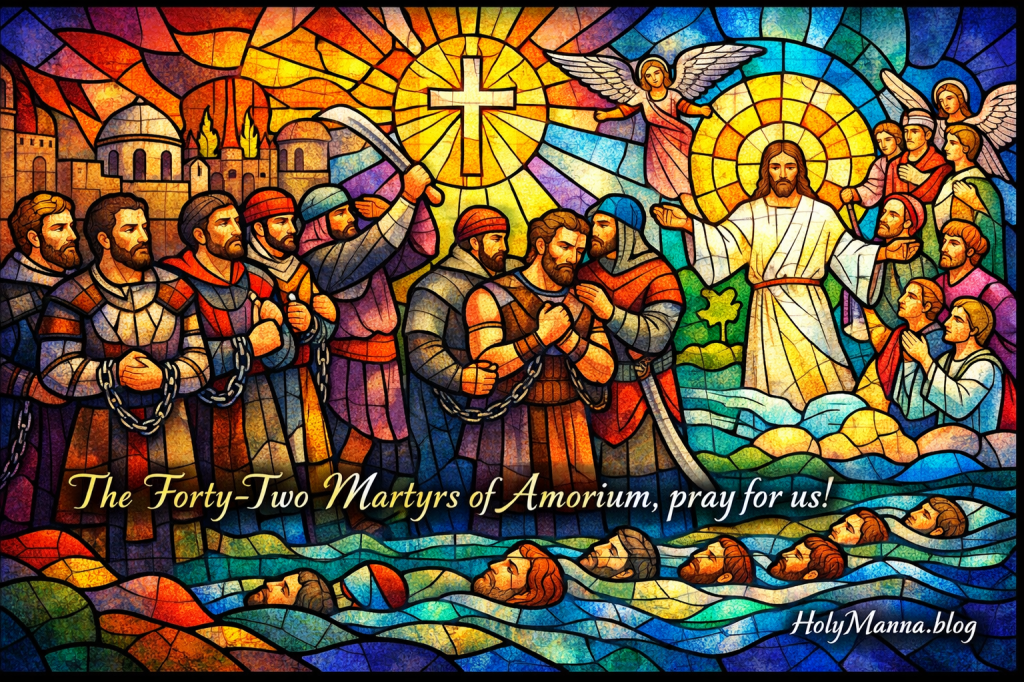
The Crowned Captives at the River
Some saints are remembered for what they built. Some are remembered for what they wrote. These saints are remembered for what they refused to do.
The Forty-Two Martyrs of Amorium were not famous because they founded a monastery or preached to crowds. They were remembered because they held the line when everything in their world fell apart. They were captured after the fall of Amorium in Phrygia, carried far from home into Syria, brought to the Euphrates, and there they received martyrdom after a long trial. The Church keeps their memory on March 6 in the Roman Martyrology, and that is already enough to tell the heart of the story. They suffered a real test, and they did not abandon Christ.
They matter because they show what martyrdom really is, not a dramatic moment for a painting, but a slow, faithful endurance where fear, exhaustion, and pressure keep coming back every day. The Catechism puts it plainly: “Martyrdom is the supreme witness given to the truth of the faith.” CCC 2473. These men gave that witness in the most public way possible, and they did it without the comforts that modern people lean on to feel brave.
Before the Chains
A lot of people want every saint to have a neat biography, complete with childhood stories and colorful personal details. With the Forty-Two Martyrs of Amorium, the Church invites a more humble kind of listening.
What is known, in the way Catholic tradition preserves it, is that they were a group of forty-two prominent Christians connected to the defense and leadership of Amorium. They are often described as high-ranking officials and military leaders. That makes their martyrdom even more striking, because these were men who understood power, strategy, and survival. They knew how the world works, and they still chose Christ over the world.
Only a handful of names are consistently preserved in later tradition. Some are remembered as Aetios, Bassoes, Constantine, Constantine Baboutzikos, Kallistos, Theodore Krateros, and Theophilos. One tradition also preserves the name Melisseno. These names are like a few stones rising above a riverbed. The rest of the forty-two remain unnamed to most of the faithful, and that is not a problem. God knows every name, and heaven does not forget.
Because their early years are not documented in a detailed way, their “conversion” is not usually a conversion from paganism, but a conversion of the heart under trial. Their deeper turning happens in captivity, when they are forced to decide whether faith is only a private opinion or the truth worth dying for.
What does it say about the Gospel that a man can lose his city, his status, and his future, and still refuse to deny Jesus?
The Long Middle
The story of these martyrs is not mostly about a single day. It is about the long middle, the stretch of years when a person wakes up still imprisoned, still pressured, still unsure how the next conversation will go. Tradition commonly speaks of years of captivity, often described as seven, in Abbasid territory, with repeated efforts to persuade them to abandon Christianity.
It is easy to imagine the temptation. If a man renounces Christ outwardly, he can go home. He can see his family again. He can eat well again. He can live. That is exactly why their witness is so pure. Their captors did not merely want them dead. They wanted them to switch sides. They wanted the public victory of apostasy.
Some accounts describe debates and arguments, the kind of back-and-forth that happens when rulers and officials interrogate men who once held rank. These were not ignorant men. They had been formed by Christian life in an empire that had called itself Christian for centuries. So their witness was not only emotional courage. It was also clarity. They refused to treat Christ as one option among many.
If there is a “miracle” during their lives, it is the miracle of persevering grace. There is no reliable catalog of healings or wonders attributed to them during their captivity in the way some saints have. Their miracle is steadiness. They show that holiness can look like refusing to move, even when the whole world is leaning on you.
The Euphrates
Eventually the long contest ended the way so many contests ended in the age of martyrs. They were brought to the Euphrates in Syria and executed, commonly described as beheaded, on March 6, 845. Their martyrdom the final step of a sustained refusal to deny Christ.
This is where it helps to remember what Jesus told His disciples: “Do not be afraid of those who kill the body but cannot kill the soul.” Mt 10:28. That is not a line for the spiritually dramatic. It is a line for people who might actually be tested, people who might actually be threatened, people who might actually be pressed to choose between comfort and truth.
These forty-two chose truth. Their martyrdom is significant because it is a witness that Christianity is not just a cultural label. It is allegiance to a Person. They would not call anyone else “Lord” in the way that belongs to Jesus Christ alone.
Signs After Death
After their deaths, tradition says their bodies were thrown into the river. One account describes the bodies being recovered by Christians for burial, a detail that matters because it shows that the faithful did not treat these men as disposable losses. They were honored as martyrs, and their relics were venerated.
There is also later legendary material that circulates in the telling of their story. One vivid narrative includes dramatic signs surrounding the fate of an apostate betrayer contrasted with the martyrs, including animal imagery. These stories belong to the world of hagiography that aims to teach and strengthen faith through striking scenes. They can be told as part of the tradition, but they cannot be verified in the same way the core facts of their martyrdom and commemoration are preserved. So it is fair to say plainly that such dramatic miracle-like episodes are part of pious tradition and cannot be verified.
Even without those legendary details, their impact after death is real. Their memory entered the Church’s liturgical life. They are commemorated as a company of martyrs, and that is how the Church often preserves what matters most. Not every saint needs a detailed biography to become a real friend of God’s people. Sometimes the Church gives you the essential pattern: captured, tested, faithful, crowned.
There is also a tradition that an oratory was built in their honor in the imperial palace under Emperor Basil I. That detail, even if remembered through later reporting, shows something important. Their martyrdom did not remain a private tragedy. It became a public witness remembered by Christian society.
Is there any part of the faith that is treated as private and optional today, even though the Gospel demands public loyalty?
Why the Church Still Needs These Martyrs
Modern people like to imagine that martyrdom is a rare, ancient thing that has nothing to do with ordinary life. But the same spiritual battle is still here. The pressure may not be a prison cell. It may be a career threat, a social penalty, a relationship ultimatum, or a constant online humiliation. The question underneath stays the same.
Will Christ be treated as Lord, or treated as a personal preference that can be edited whenever it becomes inconvenient?
The Forty-Two Martyrs of Amorium are especially powerful for lay Catholics because they were not remembered primarily as clergy. They represent the holiness of public responsibility. They show that a man can be a leader, a defender, a decision-maker, and still belong completely to Christ. Their witness is a reminder that Christian identity is not something that gets put on a shelf when public life gets complicated.
Their story also calls Catholics back to the meaning of witness. The Catechism teaches that the disciple is bound to confess the faith and bear witness. CCC 2471-2474. The martyrs did not invent a new message. They simply refused to deny the one they had already received.
Learning to Die Before You Die
There is a reason the Church returns again and again to the martyrs. They teach the faithful how to live by teaching the faithful how to die.
Most people will never be asked to die for the faith in a literal way. But every Christian is asked to practice a quieter kind of dying. Dying to pride. Dying to the craving for approval. Dying to the fear of being misunderstood. Dying to the habit of staying silent when truth is needed.
A practical way to imitate these martyrs is to build the muscles of fidelity now, before the pressure rises. That looks like a serious sacramental life. It looks like regular confession that does not excuse sin. It looks like Sunday Mass that is non-negotiable. It looks like daily prayer that does not depend on mood. It looks like making the sign of the cross and meaning it in public. It looks like refusing to let Catholic teaching be reduced to “my opinion.”
It also looks like learning to speak with clarity and charity. The martyrs did not witness through cruelty. They witnessed through firmness. They did not hate their persecutors. They refused their demands.
Where is the temptation to compromise strongest right now?
What would it look like to choose Christ in that exact spot, not with drama, but with steady obedience?
Engage with Us!
Share your thoughts and reflections in the comments below. The Church never gives saints to the faithful as museum pieces. The Church gives saints as living reminders that grace is real and that holiness is possible.
- If faith became costly tomorrow, what would be the first comfort that would tempt the heart to compromise?
- What is one concrete way to practice courageous witness this week, in speech, in habits, or in boundaries?
- When fear rises, what prayer can be repeated to anchor the heart in Christ’s lordship?
- How can devotion to the martyrs strengthen fidelity to the sacraments, especially confession and the Eucharist?
- What does it mean to say yes to Christ in public life without becoming harsh or performative?
Live a life of faith with courage and humility. Do everything with the love and mercy Jesus taught us, and trust that the same grace that strengthened martyrs can strengthen ordinary disciples today.
The Forty-Two Martyrs of Amorium, pray for us!
Follow us on YouTube, Instagram and Facebook for more insights and reflections on living a faith-filled life.

 Holy Manna!
Leave a comment