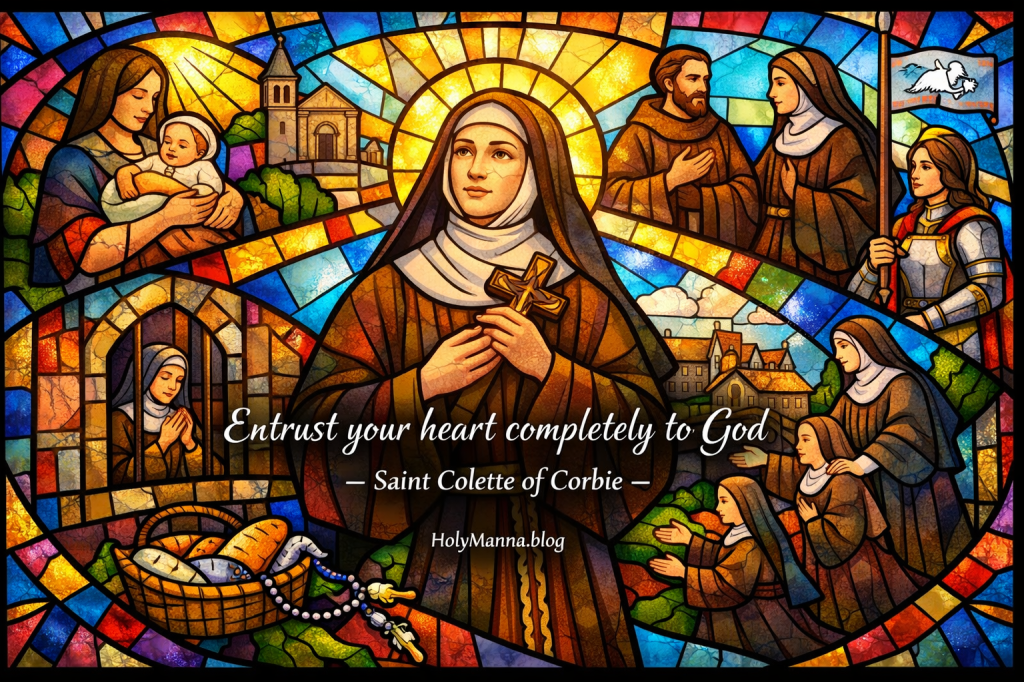
The Little Woman Who Rebuilt a Franciscan Fire
Saint Colette of Corbie lived at a time when it felt like the ground under the Church was shaking. Western Europe was torn by the Great Western Schism, Christians were confused about leadership, and religious life in many places had grown comfortable. In the middle of that storm, God raised up a petite French woman with a steel spine and a heart on fire for Jesus. She became a Poor Clare reformer, a founder of new monasteries, and a living reminder that real reform does not begin with complaining. Real reform begins with holiness.
Her life matters because it shows what the Church teaches about authentic renewal. The Lord renews the Church again and again through saints who return to the Gospel with obedience, poverty of spirit, and love. The Catechism describes consecrated life as a powerful sign of the Kingdom, a way of belonging totally to Christ through the evangelical counsels. This is not escapism. This is spiritual warfare and witness. CCC 915–916 and CCC 925–927.
The Miracle Baby from Corbie
Colette was born on January 13, 1381, in Corbie in Picardy, France. Her baptismal name was Nicolette, and “Colette” is the affectionate form of that name. Catholic tradition remembers her as a child given in answer to prayer, because her parents were elderly and had long prayed for a child. The story is cherished especially in Poor Clare memory, and it helps explain why generations of Catholics have turned to Saint Colette for the needs of mothers and children.
Her family was humble. Her father, Robert Boëllet, worked as a carpenter connected to the Benedictine Abbey at Corbie, and her mother was Marguerite Moyon. When her parents died, Colette’s heart became even more serious about belonging entirely to God, and she began searching for the vocation that would truly match what the Lord was doing in her soul.
Her path was not simple, and that is actually comforting. She tried different forms of religious life and penitential devotion, including communities connected to the Beguines, and she explored monastic life with the Benedictines. She also encountered the “Urbanist” form of Poor Clare life that existed in parts of Europe at the time. Through all of this, she kept moving toward greater simplicity, greater surrender, and greater fidelity.
Eventually, she embraced a hidden life as an anchoress. This meant living enclosed in a small cell near a church, given over to prayer, penance, and listening for God. This was not a dramatic influencer move. This was a quiet, Eucharistic kind of courage, the kind that gets built when nobody is clapping.
Then God made it clear that her hidden life was not the final chapter. Catholic tradition remembers a moment that captures the shift: her door was torn down, symbolizing that the Lord was calling her out of solitude and into a mission that would touch cities, bishops, monasteries, and even the politics of a fractured Christendom. She did not chase importance. She obeyed.
The Reform That Started on Her Knees
Colette became most known for the Colettine reform of the Poor Clares, a return to the earliest Franciscan spirit of Saint Clare of Assisi. This reform emphasized real poverty, intense prayer, and a disciplined life of penance, including strict fasting practices that set her communities apart.
Here is the heart of what she was doing. She wanted religious life to look like it belonged to Christ, not like it belonged to comfort. She wanted the Poor Clares to live the radical dependence on God that Saint Francis and Saint Clare taught, a dependence that says, “If God does not provide, then nothing provides.” When this happens in a monastery, it becomes a prophecy to the world.
Her reform unfolded during the confusion of the Schism, and she received ecclesial authorization connected to the papal claimant recognized in France at that time. This detail can feel complicated, but the Catholic takeaway is simple. Colette’s intention was not rebellion. Her intention was obedience and authentic renewal within the Church, even amid real historical confusion.
She did not do this alone. She was guided and supported by the Franciscan friar Henri de la Beaume, and she also received help from powerful Catholic patrons who believed that renewal was worth sacrificing for.
Colette founded and reformed many houses, with Catholic sources commonly naming seventeen foundations during her lifetime, with another begun in Lorraine. Her reform spread across regions of France and into the Low Countries, with Ghent becoming one of the significant centers of her later years.
One surprising fact that often gets skipped is that her reform energy did not touch only women. Catholic sources also associate her with a reform movement among Franciscan friars sometimes called the Coletani. It was never large, and it was later absorbed in broader Franciscan restructuring, but it shows the scope of her influence. She was not simply managing convents. She was helping reawaken a Franciscan spirit in an age that desperately needed it.
Colette’s own words show the tone of her holiness. She did not write like a celebrity. She wrote like a woman who knew she was dust and God was everything. In her letters she repeatedly signs herself in humbling language, and that humility was not theater. It was the foundation of her authority.
She urged souls to cling to God with confidence. She wrote, “Entrust your heart completely to God.” She also reminded her sisters what consecrated life truly means, saying, “All religious men and women are consecrated for the holy service of God.” And she spoke with realism about the road to heaven, saying in substance that the straight way to the everlasting Kingdom is the way of suffering patiently endured, a line preserved in the tradition of her correspondence and spiritual counsel. “If there be a true way that leads to the Everlasting Kingdom, it is most certainly that of suffering, patiently endured.”
This is the kind of saint who makes modern people uncomfortable in the best way, because she does not leave room for excuses. She also does not leave room for despair, because she trusted that God can rebuild anything.
Signs of Heaven in Her Hands
Catholic sources attribute to Saint Colette a genuine gift for miracles and supernatural favors, understood in the Catholic way as signs that point beyond themselves to the mercy and power of God. The Catechism reminds Christians that miracles are ordered toward faith in Christ and the salvation He offers. CCC 547–550.
In Catholic tradition, Saint Colette is remembered for miracles connected especially to children and childbirth. One story says that through her prayers a baby was restored to life. This story cannot be verified historically in a modern documentary sense, but it has lived on in Catholic devotion and helps explain her enduring patronage for mothers and infants. Another account says that she prayed for a woman in dangerous childbirth and both mother and child survived. This story also cannot be verified with complete historical certainty, but it is preserved in Catholic devotional memory.
Other miracles attributed to her in tradition include healings, prophetic insights, and the multiplication of food during scarcity. These accounts, as commonly retold, cannot always be verified in full detail, but they belong to the way the Church has remembered her as a motherly intercessor whose life was marked by unusual closeness to God.
Her spiritual life was Passion-centered. Catholic tradition connects her to regular meditation on the suffering of Christ, and she urged her communities to be faithful in penance without becoming harsh or proud. Penance without love becomes cruelty. Penance with love becomes a gift.
The Peace She Refused to Lose
Saint Colette was not a martyr in the strict sense, but she endured real hardships. Reformers always do. When a person calls a community back to simplicity, somebody will call it “too much.” When a person insists on poverty, somebody will call it “impractical.” When a person demands fidelity, somebody will call it “rigid.”
Her hardships were the daily kind that grind people down: misunderstandings, resistance, political instability, travel difficulties, and the weight of responsibility for souls. She carried the burden of founding and reforming monasteries in an era with weak infrastructure and constant uncertainty. She also lived in an age when ecclesial unity had been wounded publicly, and that alone was a suffering for a faithful Catholic heart.
There is also a well-known tradition that she had an encounter involving Saint Vincent Ferrer and a relic connected to the Cross of Christ. This story cannot be verified with full historical certainty, but it is sometimes preserved in Catholic devotional retellings as a sign of her deep love for the Crucified.
Another tradition says she met Saint Joan of Arc. Historians generally note that there is no documentation proving a meeting, so it should be treated as a pious story rather than established history. This story cannot be verified.
What can be said with confidence is that she endured her hardships the way saints do. She endured them by staying close to Christ, obeying the Church as best she could in her context, and refusing to let discouragement define her.
The Quiet Global Echo
Saint Colette died on March 6, 1447, in Ghent. Her reform did not die with her. Her communities continued, her constitutions were confirmed and approved through Church authority in the decades that followed, and her spiritual family endured.
After her death, devotion to Saint Colette remained especially strong in places linked to her foundations. Catholic monastic life remembers significant veneration at Poligny, where a monastery connected to her reform has long held devotion to her relics and welcomed pilgrims. Pilgrimage and relic veneration are not superstition in Catholic teaching. They are expressions of the communion of saints, where the faithful honor what God has done in His friends and seek their intercession. CCC 956.
Miracles continued to be attributed to her intercession after death, especially favors for families longing for children, safe pregnancies, and the healing of infants and young children. Specific stories often circulate locally and devotionally, and many cannot be verified in strict historical detail. That does not mean Catholics should mock them. It means Catholics should hold them with humility, gratitude, and prudence, always remembering that God is the author of every grace.
Her cultural impact is also visible in the survival of Colettine monasteries across countries and centuries. In a world that constantly reinvents itself, Colette’s legacy is a quiet counterculture. It says that holiness is not trendy, but it is real, and it lasts.
Her feast is commonly celebrated on March 6, and in parts of the Franciscan family she is also commemorated on February 7. Either way, the Church remembers her as a woman who rebuilt what was crumbling by returning to what never changes: prayer, poverty of spirit, obedience, and love.
What Saint Colette Teaches Us
Saint Colette’s life offers a strong, practical message for modern Catholics. When the Church feels confusing, do not run. Go deeper. When faith feels dry, do not perform. Become faithful. When the world is loud, do not compete with the noise. Become a person of prayer.
She also teaches that reform starts in the soul. It starts with confession, with the Eucharist, with quiet acts of penance done for love of Christ, and with the daily decision to stop living like comfort is the goal. The Catechism teaches that conversion is not a one-time moment. It is a daily turning back to God. CCC 1427–1429.
She is especially powerful for people trying to rebuild spiritual discipline. Her reform was not about being extreme for attention. Her reform was about being faithful because God is worthy.
If a person feels called to simplify life, to stop feeding constant distractions, to tighten up prayer, to be more intentional about Sunday Mass, to fast with purpose, and to serve the poor with real sacrifice, then Saint Colette is a friend worth knowing.
And if a person is carrying the ache of wanting a child, or the fear of pregnancy complications, or the pain of a sick infant, Saint Colette is also remembered as a motherly intercessor who knows how to bring those needs to the Heart of Jesus. How might it change your prayer life if you truly believed that the saints are not distant heroes, but living members of Christ’s family who intercede for you?
Engage with Us!
Share your thoughts and reflections in the comments below, because the Church grows when ordinary Catholics speak honestly about how God is working in their lives.
- Where has God been calling for deeper simplicity and deeper prayer, even if it feels uncomfortable?
- What is one small act of penance you can offer this week with love, not pride, united to the Cross of Christ?
- When you see confusion or weakness in the Church, do you respond with cynicism, or do you respond with prayer and fidelity?
- If you are carrying a family burden, especially related to children, how can you bring that need to Christ with the trusting heart Saint Colette modeled?
- Which of Saint Colette’s words hits hardest today, and why, especially “Entrust your heart completely to God.”?
May Saint Colette teach every heart to rebuild what is broken with prayer, to endure suffering with patience, and to love the Church enough to become holy instead of becoming bitter. Live a life of faith, stay close to the Sacraments, and do everything with the love and mercy Jesus taught us.
Saint Colette of Corbie, pray for us!
Follow us on YouTube, Instagram and Facebook for more insights and reflections on living a faith-filled life.

 Holy Manna!
Leave a comment