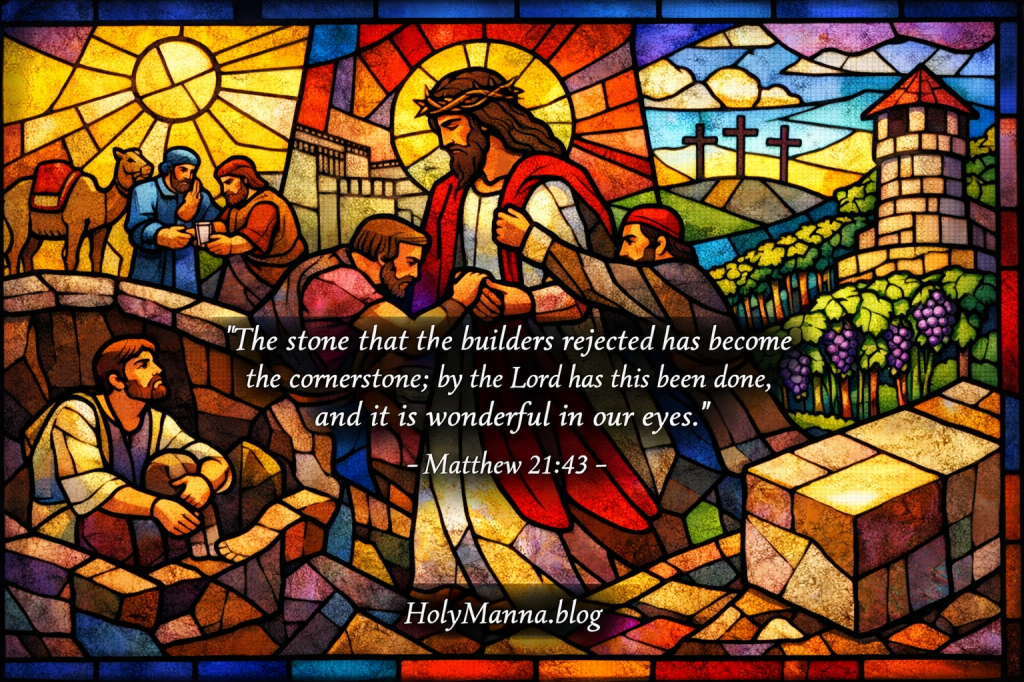
Friday of the Second Week of Lent – Lectionary: 234
When the Beloved Son Is Rejected, God Still Builds a Kingdom
Some days the Scriptures feel like a spotlight that lands right on the human heart. Today’s readings speak to anyone who has ever watched jealousy turn cold, anyone who has felt betrayed by people who should have protected them, and anyone who wonders how God can still be present when everything looks like loss. Lent is not interested in vague spirituality. Lent is interested in truth, because only truth can lead to repentance, and only repentance can lead to freedom.
The central thread tying today together is the story of rejection and stewardship. In Genesis 37:3-4, 12-13, 17-28, Joseph is the beloved son, marked out by his father’s love, and hated for it. His brothers cannot tolerate the sign of favor, so they strip him, throw him into a pit, and sell him for silver. It is a family tragedy, but it is also a warning about what envy can do when it is allowed to grow unchecked. CCC 2538 names envy as a deadly sin because it grieves at another’s good, and that grief can easily harden into cruelty.
In Psalm 105:5, 16-21, the Church lifts the curtain and shows what faith sees behind the scenes. Joseph is not only a victim of betrayal. Joseph is also a man mysteriously carried forward by providence, because God can turn a pit into a pathway and chains into preparation. The Psalm does not pretend that evil is good, but it refuses to believe that evil gets the final word. That is a very Lenten kind of hope, the kind that does not deny suffering but insists God is still Lord of the story.
Then in The Gospel of Matthew 21:33-43, 45-46, Jesus takes the same pattern and raises the stakes. The vineyard is God’s work, entrusted to tenants who are meant to produce fruit. The tragedy is that the tenants start acting like owners, and when the servants come, they are beaten and killed. When the son comes, he is cast out and murdered. Jesus is not speaking in riddles here. He is revealing the history of Israel’s prophets and pointing toward His own Passion, because the Son will be rejected just like Joseph, but in a deeper and saving way. The warning is sharp, because the kingdom is not a trophy to possess. It is a gift to receive, and a responsibility to bear fruit. CCC 736 reminds the Church that true fruitfulness is the work of the Holy Spirit, which means the vineyard cannot be managed by ego, control, or resentment.
This is why these readings fit so perfectly in the Second Week of Lent. Lent is a season of honest inspection. It asks whether the heart has been acting like a brother consumed by envy or like a tenant clinging to control. It also offers a stronger truth than guilt, because it proclaims that God can take what men mean for destruction and bend it toward salvation. The rejected son becomes the instrument of rescue, and the rejected stone becomes the cornerstone. How might God be calling for a change of heart before envy, bitterness, or control steals the fruit He wants to grow this Lent?
First Reading – Genesis 37:3-4, 12-13, 17-28
When Envy Turns Brothers into Enemies, God Still Writes a Rescue Plan
This passage drops the reader into the messy heart of Israel’s family, long before “Israel” is a nation and long before there is a temple, a king, or a promised land fully possessed. These are patriarchal days, when family is everything, inheritance is survival, and honor is guarded like treasure. In that world, a father’s public favoritism is not a private quirk. It is a spark near gasoline.
Joseph’s “long ornamented tunic” is more than clothing. It is a visible sign that Jacob’s love and hopes are leaning toward Joseph, and the brothers read it like a verdict against them. The result is a familiar spiral that still shows up in modern life: comparison becomes resentment, resentment becomes cruelty, and cruelty starts feeling justified. This is why the Church places Joseph’s rejection in Lent, because Lent is when the Lord exposes what is hiding under the surface and calls the heart back to truth. Today’s theme begins here: the beloved son is rejected, cast down, and sold, yet God is already bending the story toward salvation.
Genesis 37:3-4, 12-13, 17-28 – New American Bible (Revised Edition)
3 Israel loved Joseph best of all his sons, for he was the child of his old age; and he had made him a long ornamented tunic. 4 When his brothers saw that their father loved him best of all his brothers, they hated him so much that they could not say a kind word to him.
12 One day, when his brothers had gone to pasture their father’s flocks at Shechem, 13 Israel said to Joseph, “Are your brothers not tending our flocks at Shechem? Come and I will send you to them.” “I am ready,” Joseph answered.
17 The man told him, “They have moved on from here; in fact, I heard them say, ‘Let us go on to Dothan.’” So Joseph went after his brothers and found them in Dothan. 18 They saw him from a distance, and before he reached them, they plotted to kill him. 19 They said to one another: “Here comes that dreamer! 20 Come now, let us kill him and throw him into one of the cisterns here; we could say that a wild beast devoured him. We will see then what comes of his dreams.”
21 But when Reuben heard this, he tried to save him from their hands, saying: “We must not take his life.” 22 Then Reuben said, “Do not shed blood! Throw him into this cistern in the wilderness; but do not lay a hand on him.” His purpose was to save him from their hands and restore him to his father.
23 So when Joseph came up to his brothers, they stripped him of his tunic, the long ornamented tunic he had on; 24 then they took him and threw him into the cistern. The cistern was empty; there was no water in it.
25 Then they sat down to eat. Looking up, they saw a caravan of Ishmaelites coming from Gilead, their camels laden with gum, balm, and resin to be taken down to Egypt. 26 Judah said to his brothers: “What is to be gained by killing our brother and concealing his blood? 27 Come, let us sell him to these Ishmaelites, instead of doing away with him ourselves. After all, he is our brother, our own flesh.” His brothers agreed.
28 Midianite traders passed by, and they pulled Joseph up out of the cistern. They sold Joseph for twenty pieces of silver to the Ishmaelites, who took him to Egypt.
Detailed Exegesis
Verse 3 “Israel loved Joseph best of all his sons, for he was the child of his old age; and he had made him a long ornamented tunic.”
Jacob’s love is real, but it is not wisely expressed. Scripture is not praising favoritism here. It is showing how disordered love can wound a family. The tunic becomes a public symbol of preference, and symbols shape hearts. Joseph becomes “the favored one” before he ever speaks a word, and the family begins to fracture around that sign.
Verse 4 “When his brothers saw that their father loved him best of all his brothers, they hated him so much that they could not say a kind word to him.”
Envy is not just an emotion in this verse. It is a spiritual poison that steals even basic charity. The inability to speak kindly shows how hatred corrodes the tongue before it ever spills blood. This is how sin often begins, not with violence, but with the slow death of goodwill.
Verse 12 “One day, when his brothers had gone to pasture their father’s flocks at Shechem,”
Shechem is not a random location. It is a place already marked by tension in Jacob’s story, and it carries the weight of past conflicts. The reading quietly signals that the setting is spiritually charged. Trouble often returns to places where wounds were never healed.
Verse 13 “Israel said to Joseph, ‘Are your brothers not tending our flocks at Shechem? Come and I will send you to them.’ ‘I am ready,’ Joseph answered.”
Joseph goes in obedience, not suspicion. His response sounds simple, but it reveals a trusting son. It also highlights how often the innocent walk straight into danger without seeing it, because they cannot imagine the darkness in another person’s heart.
Verse 17 “The man told him, ‘They have moved on from here; in fact, I heard them say, ‘Let us go on to Dothan.’’ So Joseph went after his brothers and found them in Dothan.”
The details matter because God’s providence often moves through ordinary moments, including directions from a stranger. Joseph keeps searching, and that persistence brings him to the place where betrayal is waiting. Dothan becomes the stage where envy will reveal itself.
Verse 18 “They saw him from a distance, and before he reached them, they plotted to kill him.”
Sin grows when a person is reduced to an idea. Joseph is not treated as a brother here. He is treated as a problem to be removed. The distance is more than physical. Their hearts have already created a gulf where compassion cannot cross.
Verse 19 “They said to one another: ‘Here comes that dreamer!’”
They mock his calling before they attack his body. Joseph’s dreams represent God’s mysterious plan, and that is what threatens them. Envy often hates not only the person, but the possibility that God might be doing something through that person.
Verse 20 “Come now, let us kill him and throw him into one of the cisterns here; we could say that a wild beast devoured him. We will see then what comes of his dreams.”
This is calculated evil. It includes murder, deception, and the desire to “prove” God wrong. The cistern is a pit dug for holding water, but it becomes a tomb in their imagination. This is what happens when people treat God’s plan as a rival plan.
Verse 21 “But when Reuben heard this, he tried to save him from their hands, saying: ‘We must not take his life.’”
Reuben’s intervention shows that conscience still exists in the group, even if it is weak. He recognizes the horror of murder. Still, he does not confront the hatred at its root, and that hesitation will matter. Half measures rarely stop sin once the heart is set on it.
Verse 22 “Then Reuben said, ‘Do not shed blood! Throw him into this cistern in the wilderness; but do not lay a hand on him.’ His purpose was to save him from their hands and restore him to his father.”
Reuben aims for rescue, but he chooses a strategy that depends on timing and human control. The reading quietly teaches that a good intention is not the same as moral courage. The plan is fragile because it leaves Joseph vulnerable to the next wave of malice.
Verse 23 “So when Joseph came up to his brothers, they stripped him of his tunic, the long ornamented tunic he had on;”
The stripping is not incidental. They remove the sign of love and favor, as if destroying the symbol will erase the reality. In a deeper sense, sin always wants to strip a person of dignity and identity, because dignity makes cruelty harder to justify.
Verse 24 “then they took him and threw him into the cistern. The cistern was empty; there was no water in it.”
The emptiness intensifies the image. There is no water to sustain him, and there is no mercy in their action. The pit becomes a living picture of what envy creates: a world where life is withheld and love dries up.
Verse 25 “Then they sat down to eat. Looking up, they saw a caravan of Ishmaelites coming from Gilead, their camels laden with gum, balm, and resin to be taken down to Egypt.”
This verse is chilling because of its normalcy. They eat as if nothing happened. Sin can deaden the heart so much that a person can do something horrific and then carry on like it was business as usual. The caravan detail also grounds the story historically: trade routes to Egypt were real, and merchants carried goods south. Human commerce becomes the channel for human betrayal.
Verse 26 “Judah said to his brothers: ‘What is to be gained by killing our brother and concealing his blood?’”
Judah does not argue for Joseph’s dignity. He argues for advantage. This shows how sin can dress itself up as pragmatism. Murder becomes a “cost,” and conscience becomes a “risk,” and suddenly evil starts sounding reasonable.
Verse 27 “Come, let us sell him to these Ishmaelites, instead of doing away with him ourselves. After all, he is our brother, our own flesh.” His brothers agreed.”
This is the brutal compromise of a hardened heart. They acknowledge he is “brother” and still sell him. The line sounds moral, but it is only moral theater. The body is spared, but the person is still destroyed in their eyes. Betrayal often hides behind language that pretends to be compassionate.
Verse 28 “Midianite traders passed by, and they pulled Joseph up out of the cistern. They sold Joseph for twenty pieces of silver to the Ishmaelites, who took him to Egypt.”
Joseph rises from the pit, but not into freedom. He rises into slavery. The “twenty pieces of silver” land like a bitter seed that will later echo in salvation history, because betrayal for silver becomes a recurring human pattern. Yet even here, Egypt is not only a place of oppression. It will become the place where God positions Joseph to preserve life. The brothers think they are ending Joseph’s story, but God is beginning a chapter they cannot imagine.
Teachings
This reading exposes envy as a spiritual force that can unravel families and communities. The Church does not treat envy as a cute flaw or a personality quirk. The Catechism calls it what it is: CCC 2538 teaches, “Envy is a capital sin. It refers to sadness at the sight of another’s goods and the immoderate desire to acquire them for oneself, even unjustly. When it wishes grave harm to a neighbor it is a mortal sin.” Joseph’s brothers begin with sadness and resentment, and they end with a plan that wishes grave harm. The reading is showing the progression CCC 2538 warns about, because unchecked envy rarely stays small.
At the same time, the Church also reads Joseph as a prophetic figure, a foreshadowing of Christ. A beloved son is rejected by his own, stripped, cast down, and “sold,” and yet his suffering becomes the path by which many are saved. That pattern is not accidental. It is part of the way God prepares hearts to recognize Jesus. The Catechism teaches that God’s providence can bring good even from moral evil without excusing the evil. CCC 312 states, “In time we can discover that God in his almighty providence can bring a good from the consequences of an evil, even a moral evil, caused by his creatures.” Then it points to Joseph’s own words to his brothers as proof that providence is real, not sentimental. Joseph will later say, “It was not you who sent me here, but God.” The betrayal remains a sin, but God’s plan remains stronger than their sin.
This is a distinctly Catholic way of reading suffering. The Church does not pretend betrayal is “fine.” The Church also refuses to pretend betrayal has the final word. Lent trains the heart to see both truths at once: sin must be named and repented of, and God’s mercy and providence are not defeated by human darkness.
Reflection
Joseph’s story still happens in modern clothing. Envy still whispers that someone else’s blessing is a personal insult. It still convinces people that love is a limited resource, as if God runs out of favor. It still tempts hearts to strip others of dignity through sarcasm, exclusion, gossip, cold silence, or the quiet sabotage of someone else’s good name.
A practical Lenten step begins with language, because Genesis shows envy first killing kindness. When the tongue starts refusing charity, the heart is already in danger. A good practice is to deliberately speak one sincere, specific kind word each day to the person who triggers comparison. That kind of act feels small, but it is spiritual warfare against envy’s grip.
Another step is to bring resentment into the light through confession and prayer, because hidden envy grows in the dark. Lent is a season for naming the sin plainly and asking for a new heart. Joseph’s brothers were not trapped by fate. They were trapped by choices that became habits.
Most of all, Joseph’s pit teaches that God is not absent in moments of humiliation and rejection. God does not need betrayal to accomplish His plan, but God can still accomplish His plan even when betrayal happens. That truth steadies a suffering heart without turning suffering into a slogan.
Where has envy made it hard to speak a kind word, especially at home or at work?
Who is the “Joseph” that the heart is tempted to resent, simply because God seems to be blessing him or her?
What would change this Lent if gratitude replaced comparison, and stewardship replaced control?
If life feels like a pit right now, what would it look like to trust that God can still “bring a good from the consequences” of what others meant for harm, as CCC 312 teaches?
Responsorial Psalm – Psalm 105:5, 16-21
When God Feels Silent, Providence Is Still Speaking
Psalm 105 is one of Israel’s great “memory psalms,” the kind that teaches God’s people how to survive hard seasons by remembering who the Lord is and what the Lord has done. It is not written like a private diary. It is written like a public witness, meant to be prayed aloud so faith can be rebuilt when circumstances are confusing. In the life of ancient Israel, remembering was not nostalgia. Remembering was obedience, because the covenant people were commanded to recall the Lord’s mighty deeds and live accordingly.
That is why this psalm is paired with Joseph’s betrayal in Genesis 37:3-4, 12-13, 17-28. The first reading shows the pit from Joseph’s point of view. The psalm shows the same story from heaven’s point of view. It fits today’s theme perfectly because it reveals the hidden thread of providence running through rejection, suffering, and delay. What looks like disaster to the human eye is often God preparing rescue, not only for one person, but for many.
Psalm 105:5, 16-21 – New American Bible (Revised Edition)
5 Recall the wondrous deeds he has done,
his wonders and words of judgment,16 Then he called down a famine on the land,
destroyed the grain that sustained them.
17 He had sent a man ahead of them,
Joseph, sold as a slave.
18 They shackled his feet with chains;
collared his neck in iron,
19 Till his prediction came to pass,
and the word of the Lord proved him true.
20 The king sent and released him;
the ruler of peoples set him free.
21 He made him lord over his household,
ruler over all his possessions,
Detailed Exegesis
Verse 5 “Recall the wondrous deeds he has done, his wonders and words of judgment,”
This verse sets the tone. The psalm begins with a command to remember, because forgetfulness is one of the quickest paths to fear. “Words of judgment” does not mean God is harsh for sport. It means God speaks truth and acts with justice. The Lord is not a spectator. The Lord is a ruler who intervenes, corrects, and saves according to His covenant.
Verse 16 “Then he called down a famine on the land, destroyed the grain that sustained them.”
This verse can sound unsettling, but it is written as theology, not as panic. Scripture is teaching that history is not random. Even famine does not sit outside God’s sovereignty. This does not mean God delights in suffering. It means that suffering is not meaningless, and God can permit hardship in order to move His plan forward and expose what cannot be healed without humility. In the Joseph story, famine becomes the pressure that eventually brings reconciliation and life.
Verse 17 “He had sent a man ahead of them, Joseph, sold as a slave.”
This is the line that changes everything. The psalm does not deny that Joseph was “sold.” It also dares to say God “sent” him. That is providence. Human beings choose evil, and they are responsible for it, but God can still steer the consequences toward salvation. The Church teaches this clearly in CCC 312: “In time we can discover that God in his almighty providence can bring a good from the consequences of an evil, even a moral evil, caused by his creatures.” Joseph is a living example of that truth.
Verse 18 “They shackled his feet with chains; collared his neck in iron,”
This verse refuses to romanticize suffering. Providence is not a fantasy where pain is fake. Chains are real. Humiliation is real. The iron collar is the kind of detail that forces the heart to face what Joseph endured. The psalm teaches that God’s plan does not always remove the cross immediately, but God’s plan never wastes the cross.
Verse 19 “Till his prediction came to pass, and the word of the Lord proved him true.”
Joseph is tested over time. The “till” matters because it points to delay. God’s timing often includes waiting, and waiting reveals what a person truly trusts. The word of the Lord “proved him true” does not mean Joseph earned salvation by personal greatness. It means God’s promise is reliable, and God forms His servants through trials that purify faith and integrity.
Verse 20 “The king sent and released him; the ruler of peoples set him free.”
This is the reversal that only God can write. The same Joseph who was treated like disposable property is suddenly recognized by the highest authority in the land. In biblical storytelling, kings and rulers are not ultimate powers. They are instruments God can move. The psalm shows that God’s providence can turn locked doors into open ones in a moment, not because Joseph manipulated the system, but because God is faithful.
Verse 21 “He made him lord over his household, ruler over all his possessions,”
The final verse in today’s selection highlights the fruit: Joseph is elevated for the sake of a mission. This is not a “success story” for ego. It is an appointment for service. God raises Joseph up so that many will live. In the background, a deeper pattern is forming that points toward Christ, because the rejected one becomes the instrument of salvation for others.
Teachings
This psalm teaches the Church how to interpret life without falling into either despair or superstition. It rejects despair by insisting that God acts in history, and it rejects superstition by insisting that God is wise and faithful, not chaotic. When the psalm says God “sent” Joseph, it is teaching providence in the same spirit the Church teaches it.
CCC 302 expresses this foundation clearly: “Creation has its own goodness and proper perfection, but it did not spring forth complete from the hands of the Creator. The universe was created ‘in a state of journeying’ toward an ultimate perfection yet to be attained, to which God has destined it. We call ‘divine providence’ the dispositions by which God guides his creation toward this perfection.” Joseph’s life looks like a disaster in the moment, but the psalm is showing “the state of journeying.” God is guiding the story toward a perfection that is not visible yet.
The psalm also helps correct a common spiritual mistake. Some people assume that if life is hard, God must be absent or angry. Psalm 105 gives a more mature Catholic view. God can be present in suffering, working quietly, forming a soul, and preparing a mission. This is not a denial of pain. It is faith that suffering is not sovereign.
Saint Augustine often returned to this kind of trust when he taught Christians how to live under pressure. His simple clarity fits today’s psalm: God is able to draw good even from what appears to be tangled and tragic. That is not because evil is secretly good, but because God is truly God.
Reflection
This psalm is for anyone who feels stuck in the “till” of verse 19, the long stretch where nothing seems to change, prayers seem unanswered, and the heart starts wondering if God forgot the address. Psalm 105 insists that remembering is a spiritual discipline. It is not denial. It is strength. Recalling God’s deeds trains the heart to interpret the present without panic.
A practical step is to practice holy memory during Lent. Instead of replaying only what went wrong, it helps to recall concrete moments when God provided, protected, corrected, or opened a door that seemed locked. This is not positive thinking. This is biblical faith. It is the habit of the covenant people who learned that God writes straight even with crooked lines.
Another step is to refuse the temptation to become bitter in the chains. Joseph’s chains did not become his identity. They became the place where God purified him for what came next. This is where the fruit of patience and humility grows, not as a personality trait, but as grace.
Finally, the psalm invites trust that God is never improvising. God is not reacting in panic to human sin. God is guiding history toward salvation, and the fullest proof of that is Jesus Christ Himself. The rejected Son becomes the Savior, and the cross becomes the doorway to resurrection. Joseph’s story is a preview of how God works.
Where is life currently living in the “till,” where waiting feels heavy and discouraging?
What would change if the heart practiced holy memory and recalled the Lord’s “wondrous deeds” instead of rehearsing fear?
Is there a hidden bitterness that needs to be surrendered to God before it hardens into resentment?
What kind of fruit might God be preparing through this season that would never grow without patience and trust?
Holy Gospel – Matthew 21:33-43, 45-46
The Vineyard Was Never Theirs, and the Son Was Never Safe
This parable lands in the final stretch of Jesus’ public ministry, in the days leading up to the Passion. The setting is Jerusalem, where tension is thick and the religious leaders are openly challenged by Christ’s authority. Jesus speaks in vineyard imagery that every faithful Jew would recognize, because the vineyard was a classic symbol for Israel and God’s covenant care, especially through the prophets. The landowner’s careful work, the hedge, the wine press, and the watchtower echo the way God formed and protected His people, giving them worship, law, and guidance so that holiness could grow like fruit at harvest.
In the culture of the time, leasing land to tenant farmers was common, and rent was often paid with a share of the produce. A vineyard was valuable and slow to establish, which made it tempting for greedy tenants to act like owners. Jesus takes that real-world setup and reveals a spiritual crisis: when stewards forget they are stewards, they start treating God’s gifts as property. That is the same sickness seen in Joseph’s brothers, who wanted the blessings of the family without accepting the one their father loved. Today’s theme tightens here: the beloved son is rejected, cast out, and attacked, yet God turns rejection into the foundation of a kingdom that cannot be stolen.
Matthew 21:33-43, 45-46 – New American Bible (Revised Edition)
33 “Hear another parable. There was a landowner who planted a vineyard, put a hedge around it, dug a wine press in it, and built a tower. Then he leased it to tenants and went on a journey. 34 When vintage time drew near, he sent his servants to the tenants to obtain his produce. 35 But the tenants seized the servants and one they beat, another they killed, and a third they stoned. 36 Again he sent other servants, more numerous than the first ones, but they treated them in the same way. 37 Finally, he sent his son to them, thinking, ‘They will respect my son.’ 38 But when the tenants saw the son, they said to one another, ‘This is the heir. Come, let us kill him and acquire his inheritance.’ 39 They seized him, threw him out of the vineyard, and killed him. 40 What will the owner of the vineyard do to those tenants when he comes?” 41 They answered him, “He will put those wretched men to a wretched death and lease his vineyard to other tenants who will give him the produce at the proper times.” 42 Jesus said to them, “Did you never read in the scriptures:
‘The stone that the builders rejected
has become the cornerstone;
by the Lord has this been done,
and it is wonderful in our eyes’?43 Therefore, I say to you, the kingdom of God will be taken away from you and given to a people that will produce its fruit.
45 When the chief priests and the Pharisees heard his parables, they knew that he was speaking about them. 46 And although they were attempting to arrest him, they feared the crowds, for they regarded him as a prophet.
Detailed Exegesis
Verse 33 “Hear another parable. There was a landowner who planted a vineyard, put a hedge around it, dug a wine press in it, and built a tower. Then he leased it to tenants and went on a journey.”
The landowner’s careful preparation shows generosity and rightful authority. The vineyard exists because the owner made it possible, which means the tenants begin their role already in debt to a gift they did not create. Spiritually, it is a picture of God entrusting His people with worship and mission, not as owners, but as servants responsible for fruit.
Verse 34 “When vintage time drew near, he sent his servants to the tenants to obtain his produce.”
The request is not unreasonable, because the produce belongs to the owner by justice and covenant. God’s expectations are not arbitrary demands. God asks for the fruit that love should naturally produce, especially justice, fidelity, and mercy.
Verse 35 “But the tenants seized the servants and one they beat, another they killed, and a third they stoned.”
This verse echoes the long history of prophets rejected, mocked, and persecuted. The violence is not just against messengers. It is against the owner whose authority the servants represent. Sin often begins by refusing correction, then escalates by attacking anyone who speaks the truth.
Verse 36 “Again he sent other servants, more numerous than the first ones, but they treated them in the same way.”
God’s patience is the scandal here. The owner keeps sending servants, which reveals mercy that is willing to be rejected again and again. The tenants’ repeated violence reveals something deeper than a bad moment. It reveals a settled rebellion.
Verse 37 “Finally, he sent his son to them, thinking, ‘They will respect my son.’”
The son is not one messenger among many. The son carries the full weight of the father’s authority and presence. This points directly to Christ as the Father’s definitive Word. The tragedy is that the tenants will not merely reject the message. They will reject the person.
Verse 38 “But when the tenants saw the son, they said to one another, ‘This is the heir. Come, let us kill him and acquire his inheritance.’”
Their plan exposes the core temptation of fallen humanity: wanting the gifts of God while removing God from the equation. It is the same twisted logic behind envy and rivalry, because envy says, “If that person disappears, the blessing can be mine.” The tenants are not confused. They are calculating.
Verse 39 “They seized him, threw him out of the vineyard, and killed him.”
The detail of being thrown out is a shadow of the Passion, because Jesus will suffer outside the city, rejected by the leaders and handed over to death. The parable is not merely moral instruction. It is prophecy. Jesus is announcing what the leaders are already preparing to do.
Verse 40 “What will the owner of the vineyard do to those tenants when he comes?”
Jesus forces a judgment question. The owner’s return means accountability is real. God’s patience does not erase justice. It simply delays judgment to give space for repentance.
Verse 41 “They answered him, ‘He will put those wretched men to a wretched death and lease his vineyard to other tenants who will give him the produce at the proper times.’”
Their own answer becomes their indictment. They pronounce judgment on themselves while trying to sound righteous. The “other tenants” points toward a new stewardship, where the kingdom is entrusted to those who receive Christ and actually bear fruit.
Verse 42 “Jesus said to them, ‘Did you never read in the scriptures: ‘The stone that the builders rejected has become the cornerstone; by the Lord has this been done, and it is wonderful in our eyes’?”
Jesus quotes Psalm 118:22-23 and makes it personal. The “builders” are the leaders who believe they are constructing Israel’s future, yet they reject the very stone God has chosen. The shock is that rejection does not cancel God’s plan. It completes it. God turns what men discard into the foundation of salvation.
Verse 43 “Therefore, I say to you, the kingdom of God will be taken away from you and given to a people that will produce its fruit.”
This is not a statement that God abandons His promises. It is a warning that stewardship can be lost through infidelity. The kingdom is given to those who welcome the Son and live His life, producing the fruit of repentance, holiness, and mission. The focus is not ethnicity as a trophy. The focus is faithfulness as fruit.
Verse 45 “When the chief priests and the Pharisees heard his parables, they knew that he was speaking about them.”
The message lands clearly. They understand the parable is aimed at their refusal to receive Jesus and their pattern of resisting God’s messengers. The tragedy is not ignorance. The tragedy is recognition without repentance.
Verse 46 “And although they were attempting to arrest him, they feared the crowds, for they regarded him as a prophet.”
Fear of public reaction restrains them temporarily, but it does not heal their hearts. They fear the crowd more than they fear God, and that misplaced fear becomes part of the road to the Cross. Even their hesitation shows how politics can choke conversion when the heart values control over truth.
Teachings
Jesus teaches through parables not to entertain, but to reveal the kingdom and expose the heart. The Catechism describes this style of teaching plainly in CCC 546: “Jesus’ invitation to enter his kingdom comes in the form of parables, a characteristic feature of his teaching.” This matters today because the parable is an invitation and a warning at the same time. It invites the listener to become a faithful steward who bears fruit, and it warns the listener that rejecting the Son is the ultimate theft, because it is an attempt to seize what cannot be seized.
This Gospel also teaches a hard truth about providence that connects back to Joseph. God does not approve of betrayal, but God is not defeated by betrayal. The rejected stone becomes the cornerstone, and the murdered Son becomes the risen Lord. This is the same divine pattern seen in Joseph’s pit. The Catechism articulates this confidence about God’s providence in CCC 312: “In time we can discover that God in his almighty providence can bring a good from the consequences of an evil, even a moral evil, caused by his creatures.” The Cross is the ultimate proof. Human sin reaches its worst, and God’s mercy answers with redemption.
Saint John Chrysostom pressed this point when preaching on this passage by emphasizing God’s patience and the tenants’ madness. He marveled that the owner kept sending servants and even sent his son, showing a mercy that sinners abuse, but cannot exhaust. The Church hears in this parable both the history of the prophets and the nearness of the Passion, because Jesus is not just describing Israel’s past. Jesus is unveiling the decision that every generation must face: receive the Son, or attempt to build life without Him.
Reflection
This parable still plays out wherever people treat God’s gifts like personal property. The vineyard can look like a career that becomes an idol, a relationship treated as possession, a ministry used for ego, a home ruled by control, or even a spiritual life reduced to image and influence. The warning is not only for “bad people.” It is for religious people who can know the Scriptures and still resist the Son when He threatens comfort and control.
A practical Lenten step is to name the “vineyard” areas that have been treated like ownership instead of stewardship. When stewardship is real, the heart becomes teachable, grateful, and accountable. When ownership takes over, the heart becomes defensive, resentful, and quick to silence anyone who challenges it. This Gospel suggests that one of the most honest examinations of conscience is to notice how the heart reacts when corrected. A heart that belongs to God can repent. A heart that wants control will strike the messenger.
This Gospel also offers hope for anyone who feels rejected or discarded. Jesus does not pretend rejection is small. Jesus transforms it. The stone rejected becomes the cornerstone, which means that suffering united to Christ can become strangely fruitful. That does not make betrayal holy, but it does mean that betrayal does not get the final word.
Where has the heart been acting like a tenant who wants the vineyard but not the Owner?
When truth arrives through Scripture, the Church, or a difficult conversation, does the heart receive it, or does it try to “seize” control by shutting it down?
What fruit does God have a right to expect in this season of Lent, especially in patience, integrity, mercy, and repentance?
If the Lord has allowed rejection or loss, how might He be shaping that “rejected stone” into something stronger and more faithful than before?
Let Lent Bear Real Fruit
Today’s readings tell one story from three angles, and it is the kind of story Lent insists on telling because it exposes what is hiding in the heart. In Genesis 37:3-4, 12-13, 17-28, envy turns brothers into enemies, and the beloved son is stripped, thrown into a pit, and sold for silver. In Psalm 105:5, 16-21, the Church is taught to see deeper than the pit, because God’s providence is already at work in what looks like chaos, shaping suffering into a path of rescue. In The Gospel of Matthew 21:33-43, 45-46, Jesus reveals the same pattern at its fullest intensity, because the tenants reject the servants, then reject the Son, trying to seize what was never theirs, only to discover that the rejected stone becomes the cornerstone.
The key message is clear and personal. God entrusts gifts, time, and responsibility like a vineyard placed into human hands, and the soul is always tempted to treat stewardship like ownership. Envy and control both come from the same lie, because they both assume there is not enough goodness to go around, and they both try to secure a life without surrender. Yet God answers that lie with the Cross, where the rejected Son becomes the Savior, and where God proves that sin and betrayal do not get the final word.
Lent is the Lord’s invitation to step out of the old patterns and into a new way of living. This is the day to put envy on the altar and ask for a clean heart, because CCC 2538 warns that envy can become grave when it desires harm, and today’s first reading shows how quickly that path can unfold. This is also the day to practice holy memory, to recall the Lord’s “wondrous deeds” with the confidence of Psalm 105, because the God who guided Joseph through chains still guides His people through trials. Most of all, this is the day to receive Christ as the cornerstone, not as a religious accessory, but as the foundation that reorders everything, including priorities, relationships, speech, and daily choices.
The call to action is simple, but it will cost something real, which is exactly what makes it fruitful. Let this Lent produce fruit that God can recognize, not just good intentions, but concrete repentance, stronger charity, and a quieter trust that refuses bitterness. Let the tongue speak kindness where envy once lived, let the hands serve where control once tightened, and let prayer become more honest than ever, especially in the places that feel like a pit. What would change if the heart stopped trying to seize the vineyard and started living like a faithful steward who welcomes the Son and offers God the harvest He deserves?
Engage with Us!
Share reflections in the comments below, because God often speaks through the way different hearts hear the same Word, and those insights can strengthen someone else’s faith more than expected.
- First Reading, Genesis 37:3-4, 12-13, 17-28: Where has envy made it hard to speak a kind word, and what concrete act of charity could replace that pattern during Lent?
- Responsorial Psalm, Psalm 105:5, 16-21: What is one “wondrous deed” God has done in life that needs to be remembered again today, especially in a season of waiting or hardship?
- Holy Gospel, Matthew 21:33-43, 45-46: In what area has the heart been acting like an owner instead of a steward, and what would it look like to offer God the “fruit” He is rightly asking for this Lent?
Keep walking forward with courage, because the Lord still turns pits into pathways and rejection into resurrection. Live a life of faith this week by choosing mercy over resentment, gratitude over comparison, and obedience over control, and do everything with the love and mercy Jesus taught and lived.
Sacred Heart of Jesus, we trust in You!
Immaculate Heart of Mary, pray for us!
Saint Michael the Archangel, defend us in battle!
Follow us on YouTube, Instagram and Facebook for more insights and reflections on living a faith-filled life.

 Holy Manna!
Leave a comment