The Island Boy Who Chose the Crucified King
If someone wanted proof that holiness can grow in ordinary places, Saint John Joseph of the Cross would be a perfect witness. He was not a bishop or a famous public preacher with a platform. He was a Franciscan friar, formed by silence, poverty, and prayer, who somehow became impossible to ignore. People sought him out because they sensed that he belonged to Jesus, especially to Jesus crucified.
He is remembered as a man who lived the Gospel with a kind of blunt simplicity: trust God, love the poor, cling to the Cross, and keep Mary close. His life fits perfectly with what the Church teaches about sanctity, because the goal of the Christian life is not being impressive. The goal is union with Christ, even when it costs something, since the disciple is invited to share in the redeeming love of the Cross, as CCC 618 teaches.
From Ischia’s Shores to a Habit of Patches
He was born on the island of Ischia on August 15, 1654, and baptized that same day with the name Carlo Gaetano. Catholic tradition preserves the names of his parents, Giuseppe and Laura, and describes a childhood shaped by faith and serious formation, including education under the Augustinians. Even early on, there was a noticeable pull toward prayer and discipline, like a heart being quietly claimed.
As a teenager, he left Ischia for Naples, drawn to the Franciscans of the stricter Alcantarine reform, a way of life inspired by Saint Peter of Alcántara. At Santa Lucia al Monte, he entered the friars and took the name John Joseph of the Cross, which already tells the whole story. He wanted his identity tied to Jesus crucified, not to comfort, status, or applause.
A powerful piece of his story is the farewell letter he wrote to his family when he left. It reads like a young man stepping out of the world with a steady heart, not because he hated life, but because he found something greater. He wrote “Mondo addio!” which means “Farewell, world,” and he spoke of wanting only the Crucified Jesus and His Most Holy Mother. That is not teenage drama. That is a soul choosing a direction.
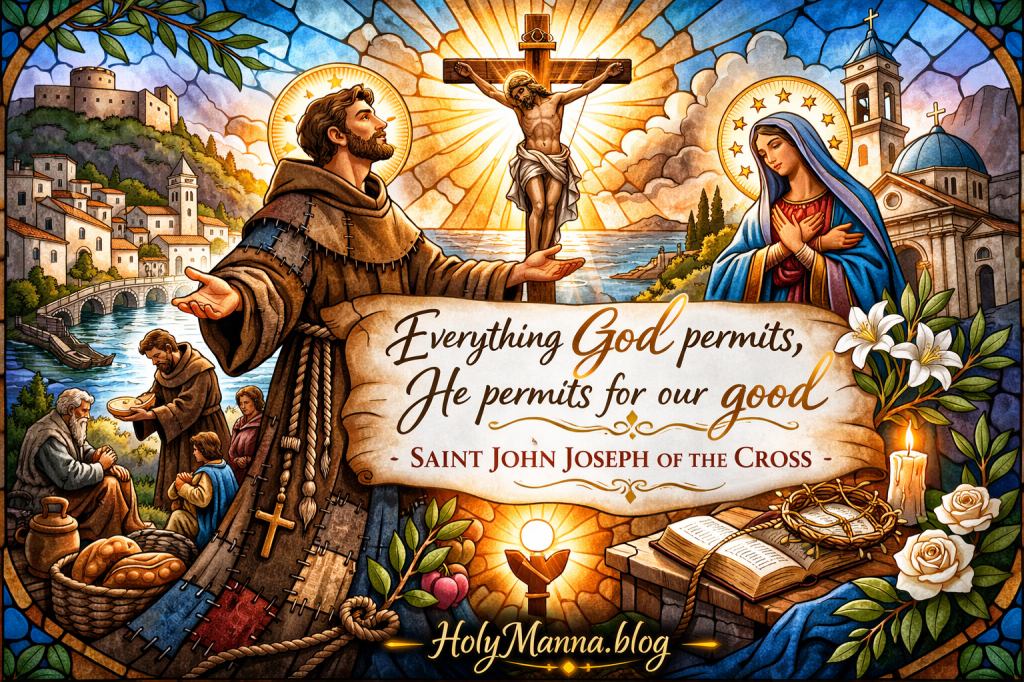
What he became known for later sounds almost unbelievable, but it was very concrete. He lived radical poverty so literally that he became famous for a single habit covered in patches. People called him “the friar of a hundred patches,” and it was not a gimmick. It was a visible sermon. In a world that wants constant upgrades, he wore his poverty like a confession that God is enough. That spirit matches the evangelical counsels the Church praises in consecrated life, especially poverty freely embraced for love of Christ, as taught in CCC 915 to 916.
The Friar Who Carried the Poor
His life included real work, not just private devotion. In 1671 he was sent with other friars to the area of Piedimonte d’Alife near the sanctuary of Santa Maria Occorrevole, where a new convent was being built. He helped establish a deeper life of recollection there, including an eremitical place known as “La Solitudine,” a name that already hints at his spiritual instinct. The silence was not an escape. It was a way of hearing God clearly so he could love people well.
He was ordained a priest on September 18, 1677, and his priesthood became a steady stream of confession, counsel, and mercy. People came to him because he did not treat souls like problems to solve. He treated them like persons to love and lead to Christ. He was also trusted with leadership among the friars during a tense period of internal division and reform. That kind of responsibility usually reveals a person’s true character, and what appeared in him was humility, firmness, and patient obedience.
He became known for charity that cost him something. He urged his friars not to send the poor away empty-handed. He looked for the forgotten, including those hiding in attics and cramped rooms, and he served them as if he were serving Christ Himself. That is exactly the logic of the Gospel and the Church’s teaching that love for the poor is not optional sentiment, but a real demand of discipleship, as CCC 2443 to 2449 makes clear.
Accounts also attribute extraordinary graces to him during his lifetime. Catholic sources associated with his cause describe healings, prophecy, reading of hearts, bilocation, and even levitations. These were never meant to be the headline. In the Catholic mind, miracles are signs, not trophies. They point to God’s mercy and confirm that holiness is real, even in a hidden life.
One miracle story repeatedly associated with him is the raising of a young nobleman named Gennaro Spada from death. The tradition is reported within Catholic devotional sources connected to his life and cult. The Church presents such accounts within the broader pattern that God sometimes confirms sanctity through wonders, yet the deepest “miracle” remains the saint’s heroic virtue. Because details in miracle narratives often come through witness tradition rather than modern documentation, the full historical verification of every detail cannot be established today.
The Long Road of Obedience
Not every trial came from outside the Church. Some of his hardest suffering came from misunderstanding and accusations within religious life. Catholic accounts describe periods when he was criticized unjustly and even calumniated. Instead of launching a self-defense campaign, he embraced silence and obedience. That is not weakness. That is spiritual strength under control.
His leadership also unfolded during a complicated conflict involving branches of the Alcantarine observance. He carried responsibility in a time when unity and discipline were fragile. Eventually, the divided branches were reunited in 1722, and he lived long enough to see the fruit of patient endurance. His life is a reminder that holiness is not proven by a life with no problems. It is proven by faithfulness when problems are unavoidable.
Through it all, his Marian devotion stayed constant and personal. He relied on Mary not as a sentimental accessory but as a real mother in the spiritual life, which is exactly how the Church speaks of her, since she is honored as Mother of the Church and a powerful intercessor for the faithful, as taught in CCC 971 and CCC 2673. Near the end of his life, his love for Mary became a final testament.
A Saint Still Walking the Streets
He died in Naples on March 5, 1734, at Santa Lucia al Monte. Catholic tradition preserves his final words as a simple Marian recommendation: “Ti raccomando la Madonna.” That means, “I commend Our Lady to you.” It sounds like a last will and testament from a spiritual father who knew where safety is found.
A saying attributed to him captures the steady confidence that shaped his whole life: “Tutto quello che Dio permette, lo permette per il nostro bene.” In English, it means, “Everything God permits, He permits for our good.” That is not a shallow slogan. It is a hard-earned conviction that only makes sense when someone has carried real crosses.
After his death, devotion grew quickly. He was beatified in 1789 and canonized in 1839. He became especially loved in Naples and on Ischia, where he is honored as a patron, and where local Catholic life has long included public celebrations in his honor. In modern times, his relics were translated from Naples back to Ischia, where they are venerated with deep affection by the faithful. Pilgrims continue to visit places associated with his life, especially the Franciscan sites tied to his prayer and ministry, because Catholics do not venerate saints as museum pieces. The saints are living members of the Church in glory, and their relics and shrines become places where people beg for help, conversion, healing, and courage.
Miracles and favors are still attributed to his intercession. Stories of healings and timely help circulate among the faithful who pray with confidence, especially those devoted to Franciscan spirituality and Marian trust. Many of these reports arise from lived devotion rather than formal historical study, so specific claims are not always verifiable with modern documentation, but they remain part of the saint’s ongoing reputation for fatherly care.
Trust God When the World Offers Shortcuts
Saint John Joseph of the Cross offers a very direct invitation: stop living as if God is a backup plan. He trusted God enough to embrace poverty without bitterness, silence without resentment, and obedience without cynicism. That kind of life confronts modern habits that quietly form the soul, like constant comfort-seeking, nonstop noise, and the need to control outcomes.
His patched habit is a spiritual mirror. It asks whether the heart is patched together by grace, or patched together by distractions. His tenderness toward the poor is another mirror. It asks whether love is real, or merely a preference for people who are easy to love.
A practical way to imitate him is to choose one hidden act of poverty each week, something that loosens attachment and strengthens freedom. It might mean simplifying a purchase, skipping a luxury, or giving a little more generously than feels comfortable. Another way is to practice disciplined silence. That could mean turning off unnecessary noise for ten minutes each day and praying slowly with Psalm 34 or the Sorrowful Mysteries, letting Jesus teach the heart how to carry the Cross with peace. A third way is to entrust decisions to Mary with childlike confidence, not because life becomes easy, but because the soul becomes steadier.
The point is not to become gloomy or extreme. The point is to become free. The Cross is not meant to crush the disciple. The Cross is meant to heal pride, purify love, and make room for resurrection, as the whole logic of Christian life proclaims, and as CCC 618 reminds every believer.
What would change if God’s will became more trusted than personal control?
Where is the Lord asking for a “patch” of humility, a small surrender that makes the soul poorer but happier?
How might Mary be inviting a deeper confidence in her Son today?
Engage with Us!
Readers are invited to share thoughts and reflections in the comments below, especially any experiences of learning trust through suffering, or any ways Saint John Joseph of the Cross has inspired deeper simplicity and prayer.
- Where is trust in God hardest right now, and what would it look like to take one small step toward surrender?
- What is one attachment that keeps the heart restless, and how could a simple act of voluntary “poverty” loosen its grip?
- How can devotion to Mary become more concrete this week, in a way that leads more directly to Jesus?
- Who is one person on the margins who needs mercy, attention, or practical help, and how can that be offered quietly and faithfully?
Keep walking forward in faith. Keep choosing love over comfort, truth over image, and mercy over pride. Do everything with the love and mercy Jesus taught, and let the saints remind the heart that holiness is not reserved for the extraordinary. Holiness is built in ordinary days by ordinary people who decide to belong to Christ completely.
Saint John Joseph of the Cross, pray for us!
Follow us on YouTube, Instagram and Facebook for more insights and reflections on living a faith-filled life.

 Holy Manna!
Leave a comment