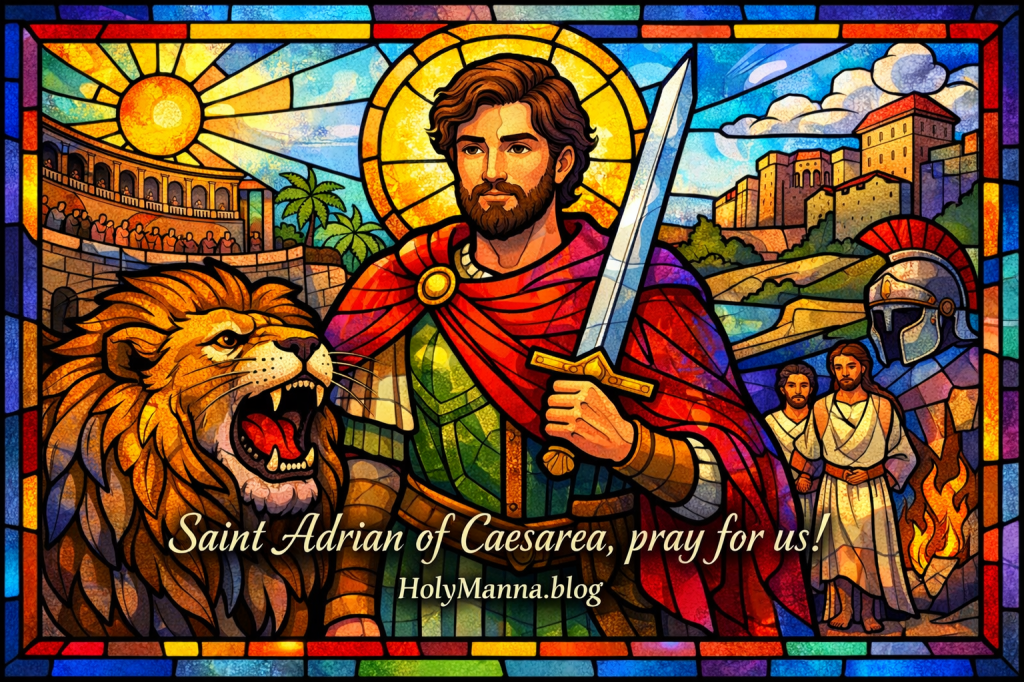
The Saint Who Chose the Hard Road
Saint Adrian of Caesarea, also known as Hadrian, shines with a kind of courage that feels almost upside down to modern instincts. He did not stumble into danger by accident. He moved toward it because love does that. In the early fourth century, when the Roman persecution was squeezing the Church hard, Adrian traveled to Caesarea in Palestine to stand near imprisoned Christians and strengthen them. That choice cost him everything, and it also made him a witness the Church still names with reverence.
The Church remembers him as a martyr, which is not just a tragic ending. It is a victory that looks like defeat to the world. The Catechism teaches that martyrdom is the supreme witness given to the truth of the faith, and it is a participation in the Passion of Christ, when a Christian chooses fidelity even unto death. This is the story of a man who refused to live by “luck” or “fate,” even when the city around him was throwing a festival to Fortuna, the pagan goddess of fortune. He lived by the Lord.
A Quiet Beginning
The oldest accounts do not give a long biography of Saint Adrian’s childhood, his parents, or the details of his upbringing. The Church is honest about that. What is known is still deeply meaningful. Adrian came from the region of Batanea, and he traveled to Caesarea during the Great Persecution. That alone tells a lot. This was not someone chasing comfort, status, or a safe life. This was someone who belonged to the suffering Body of Christ and acted like it.
There is also no surviving record of a dramatic, cinematic conversion moment for Adrian. Instead, the picture is of a man whose faith had matured into action. He was the kind of Christian who heard that brothers and sisters were suffering, and he decided they should not suffer alone. That is conversion in the truest sense. It is the heart turning fully toward the Lord, and then the feet following.
What is he most known for, beyond the manner of his death, is this: he went to be with the martyrs. He did not go to be entertained. He went to be faithful.
The Miracle of Showing Up
When people hear “saint,” they often look for a list of spectacular miracles. Sometimes God grants those signs. Sometimes He gives a quieter kind of holiness that is just as supernatural. With Saint Adrian of Caesarea, the earliest sources focus on his decision and his witness, not on a catalogue of wonders performed during his lifetime.
No reliable early account preserves specific miracle stories worked by Adrian before his martyrdom. That does not make his life less powerful. His life highlights a miracle that most people overlook because it feels too ordinary. He showed up. He put his body and his reputation where his faith was. He crossed distance to comfort the suffering Church. In a world that applauds comfort and self-protection, that kind of love is not natural. It is grace.
This is one reason the Church holds martyrs in such high honor. They show what faith looks like when it is not theoretical. They show that Jesus is not a hobby. He is Lord.
When Christ Takes the Crown
The story tightens at the city gate of Caesarea. Adrian and his companion, Saint Eubulus, arrived and were questioned about why they had come. They answered plainly. They had come for the martyrs, for the imprisoned Christians. That honest confession became their arrest warrant.
Under the governor Firmilian, Adrian suffered brutal torture. The early account describes the tearing of the body with instruments meant to shred flesh. The point was not merely punishment. It was intimidation. Rome wanted Christians to learn fear.
Then came the arena. Adrian was thrown to a lion. The Church remembers that he was torn by the beast and then finished by the sword. The detail that stings with symbolism is the setting. The tradition preserved in The Roman Martyrology connects his martyrdom with a pagan celebration honoring Fortuna. The world tried to make his death into a tribute to “chance” and “fate,” as if the gods of the empire had swallowed the Christian.
But the Church sees it the other way around. Adrian’s death was not bad luck. It was not fate winning. It was Christ crowned in a human life. It was a man saying, with his whole body, that Caesar is not lord. Fortuna is not lord. Jesus Christ is Lord.
This is also where Saint Adrian becomes a sharp examination of conscience for modern life. The idol might not be a statue of Fortuna anymore, but the temptation is familiar. It is the temptation to hand life over to the gods of probability, comfort, public approval, and self-preservation. Adrian refused that bargain.
A Lion at His Side
The earliest sources do not preserve specific posthumous miracle accounts connected to Saint Adrian of Caesarea. There is no famous, well-attested healing story tied to his tomb in the primary early witness. The Church does not force details where history is silent. Instead, she preserves what is solid and lets devotion grow where it truly grows.
His impact after death is still real and distinctly Catholic. First, the Church keeps his name in her official memory. He is commemorated in the Church’s martyrological tradition on March 5, and his companion Saint Eubulus is remembered shortly after. This matters because the Church does not treat saints as motivational posters. She treats them as members of the family. The liturgical memory is a kind of spiritual family album, and Adrian is in it because his witness belongs to everyone.
Second, Catholic tradition marks him in sacred art and memory with the sign of the lion. That image is not sentimental. It is a reminder that the early Christians faced real beasts, real steel, and real fear. It also reminds the faithful that courage is not the absence of fear. Courage is faithfulness despite fear. The Catechism describes fortitude as firmness in difficulties and constancy in pursuing the good. That is exactly what Adrian embodies, and that virtue remains needed in every generation.
Some later devotional retellings add historical claims around the larger persecution or the later fate of persecuting officials. These details cannot be verified with the same certainty as the core martyrdom account, and they should be held as later tradition rather than bedrock fact. The heart of Adrian’s legacy does not depend on them. His legacy rests on this: he chose communion with the suffering Church and confessed Christ without bargaining.
How to Stop Living Like God Is Optional
Saint Adrian of Caesarea challenges a comfortable kind of Christianity that wants spiritual benefits without spiritual costs. His story is not meant to make anyone feel trapped or hopeless. It is meant to make faith concrete.
There is a modern way of honoring Fortuna without calling her name. It is when life is treated like a game of odds, and God is treated like an accessory. It is when decisions are made purely by what feels safe, what protects reputation, what avoids discomfort, and what keeps options open. Adrian’s life is a reminder that love chooses presence. Love chooses truth. Love chooses fidelity.
This does not mean everyone is called to literal martyrdom. It means everyone is called to real discipleship. Sometimes the “arena” looks like staying faithful in a relationship when temptation is loud. Sometimes it looks like defending the Church when it is unpopular. Sometimes it looks like visiting the sick, checking on the lonely, or standing with someone who is being mocked for believing. Sometimes it looks like confession, humility, and starting again after failure.
The martyrs teach that Jesus is worth everything because Jesus is everything. The Catechism teaches that martyrdom is the supreme witness to the truth of the faith, and it reveals how precious Christ really is when the world demands a trade. Adrian refused to trade.
How often does life get navigated as if faith is only for the easy days?
Where is the Lord inviting a more honest confession, not just with words but with choices?
Who is suffering nearby, and what would it look like to show up the way Adrian showed up?
Engage With Us!
Share thoughts and reflections in the comments below. Let this saint’s witness spark a real conversation about courage, truth, and fidelity when it costs something.
- What is one “safe” habit or pattern that keeps faith from becoming real and concrete?
- Who is one person in suffering who needs presence more than advice right now?
- What is one practical act of fortitude that can be lived this week, even if it feels uncomfortable?
- When pressure rises, what usually gets chosen first: comfort, reputation, or Christ?
- How can Saint Adrian’s honesty at the gate inspire more honesty in prayer, confession, and daily decisions?
Saint Adrian reminds every Christian that holiness is not a fantasy for stained-glass heroes. Holiness is fidelity in real life. So go live with courage. Keep showing up. Keep telling the truth. Keep choosing the way of Jesus, and do everything with the love and mercy Jesus taught us.
Saint Adrian of Caesarea, pray for us!
Follow us on YouTube, Instagram and Facebook for more insights and reflections on living a faith-filled life.

 Holy Manna!
Leave a comment