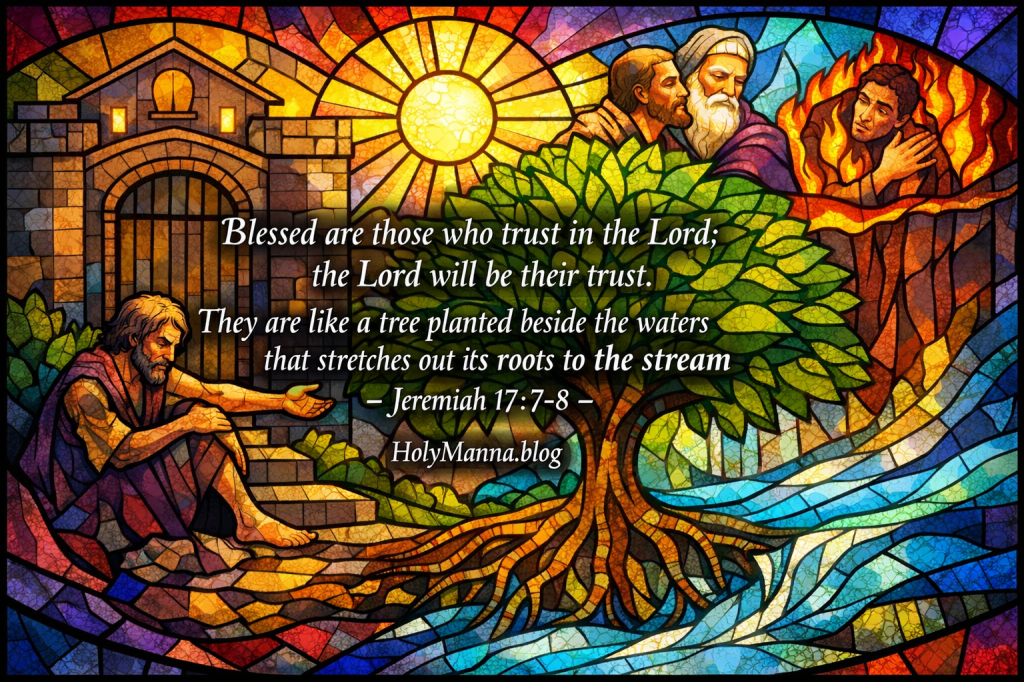
Thursday of the Second Week of Lent – Lectionary: 233
The Gate Where the Heart Chooses Its Roots
Some days in Lent feel quiet on the surface, but they land like a weight on the soul, because they ask a simple question that nobody can dodge forever. What is the heart really trusting, and what kind of life is that trust producing? That is the thread pulling tight through today’s readings, and it is why they fit Lent so perfectly. The Church is not letting anyone coast on religious habits or good intentions. The Word of God is pressing for a decision that shows up in the real world.
In Jeremiah, the Lord speaks into a moment when God’s people were tempted to lean on politics, alliances, and human strength instead of repentance and covenant faithfulness. It is the ancient version of modern temptation: trusting what can be measured, purchased, controlled, or negotiated, while quietly drifting from the Lord. Jeremiah calls that kind of life a wasteland, not because God enjoys punishing people, but because a heart that turns away from God eventually loses the water that makes it fruitful. That is why the reading dares to say “Cursed is the man who trusts in human beings” and then immediately offers the alternative: “Blessed are those who trust in the Lord”. This is not poetic exaggeration. It is spiritual realism.
Psalm 1 echoes the same wisdom, almost like a father pulling a son aside and saying, “Choose your road carefully, because roads shape people.” The blessed person does not drift into the counsel of the wicked but finds delight in the Lord’s law, letting it sink in day and night until it becomes a steady inner compass. That is why the Psalm repeats Jeremiah’s image of the tree planted by water, because Scripture is showing that trust is not just a feeling. Trust becomes a root system, and root systems determine whether a life can survive heat, drought, and disappointment.
Then Luke brings the theme down from poetry into flesh and blood with the parable of the rich man and Lazarus. A man with every comfort walks past suffering that is close enough to touch, and the gate between them becomes the symbol of his whole life. The tragedy is not only that Lazarus is hungry, but that the rich man is spiritually numb. The story reveals what Jeremiah warned about and what the Psalm tried to prevent: a heart can become so twisted that it stops seeing people as neighbors and starts seeing them as background. When death comes, that closed gate is exposed for what it always was, a refusal to listen, a refusal to love, and a refusal to let God’s Word reshape the heart.
Lent is the Church’s mercy in real time. It is the season when the Lord digs around the roots, not to shame anyone, but to save what is still alive. Today’s readings prepare the soul for an honest examination, because they insist on one central theme: the heart must be rooted in God, or it will be driven by false security and end in sterility. Could it be that the Lord has been placing Scripture at the center and the poor at the gate, not as interruptions, but as invitations to conversion?
First Reading – Jeremiah 17:5-10
True Wisdom
Jeremiah speaks to Judah in a tense, unraveling moment of history. The nation is squeezed between empires, anxious about survival, and tempted to treat alliances, armies, and influence as saviors. In that pressure cooker, the prophet does not begin with policy advice. He begins with the spiritual diagnosis: trust has shifted. The covenant people are leaning on “flesh,” meaning merely human strength, instead of leaning on the Lord.
That is why the reading sounds like the wisdom tradition and even echoes the covenant language of blessings and curses found in Deuteronomy 28. Jeremiah is not offering self-help. He is announcing a spiritual law as steady as gravity: what the heart trusts will decide whether life becomes a wasteland or an orchard. This fits today’s theme perfectly because it exposes the hidden choice behind every visible habit. The heart is either sinking roots into the Lord, like a tree by living water, or it is spreading shallow roots into control, comfort, and human approval, and that always ends in dryness.
Jeremiah 17:5-10 – New American Bible (Revised Edition)
True Wisdom
5 Thus says the Lord:
Cursed is the man who trusts in human beings,
who makes flesh his strength,
whose heart turns away from the Lord.
6 He is like a barren bush in the wasteland
that enjoys no change of season,
But stands in lava beds in the wilderness,
a land, salty and uninhabited.
7 Blessed are those who trust in the Lord;
the Lord will be their trust.
8 They are like a tree planted beside the waters
that stretches out its roots to the stream:
It does not fear heat when it comes,
its leaves stay green;
In the year of drought it shows no distress,
but still produces fruit.
9 More tortuous than anything is the human heart,
beyond remedy; who can understand it?
10 I, the Lord, explore the mind
and test the heart,
Giving to all according to their ways,
according to the fruit of their deeds.
Detailed Exegesis
Verse 5: “Thus says the Lord: Cursed is the man who trusts in human beings, who makes flesh his strength, whose heart turns away from the Lord.”
Jeremiah opens with God’s own voice, because this is not merely a prophet’s opinion. “Cursed” here is not a tantrum from heaven. It is the covenant consequence of turning from the Source of life. The problem is not friendship, work, or wise planning. The problem is ultimate reliance. When “flesh” becomes strength, the heart quietly stops praying as if God matters, stops obeying as if truth matters, and starts living as if survival is the only god. The real tragedy is in the last phrase: the heart turns away. It rarely turns away in one dramatic moment. It turns away in small, repeated choices.
Verse 6: “He is like a barren bush in the wasteland that enjoys no change of season, But stands in lava beds in the wilderness, a land, salty and uninhabited.”
The image is vivid because Jeremiah knows his land. A bush in salty ground does not flourish by trying harder. It is simply planted in the wrong place. That is the spiritual point. A heart that trusts in self can look busy and functional, but it cannot receive the living water that produces love, endurance, and joy. The phrase “no change of season” is haunting. It describes a soul that stops growing, stops repenting, and stops expecting God to act, so even grace-filled seasons feel flat.
Verse 7: “Blessed are those who trust in the Lord; the Lord will be their trust.”
Here Jeremiah mirrors verse 5, but with the opposite outcome. “Blessed” is not mere good luck. It is the stable well-being that comes from being aligned with God. The phrase “the Lord will be their trust” is stronger than it first appears. It is not only trusting that God gives gifts. It is trusting God Himself. The heart is no longer propped up by fragile supports. It is held by the One who cannot fail.
Verse 8: “They are like a tree planted beside the waters that stretches out its roots to the stream: It does not fear heat when it comes, its leaves stay green; In the year of drought it shows no distress, but still produces fruit.”
This is not the promise of a pain-free life. Heat still comes. Drought still arrives. The difference is depth. The tree survives because its roots reach beyond the surface. The fruitfulness here is the fruit of fidelity: steady prayer, real charity, patience under trial, integrity when nobody is watching. Jeremiah is showing that spiritual resilience is not personality-based. It is rootedness-based.
Verse 9: “More tortuous than anything is the human heart, beyond remedy; who can understand it?”
This verse dismantles the modern slogan that the heart is automatically trustworthy. Jeremiah’s point is not that the human person is worthless. It is that sin makes the inner world slippery. The heart can rename envy as “standards,” rename lust as “just being honest,” rename greed as “responsibility,” and rename hardness as “boundaries.” The question “who can understand it?” is a confession of human limits. Left to itself, the heart is an unreliable narrator.
Verse 10: “I, the Lord, explore the mind and test the heart, Giving to all according to their ways, according to the fruit of their deeds.”
God answers the question of verse 9. The Lord can understand the heart because the Lord sees it entirely, without being fooled by excuses, appearances, or image management. This is sobering, but it is also mercy. God’s knowledge is not only courtroom knowledge. It is physician knowledge. The Lord searches the heart to expose what is killing it, and to call the person back to life. The line about “fruit” brings everything down to reality. Love produces fruit. Self-reliance produces fruit. Every trust eventually becomes visible.
Teachings
Jeremiah’s warning is a direct confrontation with idolatry, not only statues and pagan rites, but the subtler idolatry of treating created things as saviors. The Church names this temptation plainly: CCC 2113 teaches, “Idolatry consists in divinizing what is not God.” When “flesh” becomes strength, the heart starts divinizing what cannot carry divine weight, whether that is money, control, status, romance, or even personal discipline.
Jeremiah also exposes why conversion has to go deeper than behavior management. The root issue is the heart, and the heart can deceive. That is why the Church speaks about conscience as a real interior place where God calls, not a place for self-justification. CCC 1776 describes conscience with a line that fits Jeremiah’s realism: “Its voice, ever calling him to love and to do what is good and to avoid evil, sounds in his heart at the right moment….” Jeremiah is effectively saying that when the heart turns away from the Lord, it also dulls that voice. A person still “feels” things, but feels them without truth.
And because Jeremiah uses the language of trust, it is worth naming the virtue behind it. Trust in the Lord is not vague positivity. It is the soil of theological hope. The Church defines hope in a way that matches Jeremiah’s contrast between “flesh” and grace. CCC 1817 teaches, “Hope is the theological virtue by which we desire the kingdom of heaven and eternal life as our happiness.” This hope is not passive. It is rooted. It chooses God as the future, even when circumstances feel dry.
Finally, Jeremiah’s line about the heart being beyond full self-understanding is not meant to produce despair. It is meant to drive the soul into prayer, because prayer is where the Lord searches, heals, and reorders the inner life. The Church describes the heart as the place of decision, where life and death are chosen. CCC 2563 says, “Only the Spirit of God can fathom the human heart and know it fully.” That is Jeremiah 17:10 in Catechism language. God tests the heart because God intends to save the heart.
A saintly voice helps tie it together with a single unforgettable sentence. St. Augustine, Confessions, Book I, 1 says, “You move us to delight in praising You; for You have made us for Yourself, and our hearts are restless until they rest in You.” Jeremiah’s barren bush is a restless heart trying to rest in anything but God. Jeremiah’s flourishing tree is a heart finally planted where it belongs.
Reflection
This reading lands in daily life where trust actually gets practiced, in small moments that feel ordinary but shape the soul. Trust in “flesh” often looks respectable. It can look like grinding without praying, planning without surrendering, hustling while calling it responsibility, and carrying anxiety like it is proof of love. Trust in the Lord looks different. It does not make someone lazy. It makes someone rooted. It makes someone steady in heat and humble in drought.
A simple way to live Jeremiah today is to name the “root system” before the day gets loud. When the morning begins, it helps to ask the heart what it is leaning on. It helps to pray in a way that tells the truth, not in a way that performs. It helps to let God’s Word correct the inner story. It helps to make one concrete act of trust, such as forgiving someone, giving generously, telling the truth, turning off the constant noise, or going to confession instead of pretending everything is fine.
What has been acting like a substitute savior lately, something treated as if it must work out or everything will collapse?
When pressure rises, does the heart reach for prayer first, or does it reach for control first?
If the Lord “tests the heart” by looking at fruit, what fruit has been growing most consistently in recent weeks, peace or irritation, generosity or grasping, patience or cynicism?
Jeremiah is not trying to scare anyone into being religious. Jeremiah is trying to save people from building their lives in salty ground. The Lord is offering a better place to plant the soul, and Lent is the season to let those roots move.
Responsorial Psalm – Psalm 1:1-4, 6
True Happiness in God’s Law
Psalm 1 stands at the doorway of the Psalms like a watchman, greeting every pilgrim with a serious promise and a serious warning. In ancient Israel, the Psalms were not private inspirational poetry. They were sung prayer, forming the conscience of God’s people in the Temple and in the home, shaping how a community learned to trust the Lord when life felt uncertain. This particular Psalm is wisdom literature in song form. It teaches that there are two ways to live, two paths to walk, and two outcomes that cannot be mixed.
That is why this Psalm matches today’s theme so perfectly. Jeremiah showed two root systems, one planted in “flesh” and one planted in the Lord. Now the Psalm describes the daily choices that build those roots. The difference between the blessed and the wicked is not mainly personality or social class. The difference is what they welcome into the heart, what they repeat, what they dwell on, and what they come to love. Lent places this Psalm on the lips to remind the faithful that holiness is not an event. Holiness is a direction, taken one step at a time, until the soul becomes steady enough to bear fruit.
Psalm 1:1-4, 6 – New American Bible (Revised Edition)
True Happiness in God’s Law
1 Blessed is the man who does not walk
in the counsel of the wicked,
Nor stand in the way of sinners,
nor sit in company with scoffers.
2 Rather, the law of the Lord is his joy;
and on his law he meditates day and night.
3 He is like a tree
planted near streams of water,
that yields its fruit in season;
Its leaves never wither;
whatever he does prospers.4 But not so are the wicked, not so!
They are like chaff driven by the wind.6 Because the Lord knows the way of the just,
but the way of the wicked leads to ruin.
Detailed Exegesis
Verse 1: “Blessed is the man who does not walk in the counsel of the wicked, Nor stand in the way of sinners, nor sit in company with scoffers.”
The Psalm begins with a blessing that sounds simple, but it is very practical. Notice the movement: walk, stand, sit. This is the slow drift of sin. What starts as listening can become lingering, and what becomes lingering can become belonging. “Counsel” is not only advice spoken aloud. It is the whole mindset a person absorbs, the story the world tells about what matters, what is normal, and what is worth sacrificing for. In Lent, this verse is a wake-up call. The soul cannot plant roots in the Lord while constantly standing in the same stream of mockery, impurity, cynicism, and pride.
Verse 2: “Rather, the law of the Lord is his joy; and on his law he meditates day and night.”
This verse is the turning point. The blessed person does not merely avoid evil. The blessed person desires something better. In Scripture, “law” is not only rules. It is Torah, the revealed teaching of God that forms a people into holiness. The surprising word is “joy.” The Psalm does not describe God’s Word as a burden for religious types. It describes it as delight for the person who wants life. To “meditate day and night” means the Word is revisited, chewed on, prayed slowly, and carried into ordinary decisions. This is how a heart becomes less tortuous, as Jeremiah warned, because the Word keeps shining light into the places where self-deception likes to hide.
Verse 3: “He is like a tree planted near streams of water, that yields its fruit in season; Its leaves never wither; whatever he does prospers.”
The Psalm repeats Jeremiah’s image because God wants the point to land. A tree near water has a hidden life. The fruit is visible, but the strength is underground. The “streams” are the steady gifts of grace that God provides through prayer, the sacraments, and the Word lived in the Church. The phrase “in season” matters too. The blessed life is not frantic. It is faithful. Fruit comes when God wills, and the person remains planted even when results are not immediate. “Whatever he does prospers” does not mean everything goes smoothly. It means the person’s life moves toward God, and therefore toward lasting good, even when circumstances are hard.
Verse 4: “But not so are the wicked, not so! They are like chaff driven by the wind.”
The Psalm snaps awake here, almost like a father raising his voice because the danger is real. Chaff is what is left after grain is threshed. It looks like something, but it has no weight and no nourishment. The wicked life, in biblical language, is not merely someone who slips and repents. It is the life that resists God and refuses to be formed. It becomes weightless. It becomes easily pushed by trends, impulses, cravings, and fear of man. That is exactly what Jeremiah meant by trusting in “flesh.” It is a life blown around because it is not anchored.
Verse 6: “Because the Lord knows the way of the just, but the way of the wicked leads to ruin.”
This last verse is both comforting and sobering. The Lord “knows” the way of the just. In Scripture, to be known by God is not only to be observed. It is to be held, guided, and cared for within covenant love. The opposite is ruin, not because God delights in loss, but because a road chosen against God eventually arrives at the place where God is not wanted. The Psalm ends by reminding the soul that paths have destinations, and daily choices quietly decide the end of the story.
Teachings
Psalm 1 gives the Church a vocabulary for moral formation that is very Catholic, because it connects desire, habit, and destiny. The Psalm shows that holiness is not only about avoiding wrong actions. It is about learning to love what God loves until the heart actually delights in it.
The Church teaches that Sacred Scripture is not merely information, but nourishment and a living word through which God speaks to His people. CCC 131 says, “and such is the force and power of the Word of God that it can serve the Church as her support and vigor, and the children of the Church as strength for their faith, food for the soul, and a pure and lasting source of spiritual life.” That is the “streams of water” image in doctrinal form. A soul cannot stay green without being fed.
The Psalm’s language of “meditating day and night” also fits the Church’s teaching on prayer as a relationship that must become habitual, not occasional. CCC 2708 describes meditation in a way that matches this Psalm’s steady rhythm: “Meditation is above all a quest. The mind seeks to understand the why and how of the Christian life, in order to adhere and respond to what the Lord is asking.” The blessed person is not simply thinking religious thoughts. The blessed person is letting God’s Word question, shape, and direct the heart.
Saintly wisdom strengthens the Psalm’s warning about drift. St. John Chrysostom often pressed Christians to be careful about what enters the soul, because repeated exposure forms appetite, and appetite forms behavior. His pastoral point matches the Psalm’s “walk, stand, sit” progression: sin usually becomes comfortable before it becomes obvious. That is why Lent is so intense about small disciplines. The Church is trying to interrupt drift before it becomes a direction.
And there is a historical reason this Psalm has always been cherished in Christian prayer. From the earliest centuries, believers prayed the Psalms as the school of Christ. When the Church prays the Psalms, the voice of Christ is heard, and the faithful learn Christ’s mind over time. The Psalm is not only describing a good man. It is pointing toward the truly blessed Man, Jesus Christ, who perfectly delights in the Father’s will and bears fruit in season, even through the Cross.
Reflection
This Psalm does not ask for a dramatic personality change. It asks for a change of input and a change of habit, because that is how roots grow. If the soul wants stability, it needs a stable stream. The world offers endless counsel, and much of it sounds reasonable until it is tested by suffering, temptation, or fear. The Psalm invites a different experiment: let the Word of God become the main voice the heart hears, and see what kind of person begins to emerge.
A practical way to live this Psalm in Lent is to choose one small daily pattern that plants the soul near water. That could mean praying the Psalm slowly in the morning, reading a short passage of Scripture before checking a phone, or memorizing one line and repeating it during stressful moments. It could also mean reducing the “counsel of the wicked,” not by hiding from life, but by being honest about what forms the imagination. If the mind is soaked all day in scoffing, impurity, outrage, or cynical humor, it should not be shocking when prayer feels dry and charity feels difficult. Roots grow in the soil they are given.
What voices have been shaping the inner life most strongly, and do those voices lead toward peace or toward restlessness?
If the heart were a tree, what has been watering it lately, Scripture and prayer, or endless noise and reaction?
Where has the soul slowly moved from walking near sin, to standing near it, to sitting comfortably with it?
The Psalm offers a quiet promise: the person who delights in the Lord’s instruction becomes someone with weight, someone with steadiness, someone who can love under pressure. That is the kind of person Lent is trying to form, not for show, but for salvation.
Holy Gospel – Luke 16:19-31
The Rich Man and Lazarus
Jesus tells this parable in the later part of The Gospel of Luke, as He is drawing closer to Jerusalem and sharpening His call to repentance. The audience includes Pharisees who, just a few verses earlier, are described as lovers of money. In that world, wealth was often treated as a sign of God’s favor, while poverty could be seen as a curse. Jesus does not deny that blessings exist, but He dismantles the lie that comfort automatically means holiness.
The story also carries the religious weight of Israel’s hope: Abraham represents the covenant family, Moses and the prophets represent the already-given Word of God, and the afterlife imagery reflects the Jewish conviction that earthly life matters and that justice does not end at the grave. In Lent, this Gospel lands like a sober alarm. It takes today’s theme of trust and roots and exposes it in real life. The rich man’s root system is self, comfort, and indifference. Lazarus, emptied of worldly security, becomes a living icon of dependence. The real tragedy is not merely wealth versus poverty. The tragedy is a heart that became so twisted it could step over suffering and still think everything was fine.
Luke 16:19-31 – New American Bible (Revised Edition)
19 “There was a rich man who dressed in purple garments and fine linen and dined sumptuously each day. 20 And lying at his door was a poor man named Lazarus, covered with sores, 21 who would gladly have eaten his fill of the scraps that fell from the rich man’s table. Dogs even used to come and lick his sores. 22 When the poor man died, he was carried away by angels to the bosom of Abraham. The rich man also died and was buried, 23 and from the netherworld, where he was in torment, he raised his eyes and saw Abraham far off and Lazarus at his side. 24 And he cried out, ‘Father Abraham, have pity on me. Send Lazarus to dip the tip of his finger in water and cool my tongue, for I am suffering torment in these flames.’ 25 Abraham replied, ‘My child, remember that you received what was good during your lifetime while Lazarus likewise received what was bad; but now he is comforted here, whereas you are tormented. 26 Moreover, between us and you a great chasm is established to prevent anyone from crossing who might wish to go from our side to yours or from your side to ours.’ 27 He said, ‘Then I beg you, father, send him to my father’s house, 28 for I have five brothers, so that he may warn them, lest they too come to this place of torment.’ 29 But Abraham replied, ‘They have Moses and the prophets. Let them listen to them.’ 30 He said, ‘Oh no, father Abraham, but if someone from the dead goes to them, they will repent.’ 31 Then Abraham said, ‘If they will not listen to Moses and the prophets, neither will they be persuaded if someone should rise from the dead.’”
Detailed Exegesis
Verse 19: “There was a rich man who dressed in purple garments and fine linen and dined sumptuously each day.”
Purple and fine linen signal status and luxury. This is not simple prosperity. This is public display and daily indulgence. Jesus sets the stage: a man built his life around comfort. The danger is not that he owns things, but that things own him. The rhythm of “each day” hints at habit. A soul does not become hard in one afternoon. It becomes hard by repetition.
Verse 20: “And lying at his door was a poor man named Lazarus, covered with sores.”
Jesus names the poor man, which is rare in parables and deeply intentional. “Lazarus” means “God helps.” The rich man remains unnamed, as if his identity has been swallowed by his possessions. Lazarus is not far away. He is at the door, at the gate, close enough to be seen, close enough to be helped, close enough to be inconvenient. The sores show extreme vulnerability and likely ritual impurity in Jewish perception, which makes the rich man’s indifference even more revealing.
Verse 21: “Who would gladly have eaten his fill of the scraps that fell from the rich man’s table. Dogs even used to come and lick his sores.”
This is humiliation layered on hunger. “Scraps” points to the kind of waste left after feasting. The dogs provide a haunting contrast: animals show more attention than the man made in God’s image. The scene is meant to sting because it reveals a failure of basic mercy. The rich man does not need extraordinary virtue to help. He only needs a human heart.
Verse 22: “When the poor man died, he was carried away by angels to the bosom of Abraham. The rich man also died and was buried.”
Death arrives for both, and the social hierarchy collapses instantly. Lazarus, ignored in life, is honored in death. The “bosom of Abraham” signifies rest with the righteous, the comfort of belonging to God’s covenant promises. The rich man is simply “buried,” which sounds normal, but the contrast is sharp. The one who was invisible on earth is escorted by angels. The one who was celebrated on earth is reduced to a grave.
Verse 23: “And from the netherworld, where he was in torment, he raised his eyes and saw Abraham far off and Lazarus at his side.”
The parable moves into the afterlife with the language Luke uses for the realm of the dead. The rich man sees clearly now, but clarity after death does not equal conversion. He recognizes Abraham and Lazarus, which implies he had always been aware of Lazarus. The torment is not described as arbitrary. It is the unveiling of a life lived without love.
Verse 24: “And he cried out, ‘Father Abraham, have pity on me. Send Lazarus to dip the tip of his finger in water and cool my tongue, for I am suffering torment in these flames.’”
Notice the rich man still treats Lazarus like an errand runner. Even now, he does not say, “Forgive me for ignoring him.” He says, “Send him.” This is the spiritual pathology of pride: even in pain, it wants hierarchy. The request for water echoes the thirst Lazarus experienced, but the rich man never cared about that thirst when he could have relieved it.
Verse 25: “Abraham replied, ‘My child, remember that you received what was good during your lifetime while Lazarus likewise received what was bad; but now he is comforted here, whereas you are tormented.’”
Abraham calls him “my child,” which shows this is not a petty revenge story. It is justice mixed with tragedy. The reversal is not saying poverty saves automatically or wealth condemns automatically. The point is that the rich man received gifts but did not convert those gifts into love. Lazarus suffered, but his suffering did not become bitterness in the story. He is simply received.
Verse 26: “Moreover, between us and you a great chasm is established to prevent anyone from crossing who might wish to go from our side to yours or from your side to ours.”
This is one of the most sobering lines in the Gospel. The chasm is the final form of a lifetime of choices. The rich man built a distance in his heart, and after death that distance becomes fixed. Lent places this before the faithful because conversion belongs to this life. Mercy is offered now, while the gate can still be opened.
Verse 27: “He said, ‘Then I beg you, father, send him to my father’s house.’”
The rich man shifts from self-concern to concern for his brothers, which sounds noble, but he still insists on Lazarus being sent like a messenger. He still does not speak of repentance in a personal way. There is a strange mixture here: some awareness, but not true humility. The parable is exposing how hard it is for a proud heart to actually bow.
Verse 28: “For I have five brothers, so that he may warn them, lest they too come to this place of torment.’”
The warning is real. Jesus is not playing with the idea of judgment. The rich man’s fear is not only emotional. It is theological. He knows now that choices matter. The “five brothers” also makes the story feel grounded, almost like a real family, because the temptation Jesus is confronting is common, not rare.
Verse 29: “But Abraham replied, ‘They have Moses and the prophets. Let them listen to them.’”
This line is the heart of the parable. God has already spoken. The Word has already been given. Conversion does not require a spectacular sign. It requires a willing heart. “Moses and the prophets” includes the repeated command to care for the poor, defend the vulnerable, and live covenant love. The rich man’s brothers have everything they need, if they are willing to listen.
Verse 30: “He said, ‘Oh no, father Abraham, but if someone from the dead goes to them, they will repent.’”
This is the human excuse in religious clothing. It says, “If God would just do something dramatic, then the heart would change.” But Scripture reveals the opposite: a heart that refuses God’s Word will interpret miracles as inconvenient interruptions or will demand even more miracles.
Verse 31: “Then Abraham said, ‘If they will not listen to Moses and the prophets, neither will they be persuaded if someone should rise from the dead.’”
This line points straight toward the Resurrection. It is a prophecy hidden in a warning. Even after Jesus rises from the dead, some will still refuse to believe, because disbelief is not always an evidence problem. It is often a love problem. The parable ends by insisting that the path to life is already clear: listen, repent, and love while there is time.
Teachings
This Gospel lays bare three Catholic realities that Lent never allows the faithful to ignore: the moral weight of this life, the obligation of mercy, and the reality of judgment.
First, the Church teaches that earthly life is the time for choosing God, and that each person faces judgment after death. CCC 1021 says, “Death puts an end to human life as the time open to either accepting or rejecting the divine grace manifested in Christ.” The rich man’s tragedy is that he treated time like it was unlimited. He treated mercy like it could be postponed. The parable shows that delay can become destiny.
Second, the Church is blunt that love for the poor is not an optional extra. It is a criterion that reveals whether love of God is real. CCC 2443 teaches, “God blesses those who come to the aid of the poor and rebukes those who turn away from them.” Lazarus at the gate is not a random character. Lazarus is the test the rich man failed, not because he lacked resources, but because he lacked mercy.
The Church also links this directly to Christ Himself. The poor are not only a social concern. They are a sacramental encounter with the suffering Christ. CCC 2449 says, “Beginning with the Old Testament, all the prophets insist on justice and charity toward the poor.” That is “Moses and the prophets” in Catechism language. The rich man did not lack information. He lacked obedience.
Third, this parable touches the Church’s sober teaching on hell, not as a threat used for manipulation, but as the real possibility of definitive self-exclusion from communion with God. CCC 1033 says, “To die in mortal sin without repenting and accepting God’s merciful love means remaining separated from him for ever by our own free choice.” The “great chasm” is not God’s cruelty. It is the fixed result of a heart that refused love until it no longer wanted love.
Saintly voices have preached this parable for centuries precisely because it targets respectable sin. St. John Chrysostom famously pressed his listeners to recognize that the poor at the door are not obstacles but opportunities for mercy, and that indifference is a serious spiritual disease. His preaching consistently insists that wealth is given as stewardship, not as private permission to ignore suffering. That is exactly what the rich man forgot.
St. Augustine likewise warned that the rich man’s punishment was tied not to gold itself but to a heart that was closed. Augustine’s pastoral edge is that the rich man did not need to become poor to be saved. He needed to become merciful. That is the heart of Catholic moral teaching: conversion is not merely a change of circumstances. It is a change of love.
Reflection
This Gospel is uncomfortable because it refuses to let mercy stay theoretical. It puts Lazarus at the gate, which means the question is not, “Does compassion matter?” The question is, “Who is being stepped over?”
In daily life, the gate is rarely a mansion entrance. The gate is the moment when suffering is close enough to notice, but easy enough to ignore. It is the coworker who is falling apart and gets treated like background noise. It is the family member who needs patience, but receives sarcasm. It is the elderly neighbor who is lonely, while the schedule stays packed with entertainment. It is the poor person encountered in public, and the heart immediately looks away to protect comfort.
Lent is the season to open the gate while it still opens. That starts with honesty. It continues with concrete mercy. It grows through listening to “Moses and the prophets,” meaning letting Scripture and the Church’s teaching correct a lifestyle that has become numb. It also involves prayer that asks for a heart that sees, because the rich man’s greatest poverty was not financial. It was spiritual blindness.
Who is Lazarus at the gate right now, placed close enough to be loved, but easy enough to avoid?
What comforts have become so normal that suffering feels like an interruption instead of a summons?
If the Lord measured life by the “fruit” of love, what fruit has been most consistent lately, generosity and attention, or indifference and excuse-making?
A good Lenten step is simple but serious: choose one act of mercy that costs something real, time, attention, money, pride, and do it quietly. Then choose one act of listening, reading and praying the Word that has already been given, because Abraham’s warning is still true. If the heart will not listen to God’s Word now, it will always find a reason to delay later.

 Holy Manna!
Leave a comment