The Heiress Who Became a Missionary for America’s Forgotten
Saint Katharine Drexel is one of those saints who makes people stop and blink, because her story is not what the world expects. She was born into staggering wealth in Philadelphia, yet she died as a poor religious sister who poured herself out for souls the culture treated as disposable. She is revered because she did not treat faith like an accessory for respectable people. She treated Jesus like a King who has claims on everything, including money, reputation, comfort, and the right to choose “easy.” Her life became a living protest against racism and indifference, not driven by politics, but by the Eucharist.
She is especially remembered as the foundress of the Sisters of the Blessed Sacrament, a congregation devoted to serving Black and Native American communities through Catholic education and evangelization. Her feast day is March 3, and her witness still speaks loudly in a country that loves to argue about justice but struggles to live charity.
A Childhood Shaped by Mercy and a Quiet Fire
Katharine Mary Drexel was born on November 26, 1858. Her mother died shortly after her birth, and she was raised in a home where Catholic faith was not just spoken, but practiced in ways children could see. The Drexel household became known for steady, concrete works of mercy. The poor were not a concept. They were guests. The sick were not a statistic. They were neighbors.
That kind of upbringing forms a conscience. It teaches a child that comfort is not the goal of life, and that God does not bless a family so that the family can build a bigger fence. He blesses so that the blessing can become bread for others. That is the logic of the Gospel, and it is the logic Saint Katharine carried into adulthood.
Her faith also deepened through suffering. In her young adult years she helped care for her stepmother through a long and painful illness. Watching someone you love carry the Cross changes a person. It strips away fantasies about control and reminds the heart that life is fragile, and that eternity is real. In that season, the idea of religious life moved from a “nice thought” to a serious call.
The Moment a Pope Changed Everything
As a young woman, Katharine traveled and saw the harsh conditions faced by Native American communities. She also became increasingly aware of the injustices faced by Black Americans, including the deliberate denial of education and the dignity that comes with it. Like many generous Catholics, she started by funding good works, supporting missions, and helping build schools.
Then came a moment that reads like a scene from a movie, but it is told again and again in Catholic accounts for a reason. She met Pope Leo XIII and asked him to send missionaries to serve Native Americans. His response did not land like polite encouragement. It landed like a command from Providence. “Why not, my child, yourself become a missionary?” That question did not simply redirect her plans. It redirected her life.
She would not just finance mission work. She would become mission work.
The Work She Is Most Known For
Katharine entered religious life and in 1891 founded the Sisters of the Blessed Sacrament. From the beginning, the heart of the mission was simple and demanding. The Eucharist would be adored, loved, and received, and then that love would be carried into the streets, into classrooms, into missions, into places where society had decided certain people did not matter.
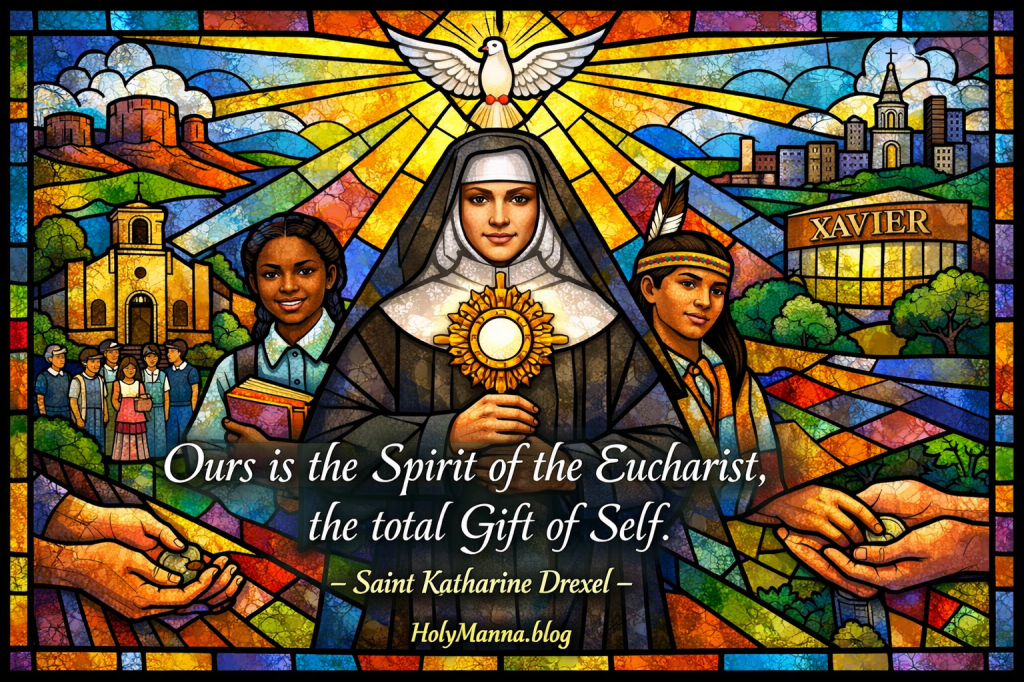
The saint is famous for using her inheritance to establish and support a vast network of Catholic schools and missions, especially for Black and Native American communities. One of the most enduring fruits of her courage is Xavier University of Louisiana in New Orleans, the only Catholic historically Black university in the United States. It became a powerhouse of formation, particularly in the sciences and health professions, and it continues to shape leaders who serve the common good.
This is not random philanthropy. It is Catholic discipleship with a backbone. It is what happens when someone believes that every human person bears God-given dignity, and that contempt for any people is a sin against the Creator. This lines up cleanly with The Catechism on the dignity of the human person and the equal respect owed to all, especially when society prefers exclusion and cruelty, as taught in CCC 1934-1935.
A Eucharistic Heart
Saint Katharine’s spirituality was not built on vague positivity. It was Eucharistic, and that matters. The Eucharist is not merely a symbol of unity. It creates unity, and it also judges every form of injustice that denies the Body of Christ in the poor. The Catechism puts it bluntly that the Eucharist commits us to the poor, as taught in CCC 1397. That is exactly how her life reads. She adored Jesus in the Blessed Sacrament, and then she went looking for Him in the people the culture ignored.
Her sayings reflect that steady, courageous spirit. One line often associated with her is a short command that feels like it belongs on a battlefield banner: “Press forward and fear nothing.” She also insisted that Eucharistic devotion is not an escape from the world, but fuel for love in the world, expressed in the teaching: “Ours is the Spirit of the Eucharist, the total Gift of Self.”
Building, Teaching, and Defying the “Normal”
Her life’s “miracle” is first the miracle of perseverance. She and her sisters built schools and missions in places where prejudice made the work dangerous and exhausting. There were communities that welcomed them, and others that resisted them with hostility. Catholic histories of her mission emphasize that the sisters faced threats, opposition, and at times violence against their works. Some accounts connected to the early Xavier story speak of intense resistance, including incidents like arson against a building associated with their ministry. These details are remembered not to dramatize the past, but to show the cost of loving real people in real history.
When it comes to miracles in the strict sense, Saint Katharine is not most famous for public displays like healing lines or dramatic wonders during her lifetime. Her ministry was more often the slow miracle of faithful Catholic education, where children learned to pray, read, think, and live with dignity. In the eyes of the Church, that matters because it is an extension of evangelization itself. She treated education as a work of mercy and a defense of human dignity, a practice deeply consistent with Catholic teaching on charity and justice, as seen in CCC 2447 and CCC 2448.
The Hidden Cross That Purifies Love
Saint Katharine was not martyred in the classic sense, but she carried a heavy cross. She had to surrender the identity the world offered her. She was an heiress and could have lived as a celebrated benefactor. Instead, she became a religious sister tied to obedience, poverty, and the daily grind of mission life.
She also endured the kind of suffering that does not make headlines. Later in life her health collapsed. A severe heart attack limited her ability to travel and lead actively. For a woman whose whole life was movement, building, and organizing, this was a crucifixion. Yet she did not treat her “inactive” years as useless. She lived them as intercession, offering her days in prayer, united to the sacrifice of Christ. That is profoundly Catholic. The Church teaches that suffering can be united to Christ’s redemptive love, and the saints show what it looks like when that belief becomes flesh.
Healings, Devotion, and a Living Legacy
After her death on March 3, 1955, devotion to Katharine grew steadily, and stories of her intercession spread. The Church eventually recognized miracles connected to her cause for canonization, including healings associated with deafness. Two healings are especially important because they were investigated and accepted in the process leading to her beatification and canonization. These are presented in Catholic accounts as signs of God’s confirmation, not as party tricks, and they highlight the Church’s careful approach to miracles.
Beyond those official miracles, many people have shared stories of favors received through her intercession, especially related to education, racial healing, and the needs of struggling families. Some of these accounts are heartfelt but cannot be fully verified with the rigor used in canonization investigations, and they should be received with that humility. They may still be meaningful personal testimonies, but they cannot be verified.
Her ongoing impact is not only devotional. It is cultural and deeply practical. Xavier University of Louisiana continues to form students who serve society, and her congregation’s mission still carries her vision. Her shrine and places associated with her life have become sites of pilgrimage where Catholics come to pray for courage, for racial reconciliation rooted in truth, and for the grace to serve without counting the cost.
Learn from a Saint Who Had Every Excuse Not to Be One
Saint Katharine Drexel is a saint for anyone tempted to believe that holiness requires perfect circumstances. She had wealth, influence, and access to power, and she used them for the Kingdom. She also shows that comfort is not the same thing as peace. Peace comes from obedience to Christ.
Her life asks a question that hits close to home in a culture addicted to convenience. What would change if every Catholic treated the Eucharist as real, and then lived like it was real? The Eucharist is the source and summit of Christian life, as taught in CCC 1324. If that is true, then devotion cannot stay trapped inside church walls. It has to become generosity, courage, and the refusal to dehumanize anyone.
A practical way to imitate her is to start small but serious. Commit to a consistent Eucharistic life. Make Sunday Mass non-negotiable and treat Confession like spiritual oxygen, not a last resort. Choose one work of mercy that costs something, even if it is time, money, comfort, or pride. Support Catholic education and faithful ministries serving the poor, especially in communities the world overlooks. Speak with clarity and charity when racism or contempt shows up in conversation, because silence can become cooperation.
Saint Katharine’s life also teaches a hard lesson for modern people who measure everything by output. She reminds the soul that prayer and hidden suffering matter. One line often passed on in her spiritual tradition captures it well: “Success is not the criterion in the spiritual life.” God looks for fidelity. The world looks for trophies.
Engage with Us!
Readers are invited to share thoughts and reflections in the comments below, especially any ways Saint Katharine’s story challenges the heart or strengthens hope.
- Where has comfort become an excuse to avoid a clear call from God?
- How does belief in the Real Presence of Jesus in the Eucharist change the way daily life is lived, especially toward the poor and marginalized?
- What is one concrete act of mercy that can be practiced this week in a way that costs something real?
- Is there a person or group that has been judged too quickly, and what would repentance and charity look like in that relationship?
- What part of Saint Katharine Drexel’s courage feels most needed in the Church right now, and why?
May Saint Katharine Drexel teach the heart to love Jesus in the Blessed Sacrament with reverence, and then to carry that love into the world with courage. May every day be lived with the love and mercy Jesus taught, so that faith becomes visible, charity becomes concrete, and the Gospel becomes credible in the way life is lived.
Saint Katharine Drexel, pray for us!
Follow us on YouTube, Instagram and Facebook for more insights and reflections on living a faith-filled life.

 Holy Manna!
Leave a comment