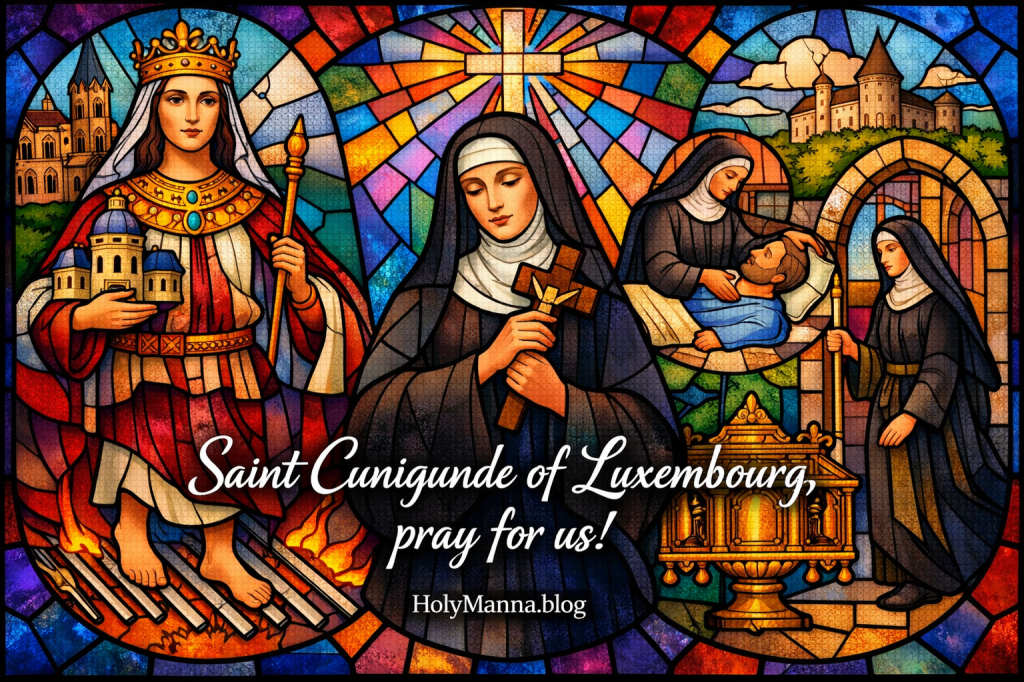
The Quiet Fire of a Holy Empress
Saint Cunigunde of Luxembourg is one of those saints who surprises people, because her road to holiness ran straight through the middle of power. She was a Holy Roman Empress, the wife of Saint Henry II, and she lived close to the pressure of politics, courts, and public scrutiny. Yet the Church remembers her not because she played the game well, but because she refused to let the game play her.
In the Catholic memory of Bamberg, Cunigunde is honored as a patroness and a co-founder of the local Church’s life, especially through the founding and support of churches and monasteries. Her feast is celebrated on March 3 as a major day of joy in Bamberg. Her life teaches a simple lesson that modern people need to hear again: holiness is not blocked by your station in life, because grace can sanctify a throne just as surely as it can sanctify a cloister.
Raised for Great Things, Formed for Eternal Things
Cunigunde came from the noble house of Luxembourg and received a Christian upbringing that shaped her character early. She did not “convert” from paganism the way some early martyrs did, but she experienced a deeper conversion that is just as real. It is the steady conversion of the heart, where a person keeps choosing God, not once, but again and again, even when life keeps getting bigger and louder.
She married Henry of Bavaria around the turn of the millennium. When Henry became king, Cunigunde was crowned queen in 1002, and later, in 1014, she traveled with him to Rome where they received the imperial crown from Pope Benedict VIII. That detail matters because it shows what kind of couple they were in the Catholic imagination: not merely rulers who happened to be Christian, but rulers who wanted their authority under the blessing of the Church.
A major thread in their story is that their marriage was childless. Some Catholic accounts speak openly about infertility, and they point out that while the legal customs of the time could have made this a cause for repudiation, Henry did not choose that path. Instead, the couple became famous for building up the Church and serving the poor, and they are remembered as a saintly imperial couple who tried to renew Christian life in their realm.
There is also a well-known tradition that their union was marked by a special chastity, so much so that it was called “the marriage of Saint Joseph.” This cannot be proven like a modern document, but it has endured in Catholic devotion because it points to something the Church always teaches: chastity is not a rejection of love, it is love ordered toward God. The Catechism teaches that chastity integrates desire within the person and leads to inner freedom, not bondage, and that is exactly how Cunigunde’s story has been told through the centuries, as a life governed by God rather than by impulse. CCC 2337-2345.
Building the Church While Wearing a Crown
Cunigunde is remembered for more than personal virtue. She and Henry invested heavily in building up the Church, including the establishment of Bamberg’s ecclesial life and the cathedral where they would later be buried. She did not treat faith like a private hobby. She treated it like reality, meaning the Church mattered, the poor mattered, and reform mattered.
Catholic tradition in Bamberg also remembers the couple as supportive of reform and peace-making. That is not small. In a world where rulers often used religion as decoration, Cunigunde is remembered for taking the demands of Christ seriously. Her sanctity looked like foundation stones, endowments, prayer, counsel, and stubborn faithfulness when it would have been easier to live for comfort.
Fire Underfoot and the Courage to Trust God
The most famous miracle-story connected with Cunigunde during her lifetime is the ordeal by fire. The tradition says she was slandered with accusations of infidelity, and to prove her innocence she walked over burning coals or red-hot plowshares and was not harmed. This story is told as a sign of divine vindication. It is also the reason many people connect her to the spiritual pain of being falsely accused.
Whether every detail can be verified historically or not, the story still functions like a parable written into her life. It reminds the faithful that God sees what others do not see, and that patience under unjust judgment is a real form of spiritual strength. The Catechism warns against detraction and calumny, because they can destroy reputations and wound souls. CCC 2477. Cunigunde’s story puts a face on that teaching. It also points to the Gospel promise, “Blessed are the pure in heart, for they shall see God.” Mt 5:8.
Another legend connected to her life appears in the artistic tradition surrounding the imperial tomb in Bamberg. In one story depicted in this tradition, Cunigunde is shown paying workers, and a greedy worker takes more than his share, after which the coin burns his hand. This story cannot be verified as a historical event, but it has been repeated as a moral lesson about justice, greed, and the holiness expected even in the practical work of building the Church, and it cannot be verified.
The Hardest Battle Was Not Political
Cunigunde’s deepest hardship was not an enemy army. It was the slow suffering of public life, the burden of childlessness, the sting of slander in the legends, and then the grief of widowhood when Henry died in 1024.
Catholic tradition describes a striking moment one year later. At the anniversary of Henry’s death, Cunigunde went to the monastery at Kaufungen, offered a relic of the Holy Cross to the community, laid aside her royal clothing, and took up the Benedictine habit. In other words, she chose to vanish on purpose. She did not cling to court influence to protect her comfort. She stepped away from her power so she could live the rest of her life in humility, prayer, and service.
This is not martyrdom by sword, but it is still a kind of dying. It is the death of status, the death of control, the death of being seen. It is the kind of death that makes room for resurrection in the soul. The Catechism teaches that the consecrated life is a sign of the world to come, a living witness that God is worth everything. CCC 914-916.
Cunigunde died at Kaufungen on March 3. Catholic sources sometimes differ on the exact year, often placing it around 1033 and sometimes later in the decade. The Church’s focus is not on the calendar argument. The focus is on the end of the story: the empress died as a nun.
After Death: A Tomb That Preaches, A Saint Who Still Helps
Cunigunde was canonized in 1200 by Pope Innocent III, and her veneration has remained especially strong in Bamberg, where she is buried beside Saint Henry II in the cathedral. Their tomb became a kind of stone sermon. The reliefs and stories surrounding their memory kept teaching pilgrims long after the couple had died.
Miracles after her death are often described in a general way as healings and help received through her intercession, especially in the devotional life surrounding Bamberg. Many of the specific miracle reports from medieval shrines are not the kind of thing that can be verified with modern methods, but that does not stop the faithful from doing what Catholics have always done: asking saints to pray, trusting that God is still generous.
This is exactly how The Catechism describes the communion of saints. The saints are not dead and gone. They are alive in Christ, and their intercession is real. CCC 956. When Catholics honor a saint, they are not worshiping a human being. They are praising what God has done in a human being, and they are asking for help to follow that same path.
Cunigunde’s cultural impact shows up most clearly in places that still speak her name with love. Bamberg celebrates its diocesan festival, the Heinrichsfest, as a living memory of the holy founders of that local Church. Luxembourg also remembers her through churches and devotion tied to her homeland. Even now, her story stands out because it is a saint’s life that refuses to fit into a modern category. She was a ruler, a wife, a widow, and a nun, and she kept choosing Christ in every season.
One line used by the Church to summarize her life comes from the saint-day tradition that describes her choice after Henry’s death. “She made Christ her inheritance.” That is not presented as her personal quotation, but it is the Church’s way of telling the truth about her soul.
What This Saint Teaches People Living in the Real World
Saint Cunigunde is a gift for anyone who feels pulled in too many directions. Her life says that holiness is not an escape hatch for people who cannot handle real responsibility. Holiness is fidelity to Christ right in the middle of responsibility.
Her story also speaks to anyone who has been misunderstood or judged. The legends about slander and vindication are not just medieval drama. They reveal a spiritual reality: God does not forget the truth, even when people rewrite it. The Christian response is not revenge. It is endurance, prayer, and the decision to keep doing good. Scripture says, “Do not be overcome by evil, but overcome evil with good.” Rom 12:21.
Her final years also offer a sharp examination of conscience. Plenty of people claim they would give up everything for God, but most people panic when they have to give up a little comfort, a little reputation, or a little control. Cunigunde laid down an empire and picked up a humble rule of life. That is why she shines.
Anyone can imitate her in concrete ways. A person can honor God in the workday by refusing corruption and refusing gossip. A person can practice generosity quietly, not for applause. A person can protect purity of heart by choosing discipline over indulgence, because chastity is not about being cold. It is about being free. CCC 2337. A person can also learn to treat the Church as family, supporting parishes, religious houses, and works of mercy, because love for the poor is not optional in Catholic life. CCC 2447.
Most of all, her life teaches that the real victory is not being remembered on earth. The real victory is belonging to Christ.
Engage with Us!
Share your thoughts and reflections in the comments below. Saint Cunigunde’s story has a way of pulling hidden struggles into the light, especially the struggles of reputation, purity, and letting go of control.
- Where does life feel like a “courtroom” right now, and how can trust in God replace the urge to defend the ego?
- What is one practical way to practice mercy with your speech this week, especially by refusing gossip or rash judgment?
- What would it look like to “make Christ your inheritance” in your current season of life, whether single, married, struggling, or thriving?
- Which virtue from Saint Cunigunde’s life feels hardest right now, chastity, humility, patience under criticism, or generosity, and why?
Keep walking forward in faith. Keep choosing what is true. Keep doing everything with the love and mercy Jesus taught us, because that is how saints are made, one obedient day at a time.
Saint Cunigunde of Luxembourg, pray for us!
Follow us on YouTube, Instagram and Facebook for more insights and reflections on living a faith-filled life.

 Holy Manna!
Leave a comment