Tuesday of the Second Week of Lent – Lectionary: 231
When God Says: “Let’s Set This Right”
There are days in Lent when the Church sounds gentle, like a mother whispering encouragement, and there are days when she sounds like a prophet pounding on the door because something inside the house is on fire. Today is one of those prophetic days. The First Reading from The Book of Isaiah, the hard-edged honesty of Psalm 50, and the Holy Gospel from The Gospel of Matthew all converge on one central theme: God refuses to be impressed by religious performance, because He is after real conversion that shows itself in humble obedience and concrete love.
This is the spiritual backdrop of Lent itself. From the earliest centuries, Christians treated these forty days as a season of purification, not just for the already-devout, but especially for those preparing for Baptism and for public penitents being reconciled to the Church. The Church still carries that ancient instinct. Lent is not a time to decorate sin with pious words, but a time to let grace scrape away what is false so what is holy can finally breathe. That is why today’s readings keep returning to the same uncomfortable question: Is faith becoming a mask, or is it becoming a life?
Isaiah addresses people who maintain the appearance of worship while tolerating injustice, and God’s command is both blunt and merciful: “Wash yourselves clean! Put away your misdeeds from before my eyes; cease doing evil; learn to do good.” The psalm echoes the same divine protest, exposing the contradiction of speaking God’s covenant while resisting His discipline, as though reciting holy words could replace holiness. Then Jesus, in the Gospel, confronts a familiar temptation that never really goes away: the desire to be seen as righteous while refusing the hidden work of repentance. He warns against leaders who load burdens on others, love titles and honors, and turn devotion into theater. In response, Christ gives the mark of authentic greatness in His Kingdom: **“The greatest among you must be your servant.”
Put together, the readings form a single call: let worship become honest again, let repentance become real again, and let humility become visible through service. Lent is not asking for a better religious image. Lent is asking for a cleaner heart, a steadier way of life, and a love that defends the vulnerable when nobody is watching. Where has faith been reduced to talk, while God is asking for obedience? Where has devotion stayed on the surface, while the Lord is inviting a deeper cleansing?
First Reading – Isaiah 1:10, 16-20
God Is Not Asking for Better Religion. God Is Asking for a Clean Heart.
The Book of Isaiah opens like a courtroom scene. The prophet is sent to Jerusalem and Judah in a time when God’s people still knew how to “do religion” on schedule. The temple sacrifices continued, the feasts were observed, and the public signs of devotion were visible. Yet beneath the surface, the covenant life was cracking. The strong were taking advantage of the weak, the poor were being ignored, and injustice was being tolerated while worship carried on as if everything were fine.
That is why Isaiah begins with a punch to the gut. He calls the leaders “Sodom” and the people “Gomorrah,” not because they live there, but because their hearts have begun to resemble the spiritual rot of those infamous cities. In today’s Lenten theme, this reading lands like a wake up call: God refuses to be bribed by outward piety. He wants repentance that becomes justice, mercy, and obedience. The good news is that the Lord does not only accuse. The Lord invites. The Lord promises cleansing. The Lord offers a real new beginning.
Isaiah 1:10, 16-20 – New American Bible (Revised Edition)
10 Hear the word of the Lord,
princes of Sodom!
Listen to the instruction of our God,
people of Gomorrah!16 Wash yourselves clean!
Put away your misdeeds from before my eyes;
cease doing evil;
17 learn to do good.
Make justice your aim: redress the wronged,
hear the orphan’s plea, defend the widow.18 Come now, let us set things right,
says the Lord:
Though your sins be like scarlet,
they may become white as snow;
Though they be red like crimson,
they may become white as wool.
19 If you are willing, and obey,
you shall eat the good things of the land;
20 But if you refuse and resist,
you shall be eaten by the sword:
for the mouth of the Lord has spoken!
Detailed Exegesis
Verse 10 – “Hear the word of the Lord, princes of Sodom! Listen to the instruction of our God, people of Gomorrah!”
Isaiah uses shocking language to break through spiritual numbness. Sodom and Gomorrah represent a society hardened against God, especially through grave sin and the abuse of the vulnerable. The prophet is saying, in effect, “Do not assume that being God’s people automatically means living like God’s people.” Lent presses the same issue. A Catholic can know the prayers, know the rules, and still be resisting conversion.
Verse 16 – “Wash yourselves clean! Put away your misdeeds from before my eyes; cease doing evil.”
God’s command is direct because mercy is not sentimental. To be washed clean means sin must be named and renounced, not explained away. This is not a call to self-improvement. It is a call to repentance. For Catholics, this points straight to conversion of heart and the sacramental life, especially Confession, where Christ actually cleanses what is confessed with humility and honesty.
Verse 17 – “Learn to do good. Make justice your aim: redress the wronged, hear the orphan’s plea, defend the widow.”
Here the Lord defines what real repentance looks like in public. The orphan and the widow are not random examples. In the ancient world, they were the people most likely to be exploited because they lacked protection, income, and social power. God ties worship to justice because covenant life is never only private. A cleansed heart begins to show itself in how the powerless are treated, how business is done, how words are used, and whether the wounded are defended or dismissed.
Verse 18 – “Come now, let us set things right, says the Lord: Though your sins be like scarlet, they may become white as snow; Though they be red like crimson, they may become white as wool.”
This is one of Scripture’s most tender invitations. God does not deny the ugliness of sin. Scarlet and crimson are vivid, permanent dyes. The point is that sin stains deeply, and only God can bleach what the soul cannot remove on its own. The Lord does not merely tolerate the sinner. He offers restoration, purity, and reconciliation. Lent is not about staying in shame. Lent is about letting God “set things right.”
Verse 19 – “If you are willing, and obey, you shall eat the good things of the land.”
God attaches blessing to obedience, not as a gimmick, but as a spiritual reality. When a people return to God, life becomes ordered again. Peace, stability, and fruitfulness are described here as “the good things of the land.” This is covenant language. It teaches that grace is not only about avoiding punishment. Grace is about entering the life that actually works because it is aligned with God.
Verse 20 – “But if you refuse and resist, you shall be eaten by the sword: for the mouth of the Lord has spoken!”
This is not God being petty. This is God being truthful. Refusing conversion has consequences, personally and socially. When sin is protected, violence eventually replaces peace, either through literal conflict or through the slow destruction of relationships, families, and communities. The warning is severe because the danger is real. God speaks this way because He wants His people to live.
Teachings
Today’s reading matches the Church’s constant teaching that outward religion without interior conversion is hollow, and that conversion must bear fruit in charity and justice. The Catechism describes what God is demanding here with unmistakable clarity in CCC 1431: “Interior repentance is a radical reorientation of our whole life, a return, a conversion to God with all our heart, an end of sin, a turning away from evil, with repugnance toward the evil actions we have committed. At the same time it entails the desire and resolution to change one’s life, with hope in God’s mercy and trust in the help of his grace.” That is Isaiah’s “wash yourselves clean” in Catholic language.
Isaiah’s insistence on defending the widow and hearing the orphan also lines up with the Church’s teaching that love for the poor is not optional spirituality. It is part of fidelity to God. The Catechism explains how concrete mercy must become in CCC 2447: “The works of mercy are charitable actions by which we come to the aid of our neighbor in his spiritual and bodily necessities. Instructing, advising, consoling, comforting are spiritual works of mercy, as are forgiving and bearing wrongs patiently. The corporal works of mercy consist especially in feeding the hungry, sheltering the homeless, clothing the naked, visiting the sick and imprisoned, and burying the dead. Among all these, giving alms to the poor is one of the chief witnesses to fraternal charity: it is also a work of justice pleasing to God.” Isaiah is not inventing a new standard. He is repeating God’s old standard: worship and justice belong together.
Historically, this prophetic message shaped how the early Church understood repentance. Christians were taught that true penance includes both turning from sin and repairing harm through charity, restitution, and concrete acts of mercy. That is why Lent has always carried a double focus: conversion of the heart and practical love for neighbor. Isaiah makes it plain that a clean conscience is meant to produce clean hands.
Reflection
This reading is not meant to make anyone despair. It is meant to stop the spiritual habit of hiding behind religious activity while refusing real change. God does not ask for a perfect record. God asks for a willing heart. The Lord’s invitation, “Come now, let us set things right,” sounds like a Father who is ready to forgive the moment His child stops arguing and comes home.
A practical Lenten response begins with honesty. It helps to name one misdeed that has been excused, minimized, or delayed, and then bring it into the light with real repentance. It also helps to take Isaiah’s command seriously: “learn to do good” is learned through practice. A single act of justice can become a turning point. An apology that is long overdue can become a cleansing. A choice to stop gossiping can become the beginning of peace. A decision to defend someone being mocked can become a small but real stand for the widow and the orphan of the modern world, meaning the person with no voice in the room.
Where has religious routine become a cover for a habit that needs to die? Who is being “wronged” nearby, and what would it look like to redress that wrong instead of ignoring it? If sins can become white as snow by God’s mercy, what is stopping a full return to Him today?
Responsorial Psalm – Psalm 50:8-9, 16-17, 21, 23
God Sees Through Religious Talk, and He Still Invites Real Worship.
Psalm 50 sounds like a courtroom scene, which makes it a perfect companion to Isaiah. In ancient Israel, sacrifice was not a random religious hobby. It was covenant worship. Offerings expressed thanksgiving, repentance, and communion with God. Yet the prophets and the psalms repeatedly warn that sacrifice becomes an insult when it is used like a cover for sin. That is the atmosphere of today’s psalm. God is not rejecting worship itself. God is rejecting worship that is separated from obedience.
This fits today’s theme like a key fits a lock. The First Reading commanded, “Wash yourselves clean,” and the Gospel will condemn spiritual performance. The psalm stands in the middle like a divine mirror, forcing the heart to ask whether prayer and religious language have become a mask. God is not fooled by a mouth that recites commandments while a life discards them. At the same time, the psalm ends with hope: the Lord still shows the path back, a path marked by praise, steadfastness, and real conversion.
Psalm 50:8-9, 16-17, 21, 23 – New American Bible (Revised Edition)
8 Not for your sacrifices do I rebuke you,
your burnt offerings are always before me.
9 I will not take a bullock from your house,
or he-goats from your folds.16 But to the wicked God says:
“Why do you recite my commandments
and profess my covenant with your mouth?
17 You hate discipline;
you cast my words behind you!21 When you do these things should I be silent?
Do you think that I am like you?
I accuse you, I lay out the matter before your eyes.23 Those who offer praise as a sacrifice honor me;
I will let him whose way is steadfast
look upon the salvation of God.”
Detailed Exegesis
Verse 8 – “Not for your sacrifices do I rebuke you, your burnt offerings are always before me.”
God begins by removing a common excuse. The problem is not that the people stopped worshiping. The problem is that they kept worshiping without changing. It is possible to be present at holy things and still be far from holiness. Lent calls Catholics to resist that danger, especially when religious routine becomes automatic.
Verse 9 – “I will not take a bullock from your house, or he-goats from your folds.”
This verse exposes a mistaken idea of God, as if worship feeds Him, as if offerings fill a need in Him. God is not a pagan idol who depends on human gifts. The sacrifices were for the people’s conversion, gratitude, and communion, not for God’s survival. When Catholics give time, money, and devotion, it is not to “buy” God, but to be reshaped by love and truth.
Verse 16 – “But to the wicked God says: ‘Why do you recite my commandments and profess my covenant with your mouth?’”
Here the psalm becomes personal. The issue is not ignorance, but contradiction. A person can speak the right words and still live like those words are meaningless. This is the sin of hypocrisy that Jesus will confront in the Gospel. The psalm is warning that religious vocabulary without conversion becomes self-deception.
Verse 17 – “You hate discipline; you cast my words behind you!”
Discipline here means God’s correction, His instruction, His training of the heart. The wicked do not simply struggle. They resist being formed. They throw God’s words behind them like something unwanted. Lent is a season of discipline precisely because love accepts correction. A refusal to be corrected is often the clearest sign that pride is running the show.
Verse 21 – “When you do these things should I be silent? Do you think that I am like you? I accuse you, I lay out the matter before your eyes.”
God rejects the fantasy that He is indifferent or morally similar to the sinner. The phrase, “Do you think that I am like you?” is a direct strike against projecting human weakness onto God. Many people assume God shrugs at sin because they shrug at it. The psalm corrects that lie. God sees clearly, and God speaks because He wants repentance, not ruin.
Verse 23 – “Those who offer praise as a sacrifice honor me; I will let him whose way is steadfast look upon the salvation of God.”
The ending is a doorway back home. True worship is not only ritual action. True worship is praise flowing from a life that is being made steadfast, meaning consistent, faithful, and obedient. God promises salvation to the one who returns with sincerity. This is not perfectionism. This is perseverance. The Lord honors the heart that stops performing and starts being faithful.
Teachings
This psalm carries the same teaching found throughout Scripture and made explicit in the Church’s doctrine: authentic worship requires interior conversion and a life of charity. The Church teaches that the Old Covenant sacrifices prepared for Christ and pointed beyond themselves to a deeper offering of the heart. Worship is meant to unite the believer to God in truth.
The Catechism describes this dynamic when it speaks about prayer and sacrifice in the old covenant as a real preparation for the fullness of worship in Christ. It also warns against the very hypocrisy Psalm 50 condemns. In CCC 2100, the Church explains the relationship between interior sacrifice and outward offering: “Outward sacrifice, to be genuine, must be the expression of spiritual sacrifice: ‘The sacrifice acceptable to God is a broken spirit…’ (Psalm 51:19). The prophets of the Old Covenant often denounced sacrifices that were not from the heart or not coupled with love of neighbor.” Psalm 50 is one of those denunciations, and it does it with the sharpness of a father correcting a son who is pretending.
The psalm also connects to what the Church teaches about praise as a form of sacrifice. Praise is not flattery. Praise is truth spoken to God with love, especially when it costs something, like humility, repentance, or patience in suffering. In CCC 2639, the Church calls praise the form of prayer that recognizes God most directly: “Praise is the form of prayer which recognizes most immediately that God is God. It lauds God for his own sake and gives him glory, quite beyond what he does, but simply because HE IS.” When Psalm 50 says, “Those who offer praise as a sacrifice honor me,” it is describing worship that is no longer transactional. It is worship that is true.
Saint Augustine often returned to the idea that God desires the sacrifice of a humble heart rather than the noise of empty ritual. He taught that what God wants is not a gift placed on an altar while the soul refuses to be changed, but a life placed in God’s hands. This is exactly the point: God is not impressed by religious speech if the heart refuses discipline.
Reflection
This psalm lands in the middle of Lent like a spiritual checkpoint. It asks whether faith has become something spoken rather than something lived. It also challenges a modern habit: treating God like a sentimental bystander who does not mind what is done, as long as some religious words are said afterward. The Lord corrects that illusion with one of the most sobering lines in the psalm: “Do you think that I am like you?” God is not the sinner’s reflection. God is holiness itself, and His mercy is meant to change the sinner, not excuse the sin.
A practical way to live this psalm is to slow down during prayer and examine what is being “cast behind” in daily life. If God’s words are being ignored in one area, then that is the place where the psalm is speaking most directly. Another practical step is to offer praise as a sacrifice, especially when the heart feels dry, irritated, or distracted. Praise offered in difficulty is often the most honest worship because it is not performed for a mood, a crowd, or a reward.
Where has God’s discipline been resisted because it feels uncomfortable or inconvenient? When the commandments are recited, is there a place where the life quietly contradicts the mouth? If God is offering “salvation” to the one whose way is steadfast, what is one concrete change that would make the daily walk more consistent and faithful this week?
Holy Gospel – Matthew 23:1-12
When Holiness Becomes Theater, Jesus Calls It Out, and Then Shows the Better Way.
By the time Jesus speaks these words, the religious life of Israel has real structure and real authority. The scribes are experts in the Law, trained to interpret and teach it. The Pharisees are known for strict observance and zeal for holiness in daily life. Many of them sincerely want to protect God’s people from drifting into compromise. Yet Jesus exposes a deadly spiritual temptation that can infect any religious culture, including Catholic life today. It is the temptation to look holy instead of becoming holy.
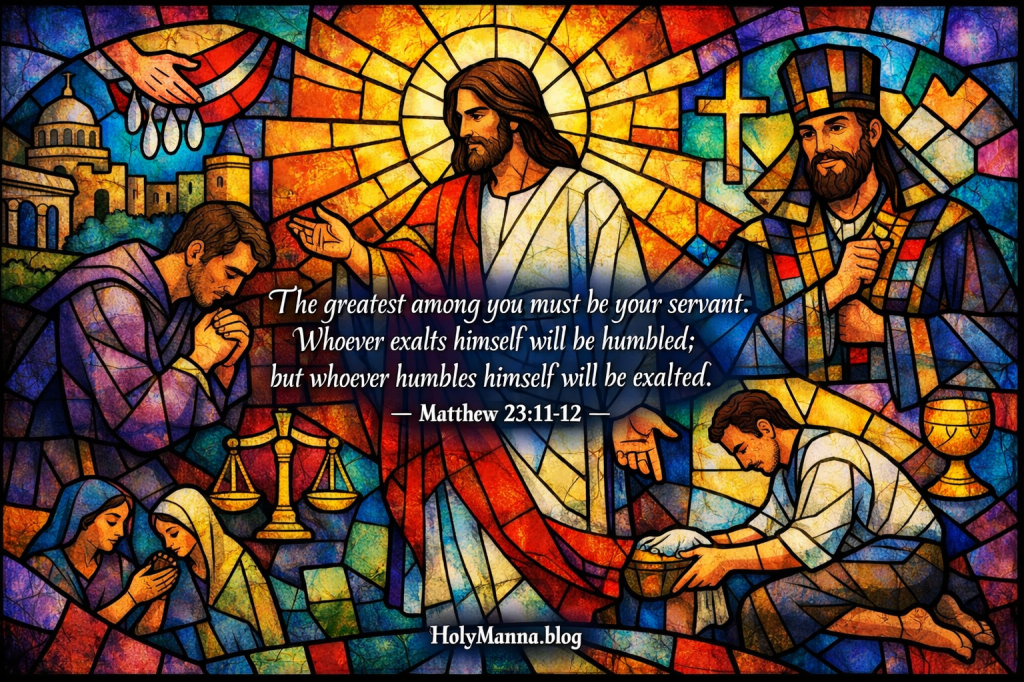
Jesus references “the chair of Moses”, an image of legitimate teaching authority rooted in the synagogue tradition, where Moses represents the Law given by God. Christ is not mocking God’s Law, and He is not attacking rightful authority. He is confronting hypocrisy and pride, especially when leaders use religion to load burdens on others, chase status, and perform for applause. That fits today’s theme perfectly. Isaiah demanded real cleansing and justice, Psalm 50 condemned covenant words without obedience, and now Jesus names the same disease at street level: preaching without practicing, religion as self-promotion, and authority without service. Then Christ gives the cure in one line that sounds simple, but costs everything: “The greatest among you must be your servant.”
Matthew 23:1-12 – New American Bible (Revised Edition)
Denunciation of the Scribes and Pharisees. 1 Then Jesus spoke to the crowds and to his disciples, 2 saying, “The scribes and the Pharisees have taken their seat on the chair of Moses. 3 Therefore, do and observe all things whatsoever they tell you, but do not follow their example. For they preach but they do not practice. 4 They tie up heavy burdens [hard to carry] and lay them on people’s shoulders, but they will not lift a finger to move them. 5 All their works are performed to be seen. They widen their phylacteries and lengthen their tassels. 6 They love places of honor at banquets, seats of honor in synagogues, 7 greetings in marketplaces, and the salutation ‘Rabbi.’ 8 As for you, do not be called ‘Rabbi.’ You have but one teacher, and you are all brothers. 9 Call no one on earth your father; you have but one Father in heaven. 10 Do not be called ‘Master’; you have but one master, the Messiah. 11 The greatest among you must be your servant. 12 Whoever exalts himself will be humbled; but whoever humbles himself will be exalted.
Detailed Exegesis
Verse 1 – “Then Jesus spoke to the crowds and to his disciples,”
Jesus speaks publicly, which matters. This is not petty drama. This is a serious warning meant to protect ordinary believers from confusion and scandal, and to call leaders back to integrity.
Verse 2 – “saying, ‘The scribes and the Pharisees have taken their seat on the chair of Moses.’”
Jesus acknowledges the reality of a teaching office connected to the Law. Authority itself is not the problem. The problem is what happens when authority is treated like a throne instead of a responsibility.
Verse 3 – “Therefore, do and observe all things whatsoever they tell you, but do not follow their example. For they preach but they do not practice.’”
Christ separates true teaching from hypocritical living. The people are not told to rebel against God’s Law just because some teachers are inconsistent. At the same time, Jesus refuses to let hypocrisy become normal. The line “they preach but they do not practice” is a warning that knowledge without obedience can harden the heart.
Verse 4 – “They tie up heavy burdens [hard to carry] and lay them on people’s shoulders, but they will not lift a finger to move them.’”
This is spiritual cruelty disguised as zeal. The burdens are not only moral demands, but the way those demands are imposed. True shepherds help people carry the yoke with mercy, patience, and practical guidance. Hypocrites weaponize rules to feel superior.
Verse 5 – “All their works are performed to be seen. They widen their phylacteries and lengthen their tassels.’”
Phylacteries are small leather boxes containing Scripture passages, worn as a sign of devotion. Tassels recall God’s commandments and covenant identity. These things can be good. Jesus condemns the motive: doing holy signs for attention. The issue is not devotion, but vanity.
Verse 6 – “They love places of honor at banquets, seats of honor in synagogues,”
Status becomes a drug. When religion becomes a ladder, people climb on others to feel important. Jesus is exposing the hunger to be recognized rather than the hunger to be righteous.
Verse 7 – “greetings in marketplaces, and the salutation ‘Rabbi.’”
Public titles and flattering greetings become the payoff. Christ is not banning courtesy. He is warning against spiritual vanity, the kind that quietly feeds on being admired as “the holy one.”
Verse 8 – “As for you, do not be called ‘Rabbi.’ You have but one teacher, and you are all brothers.”
Jesus levels the room. Among His disciples, greatness is not measured by title. All are brothers because all stand under the authority of the one true Teacher. Leadership in the Church must always remain a form of service, not self-exaltation.
Verse 9 – “Call no one on earth your father; you have but one Father in heaven.”
Christ is attacking prideful spiritual possession, not abolishing natural fatherhood or the language people use for it. The point is that all fatherhood is derivative and must never compete with God. Anyone with authority, including spiritual authority, must remember it is received, not owned.
Verse 10 – “Do not be called ‘Master’; you have but one master, the Messiah.”
The disciple is protected from human domination. No leader gets to replace Christ, no matter how educated, charismatic, or influential. Christ alone is Lord.
Verse 11 – “The greatest among you must be your servant.”
This is the rule of the Kingdom. Greatness is measured by sacrificial love, not personal branding. The model is Christ Himself, who teaches like a King and serves like a slave.
Verse 12 – “Whoever exalts himself will be humbled; but whoever humbles himself will be exalted.”
God is not impressed by inflated egos. Pride collapses because it is built on illusion. Humility rises because it is built on truth. This is a spiritual law that plays out over time, and Lent is a season where God gently applies it.
Teachings
Jesus’ warning in The Gospel of Matthew is not merely about ancient Pharisees. It is about a recurring spiritual danger: using religious life to feed pride. The Church’s teaching reinforces Christ’s point that authority exists to serve, and holiness must be real.
The Catechism describes the Church’s hierarchy in a way that matches Jesus’ line about servant leadership. In CCC 876, the Church teaches: “Intrinsically linked to the sacramental nature of ecclesial ministry is its character of service.” This means Catholic leadership is not a platform for ego. It is a call to carry burdens, not stack them on others.
The Gospel also warns about scandal, which is what happens when leaders preach one thing and live another, confusing and discouraging the faithful. The Catechism states in CCC 2284: “Scandal is an attitude or behavior which leads another to do evil.” Hypocrisy is not only personal failure. It can become a trap for others.
Jesus’ insistence on humility also touches the spiritual foundation of prayer itself. The Catechism says in CCC 2559: “Humility is the foundation of prayer.” That single sentence explains why religious performance is so poisonous. If humility collapses, prayer becomes theater, and religion becomes self-talk.
The saints preached this Gospel with clarity. Saint John Chrysostom, reflecting on this passage, stresses that Christ protects the faithful from using bad examples as an excuse to disobey God. A short line from his preaching captures it well: “They say, and do not.” That blunt diagnosis is meant to wake up both leaders and listeners, and to call everyone back to integrity.
In the history of the Church, reform movements often begin right here, not with new programs, but with renewed holiness and humble service. When saints like Francis of Assisi, Charles Borromeo, or Teresa of Calcutta shook the world, they did not do it by demanding honor. They did it by becoming servants. That is why this Gospel belongs in Lent. Lent is when God cuts away what is performative so what is sincere can grow.
Reflection
This Gospel is a mercy, even when it feels sharp. Jesus is not trying to create cynics who assume all leaders are frauds. Jesus is trying to create disciples who refuse to confuse titles with holiness, and who refuse to use religion as a cover for pride. The words are meant to protect the heart from two opposite traps: blind trust in human personalities, and bitter rejection of all authority. Christ shows the narrow, healthy path in the middle. Truth must be obeyed, hypocrisy must be resisted, and greatness must look like service.
A practical response begins with an honest look at motive. Religious habits can become performance without anyone noticing. The temptation is especially strong when faith becomes public, whether through ministry roles, social media, or being known as “the Catholic one” in a family. A good Lenten step is to choose one hidden act of service that will not be noticed and will not be praised, and then do it faithfully. Another step is to lighten someone’s burden instead of adding to it, especially at home, where virtue is tested most honestly. A third step is to examine speech. If the mouth speaks about God easily, but obedience is delayed, then the Gospel is asking for alignment.
Where has the desire to be seen as righteous quietly replaced the desire to actually become righteous? When correction is given to others, is it offered with patience and mercy, or with the cold satisfaction of being right? If the greatest must be a servant, what specific burden can be lifted for someone this week without expecting recognition?
Let God Make the Scarlet White
Today’s readings all tell the same story from three different angles, and Lent makes sure it is heard clearly. The Book of Isaiah refuses to let worship become a cover for sin, insisting that real repentance must look like a cleansed life and concrete justice. Psalm 50 presses the same truth into the heart, warning that God is not impressed by religious words when His discipline is thrown behind the back. Then The Gospel of Matthew brings it to street level, as Jesus exposes holiness-as-theater and replaces it with the only kind of greatness that survives in the Kingdom of God, which is humble service.
The message is both sobering and full of hope. God does not ask for a more polished image. God asks for a real return. God names sin honestly, not to crush the sinner, but to heal the wound. That is why the Lord’s invitation in Isaiah still rings like a lifeline: “Come now, let us set things right.” This is the heart of Lent. It is the season where God tells the truth so that mercy can actually do its work, where hypocrisy is exposed so integrity can be rebuilt, and where pride is humbled so love can finally become visible.
A simple call to action flows naturally from the readings. Let repentance become specific instead of vague, because vague repentance rarely changes anything. Let prayer become honest instead of performative, because God already sees the heart. Let faith become service instead of status, because Christ measures greatness by how burdens are lifted, not how loudly devotion is displayed. What would change if the next confession was made with total honesty and zero excuses? What would change if one hidden act of mercy was done this week only for God’s eyes? What would change if the person with the least voice in the room was defended without hesitation?
Lent is not asking for perfection overnight. Lent is asking for willingness, obedience, and humility that keeps moving forward. God can turn scarlet into snow, but the heart has to stop resisting and start returning.
Engage with Us!
Readers are invited to share reflections in the comments below, especially any line from today’s readings that convicted the heart, brought comfort, or sparked a desire to change. These passages are meant to be lived, not merely admired, and hearing how God is working in different lives strengthens the whole community.
- First Reading, Isaiah 1:10, 16-20: Where is God inviting a deeper cleansing, meaning a specific sin or habit that needs to be confessed, renounced, and replaced with obedience? Who is the “orphan” or “widow” in daily life right now, meaning the person without support or a voice, and what would it look like to defend or help them in a concrete way this week?
- Responsorial Psalm, Psalm 50:8-9, 16-17, 21, 23: Where has faith become mostly words, while God’s discipline has been resisted in practice? What would it look like to offer “praise as a sacrifice” today, especially in a moment of stress, temptation, or frustration?
- Holy Gospel, Matthew 23:1-12: Where is there a temptation to seek recognition, approval, or spiritual status instead of quiet holiness and humble service? What is one burden that can be lifted for someone close by, with patience and charity, so that the Gospel becomes visible through action?
Keep walking forward with courage. Let the Lord turn the scarlet into snow, let prayer become honest, and let humility become real through service. Everything can be done with the love and mercy Jesus taught, because holiness is not a performance, but a life surrendered to God.
Sacred Heart of Jesus, we trust in You!
Immaculate Heart of Mary, pray for us!
Saint Michael the Archangel, defend us in battle!
Follow us on YouTube, Instagram and Facebook for more insights and reflections on living a faith-filled life.

 Holy Manna!
Leave a comment