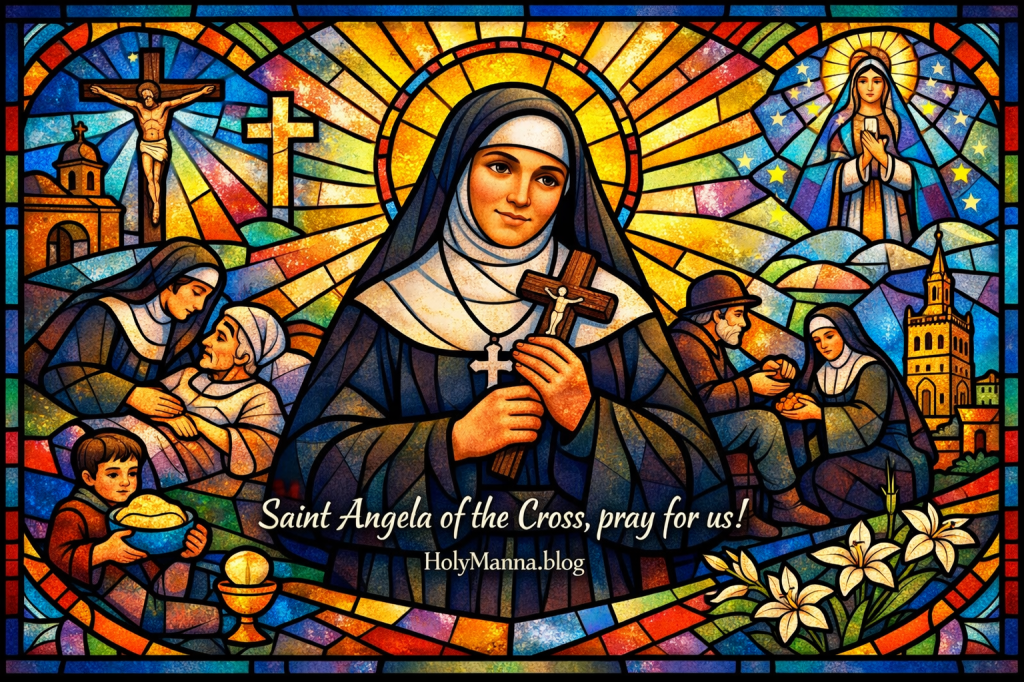
The Saint Who Chose to Live with the Suffering
Saint Angela of the Cross, born María de los Ángeles Guerrero González, did not win hearts by standing on stages or writing famous books. She won hearts the way the saints often do, by disappearing into love. She became a living reminder that Jesus is not found only in beautiful churches and peaceful chapels, but also in cramped rooms, sickbeds, and forgotten corners of the city where pain sits alone.
Her legacy is the religious family she founded, the Sisters of the Company of the Cross, women who chose to live close to the poor and serve them with an almost shocking simplicity. The Church reveres her because she turned the Gospel into something you could see and touch. Her life makes a person take The Gospel of Matthew seriously when Jesus says, “Whatever you did for one of these least brothers of mine, you did for me.” Mt 25:40
She is remembered as a saint of Seville and a saint for anyone who wonders if small, hidden acts of mercy can really change the world. They can. She proves it.
From a Sevillian Workshop to the School of the Cross
Angela was born in Seville on January 30, 1846, into a working-class family that knew hardship up close. As a young girl she worked in a shoe workshop, which meant her hands learned labor early, and her heart learned what it feels like when life is heavy. That kind of beginning can harden a person, but in her case it softened her. The poor were not an idea to her. They were neighbors.
Her faith did not come from a dramatic, lightning-bolt conversion. It grew like a flame protected from wind, steady and bright. She felt drawn to religious life and tried to follow the paths available to her. She attempted to enter Carmelite life, and later she entered the Daughters of Charity, but her health failed and she had to leave. That experience alone would have crushed many people. It is humiliating to feel called and then feel physically unable to keep up. Angela carried that cross without quitting on God.
Her spiritual direction under Father José Torres Padilla helped her understand what the Lord was doing. The closed doors were not rejection. They were redirection. She began to see that God was not calling her merely to join an existing community, but to become part of something new, something that would plant consecrated life right in the middle of the suffering she saw every day.
This is where her identity becomes crystal clear. She chose the name “Angela of the Cross,” and she meant it. She believed the Cross was not only something to admire, but something to share, because that is how love becomes real. CCC 618
A Love That Looked Like the Gospel
In 1875, Angela founded the Sisters of the Company of the Cross. The heart of the charism was simple to say and hard to live. The sisters would live in poverty and serve the poor directly, especially the sick, the elderly, and those with no one to care for them. This was not “charity as a hobby.” It was charity as a vocation, charity as a total offering.
Angela’s own words reveal the logic behind the foundation. She believed that if Christians tell the poor to suffer patiently, they must be willing to share the conditions of poverty themselves. She wrote in Spanish, “¡Qué hermoso sería un Instituto que por amor a Dios abrazara la mayor pobreza, para de este modo ganar a los pobres y subirlos hasta Él!” In English, it means, “How beautiful it would be if there were an institute that, for love of God, embraced the greatest poverty, so as to win the poor and raise them up to Him.”
That is not political ideology. That is Catholic charity rooted in Jesus Christ, the One who became poor for our sake. It is also deeply aligned with the Church’s teaching that love for the poor is not optional, because the poor hold a privileged place in the heart of Christ. CCC 2443-2449
During her lifetime, many people spoke of her extraordinary interior life. Accounts circulated of ecstasies during prayer, and even stories of levitation. These stories are part of the tradition surrounding her holiness, but they are not always documented in a way that can be historically verified, so they should be received as devotional reports that cannot be verified.
What is undeniably verified is the miracle of her day-to-day mercy. She taught her sisters to treat the poor with the tenderness you would offer to Christ Himself. She was known for intense humility and a spirituality that crushed pride before it could poison love. One saying attributed to her captures the tone of her whole life: “Obedecer, callar, sufrir y morir.” In English, “Obey, be silent, suffer, and die.” That is not gloomy if it is understood correctly. It is the language of surrender. It is what a person says when they are trying to love God more than they love comfort.
The Hidden Wounds That Made Her Holy
Saint Angela was not a martyr in the classic sense. No executioner took her life. Still, her life contained real suffering, and it came in forms that are familiar to modern people.
She faced the hardship of frailty and illness, including the painful experience of leaving the Daughters of Charity because she could not physically continue. She faced the hardship of misunderstanding, because radical poverty always looks strange to people who prefer religion to stay comfortable. She faced the hardship of leadership, because founding a community means carrying the burdens of others, especially when resources are scarce.
In her later years, she suffered serious illness and a stroke, and she endured it with the same humility she preached. Her final words, preserved in the memory of her community, were a fierce rejection of ego. She said, “No ser, no querer ser; pisotear el yo, enterrarlo si posible fuera.” In English, “To be nothing, to want to be nothing; to trample the self, to bury it if possible.”
Some people hear that and think it sounds extreme. The Catholic mind hears something else. It hears the logic of the saints, the logic of John the Baptist, the logic of the Cross: less of the ego, more room for Christ. CCC 2013-2015
Another saying attributed to her points in the same direction: “La nada calla, la nada no se defiende.” In English, “Nothingness is silent; nothingness does not defend itself.” It is a tough line, but it makes sense in the spiritual life. A person obsessed with being right will struggle to love. A person who can be silent and humble can become peaceful enough to serve without bitterness.
When a City Called Her “Mother”
Angela died on March 2, 1932, and Seville responded as if it had lost a mother. Large crowds came to honor her, and popular devotion grew quickly. Devotional accounts also speak about her body remaining preserved in a remarkable way, a tradition often described as incorruptibility. This is part of the strong local testimony surrounding her, but the safest Catholic way to describe it is simply this: many faithful have long regarded her remains with deep reverence, and her memory has remained vivid and powerful.
After her death, miracles were attributed to her intercession. Two stand out as especially significant because they are associated with the Church’s canonization process and public recognition of her sanctity.
One reported miracle tied to her cause speaks of a woman named Concepción García Núñez who was gravely ill with life-threatening pneumonia and was healed after invoking Angela’s intercession. The story is widely repeated in Catholic accounts connected to her cause, but most everyday summaries do not present full medical documentation publicly, so it should be received as a respected claim from her cause that cannot be independently verified in full detail by the average reader.
Another miracle associated with her canonization centers on the healing of a severe loss of sight connected to retinal vascular obstruction. The testimony surrounding this healing is frequently cited in Catholic reporting around her canonization. The Church’s process treats such events with scrutiny, seeking to discern what cannot be explained naturally and what truly points to God’s action through a saint’s intercession. CCC 547
Her cultural impact is especially strong in Seville and Andalusia. Her name is woven into the Catholic identity of the region, her congregation remains active, and devotion to her has shaped public religious life in ways that still feel personal. She is not a museum saint. She is a living presence in the memory of a people who saw holiness up close.
Bringing Saint Angela’s Lessons Into Real Life
Saint Angela of the Cross speaks to modern Catholics who feel overwhelmed by noise, ego, and constant self-promotion. Her life says that holiness does not require fame. It requires fidelity. It requires mercy. It requires the courage to take Jesus seriously.
Her story is a challenge to comfortable Christianity. It asks a simple question that cuts deep. Do the poor feel loved in a way that costs something? Charity that never costs anything often becomes sentimentality. Catholic charity is different. It is love that bends down, love that touches wounds, love that shows up when it is inconvenient. CCC 2447
Her humility also offers medicine for the modern soul. Many people live exhausted because they are constantly protecting their image. Angela’s spirituality offers freedom, the freedom that comes when pride is not in control. She called herself, in a phrase repeated in the Church’s memory of her, “Expropiada para utilidad pública.” In English, “Expropriated for public use.” She meant that her life did not belong to her anymore. It belonged to God, and therefore it belonged to God’s people.
This does not mean everyone must found a religious order or embrace extreme poverty. It does mean every Catholic can live the Gospel more concretely. Mercy can look like checking on the elderly neighbor who never gets visitors. Mercy can look like visiting the sick, feeding someone who is hungry, or offering patient companionship to a person who is lonely. Mercy can look like rejecting gossip, swallowing pride, and choosing peace in the home.
And if the heart needs a place to start, the Church gives a dependable beginning: prayer, confession, the Eucharist, and concrete acts of charity. The Cross is not only something to endure. In the hands of a saint, it becomes the shape of love.
Engage with Us!
Readers are invited to share their thoughts and reflections in the comments below, because saints are not meant to be admired from a distance. Saints are meant to be learned from, prayed with, and imitated.
- Where has pride been making life heavier than it needs to be, and what would “to be nothing” look like in that area?
- Who is one poor, sick, or lonely person that could be served this week in a practical way?
- What would change in daily life if Christ were truly seen in the “least,” as taught in Mt 25:40 and lived by Saint Angela?
- What kind of suffering is being avoided, and how could it be offered to God with faith instead of resentment, in the spirit of the Cross?
May Saint Angela of the Cross teach every heart to love with the kind of mercy Jesus taught, the kind that shows up, stays humble, and refuses to walk past suffering. Live a life of faith, stay close to the sacraments, and do everything with the love and mercy Jesus Christ has shown to the world.
Saint Angela of the Cross, pray for us!
Follow us on YouTube, Instagram and Facebook for more insights and reflections on living a faith-filled life.

 Holy Manna!
Leave a comment