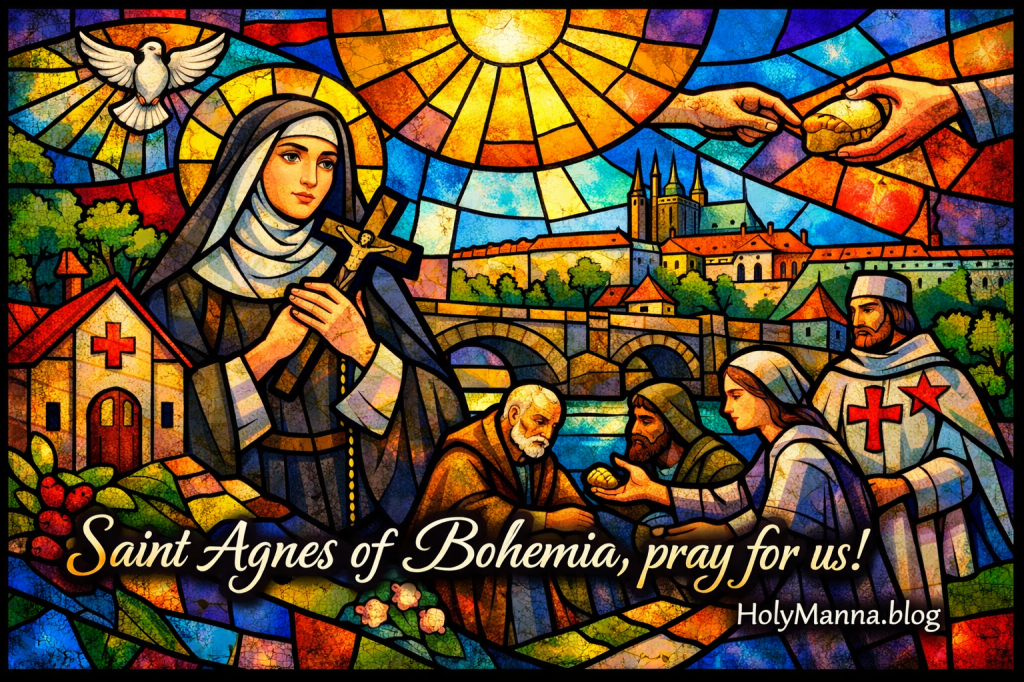
The Princess Who Chose Poverty and Changed a Nation
Saint Agnes of Bohemia, also called Agnes of Prague, was born into royal power, raised around politics, and expected to spend her life securing alliances through marriage. Instead, she did something that still feels shocking today. She looked at the most glittering path in front of her and said no, because she had discovered something greater. She wanted Christ, not a crown. She wanted the poor, not a palace.
Her significance in Catholic tradition is not simply that she was a princess who became a nun. Her greatness is that she turned privilege into mercy, ambition into prayer, and status into service. She built a life that preached the Gospel without needing a pulpit. She helped root the Franciscan spirit in her homeland, cared for the sick, defended the beauty of evangelical poverty, and became a national sign of hope for her people.
The story of Agnes proves that holiness is not about escaping the world. Holiness is about letting Christ reorder the world inside the heart, and then letting that transformed heart bless everyone around it.
A Royal Childhood That Could Not Contain Her Calling
Agnes was born into the ruling family of Bohemia in the early thirteenth century. Even as a child, her future was treated like a chess piece on a royal board. Marriage proposals were not romantic possibilities. They were political tools. She was educated among religious communities, which was common for noble girls, and that upbringing placed her near the Church’s prayer and liturgy.
That exposure mattered. The Lord often begins a calling quietly. A young girl watches nuns pray the psalms, sees candles flicker in a chapel, hears Scripture proclaimed, and something in her awakens. The world may see only a princess being trained. God sees a soul being prepared.
As Agnes grew, the pressure to marry increased. She was offered matches that would have lifted her to the highest levels of European influence. The tradition even preserves the reaction of an emperor when she refused him. “I cannot take offense… she has chosen the King of Heaven.” That line captures what everyone could see. Agnes was not merely rejecting men. She was saying yes to Someone else.
Her conversion was not from unbelief to belief. It was the deeper conversion that many Catholics are called to again and again, the conversion from a divided heart to a single-hearted love. She chose to belong to Christ with an undistracted freedom.
A City Transformed by One Woman’s Yes
Agnes did not only retreat into prayer. She built something. In Prague, she helped establish a spiritual and charitable center that held together two things many people try to separate. She built a place for consecrated religious life, and she also built a place to care for the poor and sick. This was not a side project. It was an expression of the Gospel.
This is why she is remembered. She lived the corporal works of mercy in a concrete way, and she placed them next to prayer. That is Catholic life when it is healthy. Love of God and love of neighbor are not competitors. They are one movement of charity flowing from the Sacred Heart of Jesus into the world through His people. CCC 2447.
Agnes entered the Poor Clare way of life, shaped by Saint Clare of Assisi and the Franciscan spirit. Her story is closely connected to Clare because Clare wrote letters to Agnes, encouraging her to remain faithful to the demanding beauty of Gospel poverty. Agnes became a living proof that radical discipleship was not only for the streets of Assisi. It could be lived in the heart of a royal city.
Even when she carried authority as abbess, the tradition remembers her humility. Leadership did not inflate her. It lowered her. She chose the hidden tasks, the ordinary service, and the kind of humility that does not need applause.
Mercy in Action and Signs of God’s Favor
Agnes’s life is remembered as a life of prayer, charity, and spiritual courage. She should be remembered and imitated because she shows what happens when a person lets Christ become the true treasure. She lived the words of the Lord about storing up treasure in heaven, not on earth. The Gospel of Matthew.
When Catholic tradition speaks about miracles connected to Agnes, it often does so in the older style of saintly memory. It does not always provide modern documentation in the short biographies that survive publicly, but it does preserve accounts that highlight how her holiness was recognized in her own time.
One story remembered in Catholic tradition is that she foretold a military victory connected to her brother, King Wenceslaus, during a conflict involving Austria. This is remembered as a prophetic sign, the kind of moment that reminds the faithful that God’s providence is real and that saints are not merely moral examples. They are friends of God who live close to His heart.
Some Catholic sources also speak more generally of her having a gift for miracles, though specific details are not always preserved in the brief summaries. In a case like that, honesty is part of devotion. The tradition testifies that extraordinary graces were associated with her, but many details cannot be confirmed from the short accounts alone.
Even without dramatic miracle stories, her everyday charity is already a miracle of grace. It is not natural for a person raised for privilege to embrace poverty freely. That kind of transformation is the Holy Spirit at work.
A Daily Dying to Self
Saint Agnes is not remembered as a martyr in the usual sense. Her blood was not spilled in a public execution. Her martyrdom was quieter, but still real. She endured pressure from the world and the expectations of royalty. She carried the weight of disappointing powerful figures. She chose to be misunderstood.
That kind of suffering is familiar to many Catholics today. It is the suffering of obedience. It is the suffering of being faithful when the world calls it foolish. It is the suffering of choosing God’s will when easier options are available.
In religious life, hardship also comes from the demanding path of poverty, chastity, and obedience. That is not misery. It is a form of love. The Church teaches that consecrated life is a special sign in the Church of the world to come, and it is a real following of Christ in a stable state of life. CCC 914 to CCC 933. Agnes lived that sign with courage.
A Saint for a Nation
After her death in Prague, Agnes remained loved and remembered. Her legacy did not fade into medieval history. It kept shaping Catholic identity in her homeland.
Catholic tradition records complicated stories about her relics, including periods when they were thought lost and later stories of relics being identified and returned. Because these accounts can be complex and not always fully traceable in popular summaries, it is best to speak carefully. The veneration of her relics and the longing for them show something important. The faithful loved her as a real member of Christ’s Body, and they desired tangible connection to her witness, which is a deeply Catholic instinct.
Her greatest “after death” impact in modern memory is tied to her canonization. She was canonized by Pope Saint John Paul II in 1989, and Czech Catholics experienced her canonization as a sign of hope. A widely repeated tradition in Czech Catholic life claimed that when Agnes would be canonized, the nation would experience a new freedom. The timing became unforgettable because her canonization occurred just days before the Velvet Revolution. Many believers saw that as providential. Not as superstition, but as a reminder that the Lord moves history in ways that humble human power.
This is what saints do. They do not replace Christ. They point to Him. They show that the Gospel is not trapped in the past. It still has the power to renew a people.
The Freedom That Comes from Choosing Christ
Saint Agnes of Bohemia is a saint for anyone who feels pulled between the world’s expectations and God’s invitation. Her life teaches that freedom is not doing whatever feels good. Freedom is the ability to choose the good, to choose God, and to choose love even when it costs something. CCC 1731 to CCC 1742.
She also teaches that charity is not theoretical. Mercy needs structure. Mercy needs consistency. Mercy needs courage. Agnes did not only feel compassion. She built places where compassion could become action. She reminds Catholics that prayer and service belong together, and that the Church’s love for the poor is not a political slogan. It is the heart of Christ expressed through His Body. CCC 2443 to CCC 2449.
Her witness invites a serious question. What would change in daily life if Christ became the highest priority and not just one priority among many? Another question follows close behind it. Where is God asking for a courageous no, so that a deeper yes can finally be spoken?
A practical way to live her example is to choose one concrete work of mercy and make it real in the weekly routine. Visit someone lonely. Serve at a parish outreach. Give time, not only money. Another way is to practice voluntary simplicity. Buy less. Consume less. Pray more. Agnes shows that poverty is not about romanticizing hardship. It is about clearing space in the soul so that God can be loved without rivalry.
Engage with Us!
Readers are invited to share thoughts and reflections in the comments below, especially any insights about how Saint Agnes’s choices challenge modern habits and priorities.
- What is one “status” or “security” that can quietly compete with trust in God, and how can it be surrendered with wisdom and peace?
- Where can a corporal work of mercy become more consistent and concrete in daily life, not just occasional or emotional?
- How does Saint Agnes’s love for poverty and service reshape the way prayer and charity should be connected?
- What would it look like to choose the King of Heaven more intentionally this week, in a decision that actually costs something?
May Saint Agnes of Bohemia intercede for every heart that wants holiness but feels torn by fear or pressure. May her courage remind the faithful that Jesus never calls anyone to less love. He always calls to more. Live a life of faith, and do everything with the love and mercy Jesus taught us.
Saint Agnes of Bohemia, pray for us!
Follow us on YouTube, Instagram and Facebook for more insights and reflections on living a faith-filled life.

 Holy Manna!
Leave a comment