Monday of the Second Week of Lent – Lectionary: 230
Mercy That Starts on the Knees and Ends in the Hands
Some days in Lent feel like a mirror held up to the soul, not to shame anyone, but to finally tell the truth in God’s presence and discover that mercy is not a theory. Today’s readings move like a single story, beginning in confession, passing through a cry for rescue, and landing in the daily choices that prove whether mercy has really taken root. The central theme is simple and demanding: God’s mercy is received through humble repentance and then poured out through forgiveness and generosity.
The First Reading comes from Daniel, spoken in the shadow of exile, when Israel had been scattered and humbled because of covenant unfaithfulness. This is not the prayer of a man trying to save face. This is the prayer of a man who knows that sin is real, that God is just, and that the only hope left is the Lord’s own faithful heart. Daniel dares to say out loud what pride always tries to hide: “We have sinned, been wicked and done evil” and yet he clings to a deeper truth that holds the whole spiritual life together: “To the Lord, our God, belong compassion and forgiveness” (Dn 9:5, 9). In Lent, that is the beginning of freedom, because the point is not to pretend to be clean, but to return to the Father who can actually cleanse.
The Responsorial Psalm carries the same bruised honesty, like a people praying from the rubble. Psalm 79 is the voice of a community brought low, begging God not to keep score the way the world keeps score: “Do not remember against us the iniquities of our forefathers; let your compassion move quickly ahead of us” (Ps 79:8). It is the cry of those who have learned that survival is not earned by righteousness, but received by mercy, and it is offered not because the people are impressive, but because God’s Name is glorious.
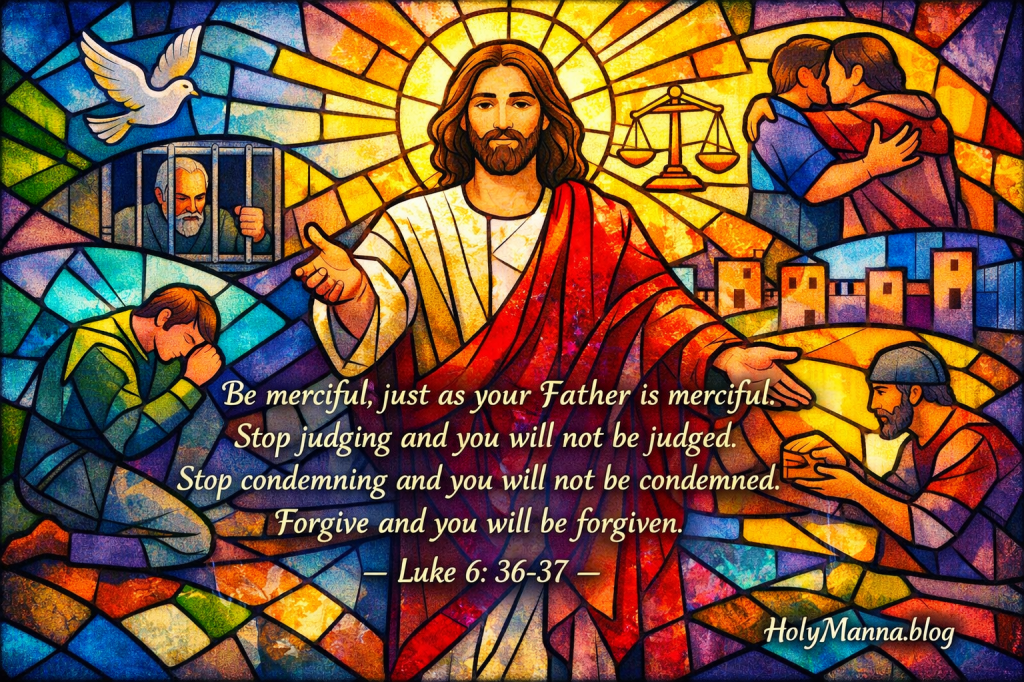
Then the Holy Gospel in Luke takes everything that was prayed on the knees and brings it into the street. Jesus does not allow mercy to remain a private comfort. He makes it the mark of God’s children: “Be merciful, just as your Father is merciful” (Lk 6:36). He names the habits that destroy mercy in everyday life: the reflex to judge, the appetite to condemn, the cold satisfaction of keeping someone guilty. Then he names the habits that prove mercy is real: “Forgive and you will be forgiven. Give and gifts will be given to you” (Lk 6:37-38). By the end of the readings, the message is clear. Lent is training the heart to stop playing God over other people, to stop measuring others with harshness, and to start living like someone who has been spared. How would life change this week if the same mercy being asked of God became the mercy offered to the people closest to home?
First Reading Daniel 9:4-10
When God’s People Stop Making Excuses and Start Coming Home
The prayer in Daniel comes from a bruised moment in Israel’s story, when the people are living with the consequences of covenant betrayal. Exile was not just a political disaster. It was a spiritual wake up call, because the Lord had bound Himself to His people in love, and that love carried real responsibilities. Israel had been warned through the Law and through the prophets that rebellion would not lead to freedom, but to slavery of heart, confusion of mind, and collapse of communal life. Daniel steps into that history and does something that feels almost shocking in a modern world that loves self-justification. He tells the truth without blaming anyone else, and he tells it directly to God.
This reading fits today’s Lenten theme like a key in a lock. Mercy is not cheap optimism. Mercy is what God pours out when someone finally stops performing and starts confessing. Daniel does not deny God’s justice, and he does not despair in shame. He stands in the tension with reverence and confidence, because he knows something deeper than Israel’s failure. He knows God’s character. The same Lord who is holy is also faithful, and the same Lord who judges sin also delights to forgive the sinner who returns.
Daniel 9:4-10 – New American Bible (Revised Edition)
4 I prayed to the Lord, my God, and confessed, “Ah, Lord, great and awesome God, you who keep your covenant and show mercy toward those who love you and keep your commandments and your precepts! 5 We have sinned, been wicked and done evil; we have rebelled and turned from your commandments and your laws. 6 We have not obeyed your servants the prophets, who spoke in your name to our kings, our princes, our ancestors, and all the people of the land. 7 Justice, O Lord, is on your side; we are shamefaced even to this day: the men of Judah, the residents of Jerusalem, and all Israel, near and far, in all the lands to which you have scattered them because of their treachery toward you. 8 O Lord, we are ashamed, like our kings, our princes, and our ancestors, for having sinned against you. 9 But to the Lord, our God, belong compassion and forgiveness, though we rebelled against him 10 and did not hear the voice of the Lord, our God, by walking in his laws given through his servants the prophets.
Detailed Exegesis
Verse 4 “I prayed to the Lord, my God, and confessed, ‘Ah, Lord, great and awesome God, you who keep your covenant and show mercy toward those who love you and keep your commandments and your precepts!’”
Daniel begins with worship and confession together, because real repentance always starts by remembering who God is. God is not a vague force. God is personal, covenant-making, and faithful. Daniel’s first move is not self-pity. Daniel’s first move is to proclaim that the Lord keeps His promises and shows mercy. That sets the whole tone of the prayer. Confession is not groveling. Confession is coming into the light of a faithful Father.
Verse 5 “We have sinned, been wicked and done evil; we have rebelled and turned from your commandments and your laws.”
This is the blunt honesty Lent trains into the soul. Daniel does not rename sin as weakness or “just being human.” He calls it sin, wickedness, evil, rebellion, and turning away. The language is intense because the reality is intense. Sin is not only breaking rules. Sin is breaking communion. It is choosing the self over God, and that choice always has consequences.
Verse 6 “We have not obeyed your servants the prophets, who spoke in your name to our kings, our princes, our ancestors, and all the people of the land.”
Daniel names a second layer of guilt: ignoring God’s voice. The prophets were not motivational speakers. They were messengers sent to call people back before disaster arrived. Israel’s leaders and people refused correction, and that refusal hardened into a culture of disobedience. This verse also exposes something uncomfortable. Sin is often sustained by selective listening. When God speaks a word that challenges comfort, the temptation is to label the message “too much” and move on.
Verse 7 “Justice, O Lord, is on your side; we are shamefaced even to this day: the men of Judah, the residents of Jerusalem, and all Israel, near and far, in all the lands to which you have scattered them because of their treachery toward you.”
Daniel does not argue with God’s justice. Daniel agrees with it. That is rare, and it is holy. This is not shame that spirals into despair. This is shame that tells the truth. The exile is described as scattering, and Daniel connects it directly to treachery, which is a strong word for betrayal. The spiritual lesson is clear. When the covenant is treated lightly, life eventually breaks.
Verse 8 “O Lord, we are ashamed, like our kings, our princes, and our ancestors, for having sinned against you.”
Daniel widens the confession across generations and leadership. This is communal repentance, not individualistic spirituality. It acknowledges that personal sin and public sin feed each other. Leaders set patterns, cultures normalize patterns, and households inherit patterns. Daniel is not excusing anyone, and Daniel is not isolating anyone. Daniel is bringing the whole wound into God’s presence.
Verse 9 “But to the Lord, our God, belong compassion and forgiveness, though we rebelled against him”
This verse is the hinge of hope. Daniel does not pretend rebellion is small, but Daniel insists that mercy is bigger. Compassion and forgiveness are not occasional moods in God. They belong to Him. That is why repentance is never pointless. The sinner returns because God is the kind of Father who receives.
Verse 10 “and did not hear the voice of the Lord, our God, by walking in his laws given through his servants the prophets.”
Daniel closes this passage by returning to the core failure: refusing to listen and refusing to walk. In Scripture, walking is a way of describing daily life. This verse is not about a one-time mistake. It is about a way of living that turned away from God’s path. Lent confronts that pattern so that grace can rebuild a new way of walking.
Teachings
This reading reveals a deeply Catholic rhythm: confession of sin, acknowledgment of God’s justice, and trust in God’s mercy. Daniel models what the Church calls interior repentance, which is not just feeling bad, but a real turning of the heart back to God. The Catechism describes this conversion in a way that sounds like Daniel’s prayer because it is the same spiritual reality in every age: “Interior repentance is a radical reorientation of our whole life, a return, a conversion to God with all our heart, an end of sin, a turning away from evil, with repugnance toward the evil actions we have committed.” CCC 1431.
Daniel also shows why repentance is never separated from hope. The Christian does not confess sin because God is eager to crush. The Christian confesses sin because God is eager to heal. The Catechism states the relationship between sin and mercy with unforgettable clarity: “There is no limit to the mercy of God, but anyone who deliberately refuses to accept his mercy by repenting, rejects the forgiveness of his sins and the salvation offered by the Holy Spirit.” CCC 1864. Daniel refuses that deadly pride. Daniel repents, and by repenting he keeps the door open to mercy.
The communal voice of Daniel, the constant use of “we,” also fits the Church’s teaching that sin has a social dimension. Personal choices can injure the community, and communal habits can make personal holiness harder. That is why Scripture shows a righteous man interceding for a people, and it is why the Church sees intercession, penance, and reparation as serious spiritual works. Daniel stands before God like a priestly figure, not because Daniel is pretending to be guilty of every act, but because love takes responsibility for the family. This is part of why Lent is not only private devotion. Lent is ecclesial. It is the whole Body learning again how to return to the Father.
Saints and Doctors of the Church often point to Daniel’s prayer as a school of humility. The saint is not the person who never sinned. The saint is the person who tells the truth quickly, bows low without theatrics, and trusts God enough to ask for mercy. Daniel’s confidence in God’s compassion prepares the heart for the Gospel command later today, because only those who live by mercy can become merciful.
Reflection
Daniel’s prayer is a guide for ordinary life, especially in a world that trains everyone to defend themselves. The first step is to stop explaining away sin and start naming it. A soul that refuses to name sin cannot truly be healed, because healing begins with truth. A practical way to live this reading is to take one quiet moment today and speak honestly to the Lord about one concrete pattern that needs to change. It could be anger that flares too fast, lust that is fed by entertainment, gossip that dresses itself up as “concern,” or a coldness toward prayer that has become normal. Daniel shows that God can handle the truth, and God welcomes the truth.
The second step is to let repentance be communal, not only private. This reading invites prayer not only for personal conversion but for the conversion of households, parishes, and even a wider culture that often forgets God. Intercession is not denial. Intercession is love refusing to give up. Daniel’s “we” can become a way of praying for those who do not yet know how to pray for themselves.
The third step is to let shame become humble surrender instead of despair. Daniel is not crushed by shame. Daniel places shame inside the bigger reality of God’s compassion. That is where peace begins.
Where has the heart been tempted to justify what God calls sin, instead of confessing it with honesty and simplicity?
What would change if repentance became less about self-criticism and more about returning to a Father whose compassion is stronger than rebellion?
Who needs intercession right now, not as gossip, but as serious prayer that says “we” and asks God to restore what sin has scattered?
Responsorial Psalm Psalm 79:8-9, 11, 13
A Prayer From the Ashes: “For Your Name’s Sake, Save Us”
This Psalm rises from a place nobody wants to visit, the place where consequences have become unavoidable and the people finally admit how low they have fallen. Psalm 79 is a communal lament, the kind of prayer God’s people learn when ruin is no longer theoretical. In Israel’s history, moments like invasion, destruction, and exile were not only national tragedies. They were spiritual alarms. The covenant had been treated casually, the prophets had been ignored, and now the people are forced to face what sin does to a community. That is why this Psalm fits today’s theme so perfectly. Daniel confesses with clear eyes, and this Psalm answers with a plea that has no pride left. Mercy is begged for, not because the people are impressive, but because God is faithful and His Name is holy.
In Lent, the Church puts this cry on the lips because it trains the heart to stop negotiating with God and start returning to God. It teaches that repentance is not self-hatred. Repentance is telling the truth and asking the Father to move quickly with compassion.
Psalm 79:8-9, 11, 13 – New American Bible (Revised Edition)
8 Do not remember against us the iniquities of our forefathers;
let your compassion move quickly ahead of us,
for we have been brought very low.9 Help us, God our savior,
on account of the glory of your name.
Deliver us, pardon our sins
for your name’s sake.11 Let the groaning of the imprisoned come in before you;
in accord with the greatness of your arm
preserve those doomed to die.13 Then we, your people, the sheep of your pasture,
will give thanks to you forever;
from generation to generation
we will recount your praise.
Detailed Exegesis
Verse 8 “Do not remember against us the iniquities of our forefathers; let your compassion move quickly ahead of us, for we have been brought very low.”
This verse sounds like a family speaking honestly after years of denial. The Psalm does not pretend that sin is only individual. It recognizes that patterns can be inherited, repeated, and normalized. The plea is not an attempt to escape responsibility. It is a request that God’s mercy would outrun the consequences. The line “we have been brought very low” is not drama. It is humility. In Scripture, humility is not low self-esteem. Humility is accurate self-knowledge before God, and that is exactly where mercy begins.
Verse 9 “Help us, God our savior, on account of the glory of your name. Deliver us, pardon our sins for your name’s sake.”
Here the Psalm reveals a powerful spiritual logic: the appeal is rooted in God’s identity. The people are not claiming they deserve rescue. They are clinging to who God is. In biblical faith, God’s Name represents His presence, His truth, and His reputation among the nations. When the Psalm prays “for your name’s sake,” it is asking God to act in a way that reveals His glory. This is the kind of prayer Lent purifies in a believer. It moves the heart away from self-centered bargaining and toward God-centered trust.
Verse 11 “Let the groaning of the imprisoned come in before you; in accord with the greatness of your arm preserve those doomed to die.”
This verse brings the suffering of the powerless directly into prayer. God is not distant from prisons, chains, and death sentences. The Psalm insists that the groans of the trapped are worthy to rise before the Lord. It also reminds the listener that God’s strength is not abstract. “The greatness of your arm” is covenant language, recalling the Lord’s saving power in history. In Lent, this verse also widens the heart. Repentance is never meant to shrink a person into private guilt. True repentance makes someone attentive to the suffering of others, especially those society forgets.
Verse 13 “Then we, your people, the sheep of your pasture, will give thanks to you forever; from generation to generation we will recount your praise.”
The Psalm ends with a promise of worship. Mercy is not only rescue from danger. Mercy restores right relationship. The people describe themselves as “the sheep of your pasture,” which is a tender image of belonging and guidance. When God saves, the proper response is gratitude, and gratitude becomes a legacy. The goal is not simply survival. The goal is that praise would return, and that faith would be handed on “from generation to generation.”
Teachings
This Psalm teaches that the Church’s prayer is often born in the very places pride tries to avoid. It teaches that God welcomes contrite petition, especially when it is honest and communal. It also teaches that mercy is never disconnected from responsibility. The Psalm admits sin plainly, yet it refuses despair, because it knows the Lord as Savior.
The verse about the imprisoned is especially concrete for Catholic life. The Church does not treat mercy as sentiment. The Church treats mercy as action, and one of the classic ways mercy becomes visible is through the works of mercy. The Catechism teaches this in a way that sounds like the Psalm’s concern for the suffering and forgotten: “The works of mercy are charitable actions by which we come to the aid of our neighbor in his spiritual and bodily necessities. Instructing, advising, consoling, comforting are spiritual works of mercy, as are forgiving and bearing wrongs patiently. The corporal works of mercy consist especially in feeding the hungry, sheltering the homeless, clothing the naked, visiting the sick and imprisoned, and burying the dead.” CCC 2447.
Saint Augustine often taught that the Psalms give voice to Christ and to His Body, the Church. That matters here, because this Psalm is not only ancient Israel speaking from crisis. It is also the Church learning how to pray in every age when sin has wounded the community and when suffering feels overwhelming. In Lent, this becomes a school of prayer: admit the truth, appeal to God’s mercy, and let rescue become thanksgiving.
Reflection
This Psalm invites a practical kind of conversion that can be lived in ordinary life. It begins by teaching the heart to stop rehearsing old grudges, old excuses, and old shame, and instead to bring everything into God’s presence with humility. A person can pray this Psalm slowly and let a hard question rise: What needs to be admitted honestly instead of hidden behind busyness or distraction? When the Psalm says “we have been brought very low,” it gives permission to stop pretending and to ask for compassion without self-protection.
It also challenges the way blame is handled. The Psalm speaks of the “iniquities of our forefathers,” not to dodge responsibility, but to admit that some sins become patterns that shape homes and cultures. Lent is a season for breaking patterns. That can look like choosing confession instead of secrecy, choosing prayer instead of numb entertainment, choosing silence instead of gossip, and choosing discipline instead of indulgence. The Psalm’s repeated appeal “for your name’s sake” also teaches a cleaner motive: life is not meant to orbit around self-image. Life is meant to reveal God’s glory through holiness, repentance, and praise.
Finally, this Psalm widens compassion for those who suffer, especially those who are easy to forget. It invites prayer for prisoners, for the dying, for the desperate, and for anyone who feels trapped by sin, addiction, or fear. It can also inspire one concrete act of mercy, because prayer that stays only inside the head is not yet fully alive.
Where is mercy needed most right now, not as a vague feeling, but as a real cry to God that asks Him to move quickly with compassion?
Who are the “imprisoned” in daily life, whether in an actual jail, or trapped in cycles of sin, and how can prayer and mercy make room for them this Lent?
If God answered this Psalm with rescue, what would it look like to “recount your praise” by living with gratitude, integrity, and mercy toward others?
Holy Gospel Luke 6:36-38
Mercy With Skin On: The Way God’s Children Talk, Think, Forgive, and Give
These words from The Gospel of Luke land in the middle of Jesus’ great teaching to His disciples, often called the Sermon on the Plain. The setting matters. Jesus is forming a community that will live in a hard world of honor and shame, public reputations, and strict ideas about who deserves respect. In that culture, people measured each other constantly, and they paid back generosity only when it benefited them. Jesus steps into that world and introduces something that cannot be reduced to manners or good vibes. He calls His followers to carry the family resemblance of God.
This Gospel fits today’s theme perfectly because it shows what happens after Daniel’s confession and the Psalm’s cry for pardon. Mercy is not only something to beg for when sin has brought life low. Mercy becomes the daily lifestyle of the forgiven. Jesus teaches that the heart that receives God’s compassion must learn to stop condemning, to forgive from the soul, and to give with a generous spirit. The measure a person uses on others becomes the measure that shapes the soul.
Luke 6:36-38 – New American Bible (Revised Edition)
36 Be merciful, just as [also] your Father is merciful.
Judging Others. 37 “Stop judging and you will not be judged. Stop condemning and you will not be condemned. Forgive and you will be forgiven. 38 Give and gifts will be given to you; a good measure, packed together, shaken down, and overflowing, will be poured into your lap. For the measure with which you measure will in return be measured out to you.”
Detailed Exegesis
Verse 36 “Be merciful, just as your Father is merciful.”
Jesus does not begin with a suggestion. Jesus gives an identity command. The pattern is the Father Himself. This is not about becoming a “nice person.” This is about becoming a son or daughter who reflects the Father’s heart. In Lent, this cuts deep, because it exposes how often mercy is reserved for the self while judgment is served to others. Jesus makes the standard clear: mercy is not optional for believers because mercy is who God is.
Verse 37 “Stop judging and you will not be judged. Stop condemning and you will not be condemned. Forgive and you will be forgiven.”
Jesus targets three habits that poison relationships and harden the soul. “Judging” here is not the necessary moral discernment that calls sin what it is. Jesus is condemning the posture of acting like God over another person, as if the whole story is known and the final verdict belongs to human beings. “Condemning” goes further. Condemnation does not just name wrongdoing. Condemnation declares the person hopeless, rejected, and defined by their worst moment. Jesus forbids this spirit because it contradicts the way the Father treats sinners who return.
Then Jesus places a luminous command in the middle: “Forgive and you will be forgiven.” Forgiveness is not pretending there was no evil. Forgiveness is refusing to become an executioner in the heart. Forgiveness releases the right to revenge and entrusts justice to God. This is why Lent always circles back to forgiveness. A soul that refuses to forgive becomes locked from the inside.
Verse 38 “Give and gifts will be given to you; a good measure, packed together, shaken down, and overflowing, will be poured into your lap. For the measure with which you measure will in return be measured out to you.”
Jesus ends with an image straight from everyday marketplace life. Grain and flour were measured. Honest merchants would pack the measure down, shake it so it settled, and fill it until it overflowed. Jesus uses that physical picture to describe the Father’s generosity. God is not stingy. God is lavish. But the warning is real: the measuring cup a person uses on others becomes the measuring cup that shapes the heart. A tight soul becomes a cramped vessel. A merciful soul becomes an open vessel. Jesus is teaching that mercy and generosity expand a person to receive more of God, not because God is manipulated, but because the heart becomes capable of receiving.
Teachings
This Gospel is one of the clearest windows into how Catholics understand mercy as both gift and command. God’s mercy is free, but it is never meant to stop at private relief. It is meant to transform the way people treat each other. This is why the Church teaches that forgiveness is not a side topic. Forgiveness sits at the center of Christian prayer, especially in the Our Father.
The Catechism connects God’s forgiveness and human forgiveness with serious clarity: “Now and this is daunting this outpouring of mercy cannot penetrate our hearts as long as we have not forgiven those who have trespassed against us. Love like the body of Christ is indivisible; we cannot love the God we cannot see if we do not love the brother or sister we do see.” CCC 2840.
Jesus’ command to “stop judging” also matches the Church’s moral teaching about how to speak and think about others. The Gospel does not cancel truth, but it does forbid the sin of assuming the worst, delighting in suspicion, and constructing a verdict without full knowledge. The Catechism teaches: “He becomes guilty of rash judgment who even tacitly assumes as true without sufficient foundation the moral fault of a neighbor.” CCC 2477.
The Gospel’s call to “give” also belongs to the Catholic tradition of mercy as action. Mercy is not only interior softness. Mercy becomes concrete through generosity, almsgiving, and the works of mercy, especially in Lent. When Jesus describes an overflowing measure, He is not describing a clever strategy to get rich. He is describing the Father’s character and the kind of open-handed life that reflects Him.
This passage also helps clear up a common confusion. Christians must make moral judgments about actions because truth matters. Parents must correct children. Pastors must teach clearly. Catholics must reject sin. But Christians must not condemn persons as if their story is finished or as if grace cannot change them. That belongs to God. Jesus is forming a people who can hold moral clarity without cruelty, and who can practice justice without forgetting mercy.
Reflection
This Gospel invites a very practical Lent, the kind that can be lived between work, family, and the ordinary pressure of life. The first step is to fast from condemnation. Condemnation often shows up as inner commentary, quick labels, sarcasm, and that subtle pleasure of feeling morally superior. Jesus calls that out because it slowly turns the heart into stone. A good Lenten practice is to catch the moment the mind begins building a case against someone and to interrupt it with prayer, asking the Father for the grace to see the person as a soul He wants to save.
The second step is to practice forgiveness as a decision before it becomes a feeling. Forgiveness can be chosen even when the emotions still burn. It often begins with refusing to repeat the story as entertainment, refusing to speak poison about the person, and refusing to rehearse revenge. Forgiveness does not cancel accountability, but it does cancel hatred. It also opens the heart to receive God’s mercy more deeply, especially in prayer and in the Sacrament of Reconciliation.
The third step is to give in a way that proves trust in God’s provision. The world trains people to protect their “lap” from being emptied. Jesus trains disciples to trust the Father enough to pour out mercy, time, attention, patience, and material generosity. A person can choose one concrete act of giving today that costs something, not to earn God’s love, but to live like someone who already has it.
Where has the heart been tempted to judge quickly, not with moral clarity, but with a spirit of superiority or suspicion?
Who is one person that needs forgiveness, not because the wound was small, but because Christ refuses to let resentment become a master?
What would it look like to give with “a good measure” this week, in a way that stretches comfort and makes room for God’s overflowing mercy?
Receive Mercy, Then Become Mercy
Today’s readings move like a single journey that starts in the conscience and ends in the way life is lived. Daniel 9:4-10 shows what real repentance looks like when excuses are finally dropped and the truth is spoken with reverence. Daniel does not argue with God’s justice, and he does not drown in shame. Daniel simply confesses and clings to the only hope that can actually hold a sinner upright: “To the Lord, our God, belong compassion and forgiveness” (Dn 9:9). That is the first key message of the day. Mercy is real, but it is received by a heart that is honest.
Psalm 79 then takes that confession and turns it into a cry from the rubble. It teaches that God’s people do not pray because they are impressive. They pray because God is faithful, and His Name is holy. The Psalm puts the right words in the mouth when life feels low: “Help us, God our savior, on account of the glory of your name” (Ps 79:9). That is the second key message. When sin has wounded life, prayer does not become silence. Prayer becomes humble pleading, and humble pleading becomes hope.
Then Jesus in Luke 6:36-38 brings everything into daily life. Mercy is not meant to stay inside a private spiritual moment. Mercy must take flesh in relationships. Jesus draws a clean line between the heart that has learned God’s compassion and the heart that still wants to play judge and executioner. He commands the lifestyle of the forgiven: “Be merciful, just as your Father is merciful” (Lk 6:36). He forbids the habits that shrink the soul, and He calls for the habits that open it wide: “Stop judging”, “Stop condemning”, “Forgive”, and “Give” (Lk 6:37-38). That is the third key message. The mercy asked of God must become the mercy offered to others, because the measure used on people becomes the measure that shapes the heart.
Lent is not a season for spiritual theater. Lent is a season for coming home. Let Daniel’s honesty become the day’s first act of courage, because the Lord cannot heal what the heart refuses to name. Let the Psalm’s urgency become the day’s first act of trust, because God’s compassion is not slow, even when consequences are heavy. Let Jesus’ command become the day’s first act of obedience, because mercy is the family resemblance of God’s children.
What would change this week if the heart stopped keeping score and started giving the same mercy it begs to receive? Let that question follow into prayer, into the next conversation, into the next temptation to judge, and into the next opportunity to forgive. Then take one real step. Choose confession over excuse, choose forgiveness over condemnation, and choose generosity over tight-fisted fear. God does not merely want to clean up behavior. God wants to remake the heart, so that mercy can flow through it, packed together, shaken down, and overflowing.
Engage with Us!
Share reflections in the comments below, because the Lord often teaches through the prayerful wisdom of His people, and one honest insight can help someone else take the next step in faith.
- First Reading, Daniel 9:4-10: Where is God inviting a more honest confession, not with excuses or comparison, but with the humble truth of “we have sinned”? What is one concrete habit or pattern that needs to be brought into the Lord’s mercy this Lent?
- Responsorial Psalm, Psalm 79:8-9, 11, 13: Where does the heart feel “brought very low” right now, and what would it look like to pray with trust, asking God to act “for your name’s sake”? Who is someone “imprisoned” by suffering or sin that needs serious intercession this week?
- Holy Gospel, Luke 6:36-38: Where has judgment or condemnation become too normal, whether in thoughts, words, or tone? Who is one person that needs forgiveness, and what is one specific way to “give” with a generous measure in the days ahead?
Keep walking forward with faith, because God is never tired of receiving repentant hearts, and Jesus never stops calling His disciples to live with the same love and mercy the Father has shown them.
Sacred Heart of Jesus, we trust in You!
Immaculate Heart of Mary, pray for us!
Saint Michael the Archangel, defend us in battle!
Follow us on YouTube, Instagram and Facebook for more insights and reflections on living a faith-filled life.

 Holy Manna!
Leave a comment