The Saint Who Made Holiness Feel Possible
There are saints who feel like towering mountains, the kind of heroes that seem almost out of reach. Saint David of Wales is still a giant in the Church’s memory, but he is a giant who keeps pointing down to the ground, to the ordinary, to the daily grind, to the small choices that shape a soul. He is honored as the patron saint of Wales, remembered as a bishop, a monastic founder, a preacher, and a steady defender of the Catholic faith in a time when Christian truth needed backbone.
What makes Saint David stand out is not that the historical record gives every detail of his life with modern precision. Catholic sources are honest that we have limited reliable information about him. Even so, the Church has cherished what is clear, and she has also preserved the devotional traditions that express how the faithful experienced his holiness. In the end, Saint David is revered because he helped build up the Church in Wales through prayer, disciplined community life, preaching, and a simple, tough love for the Gospel.
If there is one line that captures him, it is the saying traditionally linked to his last exhortation, a phrase Catholics in Wales still repeat like a family heirloom: “Gwnewch y pethau bychain.” “Do the little things.”
Roots in a Rugged Land and a Growing Faith
Saint David lived in Wales in the sixth century, a world that could be beautiful and brutal at the same time. Catholic sources describe him as the bishop of Menevia, a region in southwest Wales later closely associated with the place now called St Davids. The details of his childhood and family are wrapped in later tradition more than early documentation, and a good Catholic approach is to receive those stories with respect while also recognizing the difference between firm history and beloved memory.
According to long cherished tradition, he was linked to holy figures in early Welsh Christianity and was formed through serious spiritual training. He is often described as becoming a priest, engaging in missionary work, and founding monastic communities. Even if the exact timeline is debated, the spiritual picture is consistent: David was shaped by a Christianity that did not treat faith as a hobby. It was a whole life, built around prayer, penance, work, and obedience.
This matters because it lines up with how the Church understands sanctity. Holiness is not a personality trait. Holiness is a life surrendered to God, and it is offered to every baptized person. The Church calls this the universal call to holiness, and it is not reserved for monks, bishops, or mystics. It is the basic Christian vocation of everybody who belongs to Christ, as taught in CCC 2013-2014.
A Monastery That Preached Without Words
One of the most striking parts of Saint David’s legacy is the monastic culture associated with him. Catholic tradition consistently presents him as a founder of monasteries, with a principal community in southwest Wales. The stories that surround his monks are intense, almost shocking to modern ears, but they make a point that the Gospel is worth everything.
The tradition describes a life of strong discipline, including hard manual labor, long prayer, simplicity of food, and strict habits that kept the community focused on God. Some accounts even emphasize that the monks worked the land without relying on animals, a detail remembered to highlight their penitential spirit and their willingness to embrace hardship rather than comfort.
This is not about being dramatic for drama’s sake. It is about freedom. Catholics do penance not because the body is bad, but because the heart needs training. We fast and deny ourselves so we can love God more and stop being ruled by appetites. That is why the Church sees authentic asceticism as ordered toward charity and spiritual strength, not self hatred. When the discipline is real, it becomes a quiet sermon that says, “God is enough.”
Saint David is also remembered as a leader in defending Catholic truth in a time of doctrinal conflict, especially against errors that weakened the Church’s teaching on grace. That fight is not ancient trivia. The Church still teaches clearly that salvation is God’s gift first, and that we respond and cooperate, but we do not save ourselves by sheer effort. This is the heart of Catholic teaching on grace in CCC 1996-2001.
Signs of God’s Power in a Life of Faith
Catholic sources preserve several miracle traditions associated with Saint David. Some of these are presented as part of the devotional memory that grew around him, and the wise approach is to receive them as testimonies of how the faithful understood his holiness, even when the earliest written accounts appear centuries later.
One tradition says that on his way to a great synod, Saint David raised a widow’s son back to life. The story is told to show not only power, but compassion, because the Church has always seen miracles as signs that point to God’s mercy, not as party tricks.
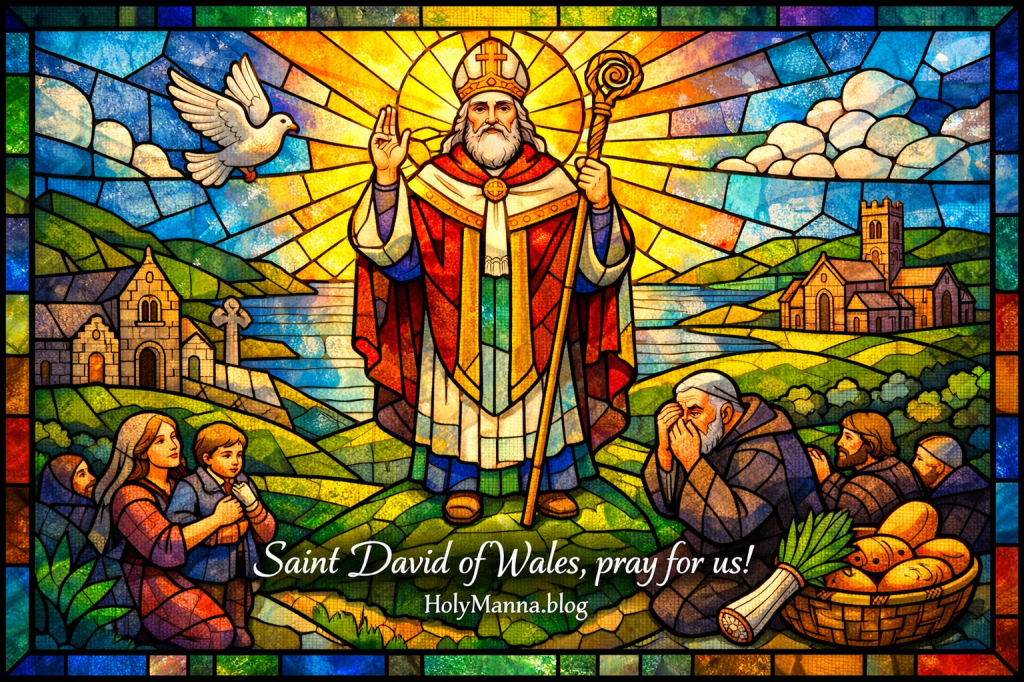
Another famous tradition is tied to his preaching at the Synod of Brefi. The story says that the ground rose beneath him so the crowd could hear him, and that a dove appeared as a sign of the Holy Spirit’s favor. This is why Saint David is often depicted standing on a little hill with a dove near him. Even if someone approaches that detail as hagiographical tradition, the spiritual meaning is solid Catholic common sense: when the Church preaches the truth, the Holy Spirit is the One who makes it land in hearts.
There is also a tradition about poisoned bread. The story says an attempt was made to harm him, but he blessed the food and ate without injury. Whether one reads that as literal history or as a devotional witness, the point is deeply Christian. The saint is not preserved by cleverness. The saint is preserved by Providence, and the saint does not respond to hostility with bitterness, but with trust in God.
Catholic tradition also connects him with healings, including cures of blindness. These stories echo what the Gospels show again and again, that God confirms His compassion through signs that restore, heal, and strengthen faith.
Trials During his Life
Saint David is not chiefly remembered as a martyr, but he still suffered. A life of strict discipline is already a kind of daily dying to self, and anyone who has tried to live seriously Catholic knows that the hardest battles are often not external. They are interior. They are the slow struggles against pride, comfort, and compromise.
He also lived in a time when Christian unity and clarity mattered. To stand for Catholic truth in a confusing moment always brings pressure. Even the traditions about opposition, hostile plots, and attempts to undermine him point to a basic reality: shepherds who guard the flock rarely get applause from wolves.
This is one reason his witness fits so well with the Church’s understanding of spiritual warfare and perseverance. The Christian life is not passive. It is a steady endurance in grace, a daily choosing of Christ. It is the kind of endurance praised throughout Scripture, and it is exactly what the Church forms in her children through prayer, the sacraments, and penance.
The Long Echo of the Little Things
Saint David’s impact did not fade when he died. The Church’s veneration grew over time, and he was formally recognized at the level of the Holy See in the medieval period. His shrine became a major center of pilgrimage, and the faithful traveled to pray, to do penance, and to seek God’s help through his intercession.
A well known medieval tradition connected to pilgrimage at St Davids speaks of special spiritual privilege attached to visiting the shrine. This belongs to the historical memory of the site and the way the medieval Church encouraged pilgrimage and repentance, even if modern Catholics should understand such privileges in the broader context of the Church’s teaching on conversion, mercy, and the seriousness of penance.
As for miracles after his death, the broad Catholic memory is clear that pilgrims came seeking favors and healings at his shrine, and that many believed they received graces through his intercession. Specific named posthumous miracle stories are not consistently preserved in the major Catholic reference summaries in the same detailed way some other saints have, so it would be dishonest to invent dramatic case files. What can be said faithfully is that devotion to Saint David flourished for centuries, and that the faithful kept coming because they believed God was meeting them there through prayer, repentance, and intercession.
Culturally, Saint David’s Day on March 1 became a powerful marker of Welsh identity, and Catholic sources also preserve the tradition of the leek connected with his feast. In other words, his memory did not stay locked inside church walls. It spilled into the life of a people.
Still, the most Catholic part of his cultural impact is not the symbol on a lapel. It is the spiritual instinct his memory keeps alive: holiness is built in small, faithful acts.
The Catholic Challenge Hidden in One Simple Sentence
Saint David’s famous saying is not cute. It is dangerous in the best way, because it strips away excuses. The Gospel is not only lived in heroic moments. It is lived in the daily choices no one claps for.
That is why his traditional exhortation still hits hard: “Do the little things.” It sounds simple until it becomes specific. It means praying when there is no emotional payoff. It means staying faithful to Sunday Mass. It means going to confession before sin becomes a lifestyle. It means showing patience when someone is annoying. It means holding the line on chastity and integrity when the world calls that weird. It means feeding the soul with Scripture and the sacraments instead of feeding the appetite for noise.
This is how saints are made, and it is how families are saved, and it is how parishes become strong. The Church teaches that holiness is real and possible because God gives grace, and grace actually changes a person. That is the point of the whole Christian life, and it is why the Church never stops calling people to conversion and deeper discipleship, as taught in CCC 1427-1433.
What would change if holiness stopped being a vague dream and became a concrete plan built from small daily choices?
What “little thing” has been ignored because it seemed too small to matter?
Engage with Us!
Share your thoughts and reflections in the comments below. Saint David’s life has a way of sneaking past big theories and landing right in the middle of daily life, and it is worth talking about honestly.
- What is one “little thing” that would make your prayer life more faithful this week?
- Where has pride tempted you to chase big recognition instead of quiet obedience?
- What is one small act of charity you can do today for someone who cannot repay you?
- If Saint David’s motto became your rule for Lent, what would you change first?
- How does trusting God’s grace, as taught in CCC 1996-2001, change the way you think about personal growth and sanctity?
Keep going. Keep the faith. Keep choosing Christ in the ordinary moments. A life of faith is not built in one dramatic leap, but in thousands of small, grace filled steps, done with the love and mercy Jesus taught us.
Saint David of Wales, pray for us!
Follow us on YouTube, Instagram and Facebook for more insights and reflections on living a faith-filled life.

 Holy Manna!
Leave a comment