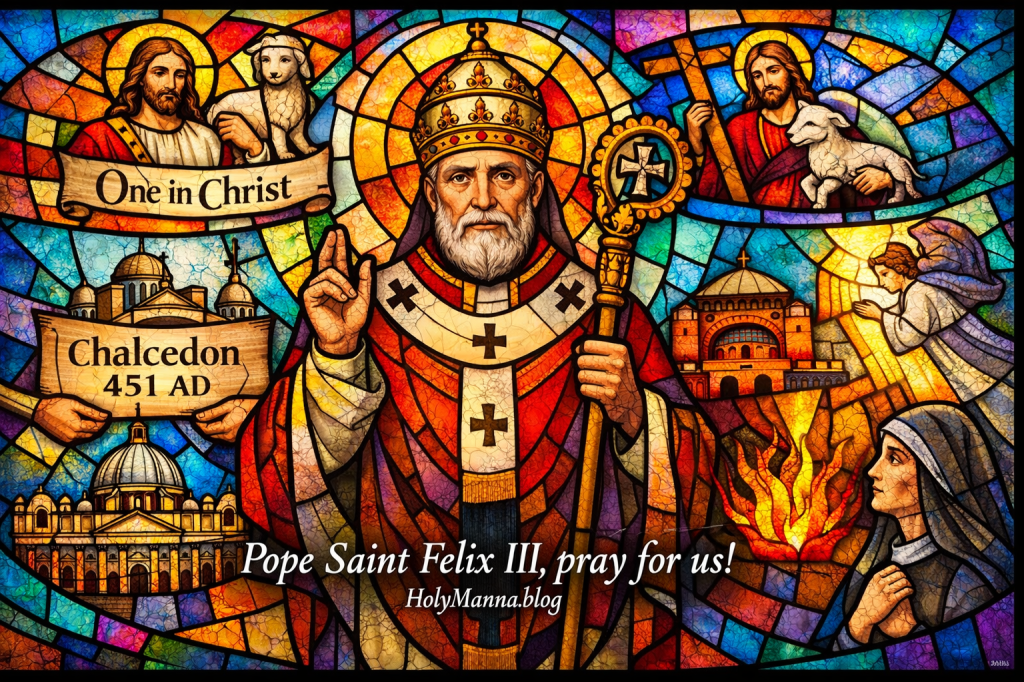
The Pope Who Refused a Fake Peace
Picture the Church like a great cathedral still under construction, with scaffolding everywhere and storms rolling in. In Pope Saint Felix III’s day, those storms were not just political. They were theological. The question shaking the world was simple to say and impossible to treat casually: Who is Jesus Christ, really?
Felix III stepped into the papacy in A.D. 483, when the Church was still defending the truth proclaimed at the Council of Chalcedon. The heart of that confession was that Jesus is truly God and truly man, not a blend, not a half-and-half, not a divine mask over a human body. The Church’s faith in Christ is the foundation of everything, and The Catechism teaches this with the clarity Catholics still rely on today in CCC 464-469. Felix is revered because he protected that foundation when powerful people wanted the Church to soften its words for the sake of “peace.”
His feast day is celebrated on March 1, and his legacy still speaks every time Catholics choose truth over comfort, and unity over pretend harmony.
From a Roman Home to the Chair of Peter
Felix was a Roman, formed by the life of the Eternal City when the Western empire had collapsed and the world felt uncertain. Ancient Catholic tradition describes him as coming from a prominent Roman family, and one detail about him surprises many people. Felix was not always a cleric. He had been married and was a father, and later became a widower. That history matters because it shows the Church was never a club for one personality type. God calls saints out of real lives, with real responsibilities, and then asks for everything.
When Felix entered deeper service to the Church, he did not come in as a dreamer. He came in as a man who understood duty, sacrifice, and the weight of decisions that affect other people. His “conversion” story is not the dramatic kind with a single lightning-bolt moment. It is the kind many faithful Catholics recognize: a steady surrender of the heart to God, until the only thing that matters is guarding the faith and loving the flock.
He is also remembered in the family line of Pope Saint Gregory the Great, which is a quiet reminder that holiness often grows like a family tree. One generation’s fidelity becomes the next generation’s strength.
The Lion at the Gate of Christ’s Truth
Felix is most known for defending the Council of Chalcedon and refusing an imperial compromise called the Henotikon. The Henotikon was presented as a “solution” to arguments in the East, a document meant to calm the waters. The problem was that it tried to unite people by avoiding the clearest language of the Church’s teaching. Felix knew what every serious Catholic eventually learns. Unity that is built on silence about the truth is not unity. It is a ceasefire that leaves the wound infected.
This was not an academic fight. The Church was defending the truth that Jesus Christ is one divine Person with two natures, fully God and fully man. Chalcedon’s famous line still echoes through Catholic teaching: “without confusion, without change, without division, without separation.” That confession protects the Gospel itself, because if Christ is not fully God, He cannot save. If He is not fully man, He cannot truly represent humanity. The Church’s teaching on Christ is not optional, and Felix treated it that way.
Felix confronted Patriarch Acacius of Constantinople and condemned the communion games being played around this compromise. His actions triggered what history calls the Acacian Schism, a painful rupture between East and West that lasted for decades. That kind of decision does not come from pride. It comes from conviction that truth matters, and from the papal duty to guard communion in the faith, a duty described in CCC 882.
A Papacy of Miracles That Look Like Fidelity
Not every saint is remembered for dramatic wonders, and the earliest sources do not preserve a clear catalog of public miracles performed by Felix III during his lifetime. That is not a weakness in his story. It is a reminder that the most important miracles in the Church often look ordinary on the outside.
Felix’s “miracle” was steadfastness. He held the line when it would have been easier to sign a paper and call it peace. He defended the truth about Christ when political power wanted a softer Church. He treated communion with seriousness, because communion is not just diplomacy. It is a spiritual reality that must be rooted in the same faith.
Felix also dealt with pastoral crises that do not make headlines but shape souls. In North Africa, Christians had suffered under Arian persecution and other turmoil, and questions arose about those who had been rebaptized outside the Church. Felix worked to apply discipline in a way that protected the sacraments and restored people to communion. That is the Church acting like a mother, guarding what is holy while still opening a door for repentance.
Felix also left a physical mark on Rome through works connected with the churches and basilicas of the city, and tradition remembers his burial near Saint Paul Outside the Walls. Rome’s saints are never only ideas. They are rooted in places, altars, and the daily worship of God.
The Cost of Saying No to an Empire
Felix did not die a martyr, but he carried a martyr’s kind of pressure. The emperor wanted unity on imperial terms. Powerful bishops wanted Rome to stop interfering. The temptation was to keep the peace, avoid scandal, and let the compromise stand.
Felix endured the hardship of being misunderstood. He endured the pain of broken communion. He endured the scandal of failure even among churchmen, including the humiliating reality that not every envoy or leader held firm under pressure. He endured the long consequences of his decisions, knowing that standing for truth can make the Church look divided before it makes the Church whole.
This is where Felix becomes deeply relevant. Modern Catholics know the pressure to “just go along” to keep relationships smooth, workplaces calm, and families quiet. Felix shows what it looks like to choose fidelity when the price is real.
A Light After Death and the Echo of His Legacy
Felix’s impact did not end with his death in A.D. 492. The controversy he faced continued, and the schism that began in his time was only healed later, when communion was restored in the early sixth century. His papacy became part of the long story of how the Church protects doctrine and repairs unity, not by erasing truth, but by returning to it.
Catholic tradition also preserves a striking posthumous story connected to his family line. Saint Trasilla, a relative of Pope Saint Gregory the Great, is associated with a vision in which Pope Felix appeared to her shortly before her death. In that tradition, Felix calls her toward heavenly joy with the words “Come because I will receive you in this light.” This story cannot be independently verified in the modern historical sense, but it has lived in Catholic memory as a witness to the communion of saints, the truth that the faithful do not walk alone, taught beautifully in CCC 956-959.
Felix’s cultural impact is not a festival with fireworks. It is something quieter and more serious. He shaped the Church’s understanding that unity must be unity in truth. He helped preserve the clarity of the Church’s confession of Christ, a clarity that still protects every Catholic who kneels at Mass and says the Creed without crossing fingers.
A Catholic Takeaway for Real Life Today
Pope Saint Felix III is a saint for Catholics who are tired of shallow slogans. His life teaches that real unity is not built by pretending disagreements do not exist. Real unity is built by clinging to Christ, speaking the truth with charity, and refusing to trade doctrine for applause.
This is also a saint for anyone who feels pressure to compromise the faith to be “reasonable.” Felix shows that reason without revelation becomes pride, and peace without truth becomes a trap. The goal is not to win arguments. The goal is to remain in Christ.
Jesus prayed for unity, but He did not pray for a unity that is bought by denying who He is. The Lord’s desire is clear: “that they may all be one” in Him, not in a carefully crafted ambiguity. Jn 17:21.
A practical way to imitate Felix is to practice truth with patience. Speak clearly about the faith without being cruel. Refuse to endorse what is false, even when it is fashionable. Stay close to the sacraments. Learn the Church’s teaching on Christ and hold it with gratitude, especially through The Catechism in CCC 464-469. When unity is wounded, do not celebrate division, but pray and work for true reconciliation rooted in the same faith.
What compromises get suggested today in the name of peace, but would quietly blur the truth? Where is God asking for courage that looks boring, steady, and faithful?
Engage With Us!
Share your thoughts and reflections in the comments below. Every saint has a way of revealing the parts of the heart that still need courage, and Pope Saint Felix III has a way of doing that gently but firmly.
- Where does the temptation to keep a “fake peace” show up most often in daily life?
- What helps keep the focus on Jesus Christ when conversations about the faith get tense or political?
- How can truth be spoken with real charity, without watering it down or weaponizing it?
- What is one small, concrete way to grow in confidence about Catholic teaching this week, especially about who Christ is?
Keep walking forward in faith. Keep choosing truth with humility. Keep loving people with the mercy of Jesus, and do everything with the love He taught, because holiness is not built on compromise. It is built on Christ.
Pope Saint Felix III, pray for us!
Follow us on YouTube, Instagram and Facebook for more insights and reflections on living a faith-filled life.

 Holy Manna!
Leave a comment