Second Sunday of Lent – Lectionary: 25
The Mountain, the Road, and the Promise
Some Sundays in Lent feel like a steady march through ordinary life, and then the Church quietly opens a window to something brighter. Today is one of those days. The readings invite the heart to step out of what is familiar, to trust a God who speaks, and to keep walking even when the road climbs into mystery and descends toward sacrifice. The central theme tying everything together is the obedience of faith: God calls, God reveals, and the believer responds by listening and moving forward.
The story begins with Abram in Genesis 12:1-4, standing at the edge of a new chapter without a map in his hands. God’s command is simple but costly, and it cuts through every human instinct to stay comfortable: “Go forth from your land, your relatives, and from your father’s house to a land that I will show you.” Abram’s world was shaped by kinship, land, and security, and in that ancient culture those were not small things. To leave was to become vulnerable. Yet the call comes with a promise that reaches far beyond one man’s future, because God is beginning a covenant meant to bless every nation. That promise sets the whole of salvation history in motion and quietly points forward to the day when the blessing will take flesh in Christ and spread to the ends of the earth.
The Responsorial Psalm, Psalm 33:4-5, 18-20, 22, answers the question that rises in every soul when God says “go.” It teaches what Abram had to learn in real time and what every disciple must learn in Lent: God’s word can be trusted because God’s heart is merciful. The psalm places confidence not in human strength, but in the Lord who sees, protects, and provides, even when the future feels thin and uncertain.
Then the Church turns to 2 Timothy 1:8-10, and the tone becomes braver. The obedience of faith is not only about starting the journey; it is about enduring it. St. Paul urges a frightened disciple not to shrink back, because the Gospel is worth hardship, and grace is not something earned by human performance. It is a gift planned by God and revealed in Jesus Christ, the Savior who has shattered death’s power and pulled immortality into the light.
Finally, the Gospel, The Gospel of Matthew 17:1-9, brings the faithful up a mountain with Peter, James, and John. Jesus is transfigured, Moses and Elijah appear, and the Father speaks with a command that gathers the whole day into a single line: “This is my beloved Son, with whom I am well pleased; listen to him.” The timing matters. Lent is moving toward the Cross, and the disciples will soon face fear, confusion, and apparent defeat. The Transfiguration is given like a torch for the dark stretch ahead, a glimpse of glory meant to strengthen weak knees. The pattern is clear: God calls a person out of the old life, God reveals His faithfulness, and God asks for a response that is both humble and bold.
This is why these readings belong together on the Second Sunday of Lent. They are not trying to entertain the imagination. They are trying to train the soul. The Catechism teaches that faith is man’s response to God who reveals Himself, and that obedience is a kind of listening that leads to action, not delay. Lent is the season when that listening becomes serious, when excuses get stripped away, and when the Father’s voice becomes the one that matters most.
What would change this week if that command became the day’s simple rule, “Listen to him”?
First Reading Genesis 12:1-4
When God Says Go, the Promise Is Already Walking Ahead
Before there was a people called Israel, before there was a temple, before there were kings and prophets, there was a voice and a man who had to decide whether that voice could be trusted. Genesis 12 begins the great turning point in salvation history. The first eleven chapters of Genesis show a world that keeps fracturing through sin, violence, pride, and confusion, especially in the scattering at Babel. Then God does something that looks small at first, but becomes the beginning of everything. He calls one man out of his old world to build a family, a covenant, and a blessing meant for all nations.
In the ancient world, land, relatives, and a father’s household were not just sentimental comforts. They were identity, protection, inheritance, and survival. To leave them was to become vulnerable. That is why God’s command is not a casual suggestion. It is a test of the obedience of faith, the kind of listening that moves the feet. This is why the Church proclaims Abram’s call on the Second Sunday of Lent, right as the Gospel lifts the disciples up the mountain to hear the Father say, “Listen to him.” Today’s theme is the same across the readings: God calls, God promises, and faith responds by going forward, even when the future is not yet visible.
Genesis 12:1-4 – New American Bible (Revised Edition)
Abram’s Call and Migration. 1 The Lord said to Abram: Go forth from your land, your relatives, and from your father’s house to a land that I will show you. 2 I will make of you a great nation, and I will bless you; I will make your name great, so that you will be a blessing. 3 I will bless those who bless you and curse those who curse you. All the families of the earth will find blessing in you.
4 Abram went as the Lord directed him, and Lot went with him. Abram was seventy-five years old when he left Haran.
Detailed Exegesis
Verse 1 “The Lord said to Abram: Go forth from your land, your relatives, and from your father’s house to a land that I will show you.”
God’s first word is a command that creates a break with the old life. Abram is not told the destination, because God is not merely relocating him. God is forming him. Faith begins here: not with total clarity, but with trust in the One who speaks. The threefold letting go, land, relatives, father’s house, presses on every human instinct to control outcomes. This is not God being harsh. This is God liberating Abram from living as if security comes from possessions, people, or predictable plans. In Lent, that same voice exposes the ways the heart clings to what feels safe, even when it quietly blocks holiness.
Verse 2 “I will make of you a great nation, and I will bless you; I will make your name great, so that you will be a blessing.”
God does not only take. God gives. Notice the rhythm: God promises identity, fruitfulness, and mission. Abram will become a people, not by human strategy, but by divine blessing. The line about making Abram’s name great is especially striking after Babel, where humanity tried to make a name for itself through pride. Here, God gives what pride cannot earn. The purpose is not ego. The purpose is vocation: Abram is blessed in order to become a blessing. In other words, election is never selfish. God chooses so that grace can spill outward.
Verse 3 “I will bless those who bless you and curse those who curse you. All the families of the earth will find blessing in you.”
This verse reveals both protection and universality. God binds Himself to Abram in a covenantal way, treating Abram’s fate as something God will defend. That is not tribal favoritism. It is the beginning of a plan to heal what sin shattered. The final sentence is the heartbeat of the whole passage. God’s covenant with one family is designed to reach every family. The Church reads this with Christ in view, because the blessing promised to the nations ultimately becomes personal in Jesus, the true Son of Abraham, who opens the covenant to all peoples.
Verse 4 “Abram went as the Lord directed him, and Lot went with him. Abram was seventy five years old when he left Haran.”
This is the quiet heroism of faith. Abram goes. No speeches, no bargaining, no delay. His obedience becomes the first step in a long pilgrimage. The detail about his age matters because it underlines the realism of God’s call. This is not a young man chasing adventure. This is a man with history, habits, and settled expectations being asked to trust God anyway. Lent often feels like God asking for change after patterns are already set. Abram’s age makes the message unmistakable: it is never too late to obey.
Teachings
The Church consistently presents Abraham, still called Abram here, as the model of faith because he responds to God’s Word with obedience. The Catechism explains what obedience really means in the life of faith, and it is worth hearing the Church say it plainly: CCC 144 teaches “To obey (from the Latin ob-audire, to ‘hear or listen to’) in faith is to submit freely to the word that has been heard, because its truth is guaranteed by God, who is Truth itself.” That definition fits Abram perfectly. He hears, he submits freely, and he moves because the truth of the promise depends on God, not on Abram’s ability to predict the future.
This call also reveals God’s plan to gather a scattered world through covenant, not coercion. The Catechism highlights the universal aim of Abram’s election. CCC 59 teaches “In order to gather together scattered humanity God calls Abram from his country, his kindred and his father’s house, and makes him Abraham, that is, ‘the father of a multitude of nations.’ ‘In you all the nations of the earth shall be blessed.’” This is why the Church never reads Abram as a private spiritual example only. His life is the beginning of a public rescue mission for the whole human family.
Historically and religiously, this passage sits at the foundation of Israel’s identity. God’s people do not originate from conquest or human greatness. They originate from a promise and a call. That is important for Lent, because it keeps conversion from turning into a self-improvement project. The Christian life starts with grace, continues by grace, and bears fruit by grace. Abram’s obedience does not earn God’s love. It receives God’s initiative and then steps into it. This is the same pattern seen later on the Mount of Transfiguration. The Father reveals the Son and commands listening. The disciple responds by following.
Reflection
Abram’s story gets real when it touches ordinary life, because everyone has a Haran, a place where the heart settles and says, “This is good enough.” Sometimes Haran is a comfortable routine that slowly squeezes out prayer. Sometimes it is a relationship dynamic that keeps faith quiet to avoid conflict. Sometimes it is a private habit that feels soothing, but leaves the soul less free.
Lent is a season of holy movement. God’s call rarely begins with a detailed explanation, because the deeper goal is trust. The practical question is not whether everything is understood. The practical question is whether the next faithful step will be taken. That step might look like returning to daily Scripture, going to Confession with honesty, setting a clear boundary with a recurring temptation, or choosing one act of charity that costs something real.
What is the one attachment that would be hardest to place in God’s hands right now? Where has the heart been demanding a map when God is offering a promise? If obedience is truly listening, what has the Lord been saying lately that keeps getting postponed?
Responsorial Psalm – Psalm 33:4-5, 18-20, 22
A Steady Heart Learns to Wait on a Faithful God
After Abram hears God say go in Genesis 12:1-4, the heart naturally asks the next question: “Can the Lord be trusted when the road is uncertain?” The Church answers that question with this psalm, not as a sentimental poem, but as a public hymn of faith. In Israel’s worship, the psalms formed God’s people to speak back to Him with reverence, honesty, and confidence. This is why the Responsorial Psalm is never filler. It is the voice of the assembly learning how to respond to God’s Word.
Psalm 33 fits today’s theme perfectly because it teaches the interior posture of obedience. Abram obeys by moving his feet. The disciples obey by falling silent and listening to the Father’s command in The Gospel of Matthew 17:1-9. This psalm teaches how to obey with the heart: to trust the Lord’s upright word, to rely on His mercy, and to wait without panic. Lent is not only about leaving sin behind. Lent is also about learning patience, because God often leads step by step, not by instant certainty.
Psalm 33:4-5, 18-20, 22 – New American Bible (Revised Edition)
4 For the Lord’s word is upright;
all his works are trustworthy.
5 He loves justice and right.
The earth is full of the mercy of the Lord.18 Behold, the eye of the Lord is upon those who fear him,
upon those who count on his mercy,
19 To deliver their soul from death,
and to keep them alive through famine.20 Our soul waits for the Lord,
he is our help and shield.22 May your mercy, Lord, be upon us;
as we put our hope in you.
Detailed Exegesis
Verse 4 “For the Lord’s word is upright; all his works are trustworthy.”
This verse anchors faith in God’s character. The Lord’s word is “upright” because God does not manipulate, flatter, or deceive. When God speaks, reality itself is being revealed. The psalmist links God’s word to God’s works, because God is consistent. He does not promise one thing and deliver another. That is why obedience is reasonable. The believer is not gambling with life. The believer is trusting Someone who is trustworthy.
Verse 5 “He loves justice and right. The earth is full of the mercy of the Lord.”
God’s justice is not cold bureaucracy. It is love for what is right, true, and good, because God loves His creatures and wants them to live in the truth. The second line balances the first with warmth: the earth is not filled with random luck, but with mercy. In Lent, this matters because repentance can feel intimidating. The psalm insists that God’s mercy is not rare. It is everywhere, like sunlight across the ground, waiting for the heart to stop resisting.
Verse 18 “Behold, the eye of the Lord is upon those who fear him, upon those who count on his mercy,”
The “fear of the Lord” here is not terror. It is reverence, the kind that takes God seriously and refuses to treat Him like a life coach. The “eye of the Lord” is a human image for divine attention, telling the believer that he is not overlooked. God watches over those who count on His mercy, which means the Lord’s gaze is not only for the spiritually impressive. It is for the humble who know they need help.
Verse 19 “To deliver their soul from death, and to keep them alive through famine.”
This is the Lord as protector and provider. The psalm speaks plainly about real threats, death and famine. Faith does not deny danger. Faith trusts that danger does not get the final word. For Israel, famine was not theoretical. It could wipe out a family line. For the Christian, this verse also echoes deeper deliverance, because Christ enters death itself and breaks it open from within.
Verse 20 “Our soul waits for the Lord, he is our help and shield.”
Waiting is not weakness. Waiting is strength under control. The psalmist does not say, “Our soul escapes,” or “Our soul distracts itself.” He says the soul waits, because the Lord is help and shield. That is the Lenten move: the heart stops chasing counterfeit security and lets God be God. This verse sounds simple, but it is a direct challenge to modern habits of constant noise, constant scrolling, and constant self-rescue.
Verse 22 “May your mercy, Lord, be upon us; as we put our hope in you.”
This is covenant language. Mercy is not asked as a vague good feeling, but as a real covering over real people. Hope is not optimism. Hope is a decision to rest in God’s goodness even when circumstances are still unresolved. The psalm ends where a disciple should end every day of Lent, asking for mercy and choosing hope.
Teachings
This psalm teaches a basic truth that can get lost when life becomes frantic: God is faithful, and that is why hope is rational. The Catechism explains God’s faithfulness in a way that fits perfectly with the psalm’s insistence that the Lord’s works are trustworthy. CCC 211 teaches “The divine name, ‘I Am’ or ‘He Is’, expresses God’s faithfulness: despite the faithlessness of men’s sin and the punishment it deserves, he keeps ‘steadfast love for thousands’.” This is the foundation under the psalmist’s confidence. God does not quit on His people, even when His people have quit on Him.
The psalm also praises the Lord’s mercy and truth together, which matches how God revealed Himself to Israel. CCC 214 teaches “God, ‘HE WHO IS’, revealed himself to Israel as the one ‘abounding in steadfast love and faithfulness’. These two terms express summarily the riches of the divine name. In all his works God displays, not only his kindness, goodness, grace and steadfast love, but also his trustworthiness, constancy, faithfulness and truth.” When Psalm 33 says the Lord’s works are trustworthy and the earth is full of His mercy, it is echoing that revelation. Mercy is not God lowering the bar because He is tired. Mercy is the faithful love of the One who is true.
Finally, this psalm shows why the Church keeps praying the psalms century after century. They are not ancient leftovers. They are living prayer, taken up by Christ and taught to His Church. CCC 2587 teaches “The Psalter is the book in which the Word of God becomes man’s prayer. In other books of the Old Testament, ‘the words proclaim [God’s] works and bring to light the mystery they contain.’ The words of the Psalmist, sung for God, both express and acclaim the Lord’s saving works; the same Spirit inspires both God’s work and man’s response. Christ will unite the two. In him, the psalms continue to teach us how to pray.” That is exactly what happens today. God speaks in Genesis and the Gospel, and the Church responds in the psalm with trust, waiting, and hope.
Reflection
Many people can handle the idea of obeying God in the abstract, but the struggle shows up in the waiting. Abram had to walk without seeing the full plan. The disciples had to come down the mountain and face the road to Jerusalem. This psalm teaches what to do in the middle of that in-between space, when prayers feel unanswered and clarity feels delayed. The soul waits for the Lord because the Lord is help and shield, not because life feels easy.
A practical Lenten step is to replace hurried self-talk with the psalm’s slower language. When anxiety rises, it helps to say, slowly and sincerely, “Our soul waits for the Lord”, and then act like it is true by choosing one concrete act of trust. That could mean turning off the noise for ten minutes of silent prayer, making a hard apology without defensiveness, returning to Confession instead of hiding, or refusing the familiar sin that promises comfort but delivers shame.
Where has the heart been demanding instant certainty instead of choosing faithful waiting? What would change this week if God’s mercy was treated as more real than fear, more solid than worst-case scenarios, and more dependable than self-reliance? If the Lord’s “eye” is upon those who count on His mercy, what would it look like to count on mercy today, not tomorrow, not after life calms down, but in the middle of the current struggle?
Second Reading – 2 Timothy 1:8-10
Courage Is Not a Personality Trait, It Is a Grace That Holds the Cross
This reading sounds like a father speaking to a son when the pressure is rising and the temptation to go quiet is strong. 2 Timothy is traditionally received as St. Paul’s final letter, written from imprisonment, with chains on his wrists and the shadow of martyrdom nearby. Timothy, his spiritual son and fellow laborer, is leading the Church in a world where confessing Christ could cost reputation, livelihood, and even life. In that setting, St. Paul does not offer sentimental comfort. He offers a supernatural foundation: the Gospel is worth suffering for, because salvation is God’s work, grace is God’s gift, and Christ has already broken death’s power.
This fits today’s theme perfectly. Abram obeys God’s call by leaving the familiar. The disciples obey the Father’s command by listening to the beloved Son. St. Paul teaches what obedience looks like when it starts to hurt. Lent is not only about going up the mountain. Lent is also about coming down from it and walking forward with steady courage.
2 Timothy 1:8-10 – New American Bible (Revised Edition)
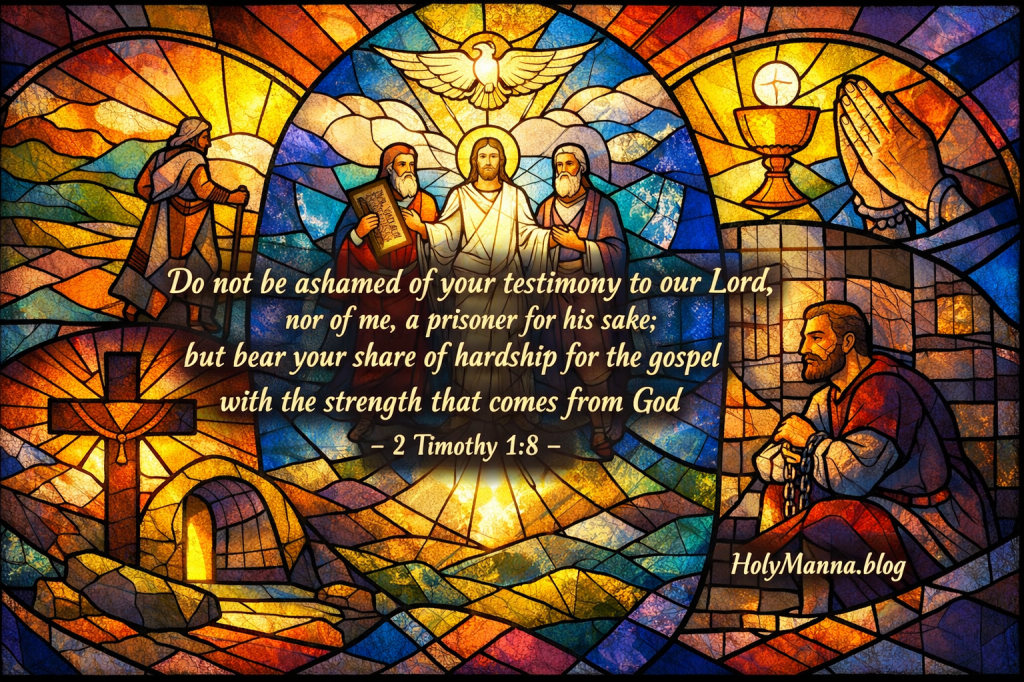
8 So do not be ashamed of your testimony to our Lord, nor of me, a prisoner for his sake; but bear your share of hardship for the gospel with the strength that comes from God.
9 He saved us and called us to a holy life, not according to our works but according to his own design and the grace bestowed on us in Christ Jesus before time began, 10 but now made manifest through the appearance of our savior Christ Jesus, who destroyed death and brought life and immortality to light through the gospel,
Detailed Exegesis
Verse 8 “So do not be ashamed of your testimony to our Lord, nor of me, a prisoner for his sake; but bear your share of hardship for the gospel with the strength that comes from God.”
St. Paul names a very modern problem with ancient roots: shame. The temptation is not always to deny Christ outright. Often it is to soften the truth, stay silent, or act as if faith is a private hobby. Paul insists that the testimony belongs to the Lord, not to the disciple, which means the disciple is not protecting a personal brand. The disciple is guarding a sacred trust. Paul also refuses to let chains become an embarrassment. His imprisonment is not a scandal; it is proof of fidelity. Then he gives the command that makes Christianity impossible without grace: bear hardship, not with personal toughness, but with strength that comes from God. This is the Catholic realism of the passage. God does not ask for heroic suffering and then leave His people alone. He supplies the strength He commands.
Verse 9 “He saved us and called us to a holy life, not according to our works but according to his own design and the grace bestowed on us in Christ Jesus before time began,”
This verse is the heartbeat of Catholic teaching on grace. God saves first, then calls, then forms holiness. Holiness is not a résumé of religious achievements. It is a life shaped by divine grace. Paul does not mean that works are irrelevant. He means they are not the source. The source is God’s design and God’s gift. The phrase “before time began” opens a window onto God’s eternal plan. Salvation is not God scrambling to fix a mistake. Salvation is God revealing what He intended from the beginning: to share His own life with His people in Christ. Lent makes sense here. Repentance is not bribing God into loving again. Repentance is returning to the grace already offered.
Verse 10 “but now made manifest through the appearance of our savior Christ Jesus, who destroyed death and brought life and immortality to light through the gospel.”
God’s plan, once hidden in promise, becomes visible in a Person. Christ “appears,” not as a motivational figure, but as Savior. Paul then makes a claim that changes everything: Christ destroyed death. Death still happens, but its tyranny is broken, because Christ passes through it and rises. That victory is not locked in the past. It is proclaimed through the Gospel and poured into souls through the life of the Church. Lent is not only about discipline. Lent is about living as if immortality is real, because Christ has brought it “to light.”
Teachings
This passage teaches that Christian courage is rooted in grace, not in temperament. Some people are naturally bold, others are more reserved, but the call is the same: do not be ashamed of Christ. The Church describes the seriousness of this witness in CCC 2471: “The duty of Christians to take part in the life of the Church impels them to act as witnesses of the Gospel and of the obligations that flow from it. This witness is a transmission of the faith in words and deeds. Witness is an act of justice that establishes the truth or makes it known.” St. Paul is not asking Timothy to win arguments. He is calling him to live and speak in a way that makes the truth known.
The reading also teaches the Catholic order of salvation: grace comes first. God saves, calls, and strengthens, and then the believer responds with real cooperation. CCC 1996 puts it plainly: “Our justification comes from the grace of God. Grace is favor, the free and undeserved help that God gives us to respond to his call to become children of God, adoptive sons, partakers of the divine nature and of eternal life.” This aligns perfectly with Paul’s words, “not according to our works but according to his own design and the grace bestowed on us in Christ Jesus.” Works matter, but they matter as response, not as purchase price.
Because this grace is not merely external assistance, but God’s own life shared with the soul, the Church speaks of sanctifying grace in a way that matches Paul’s “holy life.” CCC 1999 teaches: “The grace of Christ is the gratuitous gift that God makes to us of his own life, infused by the Holy Spirit into our soul to heal it of sin and to sanctify it. It is the sanctifying or deifying grace received in Baptism.” That means holiness is not cosmetic. It is transformation. Lent is a season of cooperating with that transformation through prayer, fasting, almsgiving, and sacramental life.
Finally, Paul’s claim that Christ “destroyed death” is not just a hopeful metaphor. It is the center of Christian proclamation. CCC 1019 declares: “Jesus, the Son of God, freely suffered death for us in complete and free submission to the will of God, his Father. By his death he has conquered death, and so opened the possibility of salvation to all men.” This is why Paul can ask Timothy to accept hardship without shame. The worst thing, death itself, has been conquered in Christ.
Reflection
Many people do not struggle with outright disbelief. They struggle with quiet shame, the kind that keeps faith hidden when it might cost something. This reading calls that out with fatherly directness, then offers a remedy that is surprisingly gentle: strength comes from God. Courage grows when the soul stops trying to carry discipleship alone.
A practical Lenten application begins with honesty. Where has the Christian life been treated like a private preference rather than a public allegiance? Where has speech become cautious, not because charity is guiding it, but because fear is? St. Paul’s answer is not to manufacture bravado. His answer is to lean into grace and accept a share of hardship for the Gospel, which can look very ordinary. It can mean speaking about Sunday Mass without embarrassment. It can mean refusing a dishonest shortcut at work. It can mean choosing chastity, patience, or sobriety when the world says those things are unnecessary. It can mean standing by the Church’s teaching with clarity, while still treating people with dignity.
This reading also re-centers the meaning of Lent. Lent is not a season to prove worthiness. Lent is a season to cooperate with grace, because God has already called His people to holiness. That changes the tone of repentance. The Christian turns away from sin, not to earn love, but because love is real and life is meant for more than sin’s small rewards.
Where has shame been shaping decisions more than the Gospel has been shaping them? What specific hardship has been avoided because it would expose faith to criticism, inconvenience, or misunderstanding? If Christ has truly brought “life and immortality to light,” what would change this week if daily choices were made with eternity in view?
Holy Gospel – Matthew 17:1-9
A Glimpse of Glory for the Days When Disciples Get Scared
Lent is honest about the road ahead. It leads to Jerusalem, to betrayal, to suffering, and to a Cross that no disciple would choose on instinct. That is why the Church gives this Gospel on the Second Sunday of Lent, because it is not trying to make anyone comfortable. It is trying to make believers faithful. In The Gospel of Matthew 17:1-9, Jesus takes Peter, James, and John up a high mountain and reveals His glory in the Transfiguration. This is not a random miracle. It is a strengthening gift. It is a divine preview meant to steady their hearts before the scandal of the Passion.
In the Jewish imagination, mountains were places of encounter with God. Moses met the Lord on Sinai. Elijah heard the Lord’s voice on the mountain. Now Jesus brings His closest disciples to a mountain, and the Father speaks. The same pattern runs through today’s theme. Abram is called to go forward without a map in Genesis 12:1-4. The psalm teaches the soul to wait and hope in mercy in Psalm 33. St. Paul teaches Timothy not to be ashamed but to share hardship for the Gospel in 2 Timothy 1:8-10. Here, the Father gives the command that pulls every reading into one sentence: “This is my beloved Son, with whom I am well pleased; listen to him.” Discipleship is listening that leads to obedience, especially when the road becomes hard.
Matthew 17:1-9 – New American Bible (Revised Edition)
The Transfiguration of Jesus. 1 After six days Jesus took Peter, James, and John his brother, and led them up a high mountain by themselves. 2 And he was transfigured before them; his face shone like the sun and his clothes became white as light. 3 And behold, Moses and Elijah appeared to them, conversing with him. 4 Then Peter said to Jesus in reply, “Lord, it is good that we are here. If you wish, I will make three tents here, one for you, one for Moses, and one for Elijah.” 5 While he was still speaking, behold, a bright cloud cast a shadow over them, then from the cloud came a voice that said, “This is my beloved Son, with whom I am well pleased; listen to him.” 6 When the disciples heard this, they fell prostrate and were very much afraid. 7 But Jesus came and touched them, saying, “Rise, and do not be afraid.” 8 And when the disciples raised their eyes, they saw no one else but Jesus alone.
The Coming of Elijah. 9 As they were coming down from the mountain, Jesus charged them, “Do not tell the vision to anyone until the Son of Man has been raised from the dead.”
Detailed Exegesis
Verse 1 “After six days Jesus took Peter, James, and John his brother, and led them up a high mountain by themselves.”
The detail “after six days” signals a deliberate moment, not a spontaneous hike. Jesus chooses the inner circle, the same three who will later be with Him in Gethsemane. He leads them, which matters because the mountain is not reached by personal initiative. It is a gift of Christ’s guidance. The “high mountain” echoes Sinai and other biblical mountain encounters, preparing the reader to expect revelation. Jesus is forming these men to understand what kind of Messiah He is, because their instincts are still shaped by worldly expectations.
Verse 2 “And he was transfigured before them; his face shone like the sun and his clothes became white as light.”
The Transfiguration is not Jesus receiving something new. It is Jesus revealing what is already true. The shining face and radiant garments communicate heavenly glory and divine majesty. In biblical imagery, light often signals God’s presence. This moment pulls back the veil and lets the disciples see that the one who will soon be rejected and beaten is also the Lord of glory. The Church reads this as mercy for weak disciples. God knows fear is coming, so He gives light before darkness.
Verse 3 “And behold, Moses and Elijah appeared to them, conversing with him.”
Moses represents the Law and Elijah represents the Prophets, which means all of Israel’s Scriptures are standing there as witnesses to Christ. Their presence proclaims continuity, not contradiction. Jesus is not a break from God’s revelation. He is its fulfillment. They are “conversing with him,” which shows Jesus as the center, not merely a participant. The Law and the Prophets do not compete with Him. They point to Him.
Verse 4 “Then Peter said to Jesus in reply, ‘Lord, it is good that we are here. If you wish, I will make three tents here, one for you, one for Moses, and one for Elijah.’”
Peter speaks like a man overwhelmed by glory who wants to freeze the moment. The desire is understandable. Nobody wants to come down from a mountain of beauty into a valley of suffering. Yet Peter’s impulse also reveals confusion. By offering three tents, he unintentionally places Jesus alongside Moses and Elijah as one among equals, and he tries to manage the mystery rather than receive it. This is a gentle warning for Lent. Even sincere disciples can try to control the spiritual life, turning grace into a project instead of surrender.
Verse 5 “While he was still speaking, behold, a bright cloud cast a shadow over them, then from the cloud came a voice that said, ‘This is my beloved Son, with whom I am well pleased; listen to him.’”
The Father interrupts Peter, and that interruption is a gift. The bright cloud echoes the divine presence in the Old Testament, especially the cloud that signified God’s glory. The voice reveals Jesus’ identity in a way that cannot be negotiated. Jesus is not only teacher, not only prophet, not only miracle worker. He is the beloved Son. Then comes the command that shapes the disciple’s whole life: listen to Him. This is not casual advice. It is the Father’s authority directing the believer toward Christ. This is why the Church proclaims this Gospel in Lent. The season is about conversion, and conversion begins with listening.
Verse 6 “When the disciples heard this, they fell prostrate and were very much afraid.”
True encounter with God produces holy fear because God is not tame. The disciples fall down because they realize they are in the presence of something beyond them. Their fear is not proof that they are bad disciples. Their fear is proof that the moment is real. Lent often reveals weakness. The point is not to pretend fear does not exist. The point is to let Christ meet fear with His presence.
Verse 7 “But Jesus came and touched them, saying, ‘Rise, and do not be afraid.’”
This is one of the most tender lines in the Gospel. Jesus does not shout them into courage. He comes near. He touches. Then He speaks. The command “do not be afraid” is not a motivational poster. It is a divine reassurance backed by His presence. The same Jesus who shines with glory is close enough to touch trembling men. This is discipleship in a nutshell. God is majestic, and God is near.
Verse 8 “And when the disciples raised their eyes, they saw no one else but Jesus alone.”
The vision narrows to the essential. Moses and Elijah are gone. The cloud is gone. The Father’s voice has been heard. Now it is Jesus alone. This is not a rejection of the Law and the Prophets. It is the point they were always driving toward. When God speaks finally and fully, the disciple’s gaze settles on Christ. Lent is meant to simplify the heart the same way, until distractions fade and the soul can say, “Jesus alone is enough.”
Verse 9 “As they were coming down from the mountain, Jesus charged them, ‘Do not tell the vision to anyone until the Son of Man has been raised from the dead.’”
They must come down. The Christian life does not stay on the mountaintop. The timing of proclamation matters because the Transfiguration cannot be understood correctly until the Resurrection. Without the Cross and Resurrection, people might interpret glory as earthly triumph. Jesus calls Himself “Son of Man,” pointing toward the path of suffering described in Scripture. He is preparing them to understand that glory comes through the Cross, not around it.
Teachings
The Transfiguration teaches that Jesus is truly the Son of God and that His Passion is freely embraced, not accidentally suffered. It is also a revelation meant to strengthen disciples before trial. The Catechism ties the Transfiguration directly to the Cross. CCC 554 teaches “From the day Peter confessed that Jesus is the Christ, the Son of the living God, Jesus began to show his disciples that he must go to Jerusalem and suffer many things. Peter tried to dissuade him from this. Christ rebuked him. The revelation of the true glory of Christ’s kingship took place at that moment on the mountain in the presence of three witnesses chosen by himself: Peter, James, and John. The Transfiguration of Christ aims at strengthening the apostles’ faith in anticipation of his Passion: the ascent onto the high mountain prepares for the ascent to Calvary. Christ, the Head of the Church, manifests what his Body contains and radiates in the sacraments: ‘the hope of glory.’” This teaching shows the Church’s lens. Tabor is not an escape from Calvary. Tabor is preparation for Calvary.
The Father’s command, “listen to him”, also reveals something central about Christian obedience. Faith is not inventing a spiritual path. Faith is receiving revelation and conforming life to it. CCC 144 defines obedience in a way that matches the Father’s command perfectly. “To obey (from the Latin ob-audire, to ‘hear or listen to’) in faith is to submit freely to the word that has been heard, because its truth is guaranteed by God, who is Truth itself.” The Father speaks, and the disciple’s proper response is listening that becomes surrender.
The appearance of Moses and Elijah shows that Jesus fulfills the whole story of Israel. The Law and the Prophets are not discarded. They reach their goal in Christ. This protects the believer from treating Christianity as a disconnected religious trend. It is the completion of God’s long, patient work of salvation, moving from covenant promises, like Abram’s call in Genesis 12, toward their fulfillment in the beloved Son.
Saints and Doctors of the Church often emphasize that the Transfiguration was given as medicine for fear. The disciples will see Christ’s face disfigured in the Passion, and they will need to remember that He is still the beloved Son. This is why the Church places this Gospel in Lent. It is a lamp for the dark valley.
Reflection
This Gospel speaks to anyone who has ever wanted to keep spiritual life comfortable. Peter’s instinct is relatable. When prayer is sweet and faith feels clear, it is tempting to build tents and settle in. Yet Jesus leads disciples down the mountain because love is proven in obedience, not in spiritual vibes. Lent is not only about having inspiring moments. Lent is about following Christ when it is inconvenient, when it is misunderstood, and when it requires sacrifice.
A practical way to live this Gospel is to treat the Father’s words as a daily rule. Listening to Jesus means letting His teaching shape decisions about money, sexuality, speech, forgiveness, and time. It means opening Scripture with humility, receiving the Church’s teaching without picking and choosing, and approaching the sacraments with real hunger for conversion. It also means remembering that fear is not the final word. The disciples fell down afraid, but Jesus touched them and told them to rise. That same Christ still meets fearful hearts through grace, especially in Confession and the Eucharist.
The key is to carry a memory of Christ’s glory into the hard places. When temptation feels loud, when anxiety feels heavy, when suffering feels pointless, the Transfiguration insists that Jesus is not only a moral teacher. He is the beloved Son, and His Cross leads to glory.
Where has the heart been trying to build tents, settling for comfort instead of obedience? What would change if the Father’s command, “listen to him”, became the filter for every decision this week? When fear rises, will the soul collapse inward, or will it let Jesus draw near, lift it up, and send it back down the mountain with courage?
Come Down the Mountain Different
Today’s readings move like one story told in four scenes, and the message is as simple as it is demanding. God calls His people forward, God proves Himself trustworthy, and God strengthens disciples to keep walking when the road gets hard. The central thread is the obedience of faith, the kind of listening that becomes movement, endurance, and real conversion.
In Genesis 12:1-4, Abram hears God say “Go forth”, and he leaves the familiar without a map because the promise is enough. That is the first step of Lent: trusting God more than comfort. In Psalm 33:4-5, 18-20, 22, the Church answers the anxiety that comes with that kind of trust, insisting that the Lord’s word is upright, His works are trustworthy, and His mercy is not scarce. In 2 Timothy 1:8-10, St. Paul speaks from prison and teaches that courage is not a personality trait. Courage is grace, and disciples are called to bear hardship without shame because Christ has already shattered death’s power and brought immortality into the light. Then in The Gospel of Matthew 17:1-9, Jesus reveals His glory on the mountain, and the Father gives the command that ties everything together: “This is my beloved Son… listen to him.” The disciples fall in fear, but Jesus touches them and says “Rise, and do not be afraid.” That is what Lent is meant to do. It is meant to lift fearful hearts, simplify distracted souls, and send believers back into daily life with Jesus alone at the center.
The invitation now is to live this Sunday like it matters on Monday. The world trains people to cling, to control, and to hide, but the Lord trains His people to trust, to listen, and to go forward. This week, the call is to leave one attachment that keeps the soul small, to make space for real listening in prayer, and to accept one concrete act of Gospel faithfulness even if it costs comfort. The Lord who called Abram still calls. The Lord who shone on the mountain still speaks. The Lord who touched trembling disciples still draws near.
What would change if the Father’s command became the week’s guiding rule, “Listen to him”? Let Lent do its work. Go forward. Hope in mercy. Share the Gospel without shame. And when fear rises, let Jesus lift the heart up, because the road down the mountain is where disciples become saints.
Engage with Us!
Share reflections in the comments below, because the Word of God grows roots when it is spoken out loud and lived on purpose. These readings are not meant to stay on the page. They are meant to shape real decisions, real relationships, and real conversion throughout the week.
- First Reading – Genesis 12:1-4: What is one “safe place” the Lord is asking to leave behind so faith can grow? Where has the heart been asking God for a detailed map instead of trusting His promise one step at a time? How can the blessing God gives be turned outward this week so someone else experiences His mercy through a simple act of charity or courage?
- Responsorial Psalm – Psalm 33:4-5, 18-20, 22: Where has fear been louder than trust lately? What would it look like to “wait for the Lord” in a concrete way through prayer, patience, or refusing a rushed and anxious decision? How can the heart practice hope today, not as optimism, but as a choice to rely on the Lord’s mercy?
- Second Reading – 2 Timothy 1:8-10: Where has shame or fear of judgment made faith quieter than it should be? What hardship for the Gospel has been avoided, even though it could be carried with the strength that comes from God? If Christ has truly brought “life and immortality to light,” how would daily priorities change if eternity was treated as real?
- Holy Gospel – Matthew 17:1-9: What does it mean in practical terms to obey the Father’s command, “listen to him”, in decisions about time, speech, relationships, and habits? Where has the heart been trying to build tents on comfort instead of following Jesus down the mountain into faithful obedience? When fear rises, how can the soul remember that Jesus still comes near, still touches, and still says “Rise, and do not be afraid”?
Keep walking in faith this week, even if the road feels steep, because the Lord who calls also provides, and the Lord who reveals His glory also gives the grace to carry the Cross. Let everything be done with the love, truth, and mercy Jesus taught, so that everyday life becomes a quiet testimony that the beloved Son is worth listening to.
Sacred Heart of Jesus, we trust in You!
Immaculate Heart of Mary, pray for us!
Saint Michael the Archangel, defend us in battle!
Follow us on YouTube, Instagram and Facebook for more insights and reflections on living a faith-filled life.

 Holy Manna!
Leave a comment