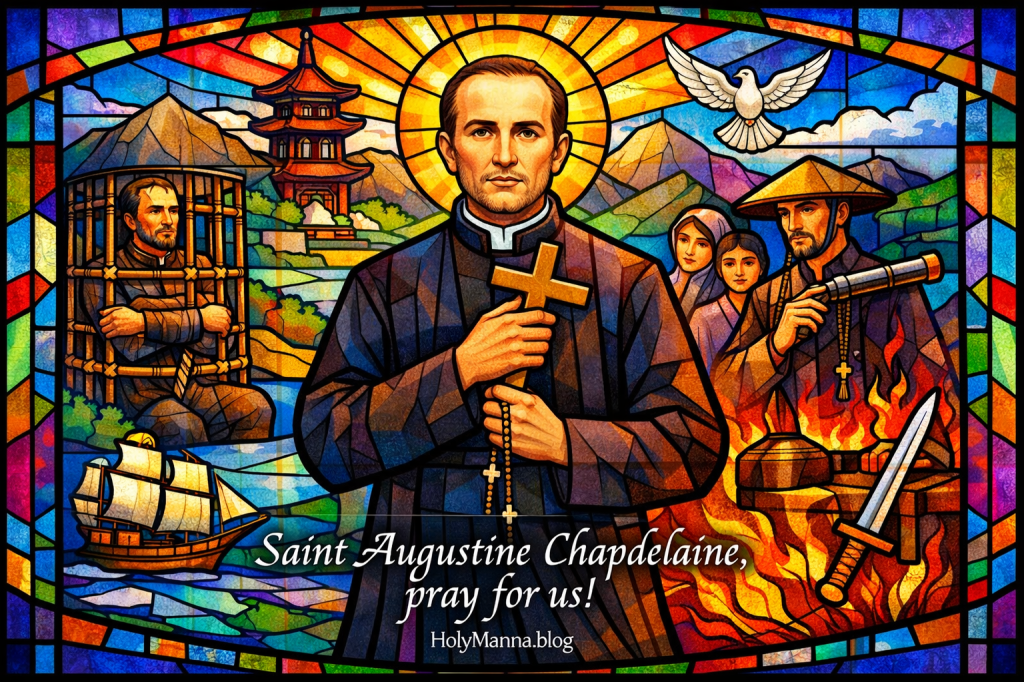
The Quiet Missionary Who Shook an Empire
Saint Augustine Chapdelaine was a French priest and missionary of the Paris Foreign Missions Society who carried the Gospel into the interior of southern China and paid for it with his life. He is remembered among the Martyrs of China, canonized by Pope Saint John Paul II, not because he built an earthly empire, but because he refused to surrender the Kingdom of God when fear and violence demanded compromise. The Church calls this kind of witness martyrdom, which The Catechism describes as “the supreme witness given to the truth of the faith.” CCC 2473.
From Normandy Soil to a Missionary Heart
Auguste Chapdelaine was born in 1814 in Normandy, France, in a farming family. His early life was not wrapped in drama. It was ordinary, earthy, and hardworking. He knew the rhythm of seasons, the demands of labor, and the quiet strength it takes to keep showing up. That humble beginning matters because it shows how God loves to shape saints from the “regular people” the world overlooks.
He studied for the priesthood and served faithfully in parish life for years before he ever crossed an ocean. He was a diocesan priest of Coutances, and he spent significant time as a vicar in Boucey, serving souls one confession, one Mass, one catechism lesson at a time. Then, the Lord’s call grew louder. He entered the Paris Foreign Missions Society, a community formed to send priests into places where the Gospel was not welcome, not protected, and not safe.
He left France for China in 1852. This was not religious tourism. This was a one-way surrender.
The Hidden Road of a Missionary
The mission field was not a straight path. Even the journey into the interior carried danger. He faced robbery and setbacks, and still pressed forward. He spent time in Hong Kong as part of the slow, practical preparation needed for missionaries heading inland. Then he moved toward regions like Guizhou and Guangxi, territories known for instability and suspicion toward foreigners and Christians.
In Guangxi, the faith was not merely “unpopular.” It could be treated as illegal, dangerous, and politically suspect. In those conditions, preaching Christ could be twisted into accusations of rebellion. That is one of the strangest burdens missionaries often carry. The Gospel saves souls, but rulers sometimes fear it because it refuses to worship the state.
Even his local name carried complications. He was known as “Ma Lai,” and in that region the name could be associated with Muslim communities, which made it easier for enemies to stir confusion and suspicion. The saint did not seek controversy, but he accepted it when it came, because the mission was never about comfort. It was about Christ.
A Life of Zeal Without the Spotlight
Stories of saints sometimes come with dramatic public miracles, crowds, and instant fame. Saint Augustine Chapdelaine’s holiness looks different. His “miracle” during life, as far as reliable accounts preserve, is the steady courage to keep evangelizing when it cost him everything.
That is not small. In a culture that treats comfort like a human right, it is powerful to meet a man who chose fidelity over survival. The Church is missionary by nature, because Jesus Himself sent the apostles, and the mission continues in every age. That calling is not a hobby for spiritual overachievers. It is part of the Church’s heartbeat. CCC 849.
When the Cross Became Personal
In late February 1856, Chapdelaine was denounced, arrested, and dragged into suffering with local Christians. Authorities demanded that he renounce the faith. He refused. Accounts describe beatings, extreme restraint, and a slow grinding attempt to break his will. He was condemned to a form of death described as “the punishment of the cage,” and he died during the night after torture. After death, his body was further desecrated in an act meant to terrorize believers and erase his memory.
Instead, it did the opposite. The blood of martyrs has a way of preaching louder than sermons.
A preserved statement attributed to him captures the clarity of his conscience. “My religion being the true one, I cannot abandon it… I exhort people to do good and to merit the happiness of Heaven.” Those words are not the voice of a political agitator. They are the voice of a priest who believed Heaven is real, sin is real, grace is real, and eternity is worth more than a few remaining years of earthly breath.
This is why martyrs matter. They remind the Church that truth is not an accessory. Truth is worth dying for, because Truth has a Name.
The Strange Power of His Memory
Reliable Catholic biographies do not preserve a catalog of specific healing miracles attributed to Saint Augustine Chapdelaine’s intercession, the way some saints’ stories do. That does not diminish his sanctity. Martyr saints are honored chiefly because their death for Christ is itself a radiant sign of grace and fidelity, and their witness strengthens the Church.
His relics and missionary memory were preserved in the tradition of the Paris Foreign Missions Society in Paris, where relics and personal objects of missionary martyrs are kept with reverence. Among the items associated with him is a telescope, a small detail that feels symbolic. A missionary is someone who learns to look beyond his own horizon, beyond his comfort, beyond his homeland, because the Gospel deserves to be carried farther.
His impact after death also includes a complicated historical shadow. His execution became entangled in international politics, and it was used as a justification in diplomatic conflict that expanded into war. That is a painful reminder that holy suffering can be exploited by worldly powers. The Church venerates the martyr for his fidelity to Christ, not for the motives or maneuvers of empires.
Even more surprising, modern local narratives have sometimes tried to portray him as a criminal figure rather than a saint. That kind of “second martyrdom” happens when the world cannot tolerate the idea that a man died simply because he loved Jesus and refused to deny Him. Yet the Church continues to name him as saint, and his name continues to be spoken in prayer.
His liturgical remembrance is traditionally tied to late February, often observed on February 28, and connected to February 29 in leap years. He is also remembered within the broader commemoration of the Martyrs of China, kept on July 9. The Church does not keep these dates to romanticize suffering. The Church keeps them to remember what love looks like when it is tested.
A Catholic Reflection for Real Life
Saint Augustine Chapdelaine does not challenge people to do something dramatic for the sake of drama. He challenges people to be faithful in the real world, where pressures are subtle and constant. Most people will not be asked to die for the faith, but everyone will be asked to compromise it.
His story invites a few serious questions. What does it look like to hold the line when it costs social approval, comfort, or convenience? What does it look like to evangelize without being obnoxious, and to witness without being cowardly?
Martyrdom begins long before a prison cell. It begins in daily decisions to tell the truth, to refuse sin, to endure misunderstanding, and to keep praying when feelings dry up. The saint’s witness also reminds believers that the Church is not a lifestyle brand. The Church is the Body of Christ, sent into the world, and the mission is real. CCC 849.
There is also a practical lesson for modern Catholics who feel exhausted or distracted. This saint’s strength was not charisma. It was conviction. Conviction grows when prayer is consistent, confession is regular, the Eucharist is central, and the mind is formed by the Church. The world will always offer easier paths. The saint shows that easier is not always better, and comfort is not the same thing as peace.
How might this week look different if faith was treated as worth defending, not just worth enjoying?
Where is the Lord asking for courage, not in grand gestures, but in quiet fidelity?
Engage with Us!
Readers are invited to share thoughts and reflections in the comments below, because the saints are not museum pieces. They are family, and their stories are meant to strengthen ordinary Catholics living ordinary lives.
- Where does fear most often pressure the heart to stay silent about Jesus?
- What is one concrete compromise that needs to be refused this week out of love for Christ?
- How can prayer and the sacraments be prioritized so courage becomes a habit instead of a last-minute emergency?
- Who is one person in daily life who needs patient, respectful evangelization, and what would a first step look like?
May Saint Augustine pray for a Church that is brave, joyful, and faithful. Keep walking forward in faith. Keep choosing truth. Keep doing everything with the love and mercy Jesus taught, because nothing offered to Christ in love is ever wasted.
Saint Augustine Chapdelaine, pray for us!
Follow us on YouTube, Instagram and Facebook for more insights and reflections on living a faith-filled life.

 Holy Manna!
Leave a comment