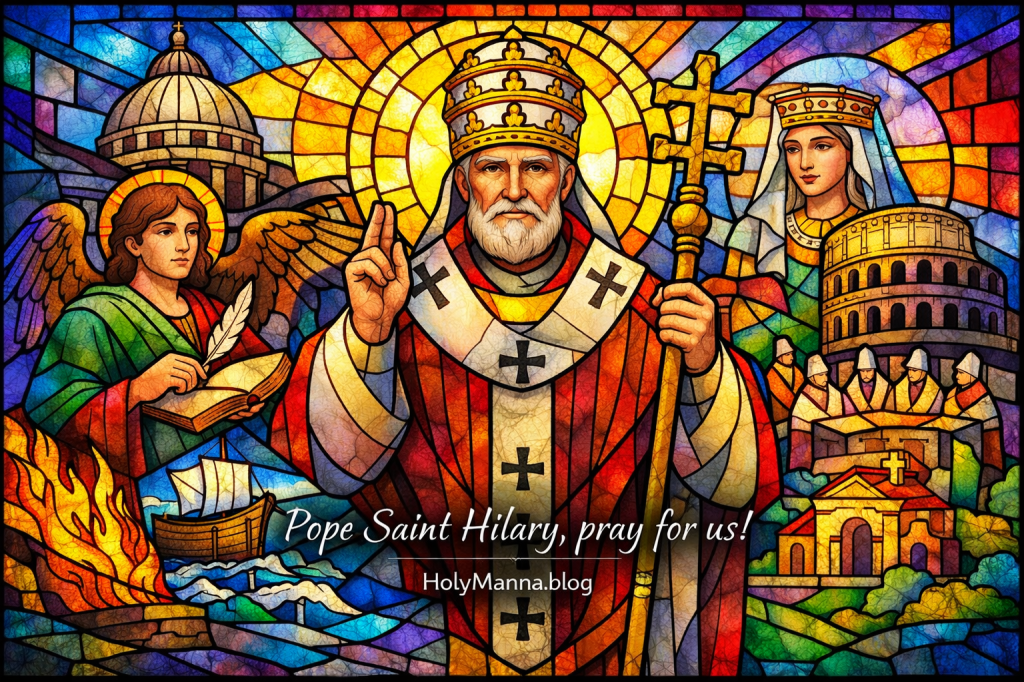
A Shepherd the Storm Could Not Silence
Pope Saint Hilary lived at a time when the Church was still catching its breath after fierce battles over who Jesus Christ truly is. In the fifth century, bishops were pressured by politics, threatened by mobs, and tempted to keep the peace by staying quiet. Hilary did not stay quiet. He is remembered as a pope with a spine of steel and a heart that loved the unity of the Church more than the comfort of an easy life.
Catholics honor him because he defended the faith handed down from the Apostles, strengthened the discipline of the Church when chaos was spreading, and protected the flock from heresy and corruption. His story is not flashy, but it is powerful, because it shows what fidelity looks like when it costs something. The Church teaches that the pope is a visible foundation of unity in the Church, not as a celebrity, but as a servant of communion. That is exactly the lane Hilary stayed in, and he stayed there courageously, as described in CCC 880-882.
A Life Shaped in the Shadow of Saint Leo
Hilary was born in Sardinia, and the details of his childhood are mostly hidden from history. That silence is a reminder that holiness does not always come with a dramatic backstory. Sometimes God simply takes a faithful man, places him near strong leaders, and forms him through responsibility.
Hilary rose in the Roman Church and served as archdeacon under Pope Saint Leo the Great. This was not a desk job. It was frontline work in the life of the Church, dealing with doctrine, discipline, and the unity of Christians spread across a turbulent empire. Hilary’s faith was not merely inherited. It was refined through service, sharpened by conflict, and deepened by the kind of trials that either make a man bitter or make him bold.
The moment that shaped his legacy happened before he ever wore the fisherman’s ring. In the year 449, Hilary was sent as a papal legate to a council at Ephesus, later remembered in Catholic history as the “Robber Council” because of the intimidation and violence that marked it. A faithful bishop, Saint Flavian of Constantinople, was unjustly condemned. Hilary opposed it publicly, and he registered the pope’s objection with one Latin word that has echoed for centuries: “Contradicitur.” That single word was not a clever soundbite. It was a line in the sand.
The Pope Who Guarded the Center
Hilary became pope in 461, after the death of Saint Leo the Great, and he governed until his death in 468. His pontificate was not about building a personal brand. It was about holding the Church together when local politics and doctrinal confusion threatened to fracture it.
He is especially known for strengthening discipline and lawful order in Gaul and Spain. Bishops were being installed improperly. Jurisdictions were being ignored. Church property was being mishandled. Hilary responded like a real father. He corrected, he organized, and he reminded local churches that unity with Rome was not optional.
In Gaul, he dealt with difficult cases involving bishops who had acquired offices unlawfully or acted outside proper authority. He reaffirmed the need for regular synods and insisted that major disputes be referred to the Apostolic See. He also defended the Church’s structures so that no bishop treated a diocese like a personal possession to be traded or seized.
In Spain, he confronted disputes over ordinations and succession. One particular Roman synod held in 465 is remembered because its acts survive as some of the oldest original synodal records from Rome. That matters because it shows Hilary was not improvising. He was governing carefully, documenting decisions, and protecting the integrity of the Church’s sacramental and apostolic life.
Hilary also showed courage in Rome itself when imperial influence tried to create space for heresy. He confronted Emperor Anthemius over support given to groups tied to the Macedonian error, which denied the full divinity of the Holy Spirit. The Catholic faith confesses the Holy Spirit as true God, equal in glory with the Father and the Son, as taught in CCC 245-248. Hilary’s stance was a reminder that political power does not get to vote on doctrine.
The Miracle of Escape
When Hilary opposed injustice at Ephesus, it placed his life in danger. Catholic tradition preserves the story that he escaped with difficulty, and that he later credited his deliverance to the intercession of Saint John the Apostle. That deliverance is the closest thing to a clearly preserved “miracle story” connected to his life, and it is told not as a rumor, but as a memory he himself honored.
As pope, Hilary expressed that gratitude in a way that a pilgrim could still understand centuries later. He built or endowed oratories connected to Saint John at the Lateran Baptistery, including one honoring Saint John the Baptist and another honoring Saint John the Apostle, along with a chapel of the Holy Cross. His thanksgiving was not merely emotional. It was concrete, visible, and public.
An ancient inscription associated with that dedication is remembered in Catholic sources and captures the humility of a man who knew he had been spared for a reason. It honors Saint John as the one who rescued him, and it identifies Hilary simply as a servant. Even in victory, he wanted the spotlight on God’s providence, not his own bravery.
Building for Souls
Hilary’s legacy was not only doctrinal and disciplinary. He also worked to strengthen Christian life in Rome through building and provision. Catholic sources attribute to him convents, public baths, and libraries near the Basilica of Saint Lawrence Outside the Walls, as well as another convent within the city. These details can sound ordinary until their purpose is remembered. The Church has always cared for bodies and souls together, because the human person is not a spirit floating around. The human person is a unity, and Christian charity has always been practical, as the Church emphasizes when speaking about the works of mercy and the dignity of the person in CCC 1700 and CCC 2447.
Hilary helped shape spaces where faith could be lived, where prayer could be offered, where learning could be preserved, and where the daily needs of a battered city could be met.
A Quiet Saint with a Lasting Footprint
Pope Saint Hilary died in 468 and was buried at Saint Lawrence Outside the Walls in Rome. The Roman Catholic tradition commemorates him on November 17. His posthumous impact is not built on dramatic legends of spectacular healings that are widely documented in early sources. His impact is more like a steady heartbeat. The Church’s veneration of him as a saint, the preservation of his name in Catholic memory, and the continued witness of the places connected to his building work are part of how his legacy endures.
Pilgrims who visit Rome still walk through spaces shaped by early popes like Hilary, and that matters. It is one thing to read about courage. It is another thing to realize that real men stood in real places, defended the real faith, and paid real costs so that today’s Catholic could walk into a parish and hear the Creed proclaimed without confusion.
Some later devotional stories speak of the prayers of the faithful seeking his intercession, as happens with many ancient saints. Specific miracle accounts after his death are not strongly preserved in the earliest mainstream records available, so anything beyond his celebrated deliverance and his lasting veneration cannot be confidently verified.
A Lesson for Catholics Who Feels Outnumbered
Pope Saint Hilary’s life hits home for anyone who has ever felt surrounded by confusion, pressured to compromise, or tempted to stay silent just to keep things easy. His story teaches that holiness is often unglamorous. It looks like doing the right thing when it would be simpler to go along.
His famous word, “Contradicitur” (“I object”), is a challenge to every Catholic living in a loud age. Sometimes the most loving thing is to object, calmly and firmly, when something contradicts the Gospel and the Church’s teaching. That does not mean acting angry or arrogant. It means staying loyal to Christ and His Church.
It is also a reminder that the Holy Spirit is not a vague force or a motivational vibe. The Holy Spirit is God, and the Catholic faith refuses to shrink the Trinity to fit modern comfort, as taught in CCC 232-267. Hilary defended that truth in a political world that wanted theology to bend.
For everyday life, Hilary’s example can be lived in simple ways. A Catholic can practice fidelity in speech, choosing truth over sarcasm and clarity over cowardice. A Catholic can practice fidelity in family life, guarding the home from what undermines the faith, and building habits that make prayer normal. A Catholic can practice fidelity in parish life, supporting good priests, respecting Church teaching, and refusing to treat Catholicism like a personal hobby.
Where has pressure made faith feel inconvenient lately? What would it look like to respond with steady courage instead of quiet compromise?
Engage with Us!
Share your thoughts and reflections in the comments below. The saints are not museum pieces. They are family, and their stories are meant to shape real life.
- What is one area of life where speaking the truth with charity feels difficult right now?
- When has God protected you from something you did not even see coming, the way Hilary believed he was protected through Saint John’s intercession?
- How can greater reverence for the Holy Trinity, as taught in CCC 232-267, change the way you pray this week?
- What practical step can be taken today to strengthen unity in your home, parish, or friendships without compromising the truth?
Keep walking forward in faith. Choose courage over comfort, clarity over confusion, and mercy over bitterness. Do everything with the love and mercy Jesus taught, because holiness is never just about winning arguments. Holiness is about belonging to Christ completely and letting that belonging shape every word, every choice, and every relationship.
Pope Saint Hilary, pray for us!
Follow us on YouTube, Instagram and Facebook for more insights and reflections on living a faith-filled life.

 Holy Manna!
Leave a comment