Saturday of the First Week of Lent – Lectionary: 229
The Covenant Written on the Heart, Proven by Perfect Love
Some days in Lent feel quiet on the surface, but underneath they press a question that cannot be avoided: Who does a life really belong to? Today’s readings answer that question with a single, demanding theme. God does not ask for a portion of a person. God asks for the whole heart, and that wholehearted belonging is proven when love reaches beyond comfort and extends even to enemies.
In Deuteronomy 26:16-19, Israel stands in a covenant moment that is both sacred and serious. This is not a casual religious preference, but a public identity. The Lord claims a people as his own, and the people accept the Lord as their God. The language is total, because covenant love is total. The command is clear: obedience is not meant to be mechanical, but personal, offered with the whole heart and the whole being. This is the foundation of everything that follows, because the Law is not simply about behavior, it is about belonging.
Then Psalm 119 gives the inner soundtrack of that covenant. It sounds less like a courtroom and more like a pilgrim’s prayer. The blessed life is described as a life that seeks God with all the heart, not merely with habit or tradition. The psalmist is not pretending to be self sufficient either. There is a quiet plea hiding in plain sight, a recognition that holiness is not maintained by human willpower alone. This is why Lent matters, because it strips away illusions and leaves the soul honest enough to ask God for help.
Finally, in The Gospel of Matthew 5:43-48, Jesus takes covenant life to its summit. He does not reduce the Law, he reveals its deepest purpose. The Father’s love is not limited to the deserving, because the sun rises and the rain falls on both the just and the unjust. Jesus teaches that real discipleship is not measured by loving people who are easy to love, because anyone can do that. Christian love becomes unmistakable when it includes prayer for persecutors and mercy toward enemies. This is not sentimental, and it is not weak. It is divine. It is the kind of love that looks like the Cross, and the Church calls this the path of holiness and perfection in charity, the very heart of CCC 2013 and CCC 1825.
So today’s readings invite a single Lenten examination: Is faith only a label, or is it a covenant that has taken possession of the heart? If the Lord truly claims a people to be holy, then holiness cannot stay trapped inside private devotion. It has to show up in relationships, especially the strained ones. It has to sound like forgiveness in a world that prefers payback. It has to look like prayer for the person who does not deserve it. It has to become, little by little, “So be perfect, just as your heavenly Father is perfect.”
First Reading – Deuteronomy 26:16-19
A Covenant That Claims the Whole Heart
The book of Deuteronomy is set like a final, fatherly speech from Moses to Israel on the edge of the Promised Land. A whole generation has been formed by the desert, chastened by failure, and carried by mercy. Now, before crossing the Jordan, the people are called to renew the covenant, not as a vague memory of Sinai, but as a present choice that shapes identity, worship, and daily life.
This passage lands with special weight in Lent because Lent is covenant season. It is the Church’s yearly call to stop living half-hearted, distracted discipleship and to return to the Lord with integrity. The theme running through these verses is not simply “keep the rules.” The theme is belonging. God claims a people as his own, and the people respond by giving their whole heart and whole being. That is the foundation for everything else, including the radical love Jesus will demand in the Gospel.
Deuteronomy 26:16-19 – New American Bible (Revised Edition)
The Covenant. 16 This day the Lord, your God, is commanding you to observe these statutes and ordinances. Be careful, then, to observe them with your whole heart and with your whole being. 17 Today you have accepted the Lord’s agreement: he will be your God, and you will walk in his ways, observe his statutes, commandments, and ordinances, and obey his voice. 18 And today the Lord has accepted your agreement: you will be a people specially his own, as he promised you, you will keep all his commandments, 19 and he will set you high in praise and renown and glory above all nations he has made, and you will be a people holy to the Lord, your God, as he promised.
Detailed Exegesis
Verse 16 – “This day the Lord, your God, is commanding you to observe these statutes and ordinances. Be careful, then, to observe them with your whole heart and with your whole being.”
This is not framed as a suggestion or a spiritual hobby. The covenant is presented as a living obligation, and the word “this day” makes it immediate. The call to obedience is also deeply personal. God does not want a people who merely perform religious motions. God wants a people whose interior life matches their exterior practice. The “whole heart” language exposes the real enemy of holiness, which is not only rebellion, but division. A divided heart keeps God at a safe distance.
Verse 17 – “Today you have accepted the Lord’s agreement: he will be your God, and you will walk in his ways, observe his statutes, commandments, and ordinances, and obey his voice.”
The covenant always moves in two directions. God gives himself, and the people respond. Israel “accepts” the Lord’s agreement, which means this is not forced compliance. It is chosen fidelity. To “walk in his ways” is more than rule-keeping. It is a whole lifestyle shaped by God’s character. Obedience here is described as hearing and responding to God’s voice, because the covenant is relational before it is legal.
Verse 18 – “And today the Lord has accepted your agreement: you will be a people specially his own, as he promised you, you will keep all his commandments,”
This verse flips the perspective. The Lord also “accepts” the people’s agreement. That is astonishing, because it reveals a God who stoops to bind himself to human beings. The phrase “a people specially his own” points to election, not as a trophy, but as a mission. God chooses in order to sanctify, and sanctifies in order to send. This is why the commandments are not presented as a burden meant to crush joy. They are presented as the shape of belonging for a people set apart.
Verse 19 – “and he will set you high in praise and renown and glory above all nations he has made, and you will be a people holy to the Lord, your God, as he promised.”
The goal is holiness. The “praise and renown and glory” are not about ego, because Israel’s glory is meant to reflect God’s glory. When God’s people live as a holy people, the nations are meant to see something true about the Lord. Holiness here is not private perfectionism. It is public witness. Israel is called to be visibly different because they visibly belong to God.
Teachings
This reading gives a clear Catholic pattern for understanding commandments: love comes first, and obedience follows. God does not begin by demanding a perfect record. God begins by claiming a people, rescuing them, and forming them through covenant. The commandments are then received as the path of a people who already belong to him.
The Church teaches that the moral law is not arbitrary, because it is rooted in God himself and ordered to human flourishing. The commandments are not the opposite of freedom. They protect true freedom from being swallowed by impulse and self-deception. The Catechism summarizes the enduring seriousness of God’s commands with a short, sharp line that fits the spirit of Deuteronomy: CCC 2072 teaches, “The Ten Commandments are fundamentally immutable, and they oblige always and everywhere.” This does not reduce life with God to legalism. It insists that love is real enough to take shape in real choices.
This covenant language also shines a light on what Lent is doing in the life of the baptized. Baptism is not merely a ritual from the past. Baptism is a covenant identity in the present. The Church describes the baptized as a people set apart for God, called to holiness not as a special interest, but as a normal Christian vocation. CCC 2013 puts the call simply and strongly: “All Christians in any state or walk of life are called to the fullness of Christian life and to the perfection of charity.” That is the same trajectory as Deuteronomy: wholehearted belonging that becomes visible holiness.
Saints and doctors of the Church consistently warn that the greatest danger is not only sin, but spiritual half-measures. A person can keep religious appearances while the heart stays untouched. This reading confronts that temptation directly. God asks for the whole heart because anything less becomes a counterfeit covenant.
Reflection
This first reading is a gentle but firm wake-up call for daily life. It challenges the habit of giving God the leftovers, the rushed prayer, the occasional Mass, the selective obedience, and then acting surprised when peace feels thin. The covenant does not thrive on leftovers. The covenant thrives on surrender.
A practical Lenten response begins with honesty. The heart has patterns, and patterns reveal priorities. If the day is shaped more by cravings, scrolling, anger, or constant distraction than by prayer and charity, then the heart is being trained to belong somewhere else. God’s invitation is not shame. God’s invitation is return.
One concrete step is to choose one command of God and live it deliberately for a week, not as a performance, but as an act of love. Another step is to examine speech, because “obey his voice” always implies learning to speak like someone who has listened to God. A third step is to reconnect obedience with identity by praying before decisions, especially the small ones, because small choices are where the heart is formed.
Where has the heart been divided, asking God for guidance while quietly reserving the right to disobey?
What would change this Lent if obedience stopped being treated like loss and started being treated like belonging?
If holiness is the goal, what is one habit that needs to be cut away so the whole heart can actually be offered to God?
Responsorial Psalm – Psalm 119:1-2, 4-5, 7-8
The Happy Life Is a Wholehearted Life
Psalm 119 is the longest psalm and one of the most deliberately crafted prayers in all of Scripture. It is written as an acrostic in Hebrew, moving through the alphabet like a pilgrim taking steady steps, teaching Israel that love for God is meant to shape a whole life, from beginning to end. In the world of ancient Israel, the “law” was not merely a legal code. The Torah was God’s instruction for a covenant people, a path that formed worship, justice, family life, and identity. That is why this psalm does not sound like a complaint about rules. It sounds like someone who has discovered that God’s ways are life-giving.
Placed beside Deuteronomy 26:16-19, this psalm becomes the interior echo of the covenant. Moses calls for obedience with the whole heart and whole being, and the psalmist responds like a man who actually wants that. Then, in Lent, the Church hands this prayer to the faithful because it trains the soul to desire what Jesus demands in the Gospel, a righteousness that is not selective or convenient, but wholehearted and real.
Psalm 119:1-2, 4-5, 7-8 – New American Bible (Revised Edition)
A Prayer to God, the Lawgiver
1 Blessed those whose way is blameless,
who walk by the law of the Lord.
2 Blessed those who keep his testimonies,
who seek him with all their heart.4 You have given them the command
to observe your precepts with care.
5 May my ways be firm
in the observance of your statutes!7 I will praise you with sincere heart
as I study your righteous judgments.
8 I will observe your statutes;
do not leave me all alone.
Detailed Exegesis
Verse 1 – “Blessed those whose way is blameless, who walk by the law of the Lord.”
“Blessed” here speaks of the deep happiness that comes from living in right relationship with God. The “blameless way” does not describe a perfect record with zero weakness. It describes a life that is not double-minded, a life that actually walks with God rather than merely talking about God. To “walk by the law of the Lord” is to let God’s instruction guide decisions, relationships, and conscience, especially when it costs something.
Verse 2 – “Blessed those who keep his testimonies, who seek him with all their heart.”
The psalm tightens the focus from behavior to desire. The heart is the center of the person, the place where choices are conceived. Seeking God “with all their heart” is covenant language, and it matches today’s theme perfectly. God is not looking for a believer who keeps appearances. God is forming a disciple whose inner life and outer life belong to him.
Verse 4 – “You have given them the command to observe your precepts with care.”
This verse remembers something modern people forget quickly. God’s commands are gifts before they are demands. The Lord “has given” the command, which means the law is not random and it is not cruel. It is instruction from a Father who knows what leads to life. The phrase “with care” matters because holiness is rarely destroyed by one dramatic fall. It is more often eroded by careless living, careless speech, and careless compromise.
Verse 5 – “May my ways be firm in the observance of your statutes!”
This is not bragging. It is a prayer. The psalmist is asking for stability, for steadiness, for a life that does not wobble every time pressure rises. That is the voice of someone who understands human weakness and still wants to be faithful. Lent is full of this same prayer, because conversion is not a mood. Conversion is a firming of the will by grace.
Verse 7 – “I will praise you with sincere heart as I study your righteous judgments.”
The psalm connects learning with worship. Studying God’s judgments is not meant to create a cold intellectual. It is meant to form a sincere heart that can praise God honestly. The “sincere heart” is the opposite of performative religion. It is the heart that praises God not because life is easy, but because God is righteous.
Verse 8 – “I will observe your statutes; do not leave me all alone.”
This final line is the hidden gem of the responsorial psalm. The psalmist promises obedience, and then immediately pleads for God’s presence. This is Catholic realism. Holiness requires cooperation, but it never begins or ends in human strength. The cry, “do not leave me all alone,” is the prayer of a child who knows that without the Father, the heart will drift.
Teachings
This psalm is a masterclass in Catholic spirituality because it holds together what people often separate: love and obedience, prayer and moral life, desire and discipline. The psalmist does not treat God’s law as a rival to joy. He treats it as the road to blessedness. That fits the Church’s teaching that prayer is not a decorative add-on to life, but the living relationship that sustains fidelity. CCC 2559 defines prayer with a clarity that matches the psalm’s tone: “Prayer is the raising of one’s mind and heart to God or the requesting of good things from God.” The psalm does both. It raises the heart in praise, and it requests the good gift of perseverance.
The ending plea, “do not leave me all alone,” also lines up with the Church’s teaching on grace. The Christian moral life is not self-improvement with religious vocabulary. It is cooperation with God’s free help. CCC 1996 describes grace in a way that belongs right next to this psalm: “Grace is favor, the free and undeserved help that God gives us to respond to his call to become children of God.” The psalmist is living that truth. He wants to observe God’s statutes, but he knows he needs God to remain close if that desire is going to survive temptation.
Saints have often read Psalm 119 as the prayer that turns duty into desire. The law becomes sweet when the heart is converted, because God’s commands stop feeling like external pressure and start feeling like a description of who a covenant person really is. In Lent, that matters because Jesus will soon demand more than minimum compliance. He will demand perfect charity. The path to that charity begins here, with a heart that seeks God wholly and asks for help honestly.
Reflection
This psalm is a strong Lenten mirror because it exposes a simple question: Is the heart seeking God, or merely managing God? Many people can “keep” religious habits while still living with a divided interior life, where resentment, lust, pride, or comfort quietly rules. The psalmist offers a better way. He asks for firmness, sincerity, and God’s nearness, because he knows the heart cannot stay faithful without prayer.
A practical way to live this today is to pray these verses slowly and personally, especially the line that most people rush past: “do not leave me all alone.” That single plea can become a daily habit in moments of irritation, temptation, or anxiety. Another step is to connect study and worship by reading a small portion of Scripture, then praising God for what it reveals, even if the day feels heavy. A third step is to practice “care” in obedience by choosing one concrete place to stop being careless, whether that is careless speech, careless entertainment, careless gossip, or careless shortcuts with integrity.
What would change if seeking God “with all the heart” became the first priority instead of the leftover priority?
Where has carelessness made sin feel normal, and where is the Lord inviting a more firm way of living?
When the soul feels alone, does it run to distraction, or does it pray like the psalmist and ask God to stay close?
Holy Gospel – Matthew 5:43-48
Love That Looks Like God, Not Like the World
This passage comes from the Sermon on the Mount, where Jesus speaks with the authority of the new Moses. He is not merely commenting on the law. He is revealing its deepest meaning and calling his disciples into a righteousness that surpasses surface religion. In first-century Jewish life, love of neighbor was a clear biblical command, but the boundary of “neighbor” was often narrowed by fear, tribal loyalty, and the wounds of oppression. Israel had lived under foreign powers for generations, and resentment was easy to justify. Many people could imagine loving their own while treating enemies as disposable. Into that world, Jesus delivers a command that sounds impossible unless God is truly Father and disciples truly belong to him.
That is why this Gospel fits today’s theme so perfectly. Deuteronomy 26:16-19 called for covenant obedience with the whole heart and whole being, and Psalm 119 prayed for that wholehearted life. Now Jesus shows what wholehearted covenant love looks like at its highest point. It is not proven by loving friendly people. It is proven by loving enemies, praying for persecutors, and becoming, by grace, children who resemble the Father.
Matthew 5:43-48 – New American Bible (Revised Edition)
43 “You have heard that it was said, ‘You shall love your neighbor and hate your enemy.’ 44 But I say to you, love your enemies, and pray for those who persecute you, 45 that you may be children of your heavenly Father, for he makes his sun rise on the bad and the good, and causes rain to fall on the just and the unjust. 46 For if you love those who love you, what recompense will you have? Do not the tax collectors do the same? 47 And if you greet your brothers only, what is unusual about that? Do not the pagans do the same? 48 So be perfect, just as your heavenly Father is perfect.
Detailed Exegesis
Verse 43 – “You have heard that it was said, ‘You shall love your neighbor and hate your enemy.’”
Jesus begins with what the crowd recognizes. The command to love neighbor is real and rooted in the Old Testament, but the second half is not a divine command stated that way. It reflects a distorted conclusion that can grow in the human heart, especially when fear and bitterness shape religious identity. Jesus exposes how easy it is to mix real revelation with a selfish addition, then call the whole thing “tradition.” Lent is a perfect time to hear this, because the heart still tries to justify grudges while pretending to be holy.
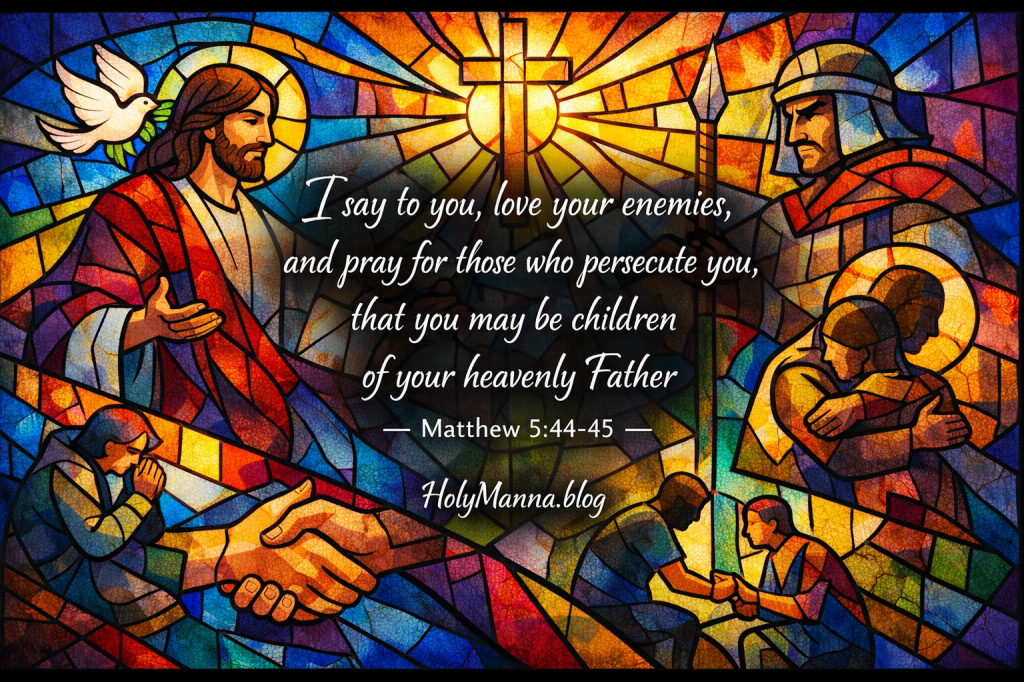
Verse 44 – “But I say to you, love your enemies, and pray for those who persecute you,”
This is one of the sharpest “But I say to you” moments in the Sermon on the Mount. Jesus does not ask for mere restraint. He commands love, and he immediately gives a concrete form of it: prayer. Prayer is the first act of supernatural charity because it hands a person over to God’s mercy instead of personal revenge. This does not deny justice, and it does not pretend evil is good. It refuses hatred. The command also reveals that Christian love is not primarily a feeling. It is a chosen willing of the other’s true good, even when emotions protest.
Verse 45 – “that you may be children of your heavenly Father, for he makes his sun rise on the bad and the good, and causes rain to fall on the just and the unjust.”
Jesus grounds the command in the Father’s own behavior. God’s providence is not distributed like a reward program for the righteous. The sun and rain fall on all. This is not indifference to moral truth. It is patience and mercy. The point is imitation. The disciple is meant to resemble the Father, and the family resemblance is shown through mercy. Jesus ties enemy-love directly to divine sonship, because children act like their Father.
Verse 46 – “For if you love those who love you, what recompense will you have? Do not the tax collectors do the same?”
Jesus uses a group widely despised in his day, tax collectors who often collaborated with Roman power and were associated with corruption. His point is not to mock them for sport. His point is to shock the listener into honesty. Loving people who already love back is basic human behavior. It requires no conversion, no grace, no Cross. Jesus is saying that discipleship cannot be measured by what is comfortable. The standard is higher, because the Father’s love is higher.
Verse 47 – “And if you greet your brothers only, what is unusual about that? Do not the pagans do the same?”
The word “unusual” is the punch. Christian life is meant to be visibly different, not because of pride, but because the Kingdom is real. Greeting only “brothers” is natural tribal behavior. Even pagans can do that. Jesus is calling for a holiness that breaks the walls people build between “us” and “them.” This is where the covenant becomes a witness, because the world recognizes when mercy appears where it should not exist.
Verse 48 – “So be perfect, just as your heavenly Father is perfect.”
This is the summit. The word “perfect” points to wholeness, completion, maturity. Jesus is not calling for sterile flawlessness. He is calling for a love that reaches its intended fullness, a love that reflects the Father’s own mercy. The context makes clear what kind of perfection Jesus means. It is a perfection of charity that refuses partial love. It is a wholehearted love that does not stop at friends.
Teachings
This Gospel is one of the clearest windows into the Church’s teaching on charity. The love Jesus commands is not optional, and it is not reserved for spiritual athletes. It is the normal shape of Christian maturity. The Catechism teaches that hatred is incompatible with this calling. CCC 2303 states, “Deliberate hatred is contrary to charity. Hatred of the neighbor is a sin when one deliberately wishes him evil. The wish to harm him is grave when one desires him grave harm.” This is not moral policing. It is spiritual diagnosis. Hatred poisons the heart that is supposed to belong wholly to God.
The Catechism also connects Christian charity to Christ’s own love for enemies. CCC 1825 teaches, “Christ died out of love for us, while we were still ‘enemies.’ The Lord asks us to love as he does, even our enemies, to make ourselves the neighbor of those farthest away, and to love children and the poor as Christ himself.” That is the Catholic center of this Gospel. Enemy-love is not a personality trait. It is participation in the love of Christ.
Saint Augustine often described this “perfection” as the perfection of love, where the heart is trained to will good even when wounded. Saint John Chrysostom speaks about this command like a ladder of transformation, where the disciple is lifted step by step beyond revenge into mercy, beyond tolerance into prayer. This is why Lent matters. Lent is training for this kind of love, because the Cross is where Jesus loved enemies most clearly.
Historically, the early Church became famous for this kind of radical mercy. Christians were persecuted, slandered, and sometimes killed, yet they prayed for their persecutors and cared for the sick, including those outside their community. That witness did not come from optimism. It came from the conviction that Jesus meant what he said, and that baptism truly made them children of the Father.
Reflection
This Gospel does not allow comfortable Christianity. It pushes straight into the places where resentment is protected like a pet and anger is treated like a right. Many people have an “enemy” even if they never use the word. Sometimes it is a person who betrayed trust. Sometimes it is a family member who never apologized. Sometimes it is a coworker who undermined everything. Sometimes it is a public figure who represents everything disliked. Jesus does not deny the reality of harm, but he refuses to let harm have the final word inside the heart.
A practical Lenten step is to name the person who triggers bitterness, then choose one act of obedience that breaks the cycle. That obedience can begin quietly, because Jesus begins with prayer. Praying for an enemy is not pretending the wound does not exist. It is placing the wound in the Father’s hands and refusing to let hatred become identity. Another step is to practice restraint in speech, because bitterness often grows through retelling the story with sharpened edges. Silence can be a form of charity when it prevents gossip and keeps the heart from rehearsing revenge. A third step is to ask for the grace to desire the other’s conversion and salvation, because that is the ultimate good, and it is the good the Father desires.
Who is being treated like an enemy in the heart, even if that word is never spoken out loud?
What would change if prayer for that person became a daily act of obedience during Lent?
If the Father gives sun and rain to the just and unjust, what kind of mercy is the Father asking his children to show in ordinary life today?
The Whole Heart, The Higher Road, The Father’s Face
Today’s readings sound like one single invitation spoken in three voices. Deuteronomy 26:16-19 lays the foundation with covenant clarity. God claims a people as his own, and the only honest response is wholehearted belonging. That is not sentimental language. It is a serious call to live as someone who truly belongs to the Lord, with a heart that is no longer divided between God and comfort, God and pride, God and resentment.
Then Psalm 119 becomes the prayer of the covenant heart. It reminds readers that holiness is not sustained by willpower alone. The blessed life is the life that seeks God with the whole heart, walks in his ways with care, and learns to praise with sincerity. It also dares to say what every honest disciple knows is true: “do not leave me all alone.” That plea is not weakness. It is wisdom. It is the confession that grace is necessary, and that God never despises a heart that asks for help.
Finally, The Gospel of Matthew 5:43-48 reveals the summit of covenant life. Jesus takes the whole heart and turns it outward into perfect charity. The Father loves with a love that is not limited to the deserving, because the sun rises on the bad and the good, and rain falls on the just and unjust. Jesus commands disciples to reflect that Fatherly love by loving enemies and praying for persecutors. This is not a soft teaching meant for idealists. It is the heart of Christianity. It is what it means to be a child of the Father, formed into the likeness of Christ, especially where love costs something.
The call to action is clear and it is deeply Lenten. Choose the covenant again today. Give God the whole heart, not the leftovers. Pray Psalm 119 slowly, and let it become a real request for steadiness and sincerity. Then take one bold Gospel step that proves love is becoming supernatural, not merely natural. Pray for the person who has been treated like an enemy in the heart. Refuse the gossip that keeps anger alive. Offer one concrete act of mercy that breaks the cycle and makes room for God to move.
This is how Lent becomes more than a season. It becomes a turning point. God does not only want better behavior. God wants a people holy to the Lord, and Jesus shows what that holiness looks like when it is fully grown: a life that resembles the Father because it loves like the Father.
Engage with Us!
Share reflections in the comments below, because God often uses another person’s insight to make a reading land deeper in the heart. Lent is not meant to be lived in isolation, and honest conversation can become part of real conversion.
- First Reading – Deuteronomy 26:16-19: Where has the heart been divided, and what would it look like to offer God wholehearted obedience in one concrete area this week?
- Responsorial Psalm – Psalm 119:1-2, 4-5, 7-8: Which line from this psalm feels most personal right now, and how can that line become a daily prayer when temptation or distraction hits?
- Holy Gospel – Matthew 5:43-48: Who is most difficult to love right now, and what is one specific way to begin obeying Jesus through prayer, mercy, or restraint in speech?
Keep going with courage. Live a life of faith that belongs wholly to God, and let every decision, every conversation, and every sacrifice be marked by the love and mercy Jesus taught, because that is how the Father’s face becomes visible in the world.
Sacred Heart of Jesus, we trust in You!
Immaculate Heart of Mary, pray for us!
Saint Michael the Archangel, defend us in battle!
Follow us on YouTube, Instagram and Facebook for more insights and reflections on living a faith-filled life.

 Holy Manna!
Leave a comment