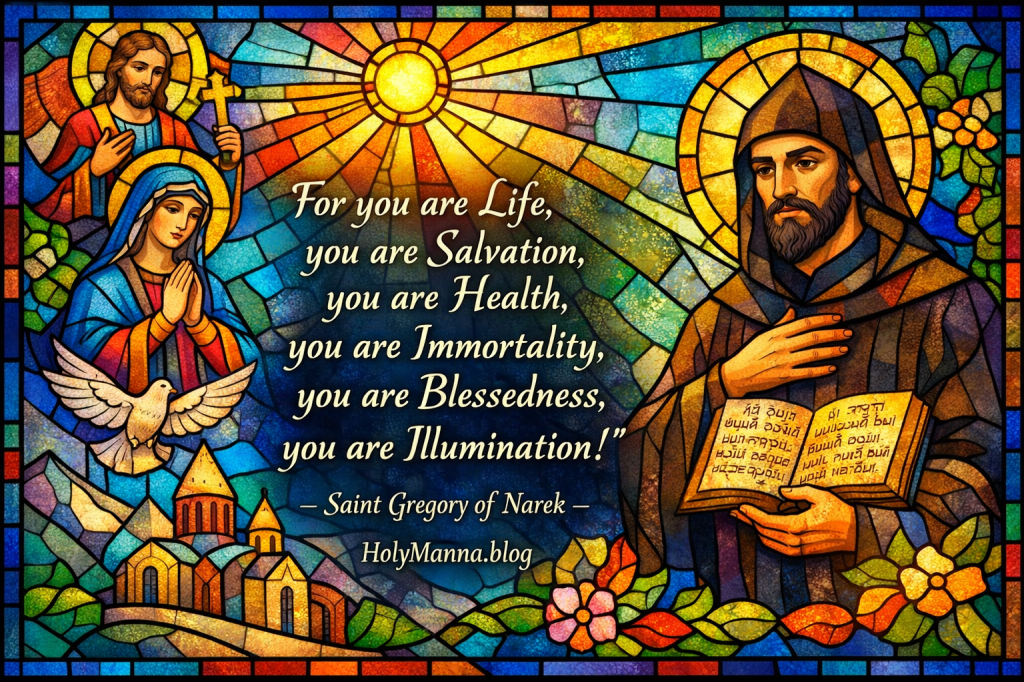
The Poet Who Taught the World How to Cry Out to God
Saint Gregory of Narek is one of those saints who can make a person feel understood in the very place they try to hide. He was a monk, priest, theologian, and mystical poet from Armenia, and the Church honors him as a towering spiritual father whose words still lead souls into repentance and hope.
He is most famous for The Book of Lamentations, a masterpiece of prayer that sounds like one long, honest confession. It is not a cold theological treatise. It is a heart speaking to God with fear, hope, shame, faith, and stubborn trust all at once. That is why Pope Francis proclaimed him a Doctor of the Church, and why the Roman Calendar now celebrates him each year on February 27 as an Optional Memorial.
A Boy Formed in a Monastery School
Gregory was born around the year 950 in the historic Armenian district of Andzevatsik. He grew up in a family shaped by the Church’s life, and as a young man he entered Narek Monastery, where he received a deep formation in Scripture, prayer, and the wisdom of the Fathers. His whole life unfolded there, in a place where prayer was not a hobby but the atmosphere everyone breathed.
The Church remembers him as a man with a profound love for the Blessed Virgin Mary. That matters, because true Marian devotion is never sentimental. It is Christ-centered and Church-shaped. Gregory loved Mary because she leads souls to Jesus, and because she is the Mother who teaches sinners how to hope. This fits perfectly with what The Catechism teaches about Mary’s continuing maternal intercession for the Church and the way Marian prayer forms the Christian heart in trust and humility. CCC 969, CCC 2673-2679
A Book Written Like a Confession
Gregory did not become famous because he traveled everywhere or built an empire. He became famous because he learned how to speak with God. He wrote widely, including a commentary on The Song of Songs and other theological and poetic works, but his crown jewel is The Book of Lamentations, completed around the year 1003.
The Church has loved his prayer so much that his words appear in liturgical readings, because his theology is not abstract. It is lived. Gregory looks at his weakness and runs straight into the mercy of Christ, not away from Him: “Therefore, knowing what my human nature is, to you will I flee for refuge, O Christ, Son of the living God, the Blessed One in all things.”
Then he explodes into praise that sounds like a believer clinging to God in the dark: “For you are Life, you are Salvation, you are Health, you are Immortality, you are Blessedness, you are Illumination!”
This is deeply Catholic. It echoes the Church’s constant teaching that salvation is God’s gift, that grace heals and elevates, and that true repentance is not self-hatred but a return to the Father who restores life. CCC 1427-1433, CCC 1996-2001
Miracles and Mercy
The historical record does not preserve a long list of detailed, named miracle accounts the way some saints have. Instead, Gregory’s life points to a different kind of miracle that the Church still recognizes as real: a man so purified by prayer that his words continue to convert hearts a thousand years later. Catholic tradition speaks of his reputation for holiness and of miracles associated with him, even while he lived.
His importance is also found in what he defended and taught. Gregory’s spirituality is not detached from the Church’s sacramental life. His prayer leads into worship, worship leads into repentance, repentance leads into the Sacraments, and the Sacraments lead back into deeper prayer. That is the Catholic pattern of conversion and healing. CCC 1113-1134, CCC 1324, CCC 1422-1470
The Hidden Cost of Holiness
Saint Gregory did not die as a martyr in the classic sense, but he still carried real hardships. He lived in a world marked by ecclesial tension, doctrinal disputes, and heavy pressure on Christian communities. Holiness is costly even when it happens inside monastery walls, because the battleground is often the human heart.
That is why his prayers do not sound like a man performing for an audience. They sound like someone who knows sin is real, judgment is real, and mercy is even more real. He begs God to quiet the storm within him, saying: “Grant me rest from the weariness of my sins, so that you too may rest from my wailing and troublesome pleading.”
This kind of prayer teaches a powerful Catholic lesson. God does not despise the crushed heart that turns back to Him. He receives it, heals it, and strengthens it. CCC 2015
A Book That Entered Homes and Hospitals
Gregory died shortly after completing The Book of Lamentations. After his death, devotion to him grew, and many miracles and favors were attributed to his intercession in Armenian Christian memory. Stories of healings, protection, and consolation became part of the way the faithful remembered him and asked for his prayers.
One of the most striking traditions connected to him is the way his book itself became a companion to the suffering. In Armenian Christian devotion, The Book of Lamentations has been carried to the sick and prayed with them, sometimes even described as present in hospitals and treated like spiritual medicine. Specific healing stories connected to this practice are often difficult to document with modern standards of verification. Some accounts are devotionally widespread, but they cannot always be verified historically.
Even when a story cannot be verified, the Catholic meaning remains clear and true. God works through the prayers of the faithful, through the communion of saints, and through the Church’s life of sacrament and intercession. The real point is not that a book becomes magic, but that the Lord draws wounded people into repentance, hope, and perseverance through the prayers of a saint and the faith of His people. CCC 956, CCC 1667-1670
Gregory’s impact also reached beyond private devotion. In modern times, the Catholic Church has held him up as a bridge between East and West, honoring him as a Doctor of the Church and placing him on the Roman Calendar, so the whole Church can learn his school of prayer.
Bringing Saint Gregory Home
Saint Gregory of Narek is a saint for anyone who has ever tried to pray and felt unworthy. He teaches that shame can either turn a soul inward into despair, or upward into humility. And humility is the doorway to mercy.
A person can live Gregory’s spirit in very practical Catholic ways. A person can learn to make an honest examination of conscience and go to Confession regularly, not waiting until everything feels fixed. A person can stop treating prayer like a performance and start speaking to God with truth. A person can cling to Mary when life feels unstable, asking her to lead the heart back to her Son, because authentic Marian devotion always ends in deeper love for Jesus and His Church. CCC 1451-1454, CCC 1468-1470, CCC 2679
Most of all, Gregory teaches something this generation needs to hear again and again. It is possible to be brutally honest about sin and wildly confident in mercy at the same time. That is not contradiction. That is Christianity.
Engage with Us!
Share your thoughts and reflections in the comments below.
- When prayer feels difficult, what usually blocks the heart from speaking honestly to God?
- Which line from Saint Gregory’s prayers hits closest to home right now, and why?
- What would change this week if Confession and the Eucharist were treated as real medicine for the soul?
- How can devotion to the Blessed Virgin Mary become more Christ-centered and more consistent in daily life?
Keep going. Keep praying. Keep returning. A life of faith is not about never falling. It is about always turning back, and doing everything with the love and mercy Jesus taught us.
Saint Gregory of Narek, pray for us!
Follow us on YouTube, Instagram and Facebook for more insights and reflections on living a faith-filled life.

 Holy Manna!
Leave a comment