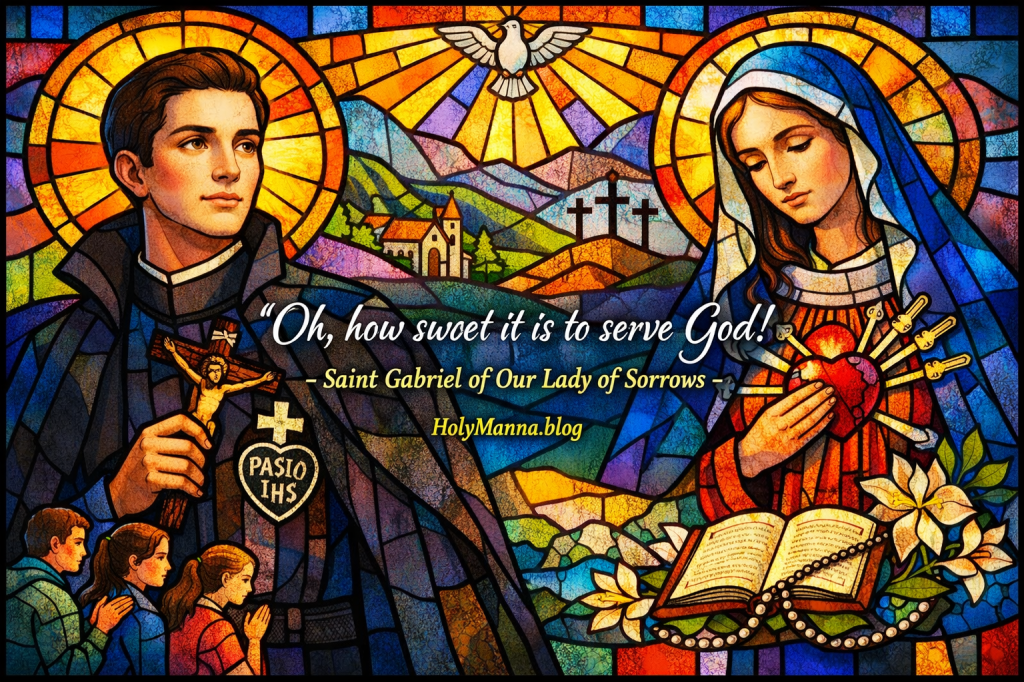
A Quiet Fire That Still Lights Up the Church
Saint Gabriel of Our Lady of Sorrows is one of those saints who surprises people. He did not live a long life. He did not become a priest. He did not found a movement or travel the world preaching. And yet, his name has drawn generations of Catholics, especially young people, into deeper love for Jesus Christ and tender devotion to the Blessed Mother.
Born Francesco Possenti, he became a Passionist and took the name “Gabriel of Our Lady of Sorrows,” placing his whole life under Mary’s mantle at the foot of the Cross. His holiness was not dramatic. It was steady. It was joyful. It was faithful in the little things. That is exactly why he is so powerful. He is a living reminder of what The Catechism teaches: holiness is not reserved for the unusual few, but is the ordinary calling of every Christian life, whatever the age or state of life, because God truly calls all to perfection of charity in their own path. CCC 2013-2014.
A Heart That Wanted More
Francesco Possenti was born in Assisi in 1838, in the Papal States, into a large family. He was the eleventh of thirteen children. His father, Sante Possenti, worked in public service, and the family’s life included frequent moves. Early on, Francesco learned what sorrow feels like in a very real way. He lost his mother while still young, and those early losses left a mark on his heart.
As he grew, he also became the kind of young man people naturally notice. He was intelligent, charming, and socially confident. He enjoyed looking sharp, enjoyed being around people, and had a future that looked bright by the standards of the world. Many people see their own younger self in him, because he was not born with a monk’s temperament. He had to choose holiness. He had to learn to want Heaven more than applause.
He studied seriously, including time under Jesuit education, and he received the sacraments that shaped him, especially the Eucharist. Even when his life looked “normal,” God was already quietly calling him.
Then came a pattern that many people recognize: a wake-up call, a promise to God, and then, after the danger passed, the temptation to drift. He experienced serious illness and made commitments in his heart, and when health returned, he felt the tug of ordinary distractions again. But God was patient, and God kept calling.
One of the most decisive moments in his story came through Mary. During a Marian procession tied to Our Lady of Sorrows, Francesco experienced an interior summons that clarified everything. The world could not satisfy what God had placed in his heart. That call became the turning point that changed the direction of his entire life.
A Teen Who Fell in Love with the Sorrowful Mother
Francesco discerned religious life seriously. He even explored the Jesuits, but Providence led him elsewhere. He was drawn to the Passionists, a congregation centered on the Passion of Jesus Christ, because the Cross was no longer just a symbol to him. It was love revealed.
When he entered, he took the name Gabriel of Our Lady of Sorrows. That title was not sentimental. It was theological. It was biblical. It was deeply Catholic. Mary is not worshiped, but she is honored as Mother of the Lord, and authentic devotion to her always leads to Jesus, never away from Him. CCC 971. Gabriel understood this with a simplicity that cuts through modern confusion. He went to Mary so he could belong to Jesus more completely.
His spirituality was marked by joy and discipline. In his own words, he could say, “Oh, how sweet it is to serve God!” He was not romanticizing religious life. He was witnessing to a real interior freedom, the kind that comes when a person stops living for the world’s approval and starts living for the Father’s will.
He wrote letters to his family that show a young man who loved deeply and cared about the salvation of those he loved. He also wrote personal spiritual resolutions, practical and direct, the kind of daily battle plan that a serious Catholic recognizes instantly. He wanted humility. He wanted purity. He wanted charity of speech. He wanted to do everything for God alone. That is the kind of hidden heroism that actually changes a soul.
He also left a line that sums up true Christian surrender in a way that feels almost shockingly simple: “God wills it so; so do I.” That is not weakness. That is strength, because it is the strength of Christ in Gethsemane, praying in The Gospel of Luke that the Father’s will be done.
The Miracle of a Holy Life
People often come looking for “miracles,” meaning something flashy. The first miracle of Saint Gabriel is something quieter, and in many ways harder: a young man who could have chased comfort and status chose purity, prayer, and obedience with joy. That is the kind of grace that only God can sustain.
In the usual sense of public miracles performed during his lifetime, there are no widely documented accounts of Saint Gabriel walking into towns and working wonders like some of the great missionary saints. His sanctity was primarily hidden, formed in community life, in prayer, and in small acts of love. That matters, because it means his example is not locked away in a category called “not for regular people.” His life says, very plainly, that sanctity can be built in the ordinary rhythm of duties when they are offered with love.
His daily focus on the Passion of Christ and on Mary at the Cross also teaches a deeply Catholic truth about suffering. The Church does not glorify pain, but she teaches that suffering, united to Christ, can become redemptive and meaningful. CCC 618. Gabriel lived this in advance of his own final illness, by training his heart to stay close to Jesus Crucified, and by letting the Sorrowful Mother teach him how to love.
Death Held by Mary
Saint Gabriel’s great hardship was not persecution by enemies. It was a slow physical breaking down through tuberculosis. He suffered young. He suffered quietly. He suffered obediently. And he suffered with a Marian tenderness that feels almost like a child’s trust.
Near the end, his humility became even more striking. He did not want to be admired. He did not want his spiritual notes to become a trophy. He wanted to disappear so Jesus would be seen. That humility is part of why he is so credible.
His dying words have been remembered with deep affection because they reveal the simplicity of a son speaking to his Mother: “My Mother, hurry.” He died on February 27, 1862, at Isola del Gran Sasso, before priestly ordination, but not before becoming what the Church calls every Christian to become, a man fully given to God.
He was not a martyr in the classic sense, but he did live a kind of white martyrdom, offering his suffering in love, and dying with his eyes fixed on Jesus and Mary.
A Young Saint Who Keeps Showing Up
After Saint Gabriel’s death, devotion grew rapidly. Reports of favors and healings through his intercession multiplied, and his shrine became one of the great places of pilgrimage, especially for young people, students, and families carrying heavy burdens.
Among the miracle stories connected to his cause and early devotion, there are accounts of serious healings attributed to his intercession, including healings from illness such as tuberculosis, and a well-known account involving a severe hernia healed after prayer through his intercession. These stories are part of the living devotional memory of the Church around this saint. At the same time, many individual testimonies of cures, protections, and conversions are personal accounts offered by pilgrims and preserved as devotional witness, and many of those cannot be independently verified.
His shrine is also known for a strong culture of ex-votos, tangible “thank you” offerings that represent the faith of people who believe heaven heard them. This is profoundly Catholic. The saints are not dead. They are alive in Christ, and the Church teaches that the saints truly intercede for us, because the communion of saints is real, and charity does not end at death. CCC 956. That is why Catholics ask for a saint’s prayers without fear. It is not competition with Jesus. It is the family of God praying together, because Christ is the one Mediator who unites the whole Body. CCC 2683.
Saint Gabriel’s cultural impact is especially strong among youth. He became a patron figure for young Catholics, and his shrine is famous for gatherings tied to students preparing for major exams, including a tradition involving the blessing of pens. That might sound small, but it is actually beautiful. It shows a saint walking into the real life of young people, into their stress, their studies, their hopes, and teaching them to bring everything to God with trust.
There is also something deeply modern about Gabriel’s message. He lived in a world with distractions, vanity, and social pressure. He could have built an identity out of image and approval. Instead he chose hiddenness, purity, and prayer. That is exactly the battle so many people fight right now.
He left one line that captures the entire logic of Christian joy, and it deserves to be heard slowly: “I would not trade a quarter-hour of this life for a year of worldly entertainments.” That is not a man who missed out. That is a man who found the treasure hidden in the field, the kind The Gospel of Matthew describes, and he sold everything else to buy it.
Bringing Saint Gabriel Into Daily Life
Saint Gabriel’s life offers a roadmap that is simple enough to follow and challenging enough to change a person.
A Catholic who wants to grow in holiness can learn from his joyful seriousness. He did not treat faith like a hobby. He treated it like the most important thing in the world, because it is. He also teaches that devotion to Mary is not a distraction from Jesus, but a school of love that forms disciples who can stand by the Cross without running away. That is why the Church encourages Marian prayer and trust, because Mary always points to her Son and helps believers follow Him faithfully. CCC 2673-2679.
His surrender to God’s will is also deeply practical. When life is confusing, when temptation feels loud, when suffering makes no sense, a Catholic can pray with Gabriel’s spirit: “God wills it so; so do I.” This is not passive resignation. It is active trust, the kind that says God is Father, and the Father can be trusted.
A Catholic who wants to imitate him can keep it concrete. Pray the Rosary with attention, especially the Sorrowful Mysteries. Spend time with Mary at the foot of the Cross and ask for the grace to love Jesus more than comfort. Make a small rule of life that includes daily prayer, weekly confession when needed, and a real commitment to purity and charity. Offer daily work and study intentionally to God, and stop treating “ordinary life” as spiritually neutral. Ordinary life is where saints are made.
And when stress rises, especially for students and young adults carrying big decisions, it is perfectly Catholic to ask for Saint Gabriel’s intercession. Heaven is not far away. The saints are family.
Reflection
Saint Gabriel of Our Lady of Sorrows is proof that holiness is not a retirement plan. It is a calling for right now. His story also shatters the myth that devotion makes a person gloomy. He was joyful because he was free. He stopped bargaining with the world and started belonging entirely to Christ.
His love for Mary teaches a Catholic how to suffer without collapsing into self-pity. Mary does not numb pain. She teaches courage. She teaches fidelity. She teaches how to stand with Jesus when it hurts, and to trust that the Cross is never the end of the story.
His hidden life teaches something even more important for a modern world addicted to visibility. God sees. God receives. God rewards what is done in secret. And the smallest act of obedience, when offered with love, can become a seed of sanctity.
What part of life is being lived for approval instead of for God?
What would change if prayer became non-negotiable instead of optional?
What would happen if devotion to Our Lady of Sorrows became a real daily relationship instead of an occasional thought?
Engage with Us!
Share thoughts and reflections in the comments below.
- What part of Saint Gabriel’s story feels most relatable right now, and why?
- Where is the Lord asking for a joyful “yes” in the small duties of daily life?
- How could devotion to Our Lady of Sorrows help carry current struggles with more faith and less fear?
- What is one concrete habit that could be offered to God each day, like Saint Gabriel did, as an act of love?
Keep walking forward with courage. Keep choosing prayer over noise, purity over compromise, and trust over anxiety. Live a life of faith, and do everything with the love and mercy Jesus taught us.
Saint Gabriel of Our Lady of Sorrows, pray for us!
Follow us on YouTube, Instagram and Facebook for more insights and reflections on living a faith-filled life.

 Holy Manna!
Leave a comment