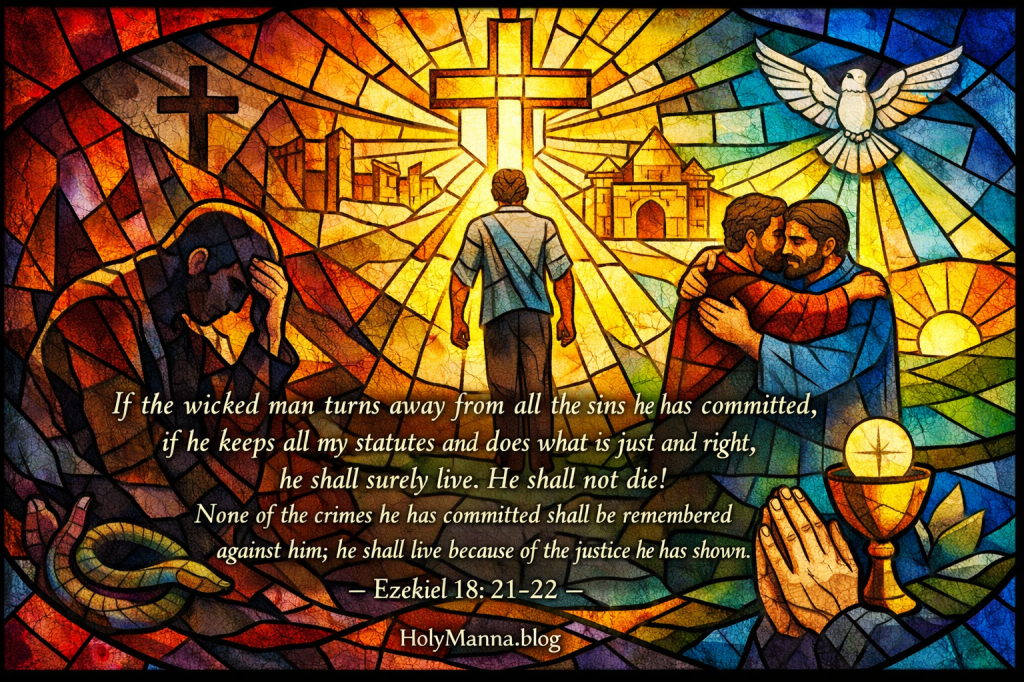
Friday of the First Week of Lent – Lectionary: 228
When Worship Becomes Real
Lent has a way of pulling people out of autopilot and into the truth, because the season is not about pretending to be holy. It is about letting God heal what is actually broken, starting in the heart and reaching into every relationship.
The central theme tying today’s readings together is simple, but it cuts deep: God desires conversion that leads to life, and that conversion must become concrete through repentance, mercy, and reconciliation. In Ezekiel 18:21-28, the Lord speaks to a people shaped by exile and disappointment, a people tempted to believe that the past is a prison and that God is unfair. Yet God reveals His own heart with startling clarity, because He does not delight in destruction. He delights in return. The message is not a vague reassurance that everything will be fine. It is a serious invitation to turn back while there is still time, because choices matter and grace is never meant to be treated casually.
That same seriousness echoes in Psalm 130, the prayer that rises from the depths where excuses finally run out. This is not the song of someone who has everything together. It is the cry of someone who knows that if God kept a strict ledger of every sin, no one would stand. And yet the psalm refuses despair, because it insists on a truth that Lent keeps repeating until it sinks in: with the Lord there is forgiveness, and that forgiveness creates reverence, not presumption.
Then The Gospel of Matthew 5:20-26 brings everything to the altar, where religion can be most tempting to perform and easiest to fake. Jesus takes the commandment against murder and drives it inward, exposing how anger, contempt, and insult can become a slow violence that kills communion long before it kills a body. He insists that righteousness must surpass the external polish of the scribes and Pharisees, because God is not impressed by appearances. He wants a clean heart. He wants a reconciled people. He wants worship that is true. Lent, then, is not only a private struggle against personal sin. It is God calling His sons and daughters back into right relationship with Him and with one another, so that mercy becomes serious and worship becomes real.
First Reading – Ezekiel 18:21-28
A God Who Refuses to Give Up on the Sinner
Ezekiel speaks into a wound that still feels familiar. The people of Israel are living in the shadow of disaster, carried off into exile, watching the old certainties collapse. In that kind of season, people start thinking in fatalistic categories. They begin to believe that the past has the final word, that family sin determines personal destiny, and that God’s justice is either cruel or rigged. Ezekiel is sent to shatter that lie. This passage insists that God’s judgment is personal, morally serious, and always ordered toward life. It fits today’s theme because it shows the first movement of real conversion: turning away from sin with the hope that God actually wants the sinner to live. Lent is not a ceremony for the already righteous. Lent is the Church putting this truth in front of everyone: repentance is possible, mercy is real, and the road back is open.
Ezekiel 18:21-28 – New American Bible (Revised Edition)
21 But if the wicked man turns away from all the sins he has committed, if he keeps all my statutes and does what is just and right, he shall surely live. He shall not die! 22 None of the crimes he has committed shall be remembered against him; he shall live because of the justice he has shown. 23 Do I find pleasure in the death of the wicked—oracle of the Lord God? Do I not rejoice when they turn from their evil way and live?
24 And if the just turn from justice and do evil, like all the abominations the wicked do, can they do this evil and still live? None of the justice they did shall be remembered, because they acted treacherously and committed these sins; because of this, they shall die. 25 You say, “The Lord’s way is not fair!” Hear now, house of Israel: Is it my way that is unfair? Are not your ways unfair? 26 When the just turn away from justice to do evil and die, on account of the evil they did they must die. 27 But if the wicked turn from the wickedness they did and do what is right and just, they save their lives; 28 since they turned away from all the sins they committed, they shall live; they shall not die.
Detailed Exegesis
Verse 21 “But if the wicked man turns away from all the sins he has committed, if he keeps all my statutes and does what is just and right, he shall surely live. He shall not die!”
This verse begins with a shock of hope. God does not describe the wicked as someone who is stuck forever. God describes the wicked as someone who can turn. The word “turn” is the heart of biblical repentance. It is not self hatred, and it is not vague regret. It is a real reorientation of life toward God’s will. The Lord also joins interior change to exterior obedience, because love is proven in action. Conversion has moral content. It includes choosing what is “just and right,” meaning a life ordered to God and neighbor. This is why the Church teaches that moral life is not optional decoration. It is part of salvation lived out. The Catechism says, CCC 1811, “It is not easy for man, wounded by sin, to maintain moral balance. Christ’s gift of salvation offers us the grace necessary to persevere in the pursuit of the virtues.” Grace does not erase effort, but it makes real obedience possible.
Verse 22 “None of the crimes he has committed shall be remembered against him; he shall live because of the justice he has shown.”
This is covenant mercy stated plainly. God is not pretending sin did not happen. God is promising that repentant sin will not be held like a weapon forever. The language of “remembered” is powerful in Scripture because it is tied to relationship. When God “remembers,” He acts in faithfulness. When God chooses not to “remember” repented sin, He is choosing not to treat the penitent as condemned. This points forward to the sacramental logic of confession, where sin is truly forgiven, not merely ignored. The Catechism describes the grace of the sacrament with clarity. CCC 1468 says, “The whole power of the sacrament of Penance consists in restoring us to God’s grace and joining us with him in an intimate friendship.” That is exactly what Ezekiel is announcing in prophetic form: God restores.
Verse 23 “Do I find pleasure in the death of the wicked oracle of the Lord God? Do I not rejoice when they turn from their evil way and live?”
Here God reveals His heart, and it is not the heart many people imagine. God is not entertained by punishment. God is not looking for reasons to discard people. God’s joy is the sinner’s return. This verse fits Lent perfectly because it counters despair and presumption at the same time. Despair says God will not forgive. Presumption says sin does not matter. Ezekiel says sin matters, and God still wants you back. That is the shape of the Gospel.
Verse 24 “And if the just turn from justice and do evil, like all the abominations the wicked do, can they do this evil and still live? None of the justice they did shall be remembered, because they acted treacherously and committed these sins; because of this, they shall die.”
This is the sober warning that keeps mercy from turning into cheap sentimentality. Past goodness does not function like a savings account that permits future rebellion. Ezekiel insists on perseverance. A person who turns away from justice and embraces evil is not simply having a rough patch. That person is choosing a different path. The Church teaches something similar when it explains mortal sin as a real rupture in communion with God. The Catechism says, CCC 1855, “Mortal sin destroys charity in the heart of man by a grave violation of God’s law; it turns man away from God.” Ezekiel is not trying to frighten the faithful into anxiety. He is trying to keep them awake.
Verse 25 “You say, ‘The Lord’s way is not fair!’ Hear now, house of Israel: Is it my way that is unfair? Are not your ways unfair?”
This is the human complaint that never goes out of style. People accuse God of injustice when God refuses to follow human logic. The Lord answers by exposing the crooked measuring stick. Human beings often call God unfair when He forgives enemies, when He demands change, or when He refuses to bless sin. Ezekiel forces the listener to stop putting God on trial and start examining the heart. Lent is a season for that kind of honesty.
Verse 26 “When the just turn away from justice to do evil and die, on account of the evil they did they must die.”
Ezekiel repeats the logic for emphasis. Death is not blamed on God’s mood. Death is tied to the chosen evil. Scripture is describing the moral structure of reality. Choices shape the soul. Sin kills. Repentance heals. This is why the Church calls sin an offense against God and a wound that harms the sinner and the community. The Catechism says, CCC 1849, “Sin is an offense against reason, truth, and right conscience; it is failure in genuine love for God and neighbor caused by a perverse attachment to certain goods.” Ezekiel is describing that failure with prophetic bluntness.
Verse 27 “But if the wicked turn from the wickedness they did and do what is right and just, they save their lives.”
God repeats the promise because hope needs repetition. The wicked person is not trapped. The wicked person can turn. Notice again that turning is proven through doing what is right and just. Repentance is not only internal emotion. It is a lived change. The Church’s Lenten discipline makes sense here. Fasting, prayer, and almsgiving are not random religious tasks. They are training for a new way of life.
Verse 28 “Since they turned away from all the sins they committed, they shall live; they shall not die.”
The passage ends where it began, with life. God is not dangling salvation like bait. God is showing the path clearly. Turn away from sin and live. In the Catholic life, that turn is not merely private. It becomes visible in confession, in the moral life, and in reconciliation with neighbor. That is why this reading pairs so naturally with today’s Gospel, where Jesus demands reconciliation before offering gifts at the altar.
Teachings
Ezekiel 18 is a cornerstone text for understanding personal responsibility, repentance, and the mercy of God. It refuses fatalism. It refuses the idea that someone is doomed because of a bad past. It also refuses the idea that someone is safe because of a good past. Instead, it teaches that God deals with persons, calls them to real conversion, and offers real mercy.
This fits perfectly with the Church’s teaching on conversion. The Catechism describes interior repentance in a way that sounds like Ezekiel’s “turning.” CCC 1431 says, “Interior repentance is a radical reorientation of our whole life, a return, a conversion to God with all our heart, an end of sin, a turning away from evil, with repugnance toward the evil actions we have committed.” Ezekiel is preaching that radical reorientation long before the word “Lent” existed.
The Church also teaches that God’s mercy is never opposed to His justice, because justice is meant to restore right order, not to satisfy divine irritation. God’s question, “Do I find pleasure in the death of the wicked?”, echoes the New Testament revelation that God’s will is salvation. The Catechism says, CCC 1037, “God predestines no one to go to hell; for this, a willful turning away from God is necessary, and persistence in it until the end.” This safeguards two truths Ezekiel holds together: God truly wants the sinner to live, and the sinner can truly refuse.
Saint Augustine often described repentance as returning home from wandering. That image captures Ezekiel’s message well. Sin is not only rule breaking. It is leaving the Father’s house. Repentance is the painful, hopeful walk back, trusting that the door is still open.
Reflection
This reading invites a different kind of Lenten honesty. It asks whether repentance has been treated like a concept instead of a decision. Many people carry a quiet belief that change is impossible, so they settle into habits that slowly harden the heart. Ezekiel speaks like a friend who loves too much to flatter. He says the turn is possible. He says God wants life. He also says that drifting into evil is not harmless, even if someone has a religious reputation.
A practical response begins by naming what needs to turn. Anger that has been excused. Impurity that has been negotiated with. Dishonesty that has been minimized. Resentment that has been fed like a pet. Then the next step is to turn in a concrete direction: confession scheduled, accountability embraced, prayer made consistent, restitution begun, and relationships repaired.
Is there a sin that has been treated as permanent because it feels embarrassing to face it directly?
Is there a pattern of “almost good” living that hides a refusal to surrender one area to God?
If God truly rejoices when sinners turn and live, what would change if that mercy was believed today instead of merely admired?
Responsorial Psalm – Psalm 130
When the Soul Hits Bottom and Finds God Waiting
Psalm 130 is the prayer for someone who has run out of excuses. It comes from the world of Israel’s temple worship, where sin was never treated like a private inconvenience. Sin was understood as something that fractures communion with God and spills into the life of the community. This psalm was sung by pilgrims as they went up to Jerusalem, and it carries the voice of a man standing in deep water, shouting toward heaven because there is nowhere else to go. In Lent, the Church places this psalm beside Ezekiel’s call to conversion and Jesus’ demand for reconciliation because it teaches the inner posture of repentance. It shows what it looks like to face God honestly, admit the truth, and still hope. It fits today’s theme because it insists on two truths at the same time: no one survives if God keeps a strict account, and everyone can survive because God is rich in mercy.
Psalm 130 – New American Bible (Revised Edition)
Prayer for Pardon and Mercy
1 A song of ascents.
Out of the depths I call to you, Lord;
2 Lord, hear my cry!
May your ears be attentive
to my cry for mercy.
3 If you, Lord, keep account of sins,
Lord, who can stand?
4 But with you is forgiveness
and so you are revered.5 I wait for the Lord,
my soul waits
and I hope for his word.
6 My soul looks for the Lord
more than sentinels for daybreak.
More than sentinels for daybreak,
7 let Israel hope in the Lord,
For with the Lord is mercy,
with him is plenteous redemption,
8 And he will redeem Israel
from all its sins.
Detailed Exegesis
Verse 1 “A song of ascents.”
This small line carries a whole setting. A “song of ascents” was tied to pilgrimage, meaning this prayer belongs to people on the move, not people who have already arrived. Lent is a pilgrimage season too. It is the Church walking toward Easter, learning again that holiness is not instant. It is a climb, and the climb begins with honesty.
Verse 2 “Out of the depths I call to you, Lord; Lord, hear my cry!”
The “depths” are not just sadness. In biblical language, the depths suggest chaos, danger, and the feeling of being swallowed. This is the prayer of someone who cannot save himself. It is also the beginning of wisdom, because salvation starts when the heart stops pretending. The Catechism describes prayer as a real battle because pride resists this posture. CCC 2725 says, “Prayer is both a gift of grace and a determined response on our part. It always presupposes effort. The great figures of prayer of the Old Covenant before Christ, as well as the Mother of God, the saints, and he himself, all teach us this: prayer is a battle.” The psalmist is already in that battle, crying out rather than shutting down.
Verse 3 “May your ears be attentive to my cry for mercy.”
The psalmist does not negotiate. He does not offer a résumé. He asks for mercy. This is the right instinct because God is not a human employer impressed by spiritual achievements. God is Father, and mercy is what the wounded child needs.
Verse 4 “If you, Lord, keep account of sins, Lord, who can stand?”
This is the line that levels everyone. The psalmist is saying that if God runs a strict ledger, the whole human race collapses. It is a confession that sin is real and universal. Lent becomes shallow the moment people act like only “bad people” need repentance. This verse destroys that illusion.
Verse 5 “But with you is forgiveness and so you are revered.”
Here is the twist that sounds almost backwards. Many people assume fear of God comes from punishment. The psalm says reverence flows from forgiveness. Mercy reveals God’s holiness in a way judgment alone never could. Forgiveness exposes the heart of God, and that should shake a person into awe, not casualness. The Catechism speaks about this filial fear, meaning the fear of a child who does not want to wound the Father who loves him. CCC 1831 says, “The seven gifts of the Holy Spirit are wisdom, understanding, counsel, fortitude, knowledge, piety, and fear of the Lord.” This fear is not terror. It is reverent love.
Verse 6 “I wait for the Lord, my soul waits and I hope for his word.”
Waiting is not passive here. It is faithful endurance. The psalmist is waiting for God’s “word,” meaning God’s saving promise, God’s verdict of mercy, God’s truth spoken into the darkness. This kind of hope refuses to quit even when feelings are unstable.
Verse 7 “My soul looks for the Lord more than sentinels for daybreak. More than sentinels for daybreak.”
A sentinel waiting for daybreak is not daydreaming. He is alert, scanning the horizon, watching through the long hours because something depends on the dawn. The repetition underlines intensity. The psalmist is teaching what longing looks like when it is purified. He is not merely trying to avoid consequences. He is hungry for God.
Verse 8 “Let Israel hope in the Lord, for with the Lord is mercy, with him is plenteous redemption.”
The prayer widens from personal confession to communal invitation. Hope is not meant to stay private. When mercy is real, it creates a people. “Plenteous redemption” means God does not forgive sparingly. God is not stingy. God is abundant.
Verse 9 “And he will redeem Israel from all its sins.”
The psalm ends with a promise of total rescue. This is not the denial of justice. It is the proclamation that God has the power to cleanse what humans cannot untangle alone. In the full light of the Gospel, Christians hear in this line the shadow of Christ’s saving work, because redemption is not only emotional relief. It is deliverance.
Teachings
Psalm 130 is one of the Church’s great penitential prayers, and it has shaped Catholic spirituality for centuries. It is frequently used in prayer for the dead and in penitential contexts because it teaches a sober realism about sin and an even stronger realism about mercy. It also harmonizes with the Church’s teaching on contrition, which is sorrow for sin rooted in love of God.
The Catechism describes contrition as more than regret. It is a movement of the heart back to God. CCC 1451 says, “Among the penitent’s acts contrition occupies first place. Contrition is ‘sorrow of the soul and detestation for the sin committed, together with the resolution not to sin again.’” That is the spirit of this psalm. It does not simply admit failure. It turns toward God.
The Church also teaches that forgiveness is not a vague spiritual mood but a real gift flowing from Christ’s sacrifice. The psalm’s confidence, “with him is plenteous redemption,” is echoed in how the Church speaks about the sacrament of Reconciliation. CCC 1468 says, “The whole power of the sacrament of Penance consists in restoring us to God’s grace and joining us with him in an intimate friendship.” The psalmist longs for intimacy with God, not merely a clean legal record.
Saint Augustine often spoke of the human heart as restless until it rests in God. That restlessness is all over Psalm 130. It is a holy restlessness, the kind that refuses to settle for sin because it has tasted the possibility of communion.
Reflection
This psalm teaches how to pray when life gets honest. It gives permission to stop performing and start pleading. It also corrects the temptation to despair, because the psalmist does not pretend he can stand on his own, yet he refuses to believe that God is cruel. He holds onto the truth that the Lord listens, forgives, and redeems.
A practical way to live this today is to speak to God from the real place, not the polished place. It means naming the “depths” without drama and without denial. It means asking for mercy instead of bargaining. It means waiting for the Lord’s word with the patience of someone who believes the dawn will come, even if the night has been long. It also means letting mercy reshape the way others are treated, because a person who lives on forgiveness cannot justify cruelty.
What does it look like to pray from the depths without trying to sound impressive?
If God kept a strict account, who could stand, and how would that truth change the way other people are judged?
Is there a sin that has been hidden because shame feels safer than mercy?
What step would make hope concrete today, especially if daybreak still feels far off?
Holy Gospel – Matthew 5:20-26
When God Wants More Than “Not Killing”
Jesus speaks these words early in the Sermon on the Mount, in a world where holiness was often measured by visible compliance. The scribes and Pharisees were admired for precision, fasting, and public devotion, but Jesus is about to reveal something deeper. He is not abolishing the Law. He is exposing its true goal, which is a heart transformed by charity. In first century Jewish life, the temple and its sacrifices stood at the center of religious identity, and courts and public judgments shaped everyday social order. Jesus places the heart right in the middle of all that. He teaches that conversion is not only about avoiding obvious sins. It is about uprooting the interior poisons that destroy communion, especially anger, contempt, and unresolved conflict. This fits today’s theme because Ezekiel insists that turning back leads to life, Psalm 130 cries out for mercy from the depths, and now Jesus shows what real righteousness looks like when mercy becomes serious and worship becomes truthful.
Matthew 5:20-26 – New American Bible (Revised Edition)
20 I tell you, unless your righteousness surpasses that of the scribes and Pharisees, you will not enter into the kingdom of heaven.
Teaching About Anger. 21 “You have heard that it was said to your ancestors, ‘You shall not kill; and whoever kills will be liable to judgment.’ 22 But I say to you, whoever is angry with his brother will be liable to judgment, and whoever says to his brother, ‘Raqa,’ will be answerable to the Sanhedrin, and whoever says, ‘You fool,’ will be liable to fiery Gehenna. 23 Therefore, if you bring your gift to the altar, and there recall that your brother has anything against you, 24 leave your gift there at the altar, go first and be reconciled with your brother, and then come and offer your gift. 25 Settle with your opponent quickly while on the way to court with him. Otherwise your opponent will hand you over to the judge, and the judge will hand you over to the guard, and you will be thrown into prison. 26 Amen, I say to you, you will not be released until you have paid the last penny.
Detailed Exegesis
Verse 20 “I tell you, unless your righteousness surpasses that of the scribes and Pharisees, you will not enter into the kingdom of heaven.”
Jesus begins with a warning that sounds impossible until the rest of the sermon clarifies it. This is not a demand for spiritual showmanship. It is a call to interior holiness. The scribes and Pharisees could excel in external observance, but Jesus demands a righteousness rooted in the heart and expressed in love. This is exactly how the Church understands the “New Law,” not as a heavier burden, but as grace that changes the inside. The Catechism says, CCC 1968, “The Law of the Gospel fulfills the commandments of the Law. The Lord’s Sermon on the Mount, far from abolishing or devaluing the moral prescriptions of the Old Law, releases their hidden potentials and causes new demands to arise from them.” The surpassing righteousness is the fruit of grace that makes charity real.
Verse 21 “You have heard that it was said to your ancestors, ‘You shall not kill; and whoever kills will be liable to judgment.’”
Jesus quotes the commandment and the recognized principle of accountability. In Israel, murder was not only a private crime. It was a violation that cried out to God and demanded justice. Jesus does not weaken this. He sets up something stronger: the root of murder begins earlier than the act.
Verse 22 “But I say to you, whoever is angry with his brother will be liable to judgment, and whoever says to his brother, ‘Raqa,’ will be answerable to the Sanhedrin, and whoever says, ‘You fool,’ will be liable to fiery Gehenna.”
Jesus moves from the act to the heart. Anger here is not every flash of irritation. It is the chosen posture of hostility that settles in and becomes contempt. “Raqa” is a dismissive insult, a way of treating another person as worthless. “You fool” is deeper than a casual jab, because it attacks the person’s dignity. Jesus is saying that contempt is spiritual violence. It trains the soul for hatred, and hatred belongs to hell, not heaven. The reference to Gehenna evokes the valley associated with defilement and judgment, used as an image for final ruin. This should not be read as Jesus being dramatic for effect. He is revealing how seriously God takes charity. The Catechism says, CCC 2303, “Deliberate hatred is contrary to charity. Hatred of the neighbor is a sin when one deliberately wishes him evil.” Jesus is not only protecting life. He is protecting communion.
Verse 23 “Therefore, if you bring your gift to the altar, and there recall that your brother has anything against you”
This line assumes temple worship, where gifts were offered as acts of adoration, thanksgiving, or atonement. Jesus uses a scene every devout listener would understand. The shock is that worship does not cancel relational responsibility. Even “your brother has anything against you” suggests that the initiative belongs to the one who is worshiping. It is not enough to claim innocence. Love takes initiative.
Verse 24 “Leave your gift there at the altar, go first and be reconciled with your brother, and then come and offer your gift.”
Jesus demands priority. Reconciliation is not a side quest. It is preparation for worship. God does not want gifts offered as a mask for an unforgiving heart. This is not because God needs something from man. It is because man needs truth. The Church echoes this connection between communion with God and communion with neighbor. The Catechism says, CCC 1397, “The Eucharist commits us to the poor. To receive in truth the Body and Blood of Christ given up for us, we must recognize Christ in the poorest, his brethren.” The logic applies broadly. Eucharistic worship demands real charity.
Verse 25 “Settle with your opponent quickly while on the way to court with him. Otherwise your opponent will hand you over to the judge, and the judge will hand you over to the guard, and you will be thrown into prison.”
Jesus shifts to a legal scene that would feel familiar in an honor based culture where disputes could escalate fast. The teaching is practical and spiritual at the same time. Practically, delayed reconciliation tends to harden hearts and increase consequences. Spiritually, unresolved conflict becomes a spiritual prison long before any courtroom appears. Jesus is pushing urgency because pride loves delay, and delay feeds resentment.
Verse 26 “Amen, I say to you, you will not be released until you have paid the last penny.”
The “Amen” signals seriousness. This is not casual advice. Jesus warns that stubborn conflict has a cost. In the moral life, debts compound. Hardness grows. The longer reconciliation is postponed, the more a person becomes the kind of man who cannot reconcile. Lent is meant to break that pattern while there is still time.
Teachings
This Gospel reveals the heart of Christian morality. God does not only forbid outward violence. God forbids the inner attitudes that breed it. Anger and contempt might look harmless because they are common, but Jesus treats them as dangerous because they destroy charity, and charity is the life of the soul.
The Church teaches that the commandment against killing includes a call to peace, mercy, and interior purification. The Catechism says, CCC 2302, “By recalling the commandment, ‘You shall not kill,’ our Lord asked for peace of heart and denounced murderous anger and hatred as immoral.” This is a direct echo of The Gospel of Matthew.
Jesus also links worship and reconciliation, which fits Catholic life with piercing clarity. The Eucharist is the summit of worship, but it is never meant to be approached with a heart that clings to hatred. The Church teaches the necessity of conversion before Communion when grave sin is present. The Catechism says, CCC 1385, “Anyone conscious of a grave sin must receive the sacrament of Reconciliation before coming to communion.” This is not an obstacle course. It is mercy protecting the soul from treating holy things casually.
Saint John Chrysostom preached with fire about this passage, insisting that reconciliation is not optional decoration but part of true religion. He points out that Christ does not say, “Stay and offer, and reconcile later.” Christ says, “go first.” The order matters because God loves the brother who has been wounded, and God loves the worshiper enough to refuse a counterfeit offering.
There is also a quiet historical lesson here. In the early Church, serious public sins often involved public penance, and reconciliation with the community was visibly tied to reconciliation with God. Over time, the Church’s discipline developed, but the principle remained: communion with God and communion with the Church belong together. A man cannot claim to love God while feeding contempt for his neighbor.
Reflection
This Gospel is for anyone who thinks holiness means avoiding big public scandals. Jesus goes straight for the hidden habits that many people excuse. He exposes how anger becomes a lifestyle, how contempt becomes a tone, and how insults become a kind of spiritual entertainment. He teaches that these are not harmless quirks. They are soul level threats.
A concrete response begins with a sober inventory of speech. Words reveal the heart, and repeated sarcasm, name calling, and dismissive labeling are often symptoms of contempt. Another step is to stop romanticizing anger as strength. Some men treat anger like fuel, but Jesus treats it like fire that spreads. A third step is to pursue reconciliation before it feels convenient. That can mean sending the hard message that admits fault, asking for a conversation, or choosing to forgive even when the other person does not deserve it. Reconciliation is not always immediate agreement, but it always begins with humility and truth.
Lent becomes real when worship becomes real. Jesus is saying that a man cannot kneel at the altar while holding someone in the throat in his heart. God wants the gift, but God wants the giver healed even more.
Who has been dismissed with contempt, even if it was only in private thoughts or jokes?
Is there someone who “has something against you” that has been avoided because pride prefers distance to humility?
If reconciliation had to happen before the next time receiving the Eucharist, what conversation would become urgent?
What would change if anger stopped being treated as normal and started being treated as a call to repentance?
From the Depths to the Altar and Back to Life
Today’s readings speak like a single conversation that refuses to let Lent stay superficial. Ezekiel 18:21-28 makes the first move by tearing down two lies that keep people stuck. The first lie says the past is stronger than grace, so change is impossible. The second lie says past goodness guarantees future safety, so vigilance is unnecessary. God answers both with a holy clarity that is meant to rescue, not crush. God does not delight in anyone’s ruin. God rejoices when sinners turn and live, and that turning must be real.
Then Psalm 130 shows what that turning sounds like when it finally becomes honest. It is the prayer of a soul that has reached the depths and stops bargaining. It admits that no one could stand if God kept a strict account, and then it clings to the better truth that with the Lord there is forgiveness and plenteous redemption. That is the heart posture Lent is trying to build: humility without despair, hope without excuses.
Finally, The Gospel of Matthew 5:20-26 brings the whole message into everyday relationships and places it right in front of worship. Jesus demands a righteousness that surpasses external religion, not by becoming more performative, but by becoming more true. He exposes anger, contempt, and insulting speech as spiritual poison, and then He gives a command that leaves no room for delay. Reconcile first. Then offer the gift. In other words, worship is not a hiding place from broken relationships. Worship is where broken relationships get healed so the heart can stand before God without pretending.
The call to action is simple, but it will change a life if it is taken seriously. Let this Lent be the season of an actual turn. Let the Lord meet the real story, not the edited one. Bring sin into the light through repentance. Bring the depths to prayer. Bring the conflict to reconciliation. Then come to the altar with a heart that is learning mercy, because God’s mercy is not sentimental. God’s mercy is powerful enough to remake a man.
What would be different by Easter if repentance stopped being vague and became specific, and reconciliation stopped being postponed and became urgent?
Engage with Us!
Readers are invited to share reflections in the comments below, because God often teaches through the way believers listen to each other and speak the truth with charity.
- First Reading, Ezekiel 18:21-28: Where is conversion being delayed because the past feels stronger than grace, and what specific step would make the “turn” real today?
- Responsorial Psalm, Psalm 130: What does it look like to cry “out of the depths” with honesty, and what would change if God’s forgiveness was trusted more than shame?
- Holy Gospel, Matthew 5:20-26: Who needs reconciliation, and what practical act of humility would make worship more truthful this week?
Keep walking through Lent with steady courage. God’s mercy is not a soft excuse for sin, but a real power that restores life, heals relationships, and teaches hearts to love as Jesus loves, with patience, truth, and compassion.
Sacred Heart of Jesus, we trust in You!
Immaculate Heart of Mary, pray for us!
Saint Michael the Archangel, defend us in battle!
Follow us on YouTube, Instagram and Facebook for more insights and reflections on living a faith-filled life.

 Holy Manna!
Leave a comment