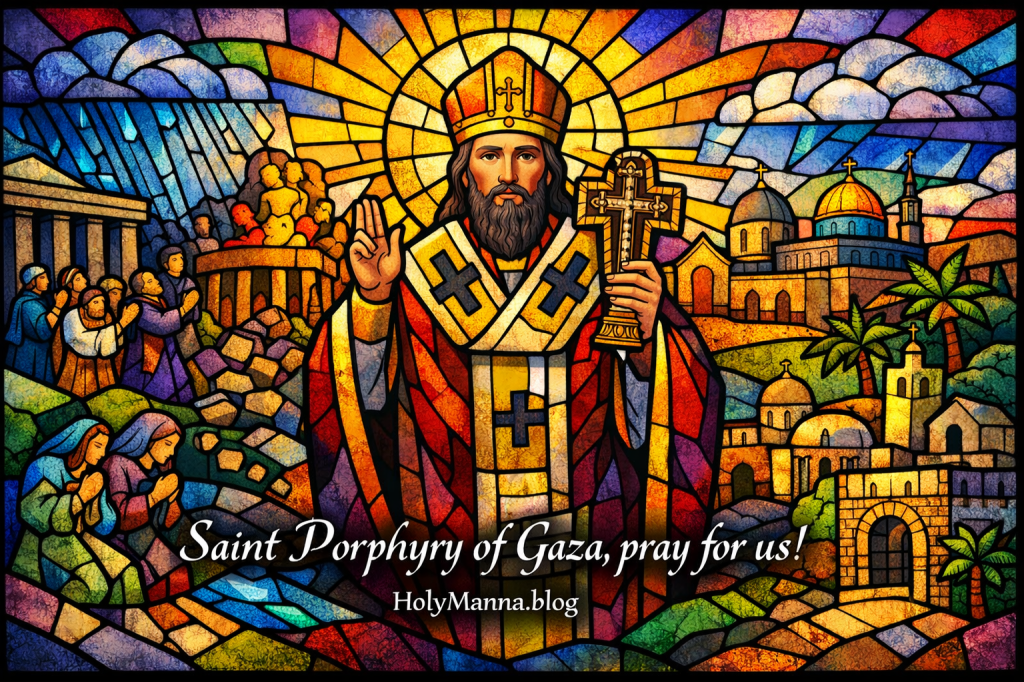
The Wood of the Cross in a City of Idols
Saint Porphyry lived in the late fourth and early fifth centuries and died on February 26 in the year 420. The Church remembers him as a bishop and confessor who helped lead Gaza out of entrenched pagan worship and into a clearer public confession of Jesus Christ. His story is preserved especially through the ancient account written by Mark the Deacon, who knew him closely and recorded the struggles of a small Christian community living under pressure, mockery, and real danger.
This is part of what makes Saint Porphyry so compelling. This is not a saint living in a comfortable Christian bubble. This is a pastor sent into a hostile place who still chose to love, to preach, to pray, and to stay.
From Thessalonica to the Desert and the Holy City
Porphyry was born in Thessalonica into a wealthy family, but comfort did not win his heart. He left the world behind and pursued the life of repentance and prayer, spending years among the desert monks and then living in severe solitude near the Jordan.
Illness eventually humbled him even more, and he made his way to Jerusalem. Mark the Deacon records a moment that became the key to Porphyry’s whole mission. At the holy places, Porphyry received healing and a deep interior commission centered on the Cross. Mark preserves the words as “Take this wood and keep it.”
Soon after, Porphyry was ordained a priest and entrusted with a relic of the Holy Cross, a detail that fits him perfectly. His spirituality was not abstract or sentimental. It was anchored in the saving Passion of Christ, and it shaped the way he lived and the way he led others.
Mark also records something surprisingly practical and down to earth. After giving away wealth for the sake of the poor, Porphyry worked with his hands to avoid living off others. Two lines of Scripture are placed on his lips as guiding principles: “We brought nothing into this world, neither can we carry anything out.” and “If a man worketh not, neither shall he eat.” These are not famous quotations the way later saints have signature sayings, but they are verified as the words his ancient biographer remembered him repeating, and they reveal the kind of man he was.
When Prayer Brought Rain
In the year 395, Porphyry became bishop of Gaza, a city described in Catholic tradition as a stronghold of paganism where the Christian community was small and frequently targeted. Mark’s account is full of scenes that feel almost modern: believers treated like a nuisance, public religion used as a weapon, and a bishop blamed for unrest simply because he represents Christ.
One of the most famous episodes centers on a drought. Mark records that the pagans sought help from their gods and received nothing, while the Christians fasted, prayed, held vigils, and processed in supplication to the true God. Then rain came, and the event shook the city and led to conversions.
In a Catholic reading, this is not about bragging or humiliating enemies. It is about the First Commandment becoming visible in real life. The Catechism teaches that idolatry is not merely an ancient problem, because it happens whenever something created takes the place that belongs to God alone. CCC 2112-2114 calls the faithful to reject false worship and cling to the living God. Saint Porphyry’s life shows what that looks like when it costs something and when it is lived publicly instead of privately.
Porphyry’s ministry also reached beyond local conflict. Catholic sources note that he attended the Synod of Diospolis in 415, placing him within the wider doctrinal life of the Church during a time of serious debate about grace and the moral life. Gaza did not distract him from the greater unity of the Church, and the greater unity of the Church did not excuse him from loving the people right in front of him.
Stones at the Gate and Courage at the Altar
Porphyry’s hardships were not a single dramatic martyrdom scene. They were the steady, grinding trials of pastoral suffering: being opposed, slandered, threatened, and pressured by a majority culture that did not want Christ’s claims. The Roman Martyrology sums him up in a way that says a lot: he overthrew the idol Marnas and its temple, and after many sufferings he went to rest in the Lord.
Catholic tradition also preserves that Porphyry appealed to imperial authorities for protection and for action against the temples, and that an imperial rescript eventually ordered the destruction of certain pagan sanctuaries. A church was raised on the site of the temple of Marnas, a public sign that the Cross had been planted where idols once ruled.
This part of the story needs a Catholic lens that is both honest and faithful. The Church rejects idolatry completely, and the Gospel does confront false gods. At the same time, the Church also teaches that faith must be embraced freely, not coerced, because the human person must respond to God with a real act of conscience. CCC 2104-2109 explains that religious freedom flows from the dignity of the person and the nature of faith itself. Saint Porphyry’s world operated with different legal instincts than the modern world, but the Church’s mature teaching helps today’s reader hold zeal and charity together without diluting either one.
A Name Still Whispered in Gaza
Saint Porphyry died on February 26 in the year 420, and the Church continues to honor him on that date. His legacy after death is carried especially through the written Life recorded by Mark the Deacon, which became one of the most detailed windows into what it meant to be a bishop in a contested city at the edge of late antiquity. His memory also remains connected to Christian presence in Gaza across the centuries, and his name continues to be spoken with reverence among Christians who have lived through hardship in that region.
When Catholics speak about miracles after death, the safest and most faithful way to speak is the way the Church herself speaks: through the communion of saints. The Catechism teaches that the saints do not stop loving the Church when they die, because in Christ they remain united with us and intercede for us. CCC 956 and CCC 2683 ground the Catholic instinct to ask saints for prayers, not as rivals to Christ, but as friends of Christ who lead souls to Him. How often does life feel like Gaza, a place where faith is tolerated only if it stays quiet?
What to Do When the Culture Pushes Back
Saint Porphyry is a saint for anyone who has ever felt outnumbered. He teaches that holiness is not proven by having the crowd cheer for the Gospel. Holiness is proven by fidelity when the room turns cold and when the pressure stays for years, not minutes.
He also teaches how to fight spiritual battles without turning the heart into stone. Porphyry battled idolatry, but he did it as a pastor, through prayer, fasting, endurance, teaching, and the slow building up of the Church. The Catechism reminds the faithful that the Church is missionary by nature, sent to proclaim Christ to all nations. CCC 849-856 frames evangelization as love in action, not marketing and not domination. Where is God asking for steady courage instead of dramatic gestures?
A practical way to live Porphyry’s spirit today is to become stubbornly faithful in ordinary Christian duties. Prayer should be daily, confession should be regular, Mass should be attended with real attention, and the faith should be learned well enough to explain it without panic or anger. Modern idols should be rejected by name, whether it is money, lust, status, ideology, or comfort. It is not enough to say no to idols. A yes to Christ must be visible in habits that prove it. What would change this week if prayer became the first response instead of the last resort?
Engage With Us!
Share thoughts and reflections in the comments below. Saint Porphyry’s story has a way of exposing where faith has gotten timid and where courage can grow with grace.
- Where does modern life try to pressure faith into silence, and what would calm confidence in Christ look like there?
- Which idol most competes for the heart right now, and what concrete act of repentance would begin breaking its grip?
- How can prayer and fasting be practiced in a realistic way that still costs something and still builds love?
- Who in personal life feels like a small flock, and what would faithful encouragement look like this month?
May Saint Porphyry pray for strength, humility, and perseverance. Keep walking in faith, keep choosing truth with charity, and do everything with the love and mercy Jesus taught us.
Saint Porphyry of Gaza, pray for us!
Follow us on YouTube, Instagram and Facebook for more insights and reflections on living a faith-filled life.

 Holy Manna!
Leave a comment