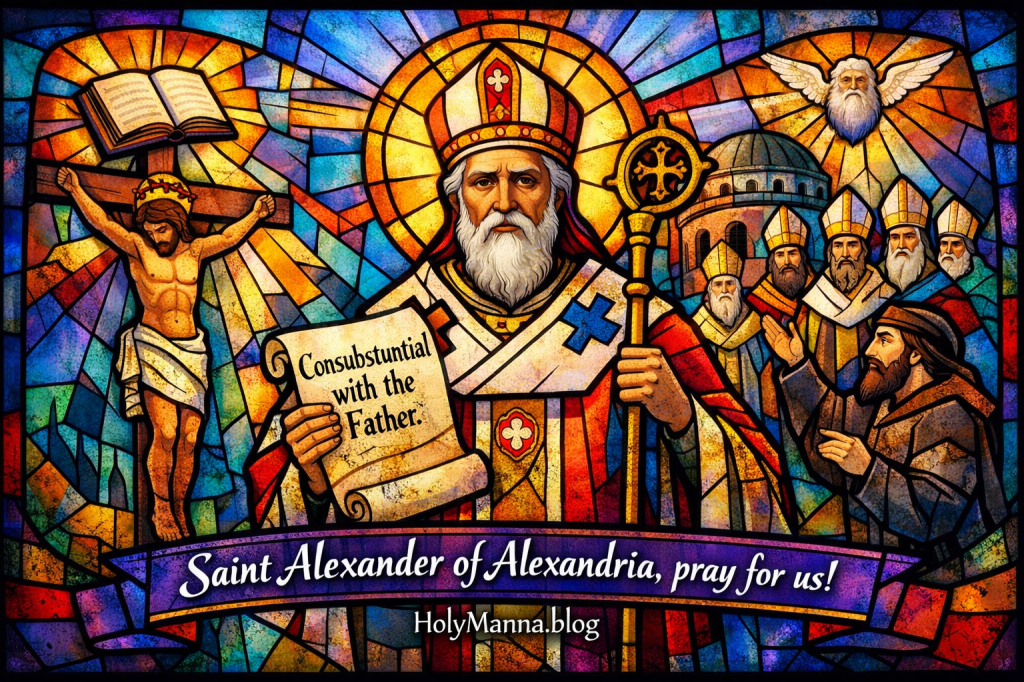
The Battle for the Real Jesus
Picture Alexandria in the early fourth century. It was a city of books, arguments, and big personalities, and it sat at the crossroads of faith and culture. Into that world stepped Saint Alexander of Alexandria, a bishop remembered not for flashiness, but for backbone. He lived at the exact moment when a seemingly reasonable idea threatened to hollow out the Gospel from the inside.
A popular priest named Arius began teaching that the Son of God was not eternal, not truly God in the full sense, but somehow less than the Father. That one idea sounds like a technical debate, until it hits the heart. If Jesus is not truly God, then salvation turns into inspiration and the Cross becomes tragedy instead of victory. Alexander understood that the Church does not defend doctrine to win arguments. The Church defends doctrine to protect worship, to protect prayer, and to protect the truth that saves.
A Bishop Forged in Fire and Silence
Details about Alexander’s earliest years are not crystal clear, but Catholic tradition consistently places him in Egypt, formed in a time when being Christian could cost everything. As a priest, he lived through the violent persecutions that battered the Church before Constantine’s peace. That kind of pressure either breaks a man or purifies him. Alexander was remembered as the kind of shepherd who did not play games with holiness. He was known for prayer, fasting, and real love for the poor.
There is also an early, sobering connection to the very crisis he would later confront as bishop. Arius had already caused trouble earlier, and the Church in Alexandria had reason to be cautious long before the controversy went worldwide. Alexander learned, the hard way, that spiritual charisma without obedience can become spiritual poison.
The Courage to Say “No” for Love of the Truth
Alexander became bishop of Alexandria in the early 300s, and his leadership quickly turned into spiritual warfare, not with swords, but with words, councils, and the painful act of drawing a line. At first, he tried patience. Tradition even remembers that he was so tolerant early on that some clergy were scandalized, because they wanted him to crack down immediately. But when Arius refused correction, Alexander did what a good father does. He protected the family.
He gathered bishops, examined the teaching, and condemned it. He expelled Arius from communion, not because he enjoyed punishment, but because the truth about Jesus is not optional. He also wrote to other bishops to warn them and to keep the Church united in one confession of faith. In one preserved letter, Alexander grieves over division with a vivid image, saying “Christ’s indivisible tunic… these wretches have dared to rend.”
If someone comes looking for a list of dramatic, physical miracles in Alexander’s life, the major Catholic reference tradition does not preserve a stable collection of such stories about him. His miracle is quieter and, in God’s eyes, massive. It is the miracle of fidelity. He fought for the truth that the Church would soon proclaim with clarity at the Council of Nicaea, and every Catholic who stands at Mass and professes the Creed is still standing in the light of that victory. CCC 242.
A Confessor in an Age of Politics
Alexander was not a martyr in the sense of dying by the sword. He is honored as a confessor, meaning a man who confessed the faith publicly and suffered for it without being killed for it. That suffering was real. It included internal Church conflict, pressure from powerful men who wanted the controversy to go away quickly, and the exhausting labor of defending the faith while still caring for souls.
He also lived in a Church landscape complicated by divisions in Egypt, including the Meletian schism, which the Council of Nicaea addressed alongside the Arian crisis. These were not neat theological seminars. They were messy pastoral battles that threatened unity. Alexander carried that burden so that ordinary Christians could continue to worship Jesus with confidence, not confusion.
A Saint Whose Voice Still Echoes in the Creed
After Alexander’s death, Catholic tradition remembers him above all as the aged bishop held in honor who drove Arius from communion and stood with the fathers of Nicaea against heresy. That is not just a historical footnote. It is a legacy written into Catholic worship.
As with his earthly life, Catholic reference tradition does not attach a widely agreed set of posthumous miracle stories to him in the way it does for some other saints. What it does show is enduring veneration. His feast is commonly kept on February 26 in many Catholic sources, and older traditions also connect him with April 17. He remains honored as a guardian of orthodox faith, and relics attributed to him have been preserved and venerated in the Church.
And then there is the greatest after-death impact of all. The Church teaches that at Nicaea the Church confessed the Son is “consubstantial” with the Father, meaning one God with Him. That is the very truth Alexander defended when it was costly to do so. CCC 242.
Pray the Creed and Mean It
Saint Alexander’s story lands right in the middle of modern life, because modern people still try to shrink Jesus. Some shrink Him into a wise teacher. Some shrink Him into a political symbol. Some shrink Him into a vague spiritual guide. Alexander reminds every Catholic that the heart of Christianity is not an idea. The heart of Christianity is a Person, and that Person is truly God.
The Catechism teaches that the Church’s confession of who Jesus is matters because salvation depends on the real Christ, not a reduced version. The Son is not close to God. The Son is God. CCC 242.
So here is a practical challenge that fits ordinary days. Pray the Creed slowly. Do not rush the line. Let it hit the heart: “true God from true God… consubstantial with the Father.” Then live like that is true. When Jesus is truly God, obedience stops being a burden and becomes an act of trust. When Jesus is truly God, confession is not shame, it is freedom. When Jesus is truly God, the Eucharist is not a symbol, it is a staggering gift.
Where has faith been treated like a preference instead of truth?
Where has Jesus been treated like an accessory instead of the Lord?
What changes when the Creed is prayed like it is life and death?
Engage With Us!
Share your thoughts and reflections in the comments below. Saints like Alexander can feel too theological at first, but his story is really about love, because defending the truth about Jesus is one of the most loving things a Christian can do.
- Where do you see people today treating Jesus as less than God, even if they do not say it out loud?
- What part of the Nicene Creed do you tend to rush, and what might change if you prayed that line slowly all week?
- When have you avoided correcting error because you wanted peace, and how can Saint Alexander’s courage reshape that instinct?
- What is one concrete way to honor Christ’s divinity today through prayer, obedience, or reverence at Mass?
Keep walking forward in faith. Keep choosing truth with charity. Keep doing everything with the love and mercy Jesus taught us, because the real Jesus, true God and true man, is worth the whole heart.
Saint Alexander of Alexandria, pray for us!
Follow us on YouTube, Instagram and Facebook for more insights and reflections on living a faith-filled life.

 Holy Manna!
Leave a comment