A Saint for Anyone Trying to Stay Faithful in Public Life
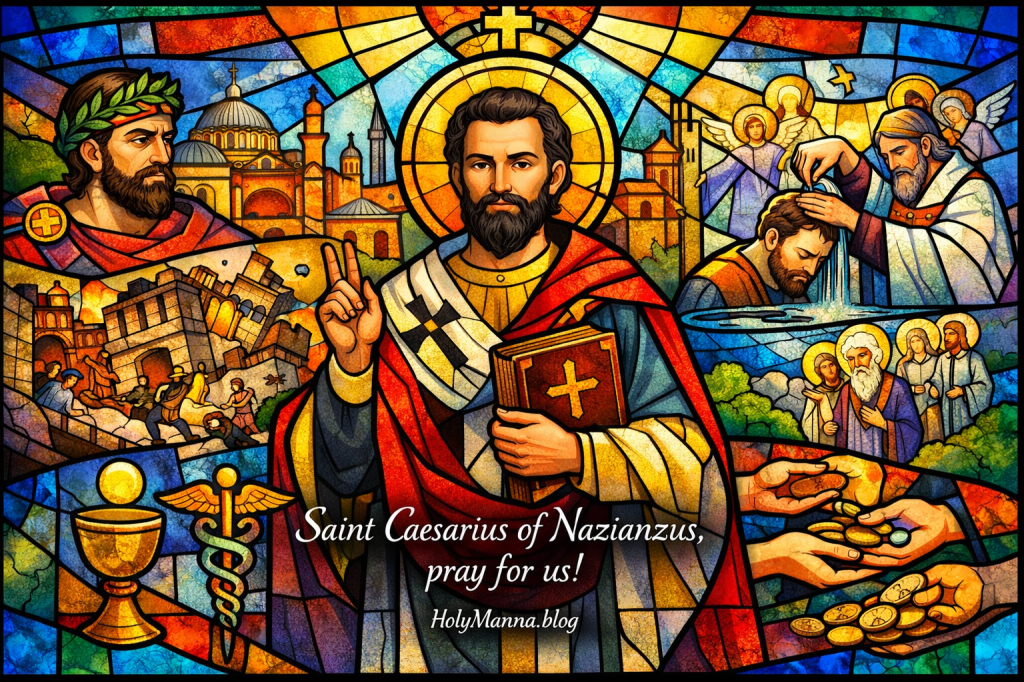
Saint Caesarius of Nazianzus is one of those saints who feels surprisingly modern. He was not a monk hidden in the desert or a bishop ruling a cathedral city. He was a highly educated Catholic Christian, a physician admired for his skill, and a public servant who moved close to imperial power without letting power rewrite his conscience. His story is known above all through the love and witness of his brother, Saint Gregory of Nazianzus, a Doctor of the Church, who preached a funeral homily for him that preserved his memory for the whole Church.
Caesarius is revered because he shows what it looks like to be serious about holiness while living in the middle of ordinary pressures: ambition, career, reputation, money, and the constant temptation to keep the peace by staying silent. He did not become famous for dramatic martyrdom, but he did make the kind of firm decisions that cost a person real comfort. He is remembered as a man who would not trade Christ for status.
Raised in a House Where Holiness Was Normal
Caesarius was born near Nazianzus in Cappadocia, in a home that can only be described as a small workshop of saints. His mother was Saint Nonna, known for her strong faith and steady prayer. His father was Saint Gregory the Elder, the bishop of Nazianzus. His siblings included Saint Gregory of Nazianzus and Saint Gorgonia. That kind of family does not happen by accident. It is a reminder that God often forms saints quietly, through faithful parents and the steady habits of prayer, worship, and moral seriousness.
Even with that holy background, Caesarius still had to choose his own path. He was gifted, ambitious, and drawn to learning. He pursued advanced study with unusual brilliance, especially in medicine, and he trained in Alexandria, one of the greatest intellectual centers of the ancient world. His mind was sharp, and his future looked wide open.
The Imperial Physician Who Would Not Deny Christ
Caesarius eventually made his way to Constantinople, where talent could quickly become influence. His medical ability and intelligence brought him into the attention of the imperial world. He served in high roles and gained honor that most people only dream about. Yet the closer he stood to the center of power, the more his faith was tested.
One of the defining moments of his life came during the reign of Julian, the emperor remembered as Julian the Apostate because he tried to pull the empire away from Christianity. The pressure was not always a single dramatic threat. Often it was the slow squeeze of public life: the expectation to conform, to participate in pagan religion, to stop being visibly Christian, to treat faith like a private hobby rather than a public truth.
Caesarius did not cooperate with that lie. His brother preserves the heart of his public confession in a simple line that still stings with clarity: “I am and I remain a Christian.” Julian’s reaction became memorable too, because it reveals what he saw. He saw a father who was honored, and sons who would not bend. Julian mocked the family with the bitter line: “O happy father, O unhappy sons!”
That moment tells a Catholic reader exactly what Caesarius was known for. He was a professional with real status who refused to let a godless culture buy his silence.
Earthquake, Awakening, and the Gift of Baptism
Caesarius lived in an age when some Christians delayed Baptism, often out of fear of sin after receiving such a great sacrament. That habit was common then, but the Church has always taught Baptism as the saving doorway into Christ’s life, the sacrament of new birth, the true beginning of sacramental life. This is why The Catechism speaks of Baptism as the foundation of Christian life, the gateway to the sacraments, and the beginning of life in the Spirit, in CCC 1213.
A turning point came in a moment of terror. Caesarius was in Nicaea during a catastrophic earthquake on October 11, 368. Buildings collapsed. People were crushed. The city shook apart. Caesarius survived in a way that seemed almost unbelievable, and his brother describes his escape as providential, a mercy that spared him when many were lost. That survival was not only physical. It became spiritual. It woke him up. It pressed him to stop living with one foot in the world and one foot in the kingdom.
After this, Caesarius received Baptism, and his heart turned more decisively toward the life of God. This is one of the reasons he is such a powerful patron for people who have lived in delay, hesitation, and half measures. God can use a jolt, a crisis, or a mercy to call someone into a cleaner and deeper surrender.
Is there any part of life where the heart has been delaying full obedience to Christ?
A Holy Death
The section of a saint’s life called “Hardships and Martyrdom” does not always end with blood. Caesarius was not executed for the faith, but he endured real persecution in the form that many modern Christians understand: pressure, ridicule, and career consequences. Under Julian, and within the imperial environment, he lived with the constant demand to compromise. He resisted it. That resistance is a kind of daily martyrdom, a steady offering of the self.
Not long after his baptismal turning point, Caesarius became ill and died suddenly, around 368 or 369. He had been spared from disaster, and then taken by sickness. That is not a contradiction. It is a reminder that life is not controlled by luck, and holiness is not the promise of a long timeline. It is the promise of belonging to Christ.
His death also revealed the purity of his intentions. Caesarius desired that his goods would be used for the poor, which is a very Catholic instinct. Love for the poor is not optional in Christian life, and The Catechism highlights the corporal works of mercy as concrete expressions of charity in CCC 2447. Yet even this was tested, because after his death, his charitable intentions had to be defended and properly carried out when others tried to misuse what he left behind. Holiness does not remove human messiness, but it does shine through it.
Signs After Death
After Caesarius died, his body was brought back to Nazianzus. Saint Gregory of Nazianzus preached a funeral oration for him, often cited as Oration 7, and it became the Church’s most important portrait of Caesarius’ soul. Gregory speaks not only as a brother, but as a priest and theologian who wants the faithful to understand how God’s grace can operate in a life that was complex and public.
The Church’s memory of Caesarius also includes a striking testimony preserved in the Roman Martyrology. It records that Gregory said he saw Caesarius among the blessed in glory. The Church does not present this as a loud legend meant to entertain. It is remembered as an edifying sign that strengthens hope, especially for those who fear they waited too long to become serious about God.
In terms of miracles after death, Caesarius is not known for a long list of spectacular posthumous wonders. His legacy is quieter. His miracle is the kind that shows up in consciences: a life of integrity remembered by the Church, honored in her liturgical memory, and held up as a model of faithful Christian witness in the midst of a hostile culture.
Walking His Path Today
Saint Caesarius has a clear message for everyday Catholics trying to live faithfully in the modern world. It is possible to be competent and holy at the same time. It is possible to succeed without selling the soul. It is possible to refuse the soft compromises that feel harmless but slowly poison the heart.
His life also challenges the habit of delay. A person can grow up around faith, admire faith, even identify with faith, and still put off real surrender. Caesarius shows that God’s mercy can still break through, and that the grace of Baptism is not a mere symbol but a real new birth in Christ, as the Church teaches in CCC 1213. His story invites a practical response: go to confession, take prayer seriously, stop feeding secret compromises, love the poor, and live with the clarity of someone who knows life can change overnight.
Where would a clearer Christian identity bring needed peace, even if it costs comfort?
What would it look like to be known as a Catholic without making excuses for it?
Engage with Us!
Share your thoughts and reflections in the comments below. What part of Saint Caesarius’ story hit closest to home today?
- Where is there pressure to compromise the faith for comfort, approval, or success?
- What habits help a Catholic stay spiritually awake in a busy professional life?
- Is there any step of deeper commitment that has been delayed, such as confession, consistent prayer, or obedience in a difficult area?
- How can the works of mercy become more concrete and consistent this week, in the spirit of Christian charity taught in CCC 2447?
- What would it look like to say, with calm confidence, the same truth Caesarius confessed: “I am and I remain a Christian.”
Keep walking forward in faith. Live with courage, stay close to the sacraments, and do everything with the love and mercy Jesus taught, because holiness is not for a few heroes. It is the normal Christian calling.
Saint Caesarius of Nazianzus, pray for us!
Follow us on YouTube, Instagram and Facebook for more insights and reflections on living a faith-filled life.

 Holy Manna!
Leave a comment