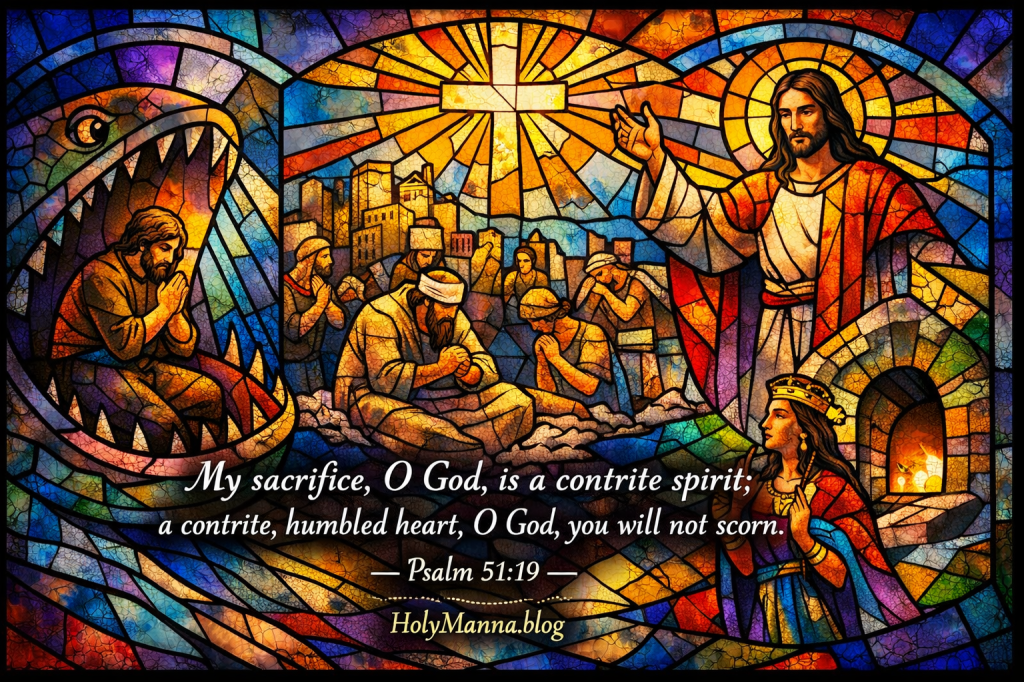
Wednesday of the First Week in Lent – Lectionary: 226
The Sign That Changes Everything
There are days in Lent when the Church speaks softly, and there are days when the Word of God sounds like a wake up call. Today is one of those days. The central theme tying these readings together is simple and bracing: God calls for real repentance, and the only sign truly needed is already given. The Lord does not bargain with the human heart, but He does pursue it with mercy, especially when it finally stops making excuses and starts turning back.
Jon 3:1-10 drops the listener into Nineveh, a massive pagan city associated with the Assyrian empire, notorious in the ancient world for power, conquest, and brutality. That background matters, because the story is not about respectable people cleaning up minor flaws. It is about a violent culture hearing God’s warning and choosing humility instead of pride. Jonah’s message is almost shockingly brief, “Forty days more and Nineveh shall be overthrown” (Jon 3:4), but the response is dramatic: fasting, sackcloth, ashes, and a public decision to abandon evil. This is the Biblical language of conversion, which the Church still echoes in Lent: outward penance meant to reveal an inward surrender, because God desires the heart before He desires the offering.
That is why the Church places Psalm 51 on the lips of every believer today. King David’s penitential prayer is the interior soundtrack of Nineveh’s exterior fasting. The Psalm does not present repentance as self loathing, but as truth telling that finally trusts mercy. “A clean heart create for me, God; renew within me a steadfast spirit” (Ps 51:12). This is the kind of repentance the Catechism describes as “interior conversion,” a turning of the heart back to God that expresses itself through prayer, fasting, and works of mercy (CCC 1430-1431). It is not performative religion. It is a sinner coming home.
Then the Gospel pulls everything into focus. In Lk 11:29-32, Jesus confronts a crowd that wants proof instead of obedience. “This generation is an evil generation; it seeks a sign” (Lk 11:29). The Lord refuses to entertain spiritual spectatorship, because endless sign seeking often becomes a sophisticated way of delaying repentance. He offers only one sign, “except the sign of Jonah” (Lk 11:29), which points both to Jonah’s preaching that brought pagans to conversion and to Christ’s own Paschal Mystery, His death and Resurrection, as the definitive sign that demands a decision.
What if the greatest danger is not that God stays silent, but that the heart stays stubborn even after God has spoken? Lent places Nineveh, David’s cry, and Jesus’ warning side by side to make one thing unmistakable: God’s mercy is real, but it is not casual. It is mercy that calls for conversion, mercy that heals contrition, and mercy that has already given the sign that matters most.
First Reading – Jonah 3
Nineveh Shows What Real Repentance Looks Like
The Book of Jonah is not a children’s tale about a fish. It is a sharp little prophetic drama aimed straight at stubborn hearts. Jonah is a reluctant prophet from Israel, sent to Nineveh, the great city of the Assyrian world. In the ancient Near East, Assyria carried a reputation for ruthless conquest and violence, so Nineveh represents more than a place on a map. It represents the kind of society Israel feared, judged, and assumed was beyond saving. That is exactly why God sends Jonah there. Today’s theme is conversion that does not wait for perfect circumstances, and mercy that meets a humbled heart. Nineveh becomes a mirror held up to everyone who thinks repentance can be postponed, softened, or negotiated. If a pagan city can turn quickly at a prophet’s warning, then Lent becomes the Church’s loving challenge to turn quickly at the voice of Christ.
Jonah 3 – New American Bible (Revised Edition)
Jonah’s Obedience and the Ninevites’ Repentance. 1 The word of the Lord came to Jonah a second time: 2 Set out for the great city of Nineveh, and announce to it the message that I will tell you. 3 So Jonah set out for Nineveh, in accord with the word of the Lord. Now Nineveh was an awesomely great city; it took three days to walk through it. 4 Jonah began his journey through the city, and when he had gone only a single day’s walk announcing, “Forty days more and Nineveh shall be overthrown,” 5 the people of Nineveh believed God; they proclaimed a fast and all of them, great and small, put on sackcloth.
6 When the news reached the king of Nineveh, he rose from his throne, laid aside his robe, covered himself with sackcloth, and sat in ashes. 7 Then he had this proclaimed throughout Nineveh: “By decree of the king and his nobles, no man or beast, no cattle or sheep, shall taste anything; they shall not eat, nor shall they drink water. 8 Man and beast alike must be covered with sackcloth and call loudly to God; they all must turn from their evil way and from the violence of their hands. 9 Who knows? God may again repent and turn from his blazing wrath, so that we will not perish.” 10 When God saw by their actions how they turned from their evil way, he repented of the evil he had threatened to do to them; he did not carry it out.
Detailed Exegesis
Verse 1: “The word of the LORD came to Jonah a second time:”
God’s first move is mercy. Jonah has already resisted God’s mission earlier in the book, yet the Lord speaks again. This “second time” reveals something foundational about conversion. God does not grow tired of calling sinners back. Lent is often experienced as God speaking a second time, sometimes a tenth time, with patience that is meant to awaken gratitude rather than complacency.
Verse 2: “Set out for the great city of Nineveh, and announce to it the message that I will tell you.”
Jonah is not sent to deliver his own opinion, his political instincts, or his personal anger. He is sent to proclaim God’s message. The prophetic vocation is always obedience before eloquence. The city is called “great,” not because it is holy, but because it is massive and influential. God’s concern stretches beyond Israel to the nations, showing that His desire is not the destruction of sinners, but their return.
Verse 3: “So Jonah set out for Nineveh, in accord with the word of the LORD. Now Nineveh was an awesomely great city; it took three days to walk through it.”
Jonah finally obeys, and the text lingers on the size of Nineveh to emphasize the scale of the mission. This is not a quick sermon to a small village. It is a confrontation with an entire culture. Conversion is rarely private when a whole society is twisted by sin. When God sends His word, it presses into public life, not as propaganda, but as truth that exposes violence and calls for change.
Verse 4: “Jonah began his journey through the city, and when he had gone only a single day’s walk announcing, ‘Forty days more and Nineveh shall be overthrown,’”
The message is short and severe. “Forty days” carries biblical weight. It echoes Israel’s time in the desert and the long training of the heart that comes through testing and purification. In Lent, the Church prays inside that same number, not because God enjoys threats, but because time is a gift. Warning is mercy when it offers a window for repentance.
Verse 5: “the people of Nineveh believed God; they proclaimed a fast and all of them, great and small, put on sackcloth.”
The first miracle is not fireworks in the sky. The first miracle is belief. They believe God, not Jonah. Then faith becomes visible. Fasting and sackcloth are not theatrical costumes. They are ancient signs of mourning, humility, and self-denial. Notice the totality: great and small. Real repentance is not a hobby for the overly religious. It is the common path of sinners who want to live.
Verse 6: “When the news reached the king of Nineveh, he rose from his throne, laid aside his robe, covered himself with sackcloth, and sat in ashes.”
The king steps down before God. This is one of the most powerful images in the reading. He leaves the throne, removes symbols of status, and chooses ashes. This is leadership in repentance, not leadership in image management. Ashes preach a hard truth: human greatness is dust without God. Lent places ashes on foreheads for the same reason, not to shame, but to awaken.
Verse 7: “Then he had this proclaimed throughout Nineveh: ‘By decree of the king and his nobles, no man or beast, no cattle or sheep, shall taste anything; they shall not eat, nor shall they drink water.’”
The decree is radical. Even animals are included, which sounds strange to modern ears, but it underscores how communal their repentance is. In the ancient world, the prosperity of animals meant the stability of the whole household and economy. This kind of fasting declares that life itself depends on God’s mercy more than daily provision.
Verse 8: “Man and beast alike must be covered with sackcloth and call loudly to God; they all must turn from their evil way and from the violence of their hands.”
Here the reading gets painfully concrete. Repentance is not only feeling sorry. It is turning from evil and specifically from violence. Violence is not only bloodshed. It includes the sinful use of power, exploitation, cruelty, unjust dealings, and the hard-hearted oppression of the weak. Their repentance is loud because it is desperate, and that is not a bad thing. Desperation can be holy when it finally tells the truth.
Verse 9: “Who knows? God may again repent and turn from his blazing wrath, so that we will not perish.”
This is hope spoken in humility. They do not presume upon mercy, yet they trust God’s character enough to plead for it. The phrase about God “repenting” uses human language to describe a real shift in God’s dealings with people when people change. God does not become more loving, as though He lacked love before. Rather, sinners move from rebellion into a place where mercy can be received without denying justice.
Verse 10: “When God saw by their actions how they turned from their evil way, he repented of the evil he had threatened to do to them; he did not carry it out.”
God looks at actions, not slogans. The turning is visible. This verse reveals a core biblical pattern: judgment is often conditional, meant to provoke conversion. God’s warning was not a trap. It was an open door. The last line is the Gospel hidden inside the Old Testament: God relents because He delights in mercy when hearts return.
Teachings
This reading teaches that conversion is both interior and exterior, and that the exterior signs only matter when the heart is actually turning. Sackcloth and ashes in Nineveh are the ancestors of Lenten penance, not as empty ritual, but as embodied prayer. The Church teaches that true repentance begins inside, but it cannot remain trapped inside, because love always moves outward into choices, habits, and repaired relationships.
It also teaches that God’s mercy is universal. Nineveh is not Israel. Nineveh is the enemy, the outsider, the feared empire. Yet God sends a prophet anyway. That is the same heartbeat heard later when Christ commands the Gospel to be preached to all nations. Jonah’s story confronts the temptation to think certain people are beyond grace, and it also confronts the temptation to think personal sin is too entrenched to change. If an entire city can turn, then a single soul can turn.
A classic teaching found throughout Catholic tradition is that God’s warnings are medicinal, not sadistic. The threat of being “overthrown” is meant to overthrow sin first. This is why the Church speaks bluntly about judgment and hell, not to entertain fear, but to rescue hope from denial. Mercy is not permission to remain the same. Mercy is power to become new.
This passage also quietly reveals something about the mystery of God’s unchanging goodness. Scripture sometimes describes God’s “repentance” to show that God is not indifferent. When people move from evil to repentance, they experience God differently. The change is real on the human side, and God’s response is real in history, yet God remains faithful to His own holiness and love. The Lord is not moody. The Lord is consistent, and that consistency includes mercy for the contrite.
A simple thread from the saints runs through this reading: God never despises humility. The pattern of salvation often begins when pride steps down from the throne. Nineveh’s king rises from his throne and sits in ashes, and that gesture becomes a living parable of the spiritual life. The heart cannot receive mercy while clinging to self-justification.
Reflection
Nineveh’s repentance is uncomfortable because it is immediate and practical. It does not wait for perfect feelings, perfect clarity, or perfect timing. It moves. That is why this reading belongs in Lent. Conversion is not meant to be admired from a distance. It is meant to be lived with urgency, because time is always shorter than pride wants to admit.
A good place to start is with Jonah himself. God speaks a second time, and Jonah finally goes. Many lives are shaped by that same moment, when God’s call returns after resistance. It might come through a homily, a difficult conversation, a sudden awareness of sin, or the quiet ache of knowing something is off. The question is not whether God is calling. The question is whether the heart will stop running.
Nineveh also offers a direct examination of conscience through one phrase: “the violence of their hands” (Jon 3:8). Violence can hide behind sarcasm, resentment, lust, manipulation, and contempt. It can hide in the way people speak to spouses, treat coworkers, parent children, or indulge private habits that slowly harden compassion. Lent is a season to name that violence and turn from it with concrete steps, not vague intentions.
What would change this week if repentance became specific instead of general?
What habit needs to be “overthrown” before it overthrows peace, marriage, fatherhood, or faith?
What would it look like to step down from the throne of pride and sit in ashes, at least interiorly, with honest confession and a real plan to change?
A strong Lenten response to this reading is simple and doable. Choose one act of fasting that actually costs something, not as punishment, but as a way to train freedom. Choose one act of repair, such as an apology, a restitution, or a hard conversation spoken with charity. Then choose one act of humble prayer each day that sounds like Nineveh, calling loudly to God, not with drama, but with sincerity. The God who spoke to Jonah a second time still speaks with the same goal: not destruction, but salvation.
Responsorial Psalm – Psalm 51:3-4, 12-13, 18-19
The Prayer God Never Refuses
This Responsorial Psalm is the Church’s classic language of repentance. Psalm 51 is traditionally linked to King David’s grief after his grave sin, when he finally stops defending himself and starts pleading for mercy. In the life of Israel, sacrifice and worship were real and commanded by God, yet the Psalm dares to say something deeper: ritual without a converted heart becomes hollow. That message fits perfectly with today’s theme. Nineveh puts on sackcloth and ashes, and Jesus warns against a sign seeking faith that never repents. Now the Church places this Psalm on the lips of every believer, so repentance becomes personal, honest, and interior. This is not a performance of guilt. This is a sinner learning how to come home.
Psalm 51:3-4, 12-13, 18-19 – New American Bible (Revised Edition)
3 Have mercy on me, God, in accord with your merciful love;
in your abundant compassion blot out my transgressions.
4 Thoroughly wash away my guilt;
and from my sin cleanse me.12 A clean heart create for me, God;
renew within me a steadfast spirit.
13 Do not drive me from before your face,
nor take from me your holy spirit.18 For you do not desire sacrifice or I would give it;
a burnt offering you would not accept.
19 My sacrifice, O God, is a contrite spirit;
a contrite, humbled heart, O God, you will not scorn.
Detailed Exegesis
Verse 3: “Have mercy on me, God, in accord with your merciful love; in your abundant compassion blot out my transgressions.”
The Psalm begins with God’s character, not the sinner’s excuses. Mercy is not demanded as a right, but begged as a gift rooted in God’s faithful love. The words “merciful love” and “abundant compassion” reveal a truth that Lent insists on repeating: God is not allergic to sinners, but He is opposed to pride. The plea is not vague. It asks for transgressions to be blotted out, meaning sin is real, and mercy is real.
Verse 4: “Thoroughly wash away my guilt; and from my sin cleanse me.”
The imagery shifts to washing and cleansing, as if sin leaves a stain that cannot be scrubbed away by willpower alone. This is the soul’s version of needing more than motivation. It needs purification. The verse also shows that repentance is not only fear of consequences. It is sorrow over guilt and a desire to be clean before God. This prepares the heart to understand why sacramental confession is not humiliation, but healing.
Verse 12: “A clean heart create for me, God; renew within me a steadfast spirit.”
This is one of the most important lines in all of Lent. The Psalm does not ask only for a fresh start, as if forgiveness is merely deleting a record. It asks for a new creation, because sin is not only something done, but something that deforms the heart. The word “create” is bold because it implies that only God can do what is being asked. The “steadfast spirit” is the strength to remain faithful when temptation returns, which is exactly what many people fear after confession. God does not only pardon. God strengthens.
Verse 13: “Do not drive me from before your face, nor take from me your holy spirit.”
The deepest pain of sin is separation from God. This verse shows what the repentant soul truly dreads: not embarrassment, not inconvenience, but losing communion with the Lord. The plea for the Holy Spirit reveals that repentance is not merely moral improvement. It is relational restoration. The heart wants to remain in God’s presence, because life without that presence becomes restless and thin.
Verse 18: “For you do not desire sacrifice or I would give it; a burnt offering you would not accept.”
This is not a rejection of worship. It is a rejection of worship used as a substitute for conversion. The Psalm exposes a temptation that still exists: offering religious activity to avoid surrender. The sinner imagines that God can be satisfied with externals while the heart stays unrepentant. This verse crushes that illusion. God cannot be bribed, and God cannot be fooled.
Verse 19: “My sacrifice, O God, is a contrite spirit; a contrite, humbled heart, O God, you will not scorn.”
Here is the sacrifice God always welcomes: contrition and humility. A contrite heart is not self-hatred. It is truth without excuses and sorrow without despair. The promise is direct: God will not scorn it. This is why the Church never tires of praying this Psalm. It teaches that the door of mercy is opened by humility, not by self-justification.
Teachings
The Church consistently teaches that outward penances only have value when they express interior conversion. The Catechism says it plainly: CCC 1430 teaches, “Jesus’ call to conversion and penance, like that of the prophets before him, does not aim first at outward works, ‘sackcloth and ashes,’ fasting and mortification, but at the conversion of the heart, interior conversion. Without this, such penances remain sterile and false; however, interior conversion urges expression in visible signs, gestures and works of penance.” That single paragraph ties today’s First Reading to today’s Psalm with surgical clarity. Nineveh’s sackcloth mattered because hearts turned, not because the clothing itself had magic.
The Catechism also defines the heartbeat of this Psalm with precision. CCC 1451 says, “Among the penitent’s acts contrition occupies first place. Contrition is ‘sorrow of the soul and detestation for the sin committed, together with the resolution not to sin again.’” This is exactly what Psalm 51 models. It is not a vague regret. It is sorrow, detestation of sin, and a real resolve to change.
The Church also places these words into daily Christian practice, not as rare emergency language. CCC 1434 teaches, “The interior penance of the Christian can be expressed in many and various ways. Scripture and the Fathers insist above all on three forms, fasting, prayer, and almsgiving, which express conversion in relation to oneself, to God, and to others.” This Psalm fuels all three. It teaches prayer that is honest, fasting that is humble, and almsgiving that is rooted in a softened heart.
The saints echo this logic. Saint Augustine, reflecting on Psalm 51, captures the core in a way that sounds like a spiritual gut-check: “Sacrifice to God is a troubled spirit, a heart broken and humbled God does not despise.” The point is not to glorify sadness. The point is to insist that God receives the repentant heart with tenderness, because humility is the beginning of healing.
Reflection
This Psalm teaches how to repent without pretending and without despairing. Many people either avoid repentance because it feels too heavy, or they fall into repentance that becomes self-focused and joyless. Psalm 51 offers a better path. It speaks clearly about sin, and even more clearly about mercy. It asks not only for forgiveness, but for transformation. That is why it belongs in Lent. God does not only want behavior management. God wants a new heart.
A practical way to live this Psalm is to pray it slowly and personally, especially when temptation returns or when the conscience feels restless. The words can become a daily examination of the heart. “Wash me” can mean a decision to step away from what stains the mind. “Renew a steadfast spirit” can mean building habits that support virtue instead of feeding weakness. “Do not take your holy spirit” can mean guarding prayer time like something precious, not optional.
The Psalm also challenges the instinct to hide behind religious busyness. Sacrifice, routines, and even good works can become a way to avoid the hard work of humility. God is not impressed by religious activity that leaves pride untouched. God is moved by a contrite heart that tells the truth.
Is repentance being treated like a seasonal mood, or like a real return to God with concrete change?
Is there a sin that keeps getting renamed and softened instead of confessed and abandoned?
What would it look like to ask God not only to forgive, but to create a clean heart that no longer wants the same filth?
If today’s Psalm is taken seriously, it leads naturally to the Sacrament of Reconciliation, because it teaches the soul to speak honestly, to trust mercy, and to resolve to begin again. Lent is not about proving strength. Lent is about letting God rebuild what sin has damaged, one contrite prayer at a time.
Holy Gospel – Luke 11:29-32
Stop Chasing Proof and Start Answering God
In the world of The Gospel of Luke, crowds often gather around Jesus with mixed motives. Some truly want God. Others want spectacle, a miracle on demand, or a sign dramatic enough to remove the burden of faith and the demand of repentance. In today’s Gospel, more people keep piling in, and Jesus does something that sounds jarring to modern ears. He does not entertain them. He confronts them. Lent is a season when the Church strips away illusions, and this passage fits that pattern perfectly. The central theme remains clear: God is offering mercy through repentance, not through endless negotiation for proof. Jesus points to Jonah because Nineveh repented with far less light than the people standing in front of the Messiah. The “sign” is not a stunt in the sky. The sign is Jesus Himself, and the only proper response is conversion.
Luke 11:29-32 – New American Bible (Revised Edition)
29 While still more people gathered in the crowd, he said to them, “This generation is an evil generation; it seeks a sign, but no sign will be given it, except the sign of Jonah. 30 Just as Jonah became a sign to the Ninevites, so will the Son of Man be to this generation. 31 At the judgment the queen of the south will rise with the men of this generation and she will condemn them, because she came from the ends of the earth to hear the wisdom of Solomon, and there is something greater than Solomon here. 32 At the judgment the men of Nineveh will arise with this generation and condemn it, because at the preaching of Jonah they repented, and there is something greater than Jonah here.
Detailed Exegesis
Verse 29: “While still more people gathered in the crowd, he said to them, ‘This generation is an evil generation; it seeks a sign, but no sign will be given it, except the sign of Jonah.’”
Jesus is not criticizing honest questions. He is exposing a hardened posture that uses questions as a shield. “This generation” points to a spiritual climate, not only a date on a calendar. The desire for a “sign” can become a polite form of unbelief, because it says, “God must meet conditions before obedience begins.” Jesus refuses because the heart that demands signs often refuses repentance. He offers the “sign of Jonah,” which is both a call to conversion and a prophecy of the Paschal Mystery. Jonah’s preaching brought pagans to repentance, and Jesus’ death and Resurrection will become the definitive sign for the world.
Verse 30: “Just as Jonah became a sign to the Ninevites, so will the Son of Man be to this generation.”
Jonah became a sign not through entertainment, but through a message that pressed the conscience. Jesus calls Himself “the Son of Man,” a title rich with biblical meaning, echoing the figure of judgment and glory in Dn 7. The Son of Man is not merely another prophet. He is the one who reveals the Father and will come as judge. The sign is personal. It is not just information about God. It is God drawing near in Christ. To reject Him is not to fail a quiz, but to refuse a relationship.
Verse 31: “At the judgment the queen of the south will rise with the men of this generation and she will condemn them, because she came from the ends of the earth to hear the wisdom of Solomon, and there is something greater than Solomon here.”
The “queen of the south” recalls the Queen of Sheba, who traveled a great distance to encounter Solomon’s wisdom in 1 Kgs 10. Jesus uses her as a witness against spiritual laziness. She responded to a lesser light with real effort. The people listening to Jesus are standing in the presence of a greater wisdom, not merely wise sayings but Wisdom made flesh. Jesus is not insulting Israel’s heritage. He is honoring it by showing its fulfillment. Solomon was a signpost. Christ is the destination.
Verse 32: “At the judgment the men of Nineveh will arise with this generation and condemn it, because at the preaching of Jonah they repented, and there is something greater than Jonah here.”
Now Jesus points directly to today’s First Reading. Nineveh repented at Jonah’s short warning, even though Jonah was reluctant and the message was brief. Yet the generation hearing Jesus hesitates, argues, and demands more. The contrast is meant to sting, because it reveals a tragic possibility: people can be near holy things and still remain unchanged. The line “something greater than Jonah here” is a declaration of Christ’s identity. Jonah was a messenger. Jesus is the message. Jonah preached judgment to provoke repentance. Jesus bears judgment in His own flesh to create repentance.
Teachings
This Gospel teaches that faith is not built on spectacle but on trustful surrender to God’s revealed truth. The Church teaches that miracles are real and meaningful, but they are not meant to satisfy curiosity or replace conversion. The Catechism explains the purpose of signs in Christ’s ministry with clarity. CCC 547 says, “Jesus accompanies his words with many ‘mighty works and wonders and signs,’ which manifest that the kingdom is present in him and attest that he was the promised Messiah.” This means signs serve the truth. They point to who Jesus is. They do not exist to let the heart remain unchanged.
The Catechism also explains why some hearts still reject Christ even with signs. CCC 548 says, “The signs worked by Jesus attest that the Father has sent him. They invite belief in him. To those who turn to him in faith, he grants what they ask. So miracles strengthen faith in the One who does his Father’s works; they bear witness that he is the Son of God. But his miracles can also be occasions for ‘offense’; they are not intended to satisfy people’s curiosity or desire for magic.” This is precisely what Jesus confronts in Lk 11. Sign seeking can be a desire for magic, not a desire for God.
This passage also teaches that judgment is real, and it will be morally revealing. The Queen of Sheba and Nineveh become courtroom witnesses, not because God enjoys condemnation, but because human choices have consequences. Those who responded to less light will expose the refusal of those who received more light. This is not a petty comparison. It is a warning against presumption. Being close to the truth is not the same as obeying the truth.
The saints and Fathers frequently interpret the “sign of Jonah” as a prophecy of Christ’s death and Resurrection. Jonah’s time in the belly of the fish becomes a shadow of Christ’s time in the tomb, and Jonah’s return to preach becomes a shadow of Christ’s Resurrection proclamation. In other words, the central sign is the Paschal Mystery, and Lent is the season of preparing to renew baptismal faith in that mystery. The Gospel presses the conscience toward the same conclusion: the sign has been given, and now the heart must respond.
Reflection
This Gospel is painfully current because sign seeking never went away. It simply put on new clothes. Some people want God to prove Himself through constant emotional highs, perfect circumstances, or dramatic interventions that remove all uncertainty. Others keep postponing obedience with one more demand: one more confirmation, one more feeling, one more event, one more guarantee. Jesus does not shame honest weakness, but He refuses the kind of sign seeking that is really a refusal to repent.
Lent is a season for naming what the heart has been using as an excuse. The crowd wanted a sign, but Jesus points to repentance. Nineveh heard a warning and changed. The Queen of Sheba traveled for wisdom. Meanwhile, a crowd stands in front of the Messiah and stalls. That is the danger this Gospel exposes. Familiarity with holy things can anesthetize urgency.
A practical response to this Gospel is to stop waiting for a better spiritual mood and begin choosing concrete obedience. Prayer becomes less about demanding answers and more about surrendering the will. Fasting becomes less about self-improvement and more about clearing the noise that keeps the conscience dull. Confession becomes less about fear and more about stepping into the light.
Where has the heart been demanding a sign instead of offering repentance?
What sin keeps getting postponed because “the time is not right,” even though God has already made the call clear?
If the men of Nineveh could turn after a single sentence from Jonah, what is stopping conversion after hearing the words of Christ?
Jesus is not offering entertainment. Jesus is offering salvation. The sign has been given. The only question that remains is whether the heart will keep negotiating, or whether it will finally turn and live.
When the Sign Is Enough, and the Heart Finally Turns
Today’s readings press one clear message into the soul: God is not asking for perfect performance, but for real repentance, and the decisive sign has already been given. Jon 3:1-10 shows a pagan city doing what many believers postpone. Nineveh hears God’s warning and responds with fasting, humility, and a visible turning from evil. The king steps down from his throne and sits in ashes, and the whole culture admits what pride never wants to admit: sin destroys, and mercy is the only hope. That scene is not meant to stay in ancient history. It is meant to expose how quickly a heart can change when it finally stops negotiating.
Then Ps 51:3-4, 12-13, 18-19 teaches the language of true return. It does not offer spiritual excuses or polite apologies. It cries out for mercy and dares to ask for transformation: “A clean heart create for me, God; renew within me a steadfast spirit” (Ps 51:12). The Psalm also delivers a simple truth that can save a life: God does not want empty religious performance; God wants the sacrifice that pride hates to give, a contrite and humbled heart. When repentance is real, the Lord does not scorn it. The Lord receives it.
Finally, Lk 11:29-32 cuts through the modern habit of delaying conversion with endless demands for proof. Jesus refuses to play the game of sign-seeking faith that never obeys. He points to “the sign of Jonah” (Lk 11:29), and He makes the comparison that should shake complacency. Nineveh repented at Jonah’s preaching, and the Queen of the South traveled for Solomon’s wisdom, yet the crowd stands in front of someone greater than Jonah and greater than Solomon and still hesitates. The point is not to crush the listener. The point is to wake the listener up. God has already spoken. God has already acted. The proper response is not more bargaining, but a changed life.
This is the invitation for today: take one real step toward God that cannot be mistaken for spiritual theater. Choose prayer that tells the truth, not prayer that performs. Choose fasting that breaks attachment, not fasting that feeds pride. Choose mercy toward others that proves repentance is not only an interior feeling. Then make room for the Lord to do what only He can do, which is to create a clean heart and renew a steadfast spirit.
What would change this week if repentance stopped being a concept and became a decision? Let Nineveh’s urgency, David’s contrition, and Christ’s warning join together into one simple call to action: do not wait for a better sign. Do not wait for a better mood. Turn to God today, because the One who calls is merciful, and the One who calls is already greater than Jonah.
Engage with Us!
Readers are invited to share their reflections in the comments below, because the Word of God is meant to be lived, prayed, and talked about with honesty. Today’s readings call for real conversion, not religious habits that leave the heart unchanged, so these questions are meant to help the message land in daily life.
- First Reading, Jon 3:1-10: Where is God calling for a “second chance” obedience, and what practical step can be taken today to stop delaying conversion?
- Responsorial Psalm, Ps 51:3-4, 12-13, 18-19: What does a “clean heart” look like in real life right now, and what habit or attachment needs to be surrendered so the spirit can become steadfast again?
- Holy Gospel, Lk 11:29-32: Where has the heart been demanding signs or perfect conditions, and what would it look like to respond to Christ with trust and repentance instead of negotiation?
May the Lord give the grace to live a life of faith that is both humble and courageous, and may every choice today be shaped by the love and mercy Jesus taught, so that repentance becomes joy, and obedience becomes peace.
Sacred Heart of Jesus, we trust in You!
Immaculate Heart of Mary, pray for us!
Saint Michael the Archangel, defend us in battle!
Follow us on YouTube, Instagram and Facebook for more insights and reflections on living a faith-filled life.

 Holy Manna!
Leave a comment