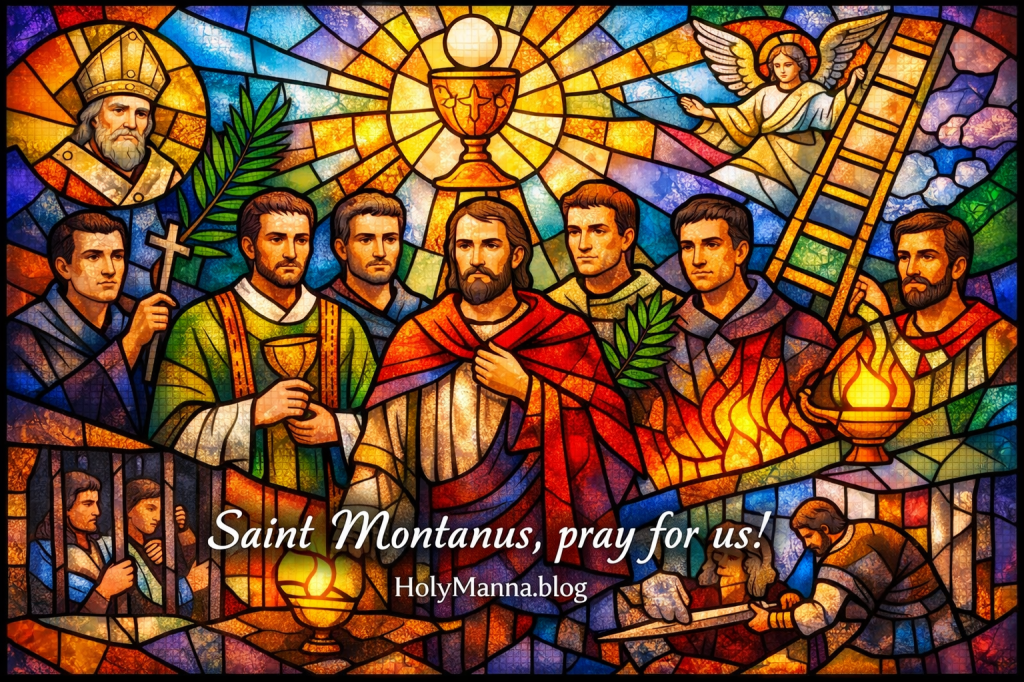
The Martyrs of Carthage
Saints Montanus and Lucius are remembered with their companions as martyrs of Carthage in North Africa, Christians who chose fidelity to Jesus over safety, status, and even life itself. Their story belongs to that fiery age when the Church was still young, the Eucharist was precious, and confession of the Name could cost everything. These saints are revered because they show what the Church still teaches today, that martyrdom is not a tragic accident but a holy witness, when a disciple clings to truth with the whole body and soul. The Catechism says it plainly: “Martyrdom is the supreme witness given to the truth of the faith: it means bearing witness even unto death.” CCC 2473
Their witness also carries a helpful clarification. This Saint Montanus is not the Montanus associated with the ancient Montanist movement. These martyrs belong to the Catholic memory of Carthage, close to the spiritual world shaped by Saint Cyprian, where unity, repentance, and sacramental life were treated like matters of life and death, because they often were.
Roots Hidden, Faith Revealed
The early personal details of Montanus, Lucius, and the others are not preserved in a full modern biography. The Church often knows martyrs this way, not through childhood stories and career plans, but through the moment when grace makes a person unshakable. What Catholic tradition does preserve is that they were Christians of Carthage, closely associated with the Church that had been shepherded by Saint Cyprian, and that several of them were clergy. Flavian is remembered as a deacon in the traditional account, and their circle is often described as disciples formed by Cyprian’s teaching and example.
Conversion, for saints like these, is not always recorded as a single dramatic event. It is seen in their choices. It shows up in the way they prayed, the way they forgave, the way they fought for unity when tension rose, and the way they embraced suffering without turning bitter. That is the kind of conversion that keeps deepening until the final breath.
The Prison Becomes a Cathedral
Their story is preserved in an ancient martyr narrative treasured in Catholic tradition. It tells of arrest, confinement, and the steady tightening of persecution. At one point, they were threatened with death by fire. The account says they prayed intensely that God would spare them that particular torment, and the threatened punishment shifted. That is not presented as a spectacle meant to impress outsiders. It is presented as God’s quiet providence, a Father strengthening His children for the road ahead.
Inside prison, the cruelty intensified. The narrative describes hunger and thirst used as weapons, the body being pressed down to break the soul. Yet the saints responded like Christians who truly believed the Gospel. Flavian is remembered for giving away what little he had, choosing charity even while his own strength was being drained.
The story also emphasizes how the Church cared for her suffering members. A priest named Lucian is described as arranging relief through the faithful, and Catholic retellings underline a deeply sacramental theme here. When everything else was stripped away, Christ did not abandon His people. The Eucharist, the Church’s “never failing food,” remained the strength of confessors. That fits the Church’s constant teaching that Holy Communion deepens union with Christ and strengthens charity. CCC 1392
The narrative includes visions meant to encourage perseverance, images of lamps and light, reminders that the faithful do not walk into death alone. These are recorded as consolations given in suffering, not as entertainment. They point to the truth that Jesus keeps His promise even in prison cells, because His promise was never limited to comfort. It was limited only by love.
Peace Won in Chains
One of the most human moments in their story is not a courtroom scene. It is a moment of strained relationships. The ancient account remembers conflict and misunderstanding, then a movement toward reconciliation and unity. That detail matters because it shows the martyr’s path is not about acting tough. It is about becoming holy. Holiness includes humility, repentance, and peace.
When judgment came, the saints held firm. The tradition places their martyrdom during the persecution associated with Emperor Valerian, in the years after Saint Cyprian’s own death. The sentence handed down for many was beheading, and the martyrs went forward encouraging the faithful.
Flavian’s witness stands out in a striking way. The account says that friends tried to save him by arguing he was not a deacon. Flavian refused the lie. He would not purchase life with falsehood. That is the kind of clarity that looks severe to the world, but it is actually freedom. The martyr does not cling to survival at any cost because the martyr already belongs to Christ.
A line attributed to Flavian captures the inner logic of martyrdom in Catholic spirituality: “The body feels no pain when the soul gives herself entirely to God.” It is not a denial of suffering. It is a confession that surrender to God can carry a person through suffering without surrendering to fear.
Their deaths were not the end of their story. In Catholic faith, the martyrs do not disappear. They enter the life of the Church in a new way, as witnesses, friends, and intercessors.
The Church Keeps Calling Their Names
Not every saint has a long catalog of posthumous miracles attached to a shrine with a famous pilgrim route. Catholic tradition does not force what it cannot verify. With Saints Montanus and Companions, the enduring “after death” legacy is especially clear in two places.
The first is the Church’s public memory. They are commemorated in the Roman Martyrology on February 24, which means the Church intentionally keeps their names on her lips. This is not mere history keeping. This is liturgical remembrance, the family of God refusing to forget the family members who died loving Jesus.
The second is the continuing reality of the Communion of Saints. The Church teaches that the saints do not stop loving the Church once they enter heaven. Their charity becomes even more pure, and their intercession continues. CCC 957 When Catholics ask these martyrs for prayers, it is not superstition. It is family life in Christ.
If specific healings or shrine traditions exist in particular local communities, they are not consistently preserved in the classic, widely received sources about this martyr group. What is preserved, and what is more than enough, is the living testimony of their prison faith, their call to unity, and their fearless confession of Christ.
A Martyr’s Lesson for Ordinary Days
Most people will never face a governor’s sentence or a sword. That does not make this story distant. It makes it practical. Saints Montanus and Companions teach that faith is not a private hobby. Faith is a allegiance, a way of living that shapes what a person refuses to do and what a person refuses to say, even when it would be easier.
This is also a lesson in spiritual toughness that does not turn cruel. Their story includes charity, sacrifice, and reconciliation. That is the kind of strength worth imitating. When the pressure is social, the temptation is to blend in. When the pressure is personal, the temptation is to compromise quietly. When the pressure is spiritual, the temptation is to pray less, to receive the sacraments less, and to isolate. These martyrs point to the opposite road. They show that the Church, the sacraments, and unity are not optional supports. They are lifelines.
This is a good moment to ask a hard question in a gentle way. Where has fear been shaping decisions more than love for Christ has been shaping them? Another question follows naturally. Is there a relationship that needs reconciliation before the next storm hits? The prison taught these saints that peace is not weakness. Peace is obedience.
A simple practice can help. A person can make a weekly confession, receive the Eucharist with reverence, and choose one concrete act of courage each day, even if it is small. That might be refusing gossip, speaking honestly without cruelty, keeping Sunday holy, protecting purity, or choosing prayer when anxiety tries to run the schedule. Ordinary courage, repeated daily, is how God prepares saints.
Engage With Us!
Share thoughts and reflections in the comments below.
- What part of this story feels most challenging to live out in everyday life?
- Where is God calling for courage right now, even if it is quiet courage no one applauds?
- Is there a relationship that needs peace and concord, so that unity can be restored before it hardens into distance?
- How can devotion to the Eucharist become more consistent and more intentional this week?
Keep walking forward in faith. Keep choosing truth with love. Keep practicing mercy and courage in the small moments, because those small moments are where Christ trains the heart. Do everything with the love and mercy Jesus taught, and trust that the saints are praying for strength to finish the race well.
Saint Montanus, pray for us!
Follow us on YouTube, Instagram and Facebook for more insights and reflections on living a faith-filled life.

 Holy Manna!
Leave a comment