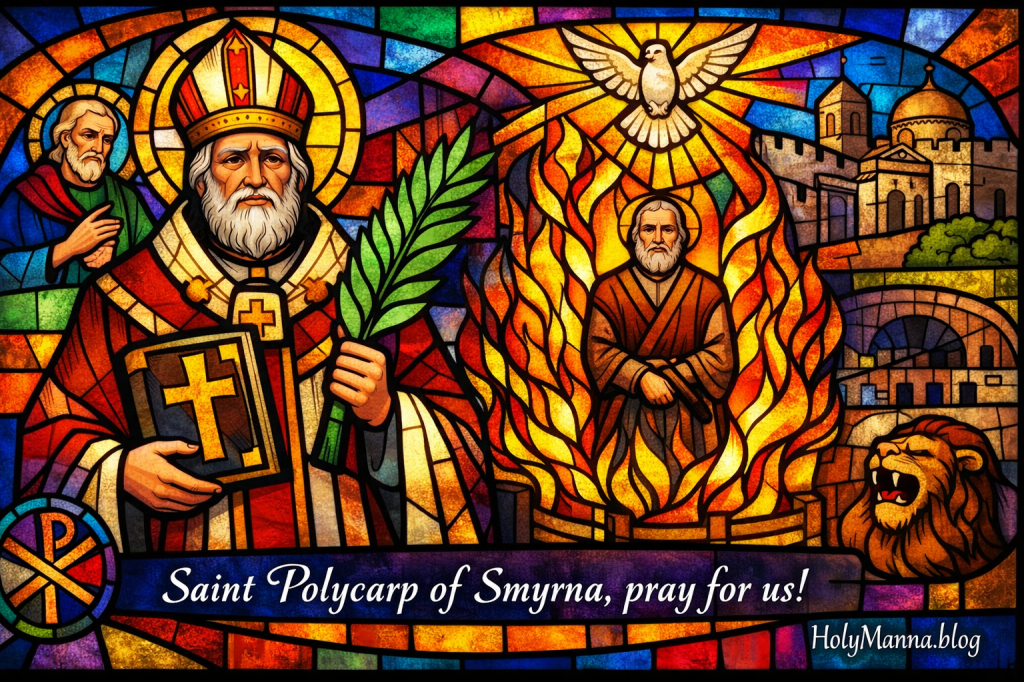
The Bishop Who Would Not Bend
Saint Polycarp is one of those saints who makes the early Church feel close enough to touch. He lived so early in Christian history that Catholic tradition remembers him as a disciple of the Apostle John and as a trusted shepherd in the Church of Smyrna. He is revered as an “Apostolic Father,” meaning his faith was formed right at the edge of the Apostles’ own lifetime, when the Gospel was still being carried across the world by bishops, martyrs, and ordinary Christians who refused to treat Jesus like a myth.
Polycarp is celebrated because he shows what the Catholic faith looks like when it is not just an idea, but a life handed on. The Church calls this the living transmission of the faith, Sacred Tradition, guarded and preached by those who stand in apostolic succession. That is not a later invention. Polycarp is evidence that the Church was already thinking and living this way from the beginning. He stands as a witness that Christianity was never meant to be a private spirituality built from scratch, but a received faith lived in communion with the bishops, the sacraments, and the teaching handed down from the Apostles.
Even his name carries a quiet symbolism. Polycarp means “much fruit,” and his life truly became fruitful, not because he chased influence, but because he stayed faithful. He is the kind of saint who proves that a steady, rooted Catholic life can echo across centuries, long after the noise of empires fades.
A Life Formed by the Apostles
Polycarp’s early years are not recorded in detail, and that silence is actually a gift. It reminds modern readers that holiness usually begins in ordinary places. What is known is that he lived in Asia Minor and became a Christian at a time when being Christian could cost a person everything. Catholic tradition consistently links him with the circle of the Apostle John, and later saints, especially Saint Irenaeus, speak of Polycarp as a man who had truly learned the faith from those who were close to the Apostles.
His “conversion” is not presented as a dramatic moment with fireworks. It is more like the steady deepening of a soul that stays close to the truth. That kind of conversion is familiar to anyone who has tried to keep the faith in a culture that pushes compromise. Polycarp grew into the kind of disciple who was not easily shaken because his roots went deep.
He eventually became bishop of Smyrna, a real city with real danger and real suffering. And he did not become famous for being clever. He became famous for being faithful. He is remembered as a pastor who could correct error without losing love, and who could speak firmly without becoming cruel. His life shows that Catholic leadership is not about personal branding. It is about guarding what has been entrusted and serving the flock Christ purchased with His Blood.
A Shepherd Who Guarded Truth
Polycarp’s day to day ministry looked like what faithful Catholic life still looks like. He taught what he had received. He urged Christians to live with integrity. He pushed the Church toward charity, purity, patience, and courage. His letter to the Philippians reads like the voice of a steady bishop who knows that doctrine and daily life cannot be separated. He calls believers to reject greed, to live chastely, and to hold onto Christ with a conscience that is clean.
He even gives a blunt reminder that generosity is not optional for Christians, saying, “Alms delivers from death.” That line lands differently when it is heard in a modern world where giving is often treated like an extra. Polycarp is pointing to the ancient Christian instinct that real faith spills into real love, especially toward the poor and forgotten.
He also guarded the Church against early errors that tried to soften or distort the Gospel. In his letter, he warns clearly that the Christian faith is not flexible on the core truth that Jesus truly became man. He writes, “Whosoever does not confess that Jesus Christ has come in the flesh, is antichrist.” That is not rude arguing. That is a pastor protecting his people from teachings that would quietly cut the heart out of the Gospel. The Catholic faith has always held that Jesus is fully God and fully man, and that salvation is not an illusion. It is the real Redeemer entering real history to save real sinners.
There is also a famous story from tradition that shows how seriously he took heresy. Polycarp is remembered for meeting the heretic Marcion and refusing to play nice with deception. When asked if he recognized Marcion, he answered with shocking bluntness that he recognized him as the “firstborn of Satan.” That sounds harsh to modern ears, but it comes from a world where false teaching was not treated as harmless opinion, because people knew it could shipwreck souls.
One of the most striking moments in his life is his meeting with the Bishop of Rome, Pope Anicetus, during an early controversy about the date of celebrating Easter. The surprising part is not that there was disagreement. The surprising part is that communion was preserved. Polycarp and the Pope did not treat unity like a hobby. They treated unity like something worth protecting, even when everyone did not do everything the same way. That kind of Catholic mindset, unity without pretending differences do not exist, is something the modern Church still needs.
The Hours Before His Witness
When people talk about Polycarp’s miracles, most of them are tied to his final days, preserved in the ancient account known as The Martyrdom of Polycarp. That document does not paint him as a reckless man chasing a dramatic death. It portrays him as a man at peace, not because life was easy, but because his soul belonged to Christ.
As persecution intensified, Polycarp did not rush into danger to prove a point. The ancient Church did not treat martyrdom like theater. In fact, the martyrdom account makes it clear that Christians were not supposed to provoke authorities or seek arrest as a kind of spiritual stunt. Polycarp is presented as obedient to God’s will, not addicted to attention.
There is a prophetic detail that stands out. The account says Polycarp had a vision that his pillow was burning, and he understood this as a sign that he would die by fire. Later, when the time came, that vision was remembered not as superstition, but as a merciful preparation. God does that sometimes with His saints. He does not always remove suffering, but He can give a strange clarity that helps a soul endure it.
When the moment came and Polycarp was arrested, he met his captors with calm hospitality, even asking that food and drink be given to them. Then he prayed, and the account describes him praying at such length and with such depth that some of those present regretted coming for him at all. The image is almost unsettling. He looks more free in chains than the men who came to bind him.
The Old Bishop Who Outlasted an Empire
Polycarp was pressured to save himself with a few easy words. All he had to do was deny Christ, or at least offer the kind of vague compromise that would make everyone happy. The proconsul urged him to swear by Caesar, to curse Christ, and to get it over with. Polycarp refused, not with screaming rage, but with a steady loyalty that made the threat look small.
His response is one of the most famous martyr quotations in Christian history because it is so simple and so human. He says, “Eighty and six years have I served Him, and He never did me any injury. How then can I blaspheme my King and my Saviour?” That line is not the voice of a fanatic. It is the voice of someone who has lived with Jesus long enough to know He is trustworthy.
When threatened with beasts, Polycarp stood his ground. When threatened with fire, he did not bargain. The account even preserves his calm surrender in a single sentence that every Catholic should memorize for hard seasons. He said, “The will of God be done.” That is the sound of a soul that knows Providence is real.
Then came the death itself, and the miracle signs that the ancient Church preserved with awe. The flames are described as forming around him like an arch, as if the fire refused to touch him in the usual way. The account says his body appeared like refined metal, and that there was a fragrance like incense or baked bread. When he was finally killed, the account describes a great flow of blood. The story is told to underline one truth: Christ is Lord even over death, and martyrdom is not defeat. It is witness.
The Birth of Catholic Devotion to Martyrs
After Polycarp died, the Christian community treated his remains with reverence, not because bones are magical, but because the body matters to Christians. Catholic faith is not about escaping the body. It is about the resurrection of the body. The ancient Church gathered his relics and commemorated the anniversary of his martyrdom as a kind of “birthday,” meaning his birth into eternal life.
This is one of the early windows into Catholic devotion to the saints. The Church worships God alone, but loves and honors those who followed Christ faithfully. That is not a distraction from Jesus. It is what happens when the family of God actually believes in the communion of saints. Polycarp’s story shows that Christians were already living that reality early on, honoring martyrs as disciples and imitators of the Lord, while adoring Christ alone.
His influence also lived on through the saints who came after him. Saint Irenaeus, who learned from Polycarp, later became one of the Church’s great defenders of the faith. That matters because it shows how holiness multiplies. One faithful bishop forms another, and the truth keeps moving forward even when the world tries to stamp it out.
Specific posthumous miracle stories are not as widely preserved as his martyrdom account, but his ongoing veneration is itself a kind of testimony. Christians have invoked him for centuries, and he is commonly associated in Catholic devotion with intercession for certain ailments, including ear troubles. Churches have been dedicated to him, especially in the region of ancient Smyrna, keeping his memory alive not as a museum piece, but as a spiritual friend who still points souls to Christ.
A Saint for Catholics Tired of Compromise
Saint Polycarp is painfully relevant. The modern world does not always demand literal incense offered to idols, but it constantly asks for small betrayals. It asks Catholics to water down the divinity of Christ, to treat truth like a personal preference, to keep faith private, or to pretend that unity does not matter. Polycarp shows another way. He teaches that the faith is received, not redesigned. He teaches that love for Christ must be concrete. He teaches that unity is worth protecting without surrendering truth.
His life invites a practical kind of courage. It means choosing honesty when lying would be easier. It means guarding what enters the mind and heart, because purity is never accidental. It means staying faithful to the Church even when it costs social approval. It means remembering that Jesus is not just a historical figure. Jesus is King, and a Catholic cannot serve two kings.
Polycarp’s witness also challenges the modern habit of treating martyrdom as something ancient and distant. Martyrdom is not always blood. Sometimes it is daily fidelity that costs comfort, reputation, or opportunity. Polycarp reminds the Church that the point is not to look brave. The point is to stay loyal to Christ and to let that loyalty shape every decision.
How often does the fear of conflict tempt the soul to call compromise “peace”?
Where has comfort started to feel more important than fidelity?
What would change if the reality of the Resurrection shaped the way suffering is faced?
Engage with Us!
Share your thoughts and reflections in the comments below. Saint Polycarp’s life is short on unnecessary drama and full of real spiritual power, and it can spark an honest conversation about what faithfulness looks like today.
- What is one area of life where the pressure to compromise the faith feels the strongest right now?
- How does “The will of God be done” challenge the way suffering and inconvenience are handled?
- What does Polycarp’s love for Church unity teach about staying Catholic even when disagreements arise?
- Which of Polycarp’s words hits the heart the most, and why: “Eighty and six years have I served Him” or “How then can I blaspheme my King and my Saviour?”?
- What is one concrete act of courage that can be practiced this week in imitation of Saint Polycarp?
Keep walking forward in faith. Keep choosing truth with charity. Keep doing the hidden good when nobody claps. A life lived in Christ is never wasted, and everything is transformed when it is done with the love and mercy Jesus taught.
Saint Polycarp of Smyrna, pray for us!
Follow us on YouTube, Instagram and Facebook for more insights and reflections on living a faith-filled life.

 Holy Manna!
Leave a comment