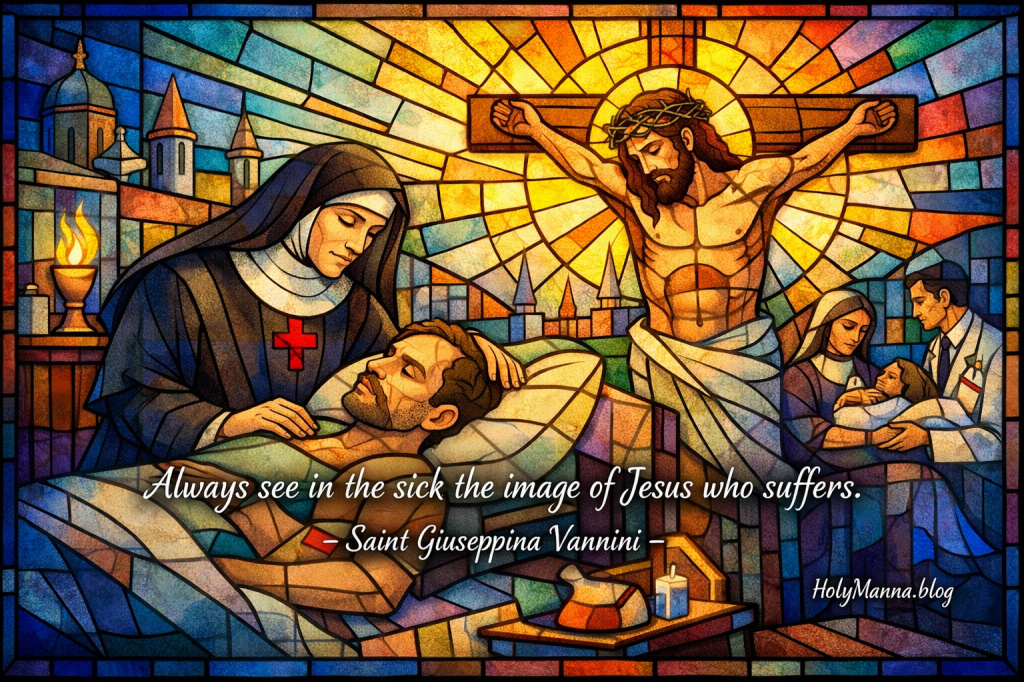
The Woman Who Taught to See Jesus in a Hospital Bed
Saint Giuseppina Vannini is the kind of saint that makes modern people pause, because her holiness did not come from a spotlight. It came from the slow, daily grind of love, the kind that shows up when someone is sick, tired, afraid, or forgotten. She founded the Daughters of Saint Camillus, a congregation formed in the spirit of Saint Camillus de Lellis, whose mission is to care for the sick with the tenderness and courage of Christ.
Her life is a living reminder of what the Church teaches about mercy. The corporal works of mercy are not optional add ons to Christianity. They are part of the Gospel’s shape. The Church speaks of feeding the hungry, visiting the sick, and comforting the suffering in a way that is meant to be concrete and real, as seen in CCC 2447. Saint Giuseppina did not just agree with that teaching. She organized her entire life around it.
The Orphan Who Became a Mother
She was born in Rome on July 7, 1859, and baptized the next day. Her baptismal name was Giuditta Adelaide Agata Vannini. Before she could even build a stable childhood, suffering arrived. Her father died when she was very young. Her mother died soon after. Her siblings were separated, and that separation never truly healed on earth.
She was received into the Torlonia Conservatory in Rome, which was served by the Daughters of Charity of Saint Vincent de Paul. That environment formed her in prayer, discipline, and service. It also formed her mind. She earned a teacher’s diploma, and she learned French well, which later became a quiet tool in God’s hands as her congregation spread beyond Italy.
From the time she received First Communion and Confirmation, she felt a pull toward consecrated life. She wanted to belong entirely to Christ, not as a vague idea, but as a real and total commitment. She entered the Daughters of Charity, but her health failed, and she was eventually dismissed. That kind of moment can shake a soul, because it feels like being told no by God Himself. Instead, it purified her. It taught her that vocation is not just about where someone goes, but about how someone trusts.
A “No” That Became the Soil of a Greater “Yes”
After leaving religious life, she lived with uncertainty and worked with her hands, supporting herself through embroidery. That detail matters because it shows her humility. She did not act entitled to religious life. She kept praying, kept working, kept trying to be faithful in the hidden seasons.
Then Providence arranged the turning point. She met Father Luigi Tezza, a Camillian priest who saw that her suffering had not made her bitter. It had made her tender, steady, and strong. He proposed a new work, an institute of women religious living the Camillian spirit, devoted to Christ in the sick.
Her response was deeply human and deeply Catholic. She did not rush. She asked for time to pray. “Father, let me pray and think, and in a few days I will give an answer.” Then she offered the kind of yes that does not come from confidence in self, but from trust in God. “I am capable of nothing, yet I trust in God.” This is the spiritual backbone of her whole story. She knew weakness, and she also knew grace.
A New Family Born Beside Hospital Beds
In 1892 the first community began in Rome near a hospital, and it was small enough that it could have been dismissed as insignificant. But saints know that the Kingdom often starts like a seed. That same year, in the room where Saint Camillus de Lellis died, she and the first sisters received the red cross, the Camillian sign. She took the name Sister Maria Giuseppina.
Her spirituality was simple but intense. She formed her sisters to see Jesus in every suffering person. She did not want them to treat the sick as tasks. She wanted them to treat the sick as sacred. One of her most famous and verified sayings captures her whole mission. “Always see in the sick the image of Jesus who suffers.” This is the heart of Mt 25:36, where Christ identifies Himself with the sick and the suffering, and it is exactly why Catholic mercy is never only sentimental.
As the community grew, she embraced the Camillian vow that expresses the extreme seriousness of their love. It included service to the sick even at risk to one’s own life. This was not poetic language. It was a promise to love to the end, the way Christ loves.
She was elected Superior General and carried the weight of leadership not as a corporate executive, but as a spiritual mother. She taught her sisters that holiness is built from humility. Another verified saying expresses this clearly. “The only foundation of holiness is humility.” In a modern world that confuses holiness with popularity, that line hits like a correction and a comfort at the same time.
Mercy That Looked Like a Mother’s Love
Saint Giuseppina’s “miracles during life” were often the quiet ones. It was the miracle of perseverance. It was the miracle of steady charity. It was the miracle of building a congregation that could serve the sick with competence and tenderness, especially the poor who had nobody else.
She insisted on a specific style of care. It was not cold, rushed, or detached. It was meant to be personal and gentle. A guiding line tied to her spiritual legacy expresses this. “Care for the poor sick with the same love a loving mother has when she cares for her only sick child.” That sentence explains why her saintliness matters today. The modern world can provide medicine, but it often struggles to provide presence. She formed women to give both, and to do it as an offering to Christ.
Her congregation spread beyond Rome, reaching other parts of Europe and even Argentina during her lifetime. This growth was not only about opening houses. It was about spreading a culture of mercy that lived out the Church’s teaching on charity in a visible way. When the Church speaks about the works of mercy in CCC 2447, it is pointing toward exactly this kind of lived Gospel.
The Cross That Tested the Foundation
Every real foundation gets tested, and Saint Giuseppina’s foundation was tested hard. The early years included painful delays and refusals in gaining official approval. The Church often moves slowly with new congregations, not because it hates new charisms, but because it protects the faithful from unstable movements and it protects genuine charisms from being ruined by haste. Waiting can be part of the purification.
Then came a deeper suffering. Father Luigi Tezza, the priest who helped begin the work, was accused and restricted. He was eventually sent far away, to Peru, and he never returned to Europe. This left Mother Giuseppina carrying the burden with a kind of loneliness that only leaders understand. She had to hold her sisters together. She had to protect the charism. She had to obey ecclesial authority while still keeping the spirit of the congregation alive.
This is one of the most powerful parts of her story. She did not become cynical. She did not quit. She did not turn her mission into a complaint. She stayed faithful, even when the path was unfair and unclear. That kind of endurance is a form of martyrdom without blood, and it is deeply Catholic.
Eventually the congregation received diocesan approval in Rome, and the work continued to grow.
A Holy Death That Left a Living Mission
Her health had always been fragile, and in her final years her condition worsened. Even so, she continued to carry the responsibility of the congregation as long as she could. She died on February 23, 1911.
Her death did not end the story. It opened a new chapter. Her congregation continued to expand, and the Church’s recognition followed in time. Her life became a witness for Catholic healthcare, for religious life, and for anyone who serves quietly without applause.
The deeper meaning of her death is this. She proved that a saint does not need to be physically strong to be spiritually powerful. She proved that weakness, united to Christ, can become a mission that feeds the whole Church.
Signs From Heaven
After her death, devotion grew around her memory, and the faithful sought her intercession. Her remains were buried and later transferred more than once, and places connected to her became centers of prayer and remembrance. The Church also recognized miracles attributed to her intercession, confirming what many had already believed in their hearts.
One miracle examined in her cause involved Olga Nuñez in Buenos Aires, who suffered from a severe and progressive illness. After prayers through Mother Giuseppina’s intercession, including a novena and the use of a relic, her healing was judged complete and medically unexplained.
A later miracle examined for canonization involved Arno Celson Klauck in Brazil. He fell a great distance down an elevator shaft while working on a retirement home connected to the sisters and named in Mother Giuseppina’s honor. In the moment of danger, he cried out to her for help. He survived in a way that was judged medically inexplicable, without the injuries expected from such a fall. The Church’s investigation concluded that the miracle could be attributed to her intercession.
She was canonized in 2019, and her liturgical memorial is celebrated on February 23.
Learning Mercy the Hard Way
Saint Giuseppina Vannini is a saint for anyone who wants to love God but feels too small to do anything great. Her life teaches that God does not build the Church only through strong personalities. He also builds it through hidden obedience and quiet charity.
She also challenges a modern temptation. It is easy to talk about mercy in theory. It is harder to practice it when suffering becomes inconvenient. The sick can demand time, patience, and emotional strength. Saint Giuseppina teaches Catholics to see that as holy ground, because Christ is present there. The Catechism speaks of Christ’s compassion toward the sick as a sign of the Kingdom, and it reminds the faithful that this compassion is essential to the Gospel, as seen in CCC 1503.
Her message can be lived in ordinary life. Caring for the sick might mean visiting someone who is lonely, helping a parent who is aging, checking on a neighbor with chronic illness, or supporting a friend who is overwhelmed by grief. It can also mean learning to slow down and treat people as persons, not as interruptions.
And her humility remains the key. She did not serve to be admired. She served because she believed Jesus meant what He said in Mt 25:36. That is why her charity stayed warm instead of becoming bitter.
How often does the heart treat the suffering person as a problem to solve instead of a person to love?
What would change in daily life if every act of care was offered directly to Jesus, as in Mt 25:36?
Where is God asking for a humble yes that sounds small but could become a lifetime of mercy?
Engage with Us!
Share your thoughts and reflections in the comments below. This community grows when people speak honestly about how the saints challenge and strengthen faith.
- Who is one sick or suffering person that needs real presence right now, not just good intentions?
- What is one practical work of mercy that can be done this week, inspired by CCC 2447?
- What is one fear or weakness that needs to be surrendered to God, the way Saint Giuseppina surrendered hers?
- How can a household become more like a “little hospital of mercy,” where patience and kindness are normal?
- What does it look like to treat the sick with the love of a mother, even when tired or stressed?
Keep walking forward in faith. Keep choosing mercy. Keep doing the small hidden acts of love that the world forgets, because heaven never forgets them. Live a life of faith and do everything with the love and mercy Jesus taught, even when nobody is watching.
Saint Giuseppina Vannini, pray for us!
Follow us on YouTube, Instagram and Facebook for more insights and reflections on living a faith-filled life.

 Holy Manna!
Leave a comment