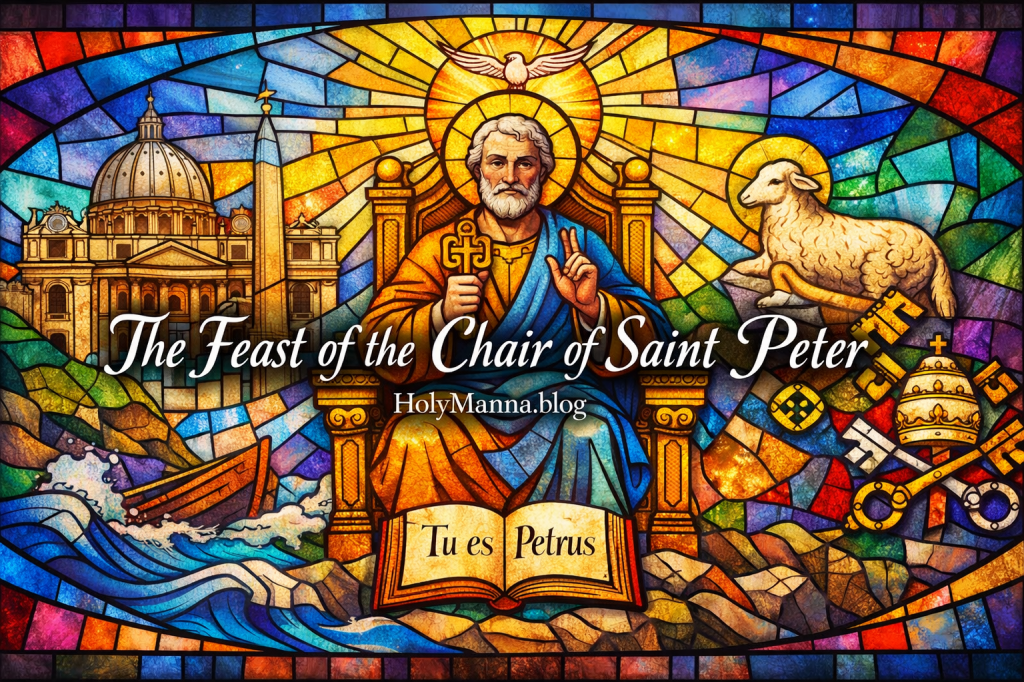
The Rock That Holds When Everything Shakes
The Feast of The Chair of Saint Peter can sound strange the first time it is heard, because it sounds like the Church is throwing a party for furniture. The truth is much deeper and much more human. This feast celebrates the way Jesus Christ chose to shepherd His Church through real history, real apostles, and a real, visible center of unity. The word “chair” comes from the cathedra, the teaching seat of a bishop, and it points to the Church’s belief that Christ gave Peter a unique pastoral mission that continues in Peter’s successors. CCC 880-882 explains that the successor of Peter is a visible source and foundation of unity for the whole Church, and this feast is basically the Church looking up and saying, “Thank You, Lord, for not leaving Your Bride orphaned.”
There is also a quiet comfort in this day. When Catholics say the Church is apostolic, it does not mean the Church has a nice origin story. It means the Church is still held together by Christ’s own design, through the apostles and their successors, especially through Peter’s role of strengthening the brethren. That is why this feast is not a victory lap. It is a prayer for unity, a renewal of faith, and a reminder that the Church is built on a rock that does not shift when the culture starts shaking.
From a Fisherman to a Church Built on Rock
The story behind the feast begins with a moment in The Gospel of Matthew that feels almost like a turning point in the whole New Testament. Jesus asks the apostles what people are saying, and then He gets personal with the question that matters: “Who do you say that I am?” Mt 16:15. Simon answers with a confession that sounds simple, but it is supernatural in its clarity: “You are the Christ, the Son of the living God.” Mt 16:16. Jesus responds with words Catholics never get to treat like poetic metaphor: “You are Peter, and upon this rock I will build my Church.” Mt 16:18. Then comes the image of the keys, which the Church has always understood as real authority given for real pastoral care: “I will give you the keys to the kingdom of heaven.” Mt 16:19.
Over the centuries, the Church began to honor Peter’s “chair” to celebrate not just Peter the man, but Peter’s mission as a shepherd and teacher. Early Christian tradition in Rome already had this feast by the fourth century, which matters because it shows how quickly the Church began reflecting liturgically on Peter’s role for the whole Church. There was also an older tradition of two related celebrations, one linked to Peter’s ministry in Rome and another linked to Antioch, because Peter preached there before his final witness in Rome. The details can feel historical, but the point is spiritual. The Church was remembering that Peter’s mission was not locked to one city as a local hero story. Peter’s ministry was for the communion of the whole Church.
There is also a detail that clears up a common misconception and makes the feast more interesting. Saint Peter’s Basilica is deeply connected to Peter’s tomb and to the Church’s devotion to him, but the cathedral of the Bishop of Rome is actually the Archbasilica of Saint John Lateran. That is where the Pope’s role as the local bishop of Rome is expressed in a special way, because every bishop has a cathedra in his cathedral. This is the Church quietly teaching something important. The papacy is not a floating office detached from the concrete life of the Church. The Pope is a bishop, and he shepherds the universal Church precisely as the Bishop of Rome, in continuity with the apostolic See associated with Peter.
The Keys Are a Responsibility
The theological significance of this feast is best understood through the lens of service. Jesus does not give Peter the keys as a reward for being the loudest apostle. He gives Peter authority so that the Church can remain one in faith and one in communion. CCC 553 explains that the “power of the keys” designates authority to govern the household of God, which is the Church. That authority is not meant to crush the faithful. It is meant to protect the flock, guard the Gospel, and keep the Church from being torn apart by every new idea that shows up as if it is the latest enlightenment.
This feast also makes sense when it is paired with Jesus’ words in The Gospel of Luke: “I have prayed that your faith may not fail; and when you have turned back, you must strengthen your brothers.” Lk 22:32. Catholics sometimes forget how tender that is. Jesus does not say Peter will never struggle. Jesus prays for Peter’s faith, and then commands Peter to strengthen the brethren. That is basically a mission statement for the Petrine ministry. It is why Catholics pray for the Pope even when they feel confused, even when they feel frustrated, and even when they do not understand everything happening in the wider Church. The Pope carries a duty given by Christ, and the faithful are meant to carry him in prayer.
This feast also gives a chance to explain “ex cathedra” without turning it into internet drama. The Church teaches that the Pope enjoys a charism of infallibility in a very specific situation, when he definitively proclaims a doctrine of faith or morals as supreme pastor and teacher. That is not a claim that the Pope is always right about politics, personalities, or preferences. It is a claim that Jesus protects His Church at decisive moments, so the faithful do not get abandoned to confusion about the essentials. CCC 891 lays this out carefully, and it is best heard as mercy, because it is Christ keeping His promise to His Bride.
A beautiful layer of meaning comes from the way the Church has spoken about the See of Rome as a ministry of unity, often described as “presiding in charity.” That phrase echoes the early Christian instinct that the Church needs a visible bond of communion, not as a power move, but as a safeguard for love and truth to remain together. Unity without truth becomes sentimentality. Truth without unity becomes a weapon. The Chair of Peter stands at that crossroads and says the Church is meant to remain one, holy, catholic, and apostolic in the confession of Christ.
Where Stone, Bronze, and Prayer Meet in Rome
This feast has always encouraged devotion that is simple enough for a kid to understand and deep enough for a theologian to never finish pondering. The most classic devotion is praying for the Pope, not as a political figure, but as a spiritual father and servant of unity. This prayer is not blind loyalty. It is humble confidence in Christ’s design for His Church. When Catholics pray for the Pope, they are praying for the whole Church, because division in the head often becomes division in the body, and Christ wants His body to live in peace.
Pilgrimage also fits this feast naturally, especially in Rome. Many pilgrims stand in Saint Peter’s Basilica and look toward the great artwork known as the Cathedra Petri. It is not just art meant to impress tourists. It is visual theology. The “Chair” is presented as upheld by four Doctors of the Church, with two from the West and two from the East, which quietly preaches that Peter’s ministry serves the unity of the universal Church across cultures, languages, and rites. Those Doctors are commonly identified as Saint Augustine and Saint Ambrose for the West, and Saint Athanasius and Saint John Chrysostom for the East. Above it all, the design draws the eyes toward the light of the Holy Spirit, which is the real secret of the Church’s endurance. The message is clear without being loud. The Church does not stand because of human genius. The Church stands because the Holy Spirit sustains the mission Christ gave.
There is also a smaller, almost forgotten kind of devotion connected to this feast. In earlier centuries, pilgrims would come to venerate the Chair with great affection, sometimes touching it with cloth or ribbons as a way of carrying the memory of that encounter home. Whatever a person thinks about the details of that custom, it reveals something important. Catholics have always loved tangible signs that point to invisible realities. The Chair is one of those signs. It is not worship. It is a physical reminder of a spiritual bond.
For anyone who cannot travel, a local pilgrimage can be just as real. Visiting one’s diocesan cathedral, praying near the bishop’s cathedra, and offering intercession for the bishop’s fidelity and courage fits perfectly with the feast. Communion with Peter is not a vague feeling. It is lived through communion with the bishops united to him. CCC 883 teaches that the bishops exercise authority in union with the Pope, and this feast reminds the faithful that unity is something practiced, not just claimed.
How Catholics Celebrate
Around the world, The Chair of Saint Peter is celebrated in the Roman Rite as a feast, which means it has real liturgical weight even if it does not always come with big cultural fireworks. In places where Catholic identity is strong and apostolic history is cherished, the day often brings special attention to praying for the Holy Father and teaching the faith clearly. In many parishes, this feast becomes a moment of catechesis, especially for Catholics who grew up hearing about “the Pope” without ever being taught why the Church speaks about Peter the way she does.
The readings commonly associated with the day also shape the way the feast is celebrated in preaching and prayer. Peter’s voice in 1 Pt 5:1-4 highlights shepherding that is humble and willing, not domineering. Psalm 23 reminds the faithful that every human shepherd must be measured against the Lord, who is the true Shepherd. Then Mt 16:13-19 anchors everything in Peter’s confession and Christ’s promise. These readings keep the feast from becoming a personality cult, because they keep the spotlight on Christ and His promises.
In some years, the feast falls close to Lent, which gives it an extra edge. It becomes a reminder that unity and fidelity do not happen by accident. They require conversion, humility, and prayer. This is why the feast often becomes a day when Catholics are encouraged to trade commentary for intercession, and to trade cynicism for a deeper trust in Christ’s ability to guide His Church.
The Chair of Peter
This feast teaches a kind of Catholic realism that is badly needed today. Peter was not chosen because he was flawless. Peter was chosen because Christ willed it, and Christ built His Church through weak men who were transformed by grace. That is not an excuse for sin. It is a reminder that the Church’s stability does not come from perfect leaders. It comes from Christ’s fidelity. The Church survives storms because Christ keeps His promises, not because the world approves of her.
The feast also presses one personal question into the heart, the same question Jesus asked the apostles: “Who do you say that I am?” Mt 16:15. The Petrine ministry exists to keep the Church’s answer steady across time, so that every generation can hear the confession clearly: “You are the Christ, the Son of the living God.” Mt 16:16. This is not just theology for classrooms. It is the foundation for daily life. If Jesus is truly the Christ, then obedience is not oppression. It is freedom. If Jesus is truly the Son of the living God, then the Church is not a club. She is His Bride, and unity matters.
A practical way to live this feast is to form the habit of praying for the Pope and bishops in ordinary seasons, not only during controversy. That habit purifies the heart. It makes it harder to treat the Church like a sports team and easier to treat her like a family. It also forms a Catholic imagination that trusts Christ’s authority even when human leadership looks messy. Christ is not asking for a naive mind. Christ is asking for a faithful heart.
How does Jesus’ question land today, not as an argument, but as a call to discipleship?
Is the heart more practiced at criticism than intercession?
Would family life, work life, and online life look different if prayer for unity became a real daily habit?
Engage with Us!
Share thoughts and reflections in the comments below. This feast has a quiet strength to it, and it often hits people differently depending on what season of life they are in.
- When the Church feels confusing or divided, what helps the heart stay anchored to Christ instead of drifting into frustration or cynicism?
- How often is prayer offered for the Pope and bishops, not as a hot take, but as a real act of love for the Church?
- What does it look like to confess, with Peter, “You are the Christ” in daily life at home, at work, and online?
- Where is God inviting deeper obedience to the Church’s teaching, not as control, but as freedom in the truth?
- What is one concrete act of unity that could be practiced this week, especially with someone who thinks differently?
Keep walking forward in faith. Keep loving the Church, even when it feels hard, because Jesus loves her first. Do everything with the love and mercy Jesus taught us, and let that love start with prayer, humility, and a steady confession of Christ.
Pope Saint Peter, pray for us!
Follow us on YouTube, Instagram and Facebook for more insights and reflections on living a faith-filled life.

 Holy Manna!
Leave a comment