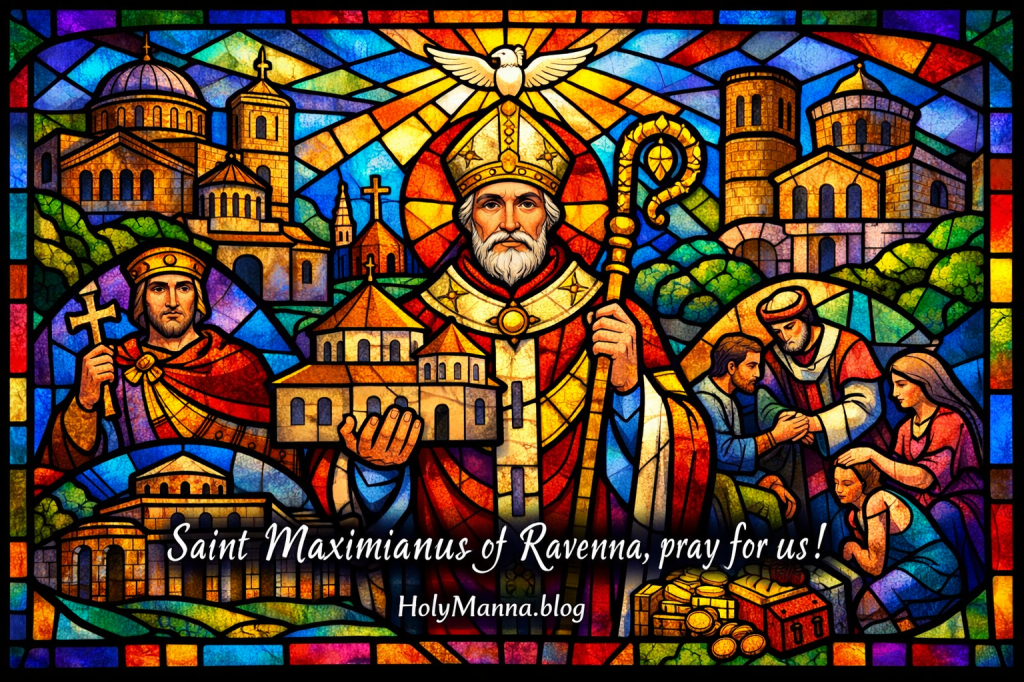
The Bishop Who Turned Division into Communion
Saint Maximianus of Ravenna stepped into leadership when Italy was a battleground of empires and ideas. Ravenna was not a quiet corner of the Christian world. It was a city where politics and religion collided, where old wounds from Arianism still lingered, and where believers could be tempted to treat the Church like a faction instead of a family. In that kind of moment, God often raises up a saint who does not win people over with charisma, but with fidelity.
The Church remembers Maximianus as a bishop who faithfully carried out his pastoral office and defended the unity of the Church against heresy. That is not a soft compliment. That is a description of a man who kept the faith steady when the ground shook under everyone’s feet. The bishop’s mission is not to echo the noise of the age, but to guard the apostolic faith and keep the flock in communion, because the bishop is meant to be a visible source and foundation of unity in the local Church, as The Catechism teaches in CCC 886. Maximianus lived that vocation with grit, patience, and a deep love for the Church’s worship.
From Istria to Ravenna’s Storm
Maximianus was born around the year 498 in Pola, in the region of Istria. He served as a deacon there before being drawn into the wider life of the Church. His path to Ravenna was not ordinary, and that is part of what makes his story so relatable. God sometimes calls someone into a mission that feels bigger than his background, and the call does not always come with a warm welcome.
Catholic tradition holds that his appointment to Ravenna was connected to imperial influence, and he was consecrated bishop in the year 546 by Pope Vigilius. That detail matters because it explains why many locals resisted him at first. People often want a shepherd who feels familiar, and they can resent a shepherd who arrives with the scent of distant power.
One of the most striking stories preserved in Catholic accounts is that Maximianus initially faced such pushback that he waited outside the city for a time, relying on hospitality until he could take full possession of his see. Even more surprising, the tradition remembers him being hosted by an Arian Gothic bishop. That detail is almost uncomfortable, but it shows how messy real history can be. It also shows what Christian patience looks like when a saint refuses to respond to rejection with bitterness. Maximianus did not force love. He earned trust through steady service.
Catholic summaries also preserve a providential tradition about a discovered “treasure” connected to him or his family, often mentioned as part of how resources became available for his work. Whether someone reads that as a literal episode or as the kind of memory that grows in the telling, the meaning is clear. God provided what was needed for the mission God gave him.
The Builder Who Preached With Gold and Stone
Maximianus is especially remembered as the first archbishop of Ravenna, serving roughly from 546 to 556. Catholic tradition also remembers that in seasons when Pope Vigilius was absent from Rome, and when other sees were weakened by turmoil, Maximianus carried heavy responsibility for maintaining ecclesial order in Italy. That does not mean he replaced the Pope. It means he was a stabilizing presence in communion with Rome during a season of chaos. That is exactly what bishops are meant to be, because the sacrament of Holy Orders makes them successors of the Apostles entrusted with teaching, governing, and sanctifying, as The Catechism explains in CCC 1558–1560.
He is also remembered for defending unity against heresy and for working amid the painful divisions connected to the Three Chapters controversy. In plain language, he labored in a Church that was arguing about theology, authority, and political pressure all at once. Maximianus did not become famous for clever slogans. He became holy by refusing to let truth be abandoned and by refusing to let charity die.
Then there is the other half of his legacy, the part that still stuns people today. Maximianus helped complete and dedicate some of Ravenna’s most celebrated basilicas, including San Vitale and Sant’Apollinare in Classe. Those churches are not just tourist landmarks. In a Catholic key, they are sermons built for the eyes, designed to lift the mind to God and to form the faithful through sacred beauty.
In San Vitale, Maximianus is not hidden in the background. He is depicted in mosaic beside Emperor Justinian, and his name is displayed prominently. That image is a message. It says the Church’s shepherd stands in the public square, not to chase power, but to guard worship and faith. It also shows how the Church uses beauty to teach. Sacred art is meant to confess the faith, not merely decorate a room, and The Catechism teaches that Christian art should evoke and glorify the mystery of God, leading hearts toward worship, as seen in CCC 2500–2503. Ravenna is a living proof of that teaching.
Catholic sources also associate Maximianus with a spectacular ivory episcopal chair traditionally called the Cathedra of Maximianus. It is covered with biblical scenes carved in ivory, like a carved catechism. Even if scholars debate details of its attribution, the Catholic tradition surrounding it remains powerful. The bishop’s “cathedra” is not only furniture. It is a symbol of the teaching office, the duty to proclaim Christ faithfully. That chair, with Scripture carved into it, captures Maximianus’ whole approach. He believed the faith should be taught clearly, beautifully, and publicly.
The Quiet Shape of Holiness
Some saints are remembered for dramatic miracles. Maximianus is remembered more for dramatic fidelity. In the main Catholic memory of him, the focus lands on his pastoral care, his defense of unity, and his strengthening of worship. That does not make him less of a saint. It makes him a saint who looks a lot like the kind of holiness most Catholics are actually called to live. His sanctity was not built on spectacle. It was built on perseverance.
A treasured description preserved in Catholic tradition captures how he was remembered by those who told his story. It says, “He welcomed strangers, called back those who fell into error, gave the poor what they needed, and consoled the suffering.” That is not the language of a politician. That is the language of a father in Christ.
That description also lines up with what the Church teaches about the Christian life. A shepherd protects truth, but he does it with a heart trained in mercy. He corrects error, but he does it like a doctor who wants healing, not like an enemy who wants a win. If a modern Catholic wants to understand what a faithful bishop looks like, Maximianus is a strong example. He was committed to unity because Christ prayed for unity, and he knew division always becomes an opening for the enemy.
Even the absence of flashy miracle stories becomes a kind of lesson. Maximianus’ “miracle,” in a practical sense, was holding a divided Church together long enough for worship, doctrine, and charity to take root again.
Courage Without Drama
Maximianus was not killed for the faith, but he still carried a real cross. He faced the bitterness of people who did not want him. He faced the tension of a Church pulled between factions. He faced the weight of imperial politics, which can suffocate pastoral freedom if a bishop forgets who his true King is.
He endured these hardships in a way that shows real spiritual maturity. He did not answer resistance with contempt. He did not treat his flock like an enemy. He stayed faithful and worked patiently for communion. That kind of endurance is a form of courage that does not get celebrated much today, but it is exactly the kind of courage that keeps families together, parishes healthy, and faith alive across generations.
This is where Maximianus becomes a saint for the modern moment. It is easy to believe courage means constant confrontation. Sometimes courage means steady, boring fidelity that refuses to quit. Sometimes courage means building slowly while everyone else is arguing loudly.
How often does the heart confuse winning an argument with winning a soul back to Christ?
How often does pride pretend it is “principle,” when it is really just impatience?
The City That Still Preaches
Saint Maximianus died on February 22 in the year 556. He was buried in Ravenna, and centuries later, amid the upheavals that followed the Napoleonic era, his remains were transferred to the cathedral. That kind of continuity matters because it reflects the Church’s lived belief in the communion of saints. The saints are not inspirational characters from a distant past. They are members of the living Body of Christ, and the Church continues to honor them, ask their intercession, and learn from their witness, as The Catechism teaches in CCC 956 and CCC 2683.
Catholic tradition also connects Maximianus with devotion to the city’s apostolic roots, especially through attention to the memory and relics of Saint Apollinaris, Ravenna’s early shepherd. In a city filled with sacred history, Maximianus helped ensure that memory did not become mere nostalgia. He helped root the faithful in continuity, reminding them that the Church does not invent herself. She receives the faith handed on from the Apostles.
Ravenna still speaks his name through beauty. The mosaics still shine. The basilicas still draw eyes upward. The sacred art still teaches, even to someone who walks in skeptical and curious. That is part of Maximianus’ legacy after death. He helped build a Catholic imagination that could survive political collapse, because the splendor of worship forms hearts to endure.
A Reflection for the Modern Heart
Saint Maximianus is a saint for Catholics who are tired of division and tired of loud spiritual theatrics. His life points to something steadier. The Church does not need more hot takes. The Church needs more fidelity.
His story teaches that unity is not built by pretending truth does not matter, and it is not built by treating people like enemies. Unity is built by refusing to compromise the divinity of Christ, refusing to abandon communion, and refusing to let charity rot. A Catholic living this out today can choose to speak clearly, pray more, gossip less, and take responsibility for peace in the family and parish.
His witness also teaches that beauty matters. Reverence matters. The way Catholics pray shapes how Catholics live. Maximianus invested in worship because worship forms the soul. That is not extra. That is essential.
What would change if Sunday Mass was treated like the center of the week instead of a weekend obligation?
What would change if the heart chose patient charity before hitting back in frustration?
Engage with Us!
Readers are invited to share thoughts and reflections in the comments below. The Church grows stronger when Catholics learn from the saints together and encourage one another to live the faith with clarity and charity.
- Where is God asking for patient endurance right now, especially in a relationship or community that feels strained?
- What is one concrete way to protect unity in truth, without watering down conviction or losing charity?
- How can beauty and reverence in prayer become a stronger part of everyday life, even in a busy schedule?
- What is one small act of mercy that can be offered this week to welcome the stranger, comfort the suffering, or help the poor?
Keep walking forward in faith. Keep choosing truth and charity together. Keep building what lasts. A life lived close to Jesus, shaped by mercy, and grounded in the Church will never be wasted, because everything done with the love and mercy Jesus taught becomes a quiet sermon that reaches farther than anyone realizes.
Saint Maximianus of Ravenna, pray for us!
Follow us on YouTube, Instagram and Facebook for more insights and reflections on living a faith-filled life.

 Holy Manna!
Leave a comment