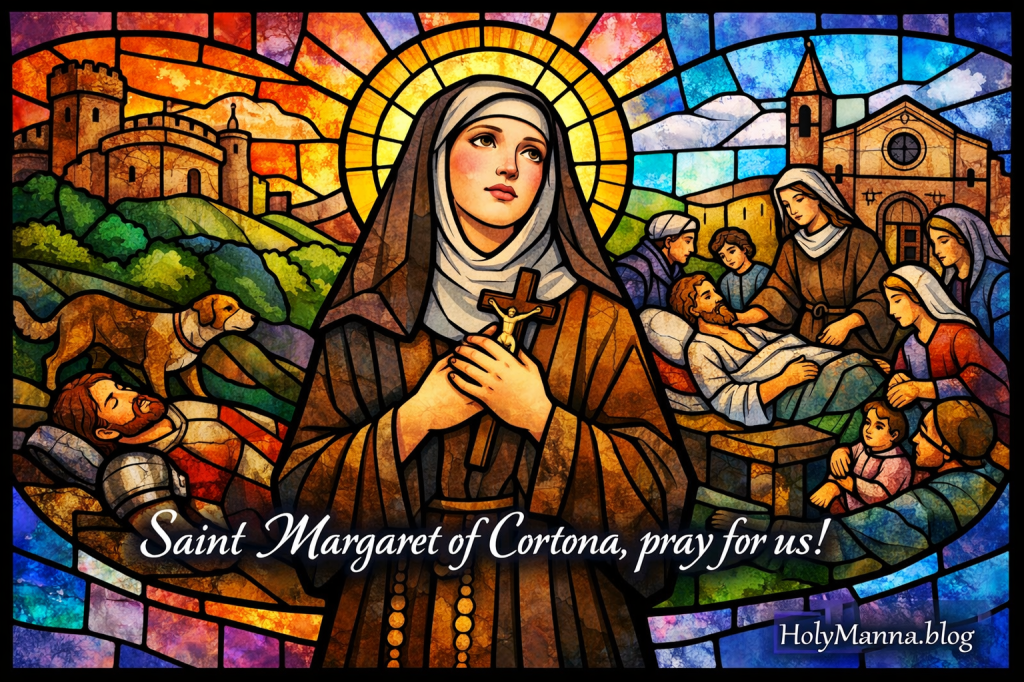
When Mercy Rewrites a Life
Saint Margaret of Cortona is the kind of saint who makes people sit up and listen, because her holiness is not a fairytale. Her story is raw, public, and deeply Catholic. She is remembered as a penitent of the Third Order of Saint Francis, a woman whose past was messy enough to scandalize the respectable, and whose conversion became so undeniable that even her critics could not ignore the grace at work in her. She is often called a “Second Magdalene,” not because the Church enjoys dramatic stories, but because the Gospel pattern is real. Jesus Christ still seeks the lost, heals the broken, and turns sinners into saints.
This is not a soft message about sin. The Church never treats sin like it is harmless. But the Church also refuses to treat sin like it has the final word. The Catechism of the Catholic Church teaches that conversion is a lifelong turning back to God, a change of heart that becomes visible in a changed life (CCC 1427 to 1433). Margaret’s whole legacy is a loud and steady witness that nobody is beyond repentance, and nobody is beyond Christ’s ability to rebuild what has been broken.
A Motherless Girl
Margaret was born in 1247 in Laviano, Tuscany, to farming parents. Her mother died when Margaret was still young, and that loss left a wound that did not simply disappear with time. Her father remarried, and the relationship between Margaret and her stepmother became tense and cold. Margaret had the kind of heart that craved affection and stability, and when she did not find it where she should have, she began looking for it where she should not have.
Around the age of seventeen, Margaret met a young nobleman, and one night she fled her father’s home with him. For nine years she lived with him in his castle near Montepulciano, not as a wife but as his mistress. A son was born to them. She repeatedly urged him to marry her, and he repeatedly promised, but he never followed through. Even while living in that irregular situation, she was not made of stone. She was known to be compassionate to the poor, and she sometimes slipped away to quiet places to dream of a different life, a life given to virtue and the love of God. More than once, neighbors warned her to look to her soul before it was too late.
There is a striking moment preserved in her tradition that says a lot about her spiritual instinct. When warned, she responded with a confidence that sounds impossible at first, but proved true in the end: “Do not fear for me. I will die a saint, and my critics will come as pilgrims to my shrine.” That is not pride. That is a soul, still tangled, but already being tugged by grace.
The Hound in the Road
Margaret’s turning point was not a gentle nudge. It was a spiritual earthquake. Her lover was murdered while traveling, and the first sign she received was his favorite hound returning home alone. The dog led her to the hidden body. In an instant she saw what sin always tries to hide. Death is real. Judgment is real. Eternity is real. The life she had built on promises and passion could not protect her from the truth.
What happened next matters, because it shows the difference between regret and repentance. Margaret did not try to manage her image. She blamed herself for the irregular life her lover had lived with her, and she began to loathe the beauty that had helped draw him into sin. She returned the jewels and property he had given her, and then she left that home behind, taking her little son with her. She went back to her father’s house, hoping for shelter, but her stepmother refused to receive her. Margaret and her son were turned away and left adrift.
That is the moment when many people collapse into bitterness or desperation. Margaret felt tempted to trade on her beauty to survive, and she knew exactly where that road led. Instead, she prayed with a desperate sincerity. In her soul she sensed a call to go to the Franciscan friars in Cortona and place herself under spiritual direction. When she arrived in Cortona, two women noticed her loneliness, took her in, and helped her connect with the friars at the church of San Francesco. God used ordinary kindness to protect a woman trying to begin again.
Three Years of Temptation
Margaret did not become holy overnight. For three years she struggled hard with temptations. She was naturally lively, and the world still pulled at her. But she did not romanticize her weakness. She learned that temptation is not proof that conversion is fake. Temptation often proves conversion is real, because the soul is finally fighting.
Her remorse sometimes pushed her toward extreme self-mortification, but her confessors guided her with wisdom. That detail is important in a Catholic perspective. Holiness is not self-hatred. True penance is ordered, obedient, and aimed at love. Margaret fasted rigorously, abstained from meat, and lived simply, often subsisting on bread and herbs. She did not do these things to punish herself into earning forgiveness. She did them to discipline a heart that had been undisciplined, and to unite herself to Christ crucified.
After those three years of probation, she was admitted to the Third Order of Saint Francis. From that point she embraced strict poverty. She begged for her bread in the Franciscan spirit, and then turned around and gave herself freely in service to others, especially the sick poor. Her conversion did not produce a private, cozy spirituality. It produced a public, sacrificial life that looked like the Gospel.
The Voice That Changed Everything
Around the time she became a Franciscan tertiary, Margaret’s mystical life deepened in a way that Catholic tradition has carefully preserved. While praying in the Franciscan church, she heard the words: “What is thy wish, poverella?” She replied with a line that has echoed through centuries of Catholic devotion: “I neither seek nor wish for aught but Thee, my Lord Jesus.”
That is not a dramatic quote for a scrapbook. It is the interior logic of sanctity. When a person truly wants Christ above everything, their whole life begins to reorder itself. Margaret’s tradition even says that at first the Lord addressed her as “poverella,” and only after purification did He call her “My child.” That is deeply Catholic in tone. God’s tenderness does not erase conversion. It crowns it.
Margaret’s mystical prayer never turned her into a spiritual celebrity chasing attention. In fact, it pushed her into hidden sacrifices and harder service. She became more and more like a recluse in her personal habits, but she remained active in mercy, because authentic prayer always bears fruit in charity.
A Hospital Built on Repentance
Margaret’s most visible legacy in Cortona was not a reputation. It was an institution of mercy. She prevailed upon the city to found a hospital for the sick poor. That hospital, known as Santa Maria della Misericordia, became a place not only for the sick, but also for the poor, the homeless, and those with nowhere else to go. It even sheltered pilgrims and protected abandoned children. Her repentance did not stay on her knees. It moved into the streets.
To provide nurses for this work, she instituted a group of tertiary sisters known as le poverelle, the “little poor ones.” These women became living extensions of Franciscan charity, serving those society preferred to ignore. Margaret also established a confraternity dedicated to Our Lady of Mercy. Members bound themselves to support the hospital and to help the needy wherever they were found, with special attention to those who were “respectable poor,” the kind of poor who suffer quietly because shame keeps them from begging.
This is one of the most challenging parts of Margaret’s story, because it forces the question every Catholic eventually has to face. Repentance is not only about turning away from sin. It is also about turning toward love. The Catechism of the Catholic Church holds up works of mercy as a concrete expression of Christian charity (CCC 2447). Margaret did not just talk about mercy. She built it, staffed it, and defended it.
A Saint Who Ended Feuds
Margaret was not only a servant of the poor. She was also a surprising peacemaker in public life. On several occasions she intervened in civic affairs to help end feuds. That matters because it shows she understood sin is not only personal. Sin also breaks communities, families, and cities. A saint who has tasted mercy often becomes a bridge-builder.
Even more striking is the tradition that she twice upbraided the Bishop of Arezzo, Guglielmo Ubertini Pazzi, because he lived more like a secular prince and soldier than like a pastor of souls. She did this, according to her tradition, in obedience to a divine command. That kind of boldness is not common. It is also not casual. A penitent does not correct others out of superiority. A true penitent speaks hard truth because she knows what sin costs and because she loves the Church enough to want her shepherds to live like shepherds.
There is a reason her story still resonates. Conversion does not make someone timid. It makes someone honest, disciplined, and brave.
Quiet on the Hill
As Margaret’s work expanded, her desire for silence grew. For the sake of greater quiet, she moved her lodging away from the hospital to near the ruined church of St. Basil above Cortona. She helped restore that little place and lived there in deeper recollection. This part of her story keeps the balance. She was not an activist who forgot prayer, and she was not a mystic who forgot people. She lived the Catholic both and. Prayer and penance. Silence and mercy. Hidden suffering and public charity.
Those final years also show that sanctity is not always loud. Sometimes God asks a saint to spend the best part of life in quiet fidelity. Margaret’s reputation for holiness continued to spread, but she kept choosing humility, obedience, and simplicity.
Purified in the Dark
Margaret was not a martyr by blood, but she lived a kind of martyrdom that many modern Catholics recognize. She endured suspicion and slander, partly because of her past and partly because holiness always irritates someone who wants to stay comfortable. Even some religious people can behave like gatekeepers of grace, acting as if mercy should be rationed.
A sharp line associated with her tradition captures that experience: “I see more Pharisees among Christians than surrounded Pilate.” That sentence stings because it has teeth, but it also has truth. Margaret knew what it felt like to be judged, and she refused to let judgment push her away from God.
Her hardships also included interior struggle. Temptations did not vanish. Remorse still threatened to become unhealthy extremes. Spiritual direction remained necessary. This is a very Catholic realism. Holiness is not a clean break into ease. It is a persevering surrender that keeps saying yes.
A Tomb That Would Not Stay Silent
Margaret died on February 22, 1297. She was acclaimed as a saint by many almost immediately, because her life had become a public testimony of conversion and mercy. After her death, miracles were widely reported through her intercession, especially healings and graces attributed to prayer at her tomb. Catholic tradition also speaks of her body being found incorrupt and venerated in Cortona, drawing generations of pilgrims who come seeking mercy, healing, and conversion.
Her legacy did not stay local. Over time, liturgical honors grew, tied in tradition to the testimony of miracles. Her veneration was strengthened and extended, and centuries later she was formally canonized in 1728. Cortona’s devotion became part of the city’s identity. Her sanctuary history remembers translations of her relics, the reception of the crucifix associated with her prayer, and civic celebrations honoring her. The church dedicated to her was eventually elevated to the dignity of a minor basilica in the twentieth century, confirming that the life of a once-scandalous penitent had become a lasting light for the Church.
This is the part of the story that feels almost poetic. The young woman once rejected at the door became the saint whose shrine welcomes crowds. The sinner once whispered about became the intercessor publicly honored. Mercy did exactly what mercy always does. It rebuilds.
How to Live Like Margaret
Saint Margaret of Cortona is not only for people with dramatic backstories. She is for anyone who has ever carried shame, anyone who has ever tried to start over, and anyone who has ever felt judged by the people who should have been the most compassionate. Her life teaches that repentance is not groveling forever. Repentance is coming home and then learning how to live like a son or daughter again.
A Catholic life shaped by Margaret will take the sacraments seriously. Confession will not be treated like an occasional reset button. It will be treated like a real encounter with Christ’s mercy. The Catechism of the Catholic Church teaches that interior repentance seeks outward expression, and that the sacrament of Reconciliation restores communion with God and the Church (CCC 1430 to 1433, CCC 1422 to 1460). Margaret’s story makes that teaching feel concrete.
Her life also challenges the modern habit of judging others while excusing personal sins. It is easy to be “religious” and still be cruel. Margaret reminds every Catholic that holiness without mercy is not holiness. A practical way to honor her is to perform works of mercy that cost something, not just the kind that feel nice. It could mean supporting a local pregnancy center, serving at a shelter, visiting the sick, or quietly helping the “respectable poor” who suffer in silence.
The final lesson is simple and hard. God can redeem any past, but grace must be protected by discipline. That means prayer that is real, friendships that are healthy, and a willingness to cut off whatever leads back into sin. Margaret proves that when Christ becomes the one desire of the heart, the rest of life begins to fall into place.
Engage with Us!
Share your thoughts and reflections in the comments below. Saint Margaret’s story hits deep, especially for anyone who has ever felt trapped in regret or judged by others.
- Where does shame try to keep the heart hiding from God, instead of running to Him?
- What practical step could be taken this week to return to the sacraments with more sincerity, especially Confession and the Eucharist?
- How can past wounds be offered to Christ so they become a source of compassion instead of a source of bitterness?
- What work of mercy could be done for someone who feels “unlovable” or forgotten, the way Margaret once did?
May Saint Margaret of Cortona intercede for every soul trying to start again. Live a life of faith, run to Jesus without delay, and do everything with the love and mercy Jesus taught us.
Saint Margaret of Cortona, pray for us!
Follow us on YouTube, Instagram and Facebook for more insights and reflections on living a faith-filled life.

 Holy Manna!
Leave a comment