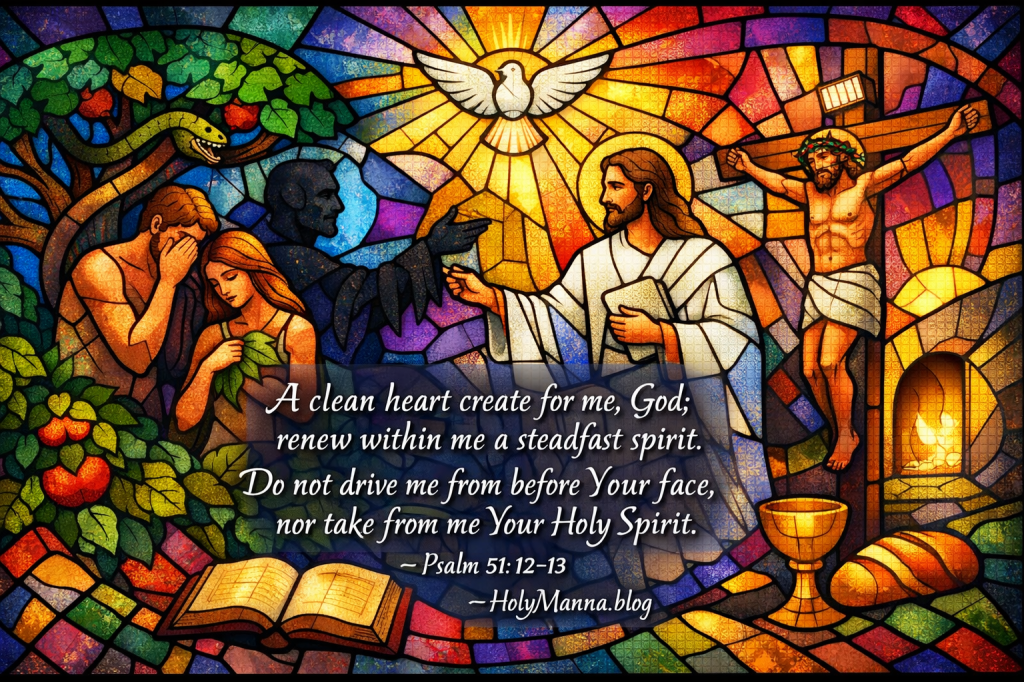
First Sunday of Lent – Lectionary: 22
The Desert Where Trust Is Reborn
There is something honest about the First Sunday of Lent, because the Church does not begin this season with spiritual slogans or vague motivation. The Church begins with a story about a garden, a serpent, a broken trust, and then a desert where that trust is fought for and restored. The central theme running through today’s readings is the battle for the human heart: temptation tries to poison trust in God, but grace restores trust through repentance and obedience.
In Genesis 2:7-9; 3:1-7, humanity’s life begins with intimacy, because the Lord forms man from the dust and breathes His own life into him. This is not a cold origin story. It is the revelation that the human person is both humble and sacred, made from earth yet animated by God’s gift. Then the serpent enters the scene with a question that still echoes in every age: “Did God really say…?” The temptation is not simply about food. It is about suspicion. It is about twisting God’s love into something to doubt, and rebranding obedience as deprivation. The fall happens when trust collapses first, and the act of disobedience follows right behind it.
The Church answers that ancient collapse with Psalm 51:3-6, 12-13, 17, a penitential cry that refuses to hide behind excuses. This psalm is the sound of fig leaves being dropped, because sin always drives the soul to cover, conceal, and perform. Yet mercy invites the truth. The prayer does not ask for a makeover. It asks for a miracle: “A clean heart create for me, God.” Lent begins here because conversion is not cosmetic. Conversion is re-creation.
Then Romans 5:12-19 pulls back the curtain and shows the deeper pattern of history. Adam’s disobedience does not remain trapped in the past. It fractures the human family, and death enters the world like a dark inheritance. But St. Paul refuses to let the story end in ruin. He sets Adam and Christ side by side and proclaims that salvation is not advice. Salvation is a gift. Where one man’s disobedience spread sin and condemnation, Christ’s obedience opens the floodgates of grace and life.
That is why the Church brings everyone into Matthew 4:1-11 today. Jesus enters the desert not as a detached observer, but as the New Adam who steps into the battlefield where humanity keeps losing. The devil tempts Him the way he tempts every generation: by urging comfort without trust, spirituality without surrender, and glory without the cross. Jesus answers with the Word of God, refusing shortcuts and refusing suspicion. Lent is not about proving personal strength. Lent is about learning again what was lost in Eden: how to live as beloved children who trust the Father, cling to His Word, and choose obedience that leads to life.
First Reading – Genesis 2:7-9; 3:1-7
Dust, Breath, and the First Whisper of Doubt
Long before Israel had kings, long before the Temple rose in Jerusalem, the Holy Spirit gave the Church this ancient story to explain what every human heart already knows. The human person is made for communion with God, and yet something inside keeps pulling away. Genesis 2:7-9; 3:1-7 is not written like a modern history report. It is written like sacred memory, revealing the spiritual roots of the world’s ache. God forms man from the dust and breathes life into him, which means human life is both humble and astonishing. The Garden is a gift, not a prison, and the command is not cruelty. The command is love setting a boundary so love can stay free. Then the serpent enters, not with brute force, but with a suggestion that God cannot be trusted. That is why this reading fits perfectly at the doorway of Lent. The season begins where the wound began, because Christ comes to heal the human heart at the level of trust.
Genesis 2:7-9; 3:1-7 – New American Bible (Revised Edition)
2:7 then the Lord God formed the man out of the dust of the ground and blew into his nostrils the breath of life, and the man became a living being.
8 The Lord God planted a garden in Eden, in the east, and placed there the man whom he had formed. 9 Out of the ground the Lord God made grow every tree that was delightful to look at and good for food, with the tree of life in the middle of the garden and the tree of the knowledge of good and evil.
Expulsion from Eden. 3:1 Now the snake was the most cunning of all the wild animals that the Lord God had made. He asked the woman, “Did God really say, ‘You shall not eat from any of the trees in the garden’?” 2 The woman answered the snake: “We may eat of the fruit of the trees in the garden; 3 it is only about the fruit of the tree in the middle of the garden that God said, ‘You shall not eat it or even touch it, or else you will die.’” 4 But the snake said to the woman: “You certainly will not die! 5 God knows well that when you eat of it your eyes will be opened and you will be like gods, who know good and evil.” 6 The woman saw that the tree was good for food and pleasing to the eyes, and the tree was desirable for gaining wisdom. So she took some of its fruit and ate it; and she also gave some to her husband, who was with her, and he ate it. 7 Then the eyes of both of them were opened, and they knew that they were naked; so they sewed fig leaves together and made loincloths for themselves.
Detailed Exegesis
Verse 7: “then the Lord God formed the man out of the dust of the ground and blew into his nostrils the breath of life, and the man became a living being.”
This verse holds together two truths that the modern world often tears apart. The human person is dust, which crushes pride, and the human person is filled with God’s breath, which destroys despair. The body is not an accident, and the soul is not a self-made spark. Life is received. That is why Lent is not self-reinvention. Lent is a return to the Giver.
Verse 8: “The Lord God planted a garden in Eden, in the east, and placed there the man whom he had formed.”
God does not create man and then abandon him to survival. God places man in a garden, a place of order, beauty, and abundance. The detail about being “in the east” evokes the direction of light and dawn, which becomes a quiet symbol of God’s initiative. The first movement is always God’s generosity.
Verse 9: “Out of the ground the Lord God made grow every tree that was delightful to look at and good for food, with the tree of life in the middle of the garden and the tree of the knowledge of good and evil.”
God’s goodness is visible and edible. The trees are “delightful” and “good,” which matters because temptation later tries to repaint God as stingy. The “tree of life” speaks to the destiny God intends, life with Him. The “tree of the knowledge of good and evil” signals a boundary. It is not a trick. It is a truth: creaturehood has limits, and receiving those limits in love is part of holiness.
Chapter 3, Verse 1: “Now the snake was the most cunning of all the wild animals that the Lord God had made. He asked the woman, ‘Did God really say, “You shall not eat from any of the trees in the garden”?’”
The serpent does not begin by praising evil. He begins by distorting God’s word, making it sound harsher than it is. That is how many temptations still start. The enemy rarely says, “Choose misery.” The enemy says, “God is holding out.” The first attack is against trust, because once trust collapses, sin feels reasonable.
Verse 2: “The woman answered the snake: ‘We may eat of the fruit of the trees in the garden;’”
Eve answers with a true reminder of abundance. God has been generous. Even here, the story shows that temptation is not defeated by ignorance alone. The problem is not that Eve has never heard God’s command. The problem is that the conversation continues.
Verse 3: “‘it is only about the fruit of the tree in the middle of the garden that God said, “You shall not eat it or even touch it, or else you will die.”’”
The boundary is recalled, but the wording subtly shifts. The added phrase “or even touch it” reveals how temptation can blur clarity. When the heart begins to fear God, His command starts to feel like danger rather than protection. Sin often grows in the fog of half-remembered truth.
Verse 4: “But the snake said to the woman: ‘You certainly will not die!’”
This is the blunt lie at the center of so many modern sins. It is the promise of consequence-free rebellion. The enemy sells disobedience as harmless, and the bill always arrives later in shame, broken relationships, and spiritual numbness.
Verse 5: “‘God knows well that when you eat of it your eyes will be opened and you will be like gods, who know good and evil.’”
The serpent frames God as threatened by human greatness, as if the Father is competing with His children. The bait is not merely pleasure. The bait is self-deification, the desire to define reality on personal terms. This is the ancient sin dressed in modern clothing, the refusal to receive truth and the demand to manufacture it.
Verse 6: “The woman saw that the tree was good for food and pleasing to the eyes, and the tree was desirable for gaining wisdom. So she took some of its fruit and ate it; and she also gave some to her husband, who was with her, and he ate it.”
Temptation recruits the senses, the imagination, and the desire for control. The fruit looks good, so the heart concludes it must be good. Adam is “with her,” which makes the silence even heavier. Sin spreads socially, not only personally. The fall is not only an individual failure. It becomes a family fracture.
Verse 7: “Then the eyes of both of them were opened, and they knew that they were naked; so they sewed fig leaves together and made loincloths for themselves.”
The serpent promised enlightenment, but what arrives is shame. Their eyes open, but not into divinity. They open into self-protection. Nakedness becomes threatening, not because the body is bad, but because innocence has been wounded. Sin twists the way a person sees God, sees self, and sees the other. The first instinct becomes hiding.
Teachings
The Church reads this passage as the revelation of original holiness, original sin, and the lasting wound that Christ alone heals. The story teaches that humanity’s first problem was not information. The first problem was trust. The Catechism names the core of the fall with clear, sobering simplicity: “Man, tempted by the devil, let his trust in his Creator die in his heart and, abusing his freedom, disobeyed God’s command.” CCC 397 This is why the serpent’s first tactic is a question. Doubt is the doorway, and disobedience is what walks through it.
The passage also exposes the false promise at the heart of sin, the urge to become self-made gods. The Catechism describes that inner reversal of love: “In that sin man preferred himself to God and by that very act scorned him.” CCC 398 Sin is not merely breaking a rule. Sin is bending worship inward, treating the self as the final authority.
Then comes the immediate aftermath, which Genesis shows with painful honesty. The fig leaves are not just clothing. They are a symbol of what every sinner still tries to do, which is to cover the wound with something human-made. The Church teaches that the first sin shattered the original harmony and left a lasting inclination toward sin. That is why the human person can love the good and still feel dragged toward lesser things. The Catechism summarizes the inherited wound without turning it into hopelessness: “Original sin does not have the character of a personal fault in any of Adam’s descendants.” CCC 405 It is a condition that needs healing, not a personal crime stamped on a newborn.
Even in the shadow of the fall, the story still whispers dignity. God’s breath remains the source of human life. The human person is not trash. The human person is not a mistake. The human person is a creature made for communion. That is why a saint like St. Irenaeus can speak with such confidence about human destiny: “The glory of God is man fully alive.” The point of salvation is not to erase humanity, but to restore it, to make the dust shine again with the breath of God.
Reflection
This reading is not only about a moment in a garden. It is about what happens in the mind on an ordinary Tuesday when temptation begins to talk. The serpent still works the same angles. The temptation often starts with suspicion that God’s commands are burdens, or that God’s timing is cruel, or that God’s will is smaller than personal desire. When that suspicion is entertained long enough, disobedience starts to feel like liberation. Then, after the moment passes, the soul reaches for fig leaves. The soul tries to cover shame with distraction, noise, excuses, cynicism, or secret habits that promise comfort but deepen loneliness.
Lent offers a better path, and it starts with a simple act that feels almost rebellious in a noisy world. It starts with refusing to negotiate with the serpent. Temptation loves dialogue. Holiness loves clarity. When a thought arrives that paints God as untrustworthy, it helps to answer it with truth immediately, and then to turn the heart toward prayer. Psalm 51 becomes a practical weapon because it is honest and confident at the same time. It teaches the soul to stop hiding and to ask God for what only God can give, a clean heart.
It also helps to remember what the serpent hides. God’s boundaries are not meant to starve joy. God’s boundaries are meant to protect love. A parent who tells a child not to run into traffic is not limiting freedom, but preserving life. In the same way, God’s commandments are the guardrails of communion.
Where has the serpent’s question been echoing lately, the subtle thought that says God cannot be trusted?
What “fig leaves” usually show up after a fall, and what would it look like to bring that shame into the light through repentance?
When desire feels urgent, what would change if the heart paused long enough to remember that life comes from God’s breath, not from grabbing forbidden fruit?
Responsorial Psalm – Psalm 51:3-6, 12-13, 17
When the Fig Leaves Fall and Mercy Starts Talking
There is a reason the Church places Psalm 51 on the First Sunday of Lent, right after the story of Eden. The fall in Genesis 3:1-7 ends with hiding, covering, and shame. This psalm is what happens when a sinner stops hiding and finally speaks to God like a child who knows the Father is both holy and merciful. Historically, Psalm 51 is tied to one of the most painful moments in King David’s life, after his grave sins and the prophet Nathan’s confrontation. It became Israel’s great prayer of repentance, and it became the Church’s own voice whenever the faithful enter a season of conversion. Lent is not a mood. Lent is a homecoming. That is why this psalm fits today’s theme so perfectly. Temptation tries to kill trust, but repentance restores trust, because mercy reopens the door that sin tried to lock.
Psalm 51:3-6, 12-13, 17 – New American Bible (Revised Edition)
3 Have mercy on me, God, in accord with your merciful love;
in your abundant compassion blot out my transgressions.
4 Thoroughly wash away my guilt;
and from my sin cleanse me.
5 For I know my transgressions;
my sin is always before me.
6 Against you, you alone have I sinned;
I have done what is evil in your eyes
So that you are just in your word,
and without reproach in your judgment.12 A clean heart create for me, God;
renew within me a steadfast spirit.
13 Do not drive me from before your face,
nor take from me your holy spirit.17 Lord, you will open my lips;
and my mouth will proclaim your praise.
Detailed Exegesis
Verse 3: “Have mercy on me, God, in accord with your merciful love; in your abundant compassion blot out my transgressions.”
This verse begins with God’s character, not with self-excuses. The psalmist appeals to “merciful love” and “abundant compassion,” which means repentance is not self-salvation. Repentance is a response to God’s steadfast love. The sinner does not bargain with God. The sinner begs for mercy because God is merciful.
Verse 4: “Thoroughly wash away my guilt; and from my sin cleanse me.”
The language is cleansing and washing, which already points toward the way God heals, not merely how He forgives. Sin is not just a legal problem. Sin is a stain, a sickness, and a defilement of the heart. This verse also prepares the soul to understand why sacramental confession matters, because God does not only declare forgiveness. God purifies and restores.
Verse 5: “For I know my transgressions; my sin is always before me.”
This is not obsession. This is clarity. True repentance is the refusal to rename sin into something harmless. The psalmist does not call it a mistake, a coping mechanism, or a phase. He calls it what it is. This verse teaches that spiritual freedom begins when truth replaces self-deception.
Verse 6: “Against you, you alone have I sinned; I have done what is evil in your eyes So that you are just in your word, and without reproach in your judgment.”
Sin harms many people, but it is ultimately a rupture with God, because God is the source of life and love. This verse does not deny the human fallout of sin. It goes deeper and names the core. It also defends God’s justice. Repentance is not arguing that God is too strict. Repentance is admitting that God is right.
Verse 12: “A clean heart create for me, God; renew within me a steadfast spirit.”
This is one of the most powerful lines in all of Scripture, because it asks for creation, not improvement. The psalmist knows that the heart cannot be fixed by willpower alone. The verb “create” echoes the opening of Genesis, which means repentance is asking God to do again what only God can do. Lent is not about self-engineering. Lent is about letting grace remake the interior life.
Verse 13: “Do not drive me from before your face, nor take from me your holy spirit.”
Here the psalm becomes intensely relational. The fear is not punishment. The fear is separation. The greatest suffering of sin is distance from God. This verse also shows the psalmist’s awareness that holiness is sustained by God’s Spirit, not by human pride. The prayer is asking to remain in God’s presence, because that presence is life.
Verse 17: “Lord, you will open my lips; and my mouth will proclaim your praise.”
Repentance ends in worship. Mercy does not leave a person silent. Mercy turns the tongue from excuses into praise. Even the ability to praise is described as God’s action, because grace comes first. God opens lips that shame had closed.
Teachings
The Church has always treated Psalm 51 as a cornerstone of penitence, because it captures what conversion really is. It is not self-pity. It is not a performance. It is the truth spoken in the presence of mercy. The Catechism describes conversion with language that matches this psalm’s movement from guilt to grace: “Jesus’ call to conversion and penance, like that of the prophets before him, does not aim first at outward works, ‘sackcloth and ashes,’ but at the conversion of the heart, interior conversion.” CCC 1430 That line fits perfectly with “A clean heart create for me, God” because the psalm does not ask for cosmetic change. It asks for interior rebirth.
This psalm also aligns with the Church’s teaching that repentance is always anchored in God’s initiative. The sinner comes home because God first calls, and God first offers mercy. The Catechism describes that interior movement as a work of grace: “The interior repentance of the Christian can be expressed in many and various ways, but above all Scripture and the Fathers insist on three forms, fasting, prayer, and almsgiving, which express conversion in relation to oneself, to God, and to others.” CCC 1434 This is why the Church places Psalm 51 on this Sunday. The psalm gives words to prayer. It gives a posture for fasting. It gives a humbled heart that can finally love neighbor without pretending to be righteous.
St. Augustine also speaks the logic of this psalm in a way that stays sharp across the centuries: “God resists the proud, but gives grace to the humble.” The point is not that God enjoys crushing people. The point is that pride refuses mercy, because pride refuses to admit need. Psalm 51 is humility in motion, and humility is the doorway of grace.
Reflection
This psalm is for anyone who has ever felt the temptation to hide from God after a fall. The world trains people to manage image, manage optics, and manage reputation. Sin then adds a darker layer, because it whispers that confession will destroy dignity. Psalm 51 exposes that lie. Confession does not destroy dignity. Confession restores it, because it brings the wounded heart back into the light where healing happens.
A practical Lenten step is simple but demanding. It is choosing honesty over fig leaves. That means naming sin as sin in prayer, without dramatics and without excuses, and then bringing it to sacramental confession with a steady heart. It also means replacing the old reflex of self-comfort with a new reflex of surrender. When guilt rises, instead of reaching for distraction, it helps to pray the words God already put on the tongue: “Have mercy on me, God” and “A clean heart create for me, God.” Those lines train the heart to trust God’s mercy more than personal shame.
Repentance also changes how daily life is lived. A “steadfast spirit” is not built in an emotional high. It is built by small acts of fidelity that teach the heart to choose God again and again. That can look like rejecting a familiar sin at the first thought, stepping away from a tempting conversation, closing the app that always leads somewhere dark, or reaching out to repair what pride damaged. Over time, these choices become a new interior structure, and grace strengthens what weakness could not hold.
Where has shame been trying to keep the soul silent, even though God is inviting truth?
What would change if repentance was treated less like a courtroom and more like a homecoming to the Father’s mercy?
If God can “create” a clean heart, what hidden habit, resentment, or rationalization needs to be placed in His hands this Lent?
Second Reading – Romans 5:12-19
Two Headwaters, Two Humanities, Two Outcomes
When St. Paul writes to the Christians in Rome, he is speaking to a community made up of both Jewish and Gentile believers who need more than moral advice. They need the big story of salvation, because the Church is not a self-help club. The Church is the family God builds through Jesus Christ. In Romans 5:12-19, St. Paul pulls back the curtain and shows two representative men at the headwaters of human history. Adam is not presented as a cartoon villain, but as the first father whose disobedience opened the door to sin and death. Christ is presented as the New Adam whose obedience opens the floodgates of grace and life. This reading fits perfectly with today’s theme, because the Garden and the desert are not just ancient scenes. They are the battleground of trust. Adam listened to the lie and fell. Jesus resisted the lie and stood. Lent becomes the season where the faithful stop pretending they can fix the human condition alone, and instead cling to the One whose obedience heals what disobedience shattered.
Romans 5:12-19 – New American Bible (Revised Edition)
Humanity’s Sin Through Adam. 12 Therefore, just as through one person sin entered the world, and through sin, death, and thus death came to all, inasmuch as all sinned— 13 for up to the time of the law, sin was in the world, though sin is not accounted when there is no law. 14 But death reigned from Adam to Moses, even over those who did not sin after the pattern of the trespass of Adam, who is the type of the one who was to come.
Grace and Life Through Christ. 15 But the gift is not like the transgression. For if by that one person’s transgression the many died, how much more did the grace of God and the gracious gift of the one person Jesus Christ overflow for the many. 16 And the gift is not like the result of the one person’s sinning. For after one sin there was the judgment that brought condemnation; but the gift, after many transgressions, brought acquittal. 17 For if, by the transgression of one person, death came to reign through that one, how much more will those who receive the abundance of grace and of the gift of justification come to reign in life through the one person Jesus Christ. 18 In conclusion, just as through one transgression condemnation came upon all, so through one righteous act acquittal and life came to all. 19 For just as through the disobedience of one person the many were made sinners, so through the obedience of one the many will be made righteous.
Detailed Exegesis
Verse 12: “Therefore, just as through one person sin entered the world, and through sin, death, and thus death came to all, inasmuch as all sinned”
St. Paul begins with a chain reaction. Sin enters, death follows, and death spreads. This is not merely about individual bad choices stacking up over time. This is about a wounded human condition. The Church hears in this verse the spiritual explanation for why even good people feel inner division, why suffering is universal, and why the grave waits for all. The point is not to trap anyone in guilt, but to show why salvation must be a gift.
Verse 13: “for up to the time of the law, sin was in the world, though sin is not accounted when there is no law.”
St. Paul is addressing a real tension between Jewish and Gentile Christians. Some might have assumed that sin is only a “Jewish problem” because of the Law of Moses. Paul corrects that. Sin was real even before the Law, because the human heart was already wounded. At the same time, Paul notes how the Law clarifies and exposes sin, giving it sharper definition.
Verse 14: “But death reigned from Adam to Moses, even over those who did not sin after the pattern of the trespass of Adam, who is the type of the one who was to come.”
Death “reigned,” which makes it sound like a tyrant king, and that is exactly the feeling many people have when confronted with mortality. Paul’s argument is that death’s reign proves the deeper reality of original sin, because even those without Adam’s personal act still experience death. Then comes the key phrase: Adam is a “type” of Christ. Adam is the first head of humanity, and Christ is the new head who restores humanity from the inside out.
Verse 15: “But the gift is not like the transgression. For if by that one person’s transgression the many died, how much more did the grace of God and the gracious gift of the one person Jesus Christ overflow for the many.”
Paul’s tone shifts into hope. The gift is greater than the wound. The contrast is not equal forces in a cosmic stalemate. Grace overflows. Lent is not meant to keep anyone staring at failure. Lent is meant to train the heart to believe that Christ’s mercy is stronger than the worst chapter of a life.
Verse 16: “And the gift is not like the result of the one person’s sinning. For after one sin there was the judgment that brought condemnation; but the gift, after many transgressions, brought acquittal.”
This verse highlights the astonishing patience of God. Condemnation follows the first rupture, but acquittal comes after “many transgressions.” God does not get tired of being merciful. This is the logic of the Cross, where Christ takes on the weight of accumulated sin and offers pardon that human justice could never manufacture.
Verse 17: “For if, by the transgression of one person, death came to reign through that one, how much more will those who receive the abundance of grace and of the gift of justification come to reign in life through the one person Jesus Christ.”
Paul introduces a shocking reversal. Death reigned, but those who receive grace will “reign in life.” This is not a promise of worldly dominance. This is the promise of restored dignity, restored sonship, and a share in divine life. The key word is “receive.” Grace is not earned like wages. Grace is received like a gift, and that gift changes everything.
Verse 18: “In conclusion, just as through one transgression condemnation came upon all, so through one righteous act acquittal and life came to all.”
Paul states the parallel with clarity. Adam’s act has consequences that touch all. Christ’s righteous act, especially His obedient self-offering, has consequences meant for all. The Church hears here the universal scope of Christ’s saving will, because the Savior is not a tribal deity. The Savior is the Lord of all nations.
Verse 19: “For just as through the disobedience of one person the many were made sinners, so through the obedience of one the many will be made righteous.”
This is the heart of the passage. Sin is not only personal wrongdoing. Sin is also a state into which humanity fell. Righteousness is not only personal virtue. Righteousness is a new state given through the obedience of Jesus. The Church never treats salvation as a do-it-yourself project. Salvation is communion with Christ, the obedient Son, who makes sinners righteous by uniting them to His own life.
Teachings
This reading stands at the center of Catholic teaching on original sin, grace, and justification, because it explains why the world needs more than encouragement. The world needs redemption. The Catechism speaks plainly about what happened at the beginning and why it matters now: “Man, tempted by the devil, let his trust in his Creator die in his heart and, abusing his freedom, disobeyed God’s command. This is what man’s first sin consisted of.” CCC 397 That loss of trust is what today’s readings keep exposing, from Eden to the desert.
St. Paul’s language about sin entering the world through one man lines up with the Church’s teaching that original sin is not merely copied behavior. It is a wounded inheritance. The Catechism explains it with careful precision: “Original sin is called ‘sin’ only in an analogical sense: it is a sin ‘contracted’ and not ‘committed’, a state and not an act.” CCC 404 This keeps the truth sharp without turning it cruel. Humanity inherits a real wound, but each person is still responsible for personal choices.
The passage also shines a bright light on the truth that grace is not a vague spiritual feeling. Grace is God’s life given to the soul. The Catechism describes that gift in a way that echoes Paul’s insistence on “abundance of grace” and “the gift of justification”: “Our justification comes from the grace of God. Grace is favor, the free and undeserved help that God gives us to respond to his call to become children of God, adoptive sons, partakers of the divine nature and of eternal life.” CCC 1996 That is why Lent cannot be reduced to personal discipline alone. Discipline matters, but discipline is not the savior. Jesus Christ is the Savior, and His obedience is the fountain of grace.
This is also why the Church never preaches a “cheap grace” that ignores repentance. St. Paul is not saying that choices do not matter. St. Paul is saying that the power to choose the good comes from union with Christ. The sacraments, especially Baptism and Reconciliation, are not sentimental rituals. They are Christ applying His victory to actual lives, moving people from the old Adam into the New Adam, from condemnation toward acquittal, from death’s reign toward life’s reign.
Reflection
This reading lands in daily life with a kind of blunt comfort. It is blunt because it tells the truth about the human condition. The heart is not neutral. The heart is wounded. That wound shows up in cravings that feel stronger than reason, in patterns that repeat even when they are hated, and in the strange ability to justify what conscience knows is wrong. That is the old Adam at work.
But the comfort is stronger than the bluntness, because St. Paul insists that grace “overflows.” That means the Christian is not trapped in a loop of shame and self-repair. The Christian is invited into a relationship with Jesus that actually changes the interior life. The most practical way to live this reading is to treat grace like something real, not theoretical. Grace is strengthened through prayer that is honest, through fasting that exposes false gods, through almsgiving that breaks selfish habits, and through the sacraments that unite the soul to Christ’s obedient life.
This reading also corrects a modern lie that says freedom means doing whatever feels right. In reality, freedom means belonging to the truth, and the truth has a name. Jesus Christ. When the heart feels stuck, it helps to remember Paul’s emphasis on receiving. The next faithful step is not always heroic. Sometimes it is simply receiving grace again through confession, receiving strength again through the Eucharist, and receiving the courage to begin again without pretending.
Where does daily life still look like “death reigning,” not only physical death, but discouragement, resentment, and the slow fading of hope?
What would change if the deepest identity was treated as “in Christ” rather than “stuck in old patterns”?
If grace is truly an “abundance,” what concrete act of prayer, fasting, or sacramental confession would show real trust in that gift this week?
Holy Gospel – Matthew 4:1-11
The New Adam Walks Into the Fight and Refuses the Shortcut
Right after Jesus is baptized and publicly affirmed as God’s beloved Son, The Gospel of Matthew shows the next scene with no delay. The Spirit leads Jesus into the desert, and the devil tries to twist that Sonship into distrust, presumption, and idolatry. The desert was not just empty geography in Israel’s memory. It was the place of testing, the place where Israel learned what was in the heart, and the place where dependence on God was either embraced or rejected. Matthew’s first listeners, many of them formed by Israel’s Scriptures and worship, would have recognized the pattern immediately. Forty days echoes forty years, and the battle is not about theatrics. The battle is about fidelity. This is why the Church proclaims this Gospel on the First Sunday of Lent. In Eden, temptation began with suspicion and ended in shame. In the desert, temptation meets the obedience of Christ, and the path back to trust opens again.
Matthew 4:1-11 – New American Bible (Revised Edition)
The Temptation of Jesus. 1 Then Jesus was led by the Spirit into the desert to be tempted by the devil. 2 He fasted for forty days and forty nights, and afterwards he was hungry. 3 The tempter approached and said to him, “If you are the Son of God, command that these stones become loaves of bread.” 4 He said in reply, “It is written:
‘One does not live by bread alone,
but by every word that comes forth from the mouth of God.’”5 Then the devil took him to the holy city, and made him stand on the parapet of the temple, 6 and said to him, “If you are the Son of God, throw yourself down. For it is written:
‘He will command his angels concerning you’
and ‘with their hands they will support you,
lest you dash your foot against a stone.’”7 Jesus answered him, “Again it is written, ‘You shall not put the Lord, your God, to the test.’” 8 Then the devil took him up to a very high mountain, and showed him all the kingdoms of the world in their magnificence, 9 and he said to him, “All these I shall give to you, if you will prostrate yourself and worship me.” 10 At this, Jesus said to him, “Get away, Satan! It is written:
‘The Lord, your God, shall you worship
and him alone shall you serve.’”11 Then the devil left him and, behold, angels came and ministered to him.
Detailed Exegesis
Verse 1: “Then Jesus was led by the Spirit into the desert to be tempted by the devil.”
This verse makes it clear that temptation is not outside God’s providence, even though it is never God’s evil. Jesus does not stumble into the desert. Jesus enters deliberately, led by the Spirit, to confront the enemy on behalf of a humanity that keeps losing the same battle. The Son of God steps into the testing ground so the faithful can learn that spiritual warfare is real, but it is not hopeless.
Verse 2: “He fasted for forty days and forty nights, and afterwards he was hungry.”
The hunger matters because temptation often strikes where the human person feels weak, tired, and unfinished. Forty days recalls Moses and Israel, but it also reveals something intensely personal. Jesus embraces real human weakness without sin, showing that holiness is not denial of the body. Holiness is the ordering of desire under the Father’s will.
Verse 3: “The tempter approached and said to him, ‘If you are the Son of God, command that these stones become loaves of bread.’”
The devil’s first move is subtle. The temptation is not simply bread. The temptation is a distorted use of Sonship, as if divine identity is proved by self-satisfaction. The devil tries to pull Jesus into independence, as if the Son should grasp rather than receive. This is the old Eden tactic dressed in a new outfit, turning need into entitlement and turning trust into control.
Verse 4: “He said in reply, ‘It is written: One does not live by bread alone, but by every word that comes forth from the mouth of God.’”
Jesus answers with Scripture, and the line comes from Israel’s desert story, where God taught His people that manna was not the ultimate security. Jesus does not despise bread. Jesus refuses to make bread into a god. The Word of God is not a religious accessory here. The Word of God is life itself, the truth that keeps desire from becoming a tyrant.
Verse 5: “Then the devil took him to the holy city, and made him stand on the parapet of the temple,”
The temptation moves from appetite to image and spectacle, and it takes place at the Temple, the center of Israel’s worship. The enemy loves to tempt people precisely in holy places, because that is where pride can masquerade as devotion. The setting warns that sacred environments do not automatically protect the heart. Fidelity still must be chosen.
Verse 6: “and said to him, ‘If you are the Son of God, throw yourself down. For it is written: He will command his angels concerning you and with their hands they will support you, lest you dash your foot against a stone.’”
Now the devil quotes Scripture, twisting it into a tool for manipulation. This temptation is not about faith. It is about forcing God’s hand, demanding proof on personal terms, and turning trust into a stunt. The devil weaponizes a promise into presumption, as if Scripture exists to justify reckless self-display.
Verse 7: “Jesus answered him, ‘Again it is written, You shall not put the Lord, your God, to the test.’”
Jesus exposes the heart of the temptation. God is not an object to be tested like a product. God is Father, and the Son lives in filial trust. Jesus refuses to make the Father perform. This verse teaches that authentic faith does not demand constant signs. Authentic faith obeys even when the heart feels vulnerable.
Verse 8: “Then the devil took him up to a very high mountain, and showed him all the kingdoms of the world in their magnificence,”
The third temptation is the most naked. It is about power, dominance, and visible success. The mountain scene echoes biblical moments of revelation, but here it becomes a counterfeit summit. The devil offers a version of kingship without the cross, a glory that is immediate and flashy, the kind that feeds ego and kills the soul.
Verse 9: “and he said to him, ‘All these I shall give to you, if you will prostrate yourself and worship me.’”
This is the real demand behind every idolatry. The devil is not interested in a partnership. The devil wants worship. The temptation is to gain the world by betraying the Father, to treat worship as a negotiable detail, and to treat evil as a means to an apparently good end. This is the oldest lie in politics, business, and personal ambition, that compromise is harmless when results look impressive.
Verse 10: “At this, Jesus said to him, ‘Get away, Satan! It is written: The Lord, your God, shall you worship and him alone shall you serve.’”
Jesus does not dialogue any longer. Jesus commands the enemy to leave. Worship belongs to God alone, and Jesus anchors this in Scripture again, revealing that the heart is preserved by truth, not by cleverness. This is the moment where the New Adam refuses what the first Adam grasped, because Jesus chooses obedience over self-exaltation.
Verse 11: “Then the devil left him and, behold, angels came and ministered to him.”
The enemy departs, and the scene ends with consolation, not because temptation was unreal, but because victory was real. Angels minister, showing that God’s care does not disappear in the wilderness. The Father sustains His Son, and the Son’s fidelity becomes a promise for the faithful who enter their own deserts.
Teachings
The Church reads this Gospel as a revelation of who Jesus is and how Jesus saves. Jesus does not merely teach about resisting temptation. Jesus conquers temptation as the representative head of a new humanity. The temptations target the same wounds seen in Eden. Appetite becomes a doorway to distrust, spirituality becomes a doorway to pride, and power becomes a doorway to idolatry. Jesus answers each attack by clinging to the Father’s Word, showing that human life becomes disordered when it forgets dependence on God.
The Catechism ties the Church’s Lenten journey directly to this mystery with a line that explains why this Gospel returns every year: “By the solemn forty days of Lent the Church unites herself each year to the mystery of Jesus in the desert.” CCC 540 Lent is not a religious fitness program. Lent is the Church walking with Christ into the desert so the faithful learn again how to live as children, not as graspers.
This Gospel also clarifies what it means to “test” God, because the second temptation tries to turn Scripture into a trap. The Catechism defines that sin with precision: “Tempting God consists in putting his goodness and almighty power to the test.” CCC 2119 Jesus refuses that sin completely. The Son will not treat the Father like a servant of spectacle. The Son trusts, obeys, and waits.
Finally, the third temptation exposes the logic of idolatry. The devil wants worship, because worship forms the heart. When worship is misplaced, the soul becomes enslaved, even if success looks impressive from the outside. Jesus’ command, “The Lord, your God, shall you worship and him alone shall you serve” reveals the core of spiritual freedom. Freedom is not the ability to get whatever is wanted. Freedom is the ability to belong wholly to God without compromise.
Reflection
This Gospel speaks to the real world, because these temptations still walk around in modern clothing. The first temptation shows up when hunger takes over, whether that hunger is for food, pleasure, attention, or distraction. It whispers that the immediate craving must be satisfied right now, and that waiting is unreasonable. Jesus responds by teaching that life is bigger than cravings, and that the Word of God is not a decoration for life. The Word of God is the anchor of life.
The second temptation shows up whenever the heart starts bargaining with God, demanding a sign before obedience, demanding emotional certainty before faithfulness, or treating prayer like a lever to pull. This temptation can even hide behind religious language. It sounds spiritual, but it is actually control. Jesus responds with trust that refuses to manipulate the Father.
The third temptation shows up whenever the world’s success stories become the standard of meaning. It promises influence, comfort, and applause, but it asks for a private compromise. It asks for silence where truth should be spoken. It asks for small acts of worship to lesser gods, money, reputation, lust, status, and power. Jesus responds with a clean line that can guide every decision, because worship belongs to God alone.
A practical way to live this Gospel during Lent is to let Scripture become the first response to temptation, not the last resort. It helps to memorize Jesus’ three lines, because temptation often strikes when the mind feels tired. It also helps to practice small fasts that teach desire it is not in charge, and to return to confession quickly when a fall happens, because shame loves delay and mercy loves honesty.
Where does the heart most often hear the devil’s favorite word, “If,” as if identity as God’s child must be proven rather than received?
What craving most often tries to speak like a master, and what would change if it was answered with the Word of God instead of fed?
When faith feels dry, does the heart demand God prove Himself, or does it choose steady obedience like a son who trusts his Father?
What “kingdom” is most tempting right now, a vision of success that would require compromise, and what would it look like to worship God alone in that exact area?
From the First Fall to the First Victory
The Church begins Lent by placing two landscapes side by side, the Garden and the desert, so the heart can finally understand what is really at stake. In Genesis 2:7-9; 3:1-7, temptation succeeds because trust collapses. The serpent does not start with violence. He starts with suspicion. He makes God’s command sound like deprivation, and he makes disobedience sound like freedom. The result is immediate shame, the instinct to hide behind fig leaves, and the quiet ache of knowing something holy was traded away.
Then the Church gives the right response on the lips through Psalm 51:3-6, 12-13, 17. This is the prayer of a soul that stops performing and starts telling the truth. It does not argue with God. It begs for mercy. It does not pretend that the heart can repair itself. It pleads for a miracle, “A clean heart create for me, God”, because only God can recreate what sin has wounded.
St. Paul then pulls the whole story into focus in Romans 5:12-19. The tragedy is real, because Adam’s disobedience opened the door to sin and death. But the hope is greater, because Christ’s obedience opens the door to grace and life. The Christian faith is not built on denial about sin. The Christian faith is built on confidence in a Savior who is stronger than sin.
That Savior steps forward in Matthew 4:1-11. Jesus enters the desert where humanity keeps failing, and He fights the same battle with a different ending. He refuses to make comfort into a god. He refuses to manipulate the Father for proof. He refuses to bow to power in exchange for glory. He answers temptation with the Word of God, and He chooses obedience that leads to life. Where the first Adam grasped, the New Adam trusts. Where the first Adam fell, the New Adam stands.
This is the invitation of Lent, and it is far more personal than giving something up. It is the invitation to rebuild trust in God where it has been poisoned by fear, cynicism, or secret compromise. It is the invitation to stop hiding and come into the light through repentance. It is the invitation to let Scripture become the first voice heard when temptation speaks. It is the invitation to worship God alone, especially in the places where lesser gods demand loyalty.
The next step does not need to be dramatic to be real. It needs to be faithful. Choose a concrete fast that exposes what usually controls the heart. Choose a daily moment of prayer that is honest, not theatrical. Choose an act of almsgiving that breaks selfish patterns and makes room for love. Then return to the sacraments with confidence, because Christ did not go into the desert to shame sinners. Christ went into the desert to rescue them.
Will this Lent be a season of fig leaves, or a season of mercy? Will the heart keep negotiating with temptation, or will it answer with God’s Word and walk in the freedom of obedience?
Engage with Us!
Readers are invited to share reflections in the comments below, because faith grows stronger when the heart speaks the truth and listens with charity. The readings today move from the Garden to the desert, from the collapse of trust to the victory of obedience, and they offer a real invitation to begin Lent with honesty and hope.
- First Reading – Genesis 2:7-9; 3:1-7: Where does the serpent’s question show up today, the subtle thought that makes God seem less trustworthy or less good than He really is? What “fig leaves” usually appear after a fall, and what would it look like to bring that hiding into the light through repentance and confession?
- Responsorial Psalm – Psalm 51:3-6, 12-13, 17: What part of the heart most needs God to do what only God can do, to “create” something clean and new? What habit of excuse-making needs to be replaced with honest prayer and a steady return to mercy?
- Second Reading – Romans 5:12-19: How does daily life change when sin is taken seriously without losing hope, because Christ’s grace is taken even more seriously? Where is God inviting trust that the obedience of Jesus is stronger than personal weakness?
- Holy Gospel – Matthew 4:1-11: Which temptation feels most familiar right now, comfort without trust, spirituality without surrender, or glory without the cross? What concrete step could be taken this week to answer temptation the way Jesus did, with Scripture, humility, and worship of God alone?
May this Lent be lived with courage and clarity, choosing truth over excuses and mercy over shame. May every act of prayer, fasting, and charity be done with the love of Jesus, and may every day become a step deeper into the Father’s heart.
Sacred Heart of Jesus, we trust in You!
Immaculate Heart of Mary, pray for us!
Saint Michael the Archangel, defend us in battle!
Follow us on YouTube, Instagram and Facebook for more insights and reflections on living a faith-filled life.

 Holy Manna!
Leave a comment