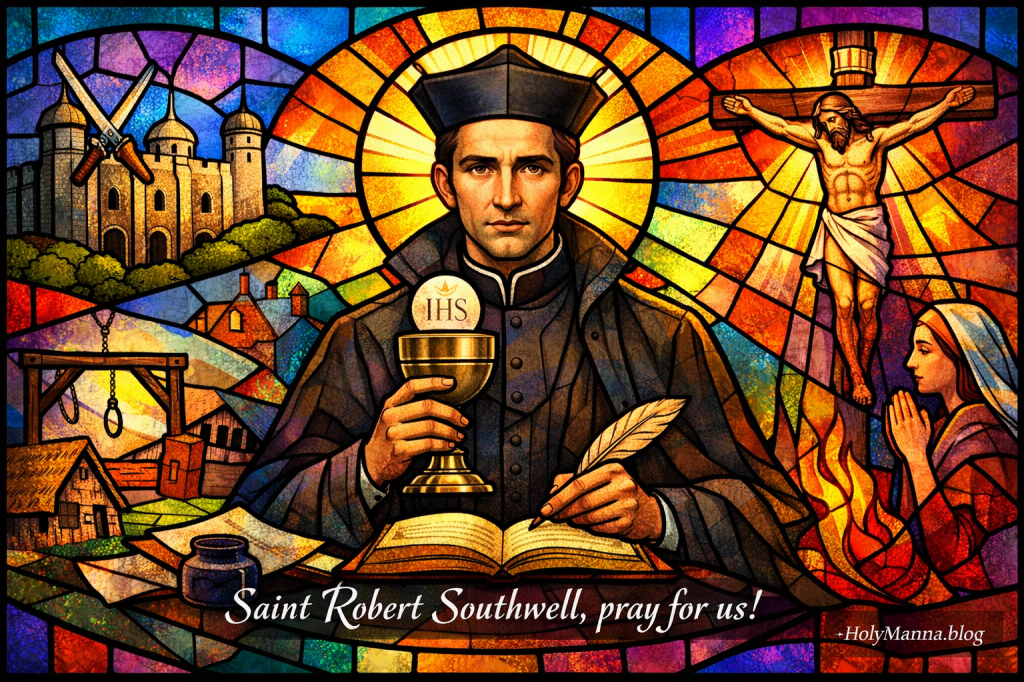
The Underground Poet Priest
Saint Robert Southwell was a Jesuit priest, a spiritual writer, and a martyr from England’s long season of Catholic persecution. He is remembered because he refused to let fear replace faith, even when simply being a Catholic priest was treated like a crime. He did not carry a sword into that battle. He carried the sacraments, especially the Holy Eucharist and confession, and he carried words that kept discouraged Catholics steady when the Church had to live in hiding.
The Church teaches that martyrdom is never reckless bravado or political theater. It is love proven to the end, and it is the final form of fidelity when every other option has been stripped away. The Catechism teaches that “Martyrdom is the supreme witness given to the truth of the faith.” CCC 2473 Southwell’s life makes that teaching feel concrete, because his courage was not loud or performative. His courage was steady, sacramental, and rooted in Christ.
A Catholic Childhood Forged Under Pressure
Robert Southwell was born around 1561 in Norfolk, England, into a Catholic family during a time when the ground was shifting under Catholic feet. England’s religious laws and cultural pressure increasingly demanded that Catholics either blend in or pay a heavy price. For many families, the question was no longer simply what they believed. The question became how much they were willing to lose in order to remain faithful.
Because Catholic life in England was being squeezed, Southwell was sent abroad for education where Catholic teaching could still be received openly. Those years shaped him in a quiet but powerful way. A young man who could have been satisfied with comfort and success instead learned that the faith is worth crossing borders for. Over time his vocation became clear, and his desire was not merely to survive as a Catholic. He wanted to serve the Church with everything he had.
His path led to Rome, where he pursued entrance into the Society of Jesus with real determination. He was trained in prayer, study, and discipline, and he was ordained a priest in 1584. This was not a dramatic conversion from unbelief. It was a deeper conversion of the will, where a man stops belonging to himself and begins belonging entirely to Christ and His Church.
The Secret Missionary Priest
In 1586, Father Southwell returned to England on the Jesuit mission, knowing the danger and accepting it anyway. In that era, laws treated Catholic missionary priests as traitors simply for being priests, because the priesthood kept Catholics united to the sacramental life of the Church. The presence of a priest meant the Eucharist could be offered, sins could be absolved, and the faithful could be strengthened to endure. That was exactly what the persecution wanted to prevent.
Southwell moved from house to house under an alias, often remembered as “Cotton,” serving Catholic families who were trying to hold on to the faith in a hostile environment. This kind of ministry demanded a disciplined courage. Every visit carried risk. Every Mass could end with a raid. Every confession required discretion, because betrayal was always a possibility.
He became closely connected with prominent Catholic households, including the Arundel circle, where he served as chaplain and spiritual support. In many ways these homes became small fortresses of faith, places where Catholics could breathe spiritually when the outside world felt hostile. Southwell’s priesthood was not abstract. It was practical love poured out in hidden rooms, whispered prayers, and patient counsel.
Sacred Words That Traveled
Southwell also wrote because ink could go where priests could not. His devotional works and poetry helped Catholics pray when they were isolated, tempted, or exhausted by fear. His writing did not treat the faith like a hobby or a cultural identity. It treated the faith as life itself, and it called souls back to repentance, courage, and the love of Christ.
Among his best-known works are Mary Magdalen’s Funeral Tears, A Short Rule of Good Life, An Epistle of Comfort, and St Peter’s Complaint. These writings were not produced from a safe distance. They were written by a man who knew the cost of fidelity, and they were meant to strengthen Catholics tempted to compromise. Southwell’s voice consistently points back to the mercy of God and the seriousness of sin, because a persecuted Church cannot afford to live in spiritual laziness.
A line often associated with his witness captures the paradox of Christian courage: “Life is but loss where death is deemed gain.” It is not morbid when understood through the Gospel. It is the sober Catholic conviction that saving one’s reputation or comfort by denying Christ is the real loss, while losing everything for Christ is the path to true life.
The Miracle of Fidelity
Catholic sources do not preserve a large set of widely verified public miracle stories performed by Saint Robert Southwell during his lifetime in the way some saints are known for dramatic healings or wonders. His sanctity shines in a different way, and that is part of what makes him so compelling. His life reveals the kind of miracle many people actually need, which is the miracle of grace giving strength to remain faithful under pressure that should break a man.
His priesthood centered on the sacraments, and that is already a miracle in Catholic terms. The Church teaches the Eucharist is the “source and summit” of the Christian life. CCC 1324 Southwell risked everything to bring that reality to souls who had been starved of it. He carried Christ into hiding places, not as a symbol, but as the living Lord who feeds His people.
His writing also became a quiet instrument of grace. He guided hearts toward repentance through meditations on Saint Peter and Saint Mary Magdalene, and he insisted that mercy is real for sinners who return to God with contrition. In a world that pressures believers toward fear or bitterness, Southwell repeatedly redirects the soul back to humility, prayer, and steady courage.
Where is the Lord asking for deeper fidelity today, not in grand gestures, but in hidden obedience and daily conversion? What would it look like to let the sacraments shape the week the way they shaped Southwell’s entire mission?
A Shepherd’s Loyalty
In 1592, Southwell was arrested after betrayal. The details are painful, and they matter because they reveal the true nature of the persecution. He was interrogated repeatedly and tortured, suffering harsh restraints and cruel treatment designed to break him. The goal was not only to punish him. The goal was to force him to expose Catholic families and fellow priests.
He refused. He would not purchase his own relief by betraying others. That loyalty is one of the clearest signs of a true shepherd. A hired hand saves himself. A shepherd protects the flock, even when the wolves are close.
One saying often attributed to him shows the calm clarity he maintained under pressure. When pressed to engage a particularly cruel interrogator, he reportedly said: “Because I have found by experience that the man is not open to reason.” This was not cynicism. It was spiritual sobriety, the kind that recognizes when words are being demanded as traps rather than received as truth.
He endured long imprisonment, including confinement in the Tower of London. Yet his interior life did not collapse into despair. Catholic memory holds up his perseverance as a lesson in what grace can do when a soul is anchored in prayer and disciplined trust.
A Death That Became a Homily
In 1595, he was condemned under laws that treated priesthood itself as treason. He was executed at Tyburn, a place stained with the blood of many martyrs. His final witness was not hatred. It was prayer and surrender. Catholic tradition remembers him praying words the Church has long prayed at the hour of death, words drawn from the Psalms: “Into your hands I commend my spirit.” Psalm 31:5 His martyrdom was a public proclamation that a Christian’s life belongs to God, not to fear.
This is why the Church continues to honor him, not because Catholics enjoy tragedy, but because martyrdom reveals the value of truth. It shows that Jesus Christ is not one option among many. He is Lord, and He is worth everything.
A Living Communion
After his death, devotion did not vanish. It continued quietly, often with the same hidden courage that sustained Catholics during his life. Catholic tradition preserves accounts of his relics being safeguarded and later recovered, a sign that the faithful refused to let the memory of the martyrs be erased. Relics are not superstition. They are a reminder that the body is destined for resurrection, and that God is glorified in His saints. CCC 990
Southwell’s canonization is also tied to the Forty Martyrs of England and Wales. Catholic accounts of that cause describe a medically examined healing attributed to the intercession of the Forty Martyrs as a group, reminding the faithful that the saints are alive in Christ and that their prayers still strengthen the Church. The Catechism teaches that the saints in heaven intercede for the Church, because they are more closely united to Christ. CCC 956 Southwell’s legacy belongs inside that living communion.
His words continued to spread after his death, often reaching beyond Catholic circles, because truth and beauty have a way of breaking through walls. His writings became a kind of spiritual refuge for generations, proving that persecution can silence a voice on the scaffold but cannot silence the grace carried through faithful words.
Living His Lesson
Saint Robert Southwell is a saint for Catholics who feel pressure to water down the faith, hide the faith, or apologize for the faith. He is also a saint for believers who want to stay faithful without becoming harsh or angry. His life proves that strong conviction and a tender heart can exist together, because both are fruits of grace.
His witness calls Catholics back to the sacraments, especially confession and the Eucharist, because those were the treasures he risked everything to bring. It calls Catholics to guard the interior life, because compromise usually begins inside long before it shows up publicly. It also calls Catholics to use words well, building up others in truth rather than feeding cynicism or distraction.
His story invites a practical kind of courage. It asks for the courage to pray when it is inconvenient, to repent when pride resists, to stay faithful when it costs something, and to love the Church even when the world mocks her. That is how saints are formed, not only in dramatic moments, but in daily fidelity.
Engage with Us!
Share your thoughts and reflections in the comments below. Saint Robert Southwell’s story is intense, but it is also strangely comforting, because it proves that grace can make a faithful Catholic stand firm even when everything is against him.
- Where does the culture pressure the faith to stay hidden, and what would gentle courage look like in that situation?
- What is one concrete way to strengthen the interior life this week through prayer, Scripture, or the sacraments?
- When fear shows up, what helps the heart remember that fidelity to Christ is worth the cost?
- How can words be used this week to build faith in others instead of feeding cynicism or distraction?
- What does martyrdom, as the Church teaches it in The Catechism (CCC 2473), reveal about the value of truth and the reality of eternal life?
May Saint Robert Southwell pray for a Church that is fearless, faithful, and full of mercy. Keep living a life of faith, keep returning to the sacraments, and keep doing everything with the love and mercy Jesus taught us.
Saint Robert Southwell, pray for us!
Follow us on YouTube, Instagram and Facebook for more insights and reflections on living a faith-filled life.

 Holy Manna!
Leave a comment